


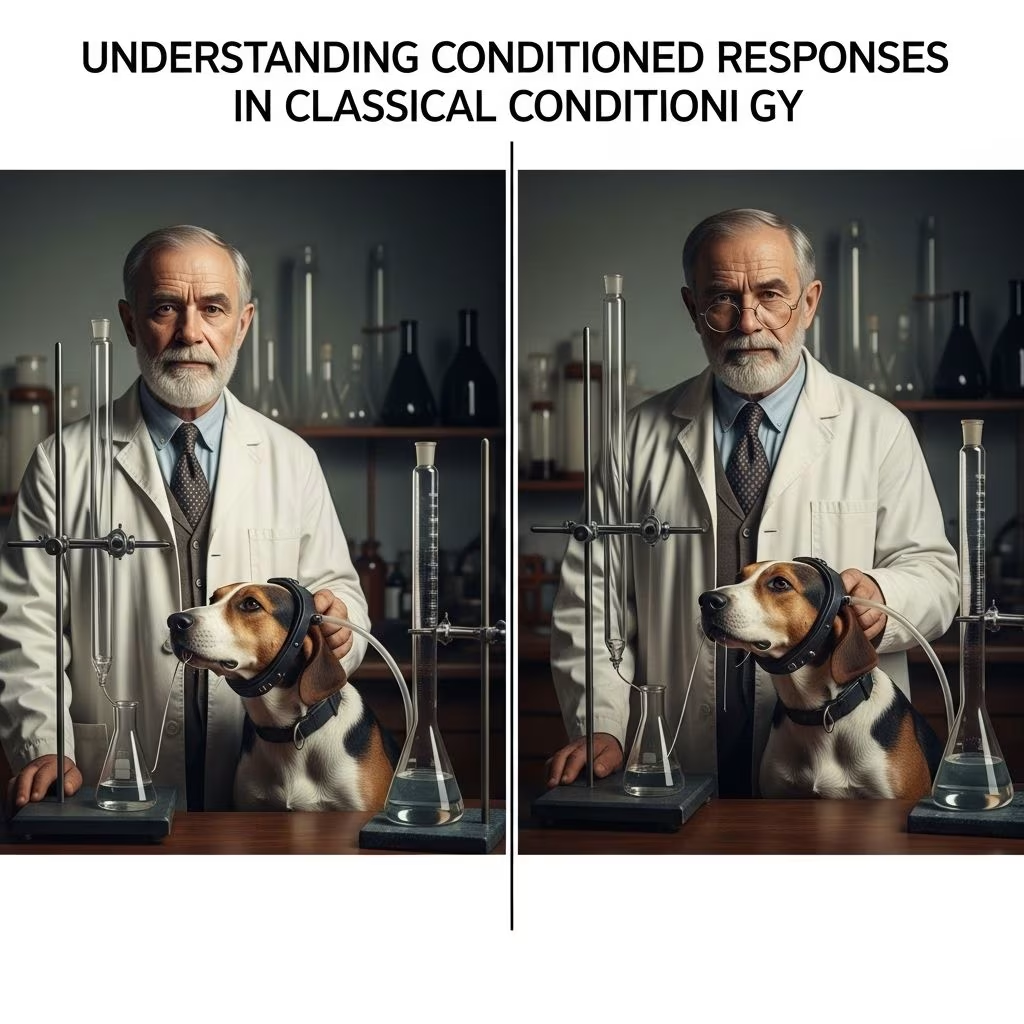
Conditioned responses are a fundamental concept in the field of psychology. Rooted in classical conditioning, they explain how we learn emotional and behavioral reactions based on experiences. By exploring how conditioned responses form, their mechanisms, and their real-life implications, we gain insight into the shaping of both human and animal behaviors.
What Is a Conditioned Response?
A conditioned response (CR) is a learned reaction to a stimulus that was initially neutral but has become significant through repeated association with a naturally meaningful stimulus. In classical conditioning, this process involves pairing a neutral stimulus (NS) with an unconditioned stimulus (US) that automatically produces an unconditioned response (UR). After several pairings, the neutral stimulus becomes a conditioned stimulus (CS) that elicits the conditioned response on its own .
- Unconditioned stimulus (US): Triggers a natural, unlearned response.
- Unconditioned response (UR): The automatic, natural reaction to the US.
- Neutral stimulus (NS): Initially does not provoke the target response.
- Conditioned stimulus (CS): Once-neutral stimulus now elicits a response due to association with the US.
- Conditioned response (CR): The learned, automatic reaction to the CS.
Example: In Ivan Pavlov’s classic experiments, dogs would naturally salivate (UR) when presented with food (US). Pavlov repeatedly rang a bell (NS) before feeding the dogs. Eventually, the dogs reacted by salivating (CR) to the bell alone (now a CS) .
How a Conditioned Response Forms
A conditioned response arises through associative learning, specifically via classical conditioning. The steps are:
- Before Conditioning:
- The unconditioned stimulus elicits an unconditioned response naturally.
- The neutral stimulus elicits no relevant response.
- During Conditioning:
- The neutral stimulus and unconditioned stimulus are presented together repeatedly.
- The subject begins to associate the two stimuli.
- After Conditioning:
- The once-neutral stimulus now triggers the response on its own, becoming the conditioned stimulus.
- The response to this stimulus is the conditioned response.
This sequence exemplifies learning by association, a hallmark of classical conditioning. The process is central to behavioral psychology and underlies many learned emotional and behavioral reactions .
Key Elements of Classical Conditioning
| Term | Abbreviation | Definition |
|---|---|---|
| Unconditioned Stimulus | US | Evokes a response naturally, without learning (e.g., food) |
| Unconditioned Response | UR | Automatic response to the US (e.g., salivation to food) |
| Neutral Stimulus | NS | No initial response or relevance (e.g., bell before conditioning) |
| Conditioned Stimulus | CS | Previously neutral, now triggers a response after association (e.g., bell after conditioning) |
| Conditioned Response | CR | Learned response to the CS (e.g., salivation at bell sound) |
Examples of Conditioned Responses
Conditioned responses are widespread in both laboratory settings and everyday life. Some notable examples include:
- Salivating at the sound of food preparation: Pets may begin to salivate or get excited whenever they hear a can opener or the crinkle of a food bag, even if no food appears, due to their repeated pairing with being fed .
- Excitement upon hearing an ice cream truck’s bell: Many children (and adults) feel excited and may look for money upon hearing the familiar music, associating it with the reward of eating ice cream .
- Fear of dogs after a bite: A person bitten by a dog (US) develops fear (UR). Eventually, merely seeing a dog (now CS) is enough to evoke fear (CR), even if the dog poses no threat .
- Aversion to specific foods: A person who gets sick after eating a particular food may later feel nauseated (CR) at just the sight or smell of that food (CS), even if it is safe now .
- Emotional responses: Songs, scents, or locations initially neutral can come to provoke joy, sadness, or anxiety due to their repeated association with emotionally significant experiences.
Types of Conditioned Responses: Positive and Negative
Conditioned responses may be positive or negative depending on the emotion or behavior induced:
- Positive conditioned responses: Pleasant feelings or excitement provoked by stimuli associated with good outcomes (e.g., happiness upon hearing music associated with celebrations).
- Negative conditioned responses: Fear, anxiety, or disgust elicited by stimuli linked with unpleasant experiences (e.g., fear of hospitals due to painful injections) .
Famous Classical Conditioning Experiments
The foundation for the concept of conditioned responses was set in motion by Ivan Pavlov, whose studies on dogs uncovered essential aspects of how learning by association takes place .
Pavlov’s Dog Experiment
- NS/CS: Bell
- US: Food
- UR: Salivation in response to food
- CR: Salivation in response to the bell after repeated pairing
Pavlov’s work demonstrated that behaviors could be learned purely by the association of previously neutral stimuli with meaningful events, giving rise to the school of psychology called behaviorism .
Other Notable Experiments
- Little Albert (Watson & Rayner): Conditioned an infant to fear a white rat by pairing the rat (NS) with a loud noise (US), resulting in fear of the rat (CR).
- Conditioned Emotional Responses in Animals: Laboratory paradigms have conditioned animals to feel fear, excitement, or other emotions via associative processes .
Conditioned Responses vs. Unconditioned Responses
| Characteristic | Conditioned Response | Unconditioned Response |
|---|---|---|
| Origin | Learned via association | Innate, unlearned |
| Stimulus | Conditioned stimulus (previously neutral) | Unconditioned stimulus (naturally effective) |
| Example | Dog salivates to bell after pairing | Dog salivates to food naturally |
| Process Required | Requires repeated pairings | No learning needed |
The Principles That Influence Conditioned Responses
- Acquisition: The initial phase during which the association between the NS and US is established, leading to the CR.
- Extinction: If the CS is repeatedly presented without the US, the CR will gradually weaken and disappear.
- Spontaneous Recovery: The sudden reappearance of a CR after extinction and a rest period.
- Generalization: When a stimulus similar to the CS also evokes the CR (such as a different bell tone).
- Discrimination: The ability to distinguish between the CS and other similar stimuli that have not been paired with the US.
Conditioned Emotional Responses
Conditioned responses are especially significant in understanding emotional learning and reactions. A conditioned emotional response (CER) occurs when a neutral stimulus is paired with an emotional experience, positive or negative . Examples include:
- Fear at the sight of a dog after being bitten
- Excitement when hearing a song associated with fond memories
- Anxiety provoked by a particular scent after a traumatic event
CERs are fundamental in explaining phobias, trauma responses, and even some cases of anxiety and depression.
Real-Life Applications of Conditioned Responses
Understanding conditioned responses helps to explain and address a variety of real-world behaviors and challenges, including:
- Phobias and Fear Reduction: Many phobias are thought to result from conditioned emotional responses. Therapies like systematic desensitization aim to reduce fear by gradually exposing individuals to the feared stimulus without any negative consequence, leading to extinction of the response.
- Addiction Treatment: Drug cravings can be triggered by environmental cues (such as locations or paraphernalia) previously paired with substance use. Treatment may involve breaking these associations.
- Education: Teachers and caregivers can promote positive behaviors in the classroom by intentionally pairing learning activities with rewards or praise.
- Marketing: Advertisements often associate products with pleasant stimuli (music, attractive images) to elicit positive feelings toward a brand.
- Healthcare and Medicine: Placebo effects and certain patient anxieties may arise from conditioned associations based on prior healthcare experiences.
- Animal Training: Trainers use classical conditioning to shape desired behaviors in animals through consistent pairing of commands and rewards.
Frequently Asked Questions
What is a conditioned response?
A conditioned response is a learned reaction to a previously neutral stimulus, which becomes significant through repeated association with an unconditioned stimulus.
How is a conditioned response different from an unconditioned response?
An unconditioned response is automatic and natural, occurring without prior learning, while a conditioned response must be learned through association.
Can emotional states like fear or happiness be conditioned responses?
Yes. Emotional reactions, including fear, happiness, and sadness, can become conditioned responses when they are associated with specific stimuli through prior experiences.
Who discovered conditioned responses?
The concept of conditioned responses was established by Ivan Pavlov, a Russian physiologist, through his research on classical conditioning in dogs in the early 20th century.
Can conditioned responses be unlearned?
Yes. Through extinction, repeated exposure to the conditioned stimulus without the unconditioned stimulus can weaken and eventually eliminate the conditioned response.
Summary
Conditioned responses reflect one of the most fundamental principles in learning and behavior. By pairing neutral stimuli with potent, meaningful experiences, both humans and animals learn to predict, anticipate, and respond to the world around them. Understanding these principles deepens our knowledge of behavioral psychology and opens up opportunities for practical interventions in education, therapy, and beyond.
References
- https://en.wikipedia.org/wiki/Conditioned_emotional_response
- https://study.com/academy/lesson/conditioned-response-definition-examples.html
- https://www.simplypsychology.org/conditioned-stimulus.html
- https://fiveable.me/key-terms/ap-psych/conditioned-responses
- https://www.ncbi.nlm.nih.gov/books/NBK470326/
- https://dictionary.apa.org/conditioned-response


