


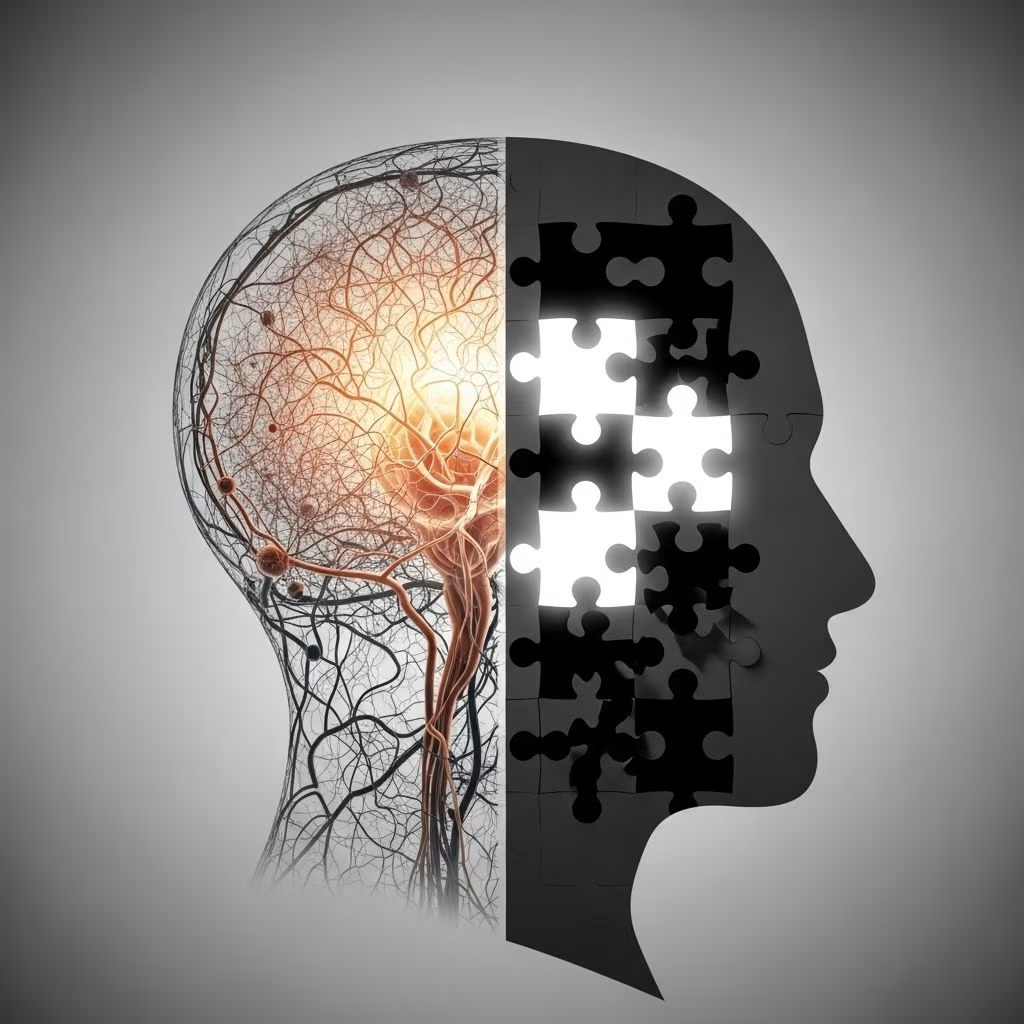
What Is Confirmation Bias?
Confirmation bias is the tendency to actively seek, interpret, favor, and recall information in a way that affirms one’s own preexisting beliefs or values, often while ignoring or discounting contradictory evidence. This psychological bias can subtly influence how we form judgments, make decisions, and interact with others.
Key Aspects of Confirmation Bias
- Selective Information Gathering: People search for information that supports their views and ignore evidence that challenges them.
- Biased Interpretation: Ambiguous or neutral evidence is often interpreted as reinforcing one’s existing beliefs.
- Biased Memory: Individuals tend to recall information that is consistent with their current beliefs, while forgetting or minimizing contradictory details.
How Confirmation Bias Works
This cognitive bias affects multiple stages of information processing:
- Attention: People pay more attention to information that aligns with what they already believe.
- Interpretation: Ambiguous data may be interpreted in a way that supports current views.
- Memory: When recalling events or evidence, supportive information is retrieved more readily.
As a result, individuals frequently form narrow or distorted perspectives, which can lead to suboptimal—or even inaccurate—judgments.
Why Does Confirmation Bias Occur?
Researchers have identified several mechanisms that drive confirmation bias.
Information Processing Efficiency
Humans face an overwhelming amount of data daily. Evaluating all possible evidence is impractical, so people simplify decision-making by focusing on information that fits their beliefs.
Protecting Self-Esteem
Seeking information that supports our views helps maintain self-esteem and confidence. Admitting error or accepting contradictory evidence can feel threatening.
Minimizing Cognitive Dissonance
*Cognitive dissonance* occurs when contradictory beliefs or information cause psychological discomfort. To reduce this tension, people tend to seek confirming evidence and avoid opposing data.
Examples of Confirmation Bias in Daily Life
- Media Consumption: People often choose news sources and social media channels that reflect their political beliefs, missing out on opposing viewpoints.
- Medical Diagnosis: A doctor might focus on symptoms that confirm their initial diagnosis while disregarding signs pointing to another condition.
- Business Decisions: Managers may favor performance metrics that support their preferred strategies and ignore evidence suggesting problems elsewhere.
- Scientific Research: Researchers may unconsciously design studies to support their hypotheses or overlook data that could disprove them.
- Interpersonal Relationships: Friends and family members may interpret ambiguous behavior according to their prior beliefs, reinforcing stereotypes.
Effects of Confirmation Bias
Confirmation bias can have significant consequences on personal, professional, and societal levels:
- Overconfidence in Beliefs: Tendency to become more certain about one’s judgments even if contrary evidence exists.
- Attitude Polarization: Disagreements can become more extreme, even when all parties have access to the same evidence.
- Belief Perseverance: People often continue to hold beliefs even after they have been disproven.
- Irrational Primacy Effect: Information encountered early is relied upon heavily, even if better evidence arises later.
- Maintaining Stereotypes: Prejudices and stereotypes are often sustained through selective attention and interpretation.
Confirmation Bias in Research and Decision-Making
This bias is prevalent across numerous domains:
- Scientific Reasoning: Confirmation bias leads to systematic errors when interpreting data, undermining objectivity.
- Criminal Investigations: Detectives may prematurely focus on a single suspect and gather evidence that points toward guilt, overlooking exculpatory data.
- Medicine: Practitioners may focus on evidence that matches their initial diagnosis, increasing risk of misdiagnosis.
- Financial Decisions: Investors may overweight information confirming their strategies, potentially leading to poor investment choices.
Case Study: The Coffee Shop Manager
Jane, a coffee shop manager, believes “hard work equals success.” When her shop experiences a sales slump, she attributes it to employee effort despite evidence that the real issue is a poor store location. Her focus on confirming her belief leads to increased staffing costs and greater losses—an illustration of how confirmation bias impedes accurate problem-solving.
Common Triggers of Confirmation Bias
- Emotionally Charged Topics: Strong feelings about an issue intensify the bias, resulting in selective attention to confirming details.
- Deeply Held Beliefs: The more entrenched a belief, the more likely one is to favor confirming information.
- Ambiguous Evidence: When information is unclear or open to interpretation, people twist it to fit their views.
- High Stakes Decisions: Important decisions amplify the pressure to confirm one’s own outlook.
- Social Networks: Filter bubbles and algorithmic curation online expose individuals primarily to information they already agree with, while opposing viewpoints are excluded.
When Does Confirmation Bias Occur?
Confirmation bias arises in multiple contexts. The following learning check highlights its presence:
- Occurs when people research only evidence that aligns with personal beliefs (Correct).
- Does not occur when every perspective is thoroughly considered before reaching a conclusion.
- Does not occur when confidence increases after considering alternative perspectives.
- Is unrelated to the gambler’s fallacy—believing event odds are higher because the event hasn’t occurred recently.
Take-home Messages
- Confirmation bias is widespread and affects how we seek, interpret, and remember information.
- It strengthens beliefs—sometimes in the face of overwhelming contradictory evidence.
- This bias is particularly powerful for emotionally charged or deeply held views.
- It can cause errors in decision-making, scientific evaluation, media consumption, and daily life.
How to Overcome Confirmation Bias
Mitigating confirmation bias involves conscious effort and critical thinking approaches. Here are practical strategies:
- Seek Disconfirming Evidence: Deliberately look for information that challenges your beliefs.
- Practice Active Listening: Engage with viewpoints that differ from your own to enhance understanding.
- Ask Probing Questions: Question your assumptions and request clarification on ambiguous issues.
- Embrace Scientific Skepticism: Use hypothesis testing procedures that consider alternative explanations.
- Diverse Information Sources: Regularly consult media, experts, and peers outside your usual circle.
- Slow Down Decisions: Allow time to reflect on your judgments before finalizing them, especially for high-stakes choices.
Confirmation Bias vs. Self-Fulfilling Prophecy
| Aspect | Confirmation Bias | Self-Fulfilling Prophecy |
|---|---|---|
| Definition | Tendency to seek evidence confirming existing beliefs | Personal expectations influence actual behavior outcomes |
| Main Mechanism | Selective attention, interpretation, and recall | Expectations shape behavior, leading to anticipated result |
| Result | Beliefs perpetuated through evidence selection | Behavior creates outcome that confirms belief |
Frequently Asked Questions About Confirmation Bias
What is an example of confirmation bias in psychology?
One classic study involved subjects trying to determine the rule governing a sequence of numbers. Participants proposed hypotheses and mostly sought confirming evidence, rather than challenging their own theories—even when their hypothesis was incorrect.
Why is confirmation bias significant in society?
It contributes to polarized viewpoints on politics, science, and social issues, spreading misinformation and reinforcing stereotypes.
Can confirmation bias occur unconsciously?
Yes. People often display this bias without awareness—it is part of automatic mental processing rather than deliberate deception.
How does confirmation bias affect scientific progress?
It leads researchers to interpret findings in ways that support established theories, potentially discouraging innovation and overlooking alternative explanations.
What are simple steps to reduce confirmation bias?
- Be open to feedback from diverse sources.
- Make a habit of questioning your beliefs.
- Regularly seek out evidence opposing your views.
- Practice mindful awareness of mental shortcuts.
Further Resources
- Books: “Thinking, Fast and Slow” by Daniel Kahneman
- Scientific Papers: “Confirmation Bias: A Ubiquitous Phenomenon in Many Guises” (Nickerson, 1998)
- Websites: The Decision Lab, Simply Psychology
- Documentaries: “Brain Games,” National Geographic
Summary
Confirmation bias is a pervasive psychological tendency influencing how we seek, interpret, and remember information across all aspects of life. Recognizing and minimizing this bias is essential for critical thinking, effective decision-making, and maintaining an open, evidence-based outlook in personal and professional domains.
References
- https://en.wikipedia.org/wiki/Confirmation_bias
- https://www.simplypsychology.org/confirmation-bias.html
- https://thedecisionlab.com/biases/confirmation-bias
- https://www.britannica.com/science/confirmation-bias
- https://www.scribbr.com/research-bias/confirmation-bias/
- https://pages.ucsd.edu/~mckenzie/nickersonConfirmationBias.pdf
- https://subjectguides.lib.neu.edu/fakenews/bias
- https://pmc.ncbi.nlm.nih.gov/articles/PMC4090078/


