


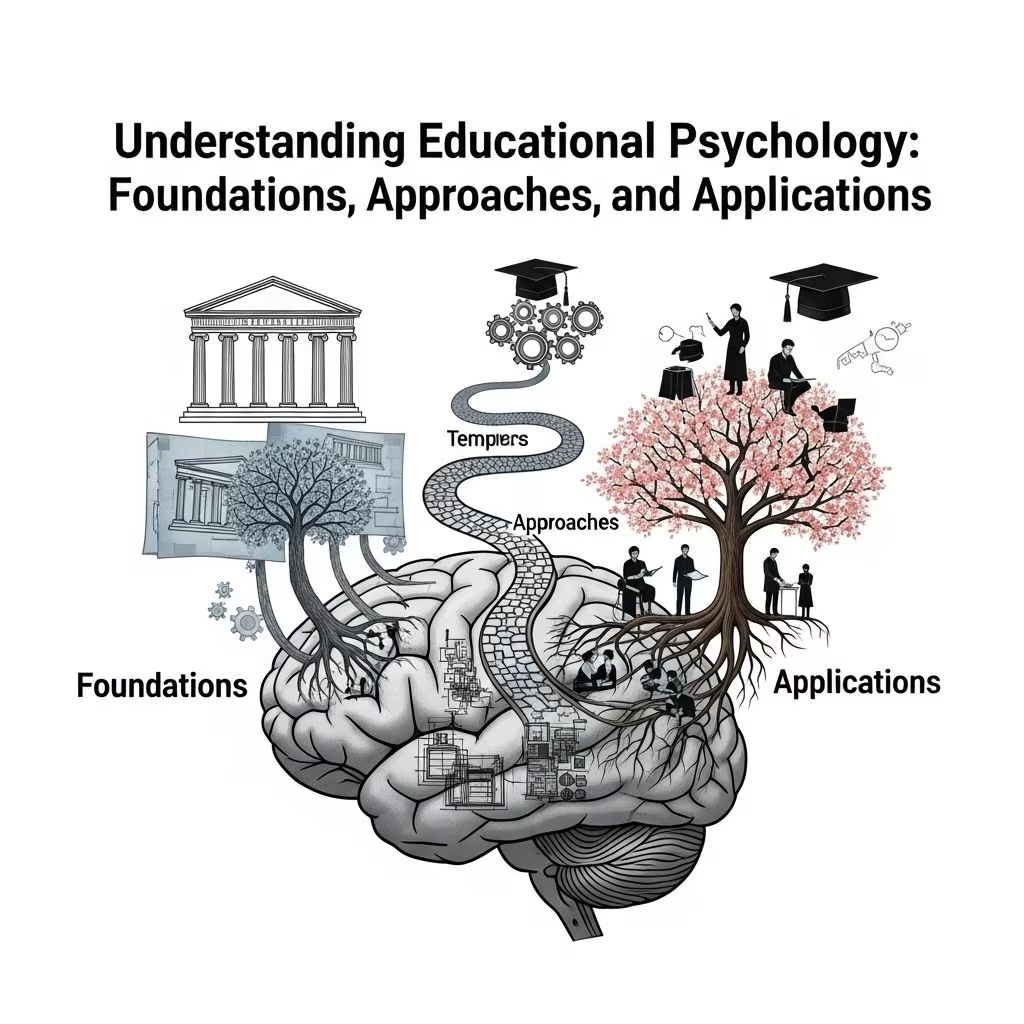
Educational psychology focuses on how humans learn and retain knowledge in formal and informal educational settings. Integrating diverse psychological principles, it aims to optimize learning experiences, develop effective teaching strategies, and understand the underlying processes that facilitate educational achievement. Through rigorous research and practical application, educational psychology helps educators, students, and policymakers address challenges and foster success in academic environments.
What Is Educational Psychology?
Educational psychology is the scientific study of human learning and the application of psychological theories to solve educational challenges. Closely linked to both psychology and education, it investigates cognitive, emotional, and social processes that influence learning outcomes, teacher effectiveness, and classroom dynamics. By analyzing how individuals of different ages and backgrounds learn, educational psychologists strive to improve instructional methods and curriculum design.
- Focus: Human development, motivation, behavior, and learning processes.
- Aim: Optimize teaching strategies and enhance student performance.
- Settings: Schools, universities, training programs, and informal learning environments.
Educational psychology is not confined to formal classroom learning; it also explores informal education, professional training, and even how people learn in everyday life. Through ongoing research, this field strives to adapt educational practices to the evolving needs of society and diverse student populations.
Brief History of Educational Psychology
The field of educational psychology has grown significantly over the past century. Rooted in broader psychological theories, it draws inspiration from early pioneers like Jean Piaget, Lev Vygotsky, John Dewey, and B.F. Skinner, whose foundational work helped define different learning models and instructional strategies.
- Early Years: Early studies focused on intelligence testing and the scientific observation of learning behaviors.
- Development: Throughout the 20th century, educational psychology embraced new insights from cognitive science and neuroscience.
- Modern Era: Recent decades have seen an expansion to include diverse learning contexts, technology integration, and differentiated instruction.
Major Theories in Educational Psychology
Educational psychology incorporates several key theories that explain how people learn and what influences learning. Each theory highlights different aspects of the learning process, shaping instructional methods and educational policy.
Behaviorism
Developed by scholars such as B.F. Skinner and John Watson, behaviorism emphasizes observable behaviors and external stimuli. Learning is viewed as a response to conditioning, reinforcement, and repetition. In the classroom, behaviorist approaches may include:
- Rewards for desired behavior (positive reinforcement)
- Clear, measurable goals
- Step-by-step instruction
- Drill and practice
Cognitivism
Cognitivism centers on internal thought processes, such as memory, perception, and problem-solving. Educational psychologists like Jean Piaget contributed theories about stages of cognitive development, suggesting that children’s thinking evolves in distinct stages. Key principles:
- Emphasis on mental processes over mere behavior
- Instruction designed to match the learner’s cognitive readiness
- Use of scaffolding and concept mapping
- Problem-solving tasks to reinforce understanding
Constructivism
Constructivism, advocated by theorists like Vygotsky and Bruner, argues that learners actively construct their own understanding from experiences. Learning is seen as a social process, often enhanced by group activities, discussions, and real-world application. Core concepts include:
- Active, hands-on learning
- Collaboration and dialogue among learners
- Connecting new information to prior knowledge
- Role of the teacher as a facilitator, not just an instructor
Humanistic Approaches
Humanistic psychology in education values individual growth, emotional well-being, and motivation. The focus is on fostering self-actualization, confidence, and a positive learning environment.
- Emphasis on student autonomy and choice
- Holistic development: cognitive, emotional, and social
- Promoting self-esteem and intrinsic motivation
Social Learning Theory
Albert Bandura’s social learning theory posits that people learn by observing others, imitating behaviors, and seeing positive outcomes. In educational settings, modeling, peer collaboration, and feedback are pivotal.
Information Processing Theory
This approach likens the human mind to a computer, studying how information is received, stored, retrieved, and used in decision-making and learning. Strategies include teaching students about metacognition (thinking about one’s own thinking), memory techniques, and problem-solving.
| Theory | Main Focus | Key Contribution to Education |
|---|---|---|
| Behaviorism | Observable behavior and reinforcement | Classroom management, rewards, habit formation |
| Cognitivism | Internal mental processes | Instructional design, problem-solving tasks, scaffolding |
| Constructivism | Active construction of knowledge | Student-centered learning, collaboration |
| Humanistic | Emotional and holistic growth | Self-directed learning, motivation, well-being |
| Social Learning | Observation and modeling | Peer learning, role models, social context |
| Information Processing | How information is processed by the mind | Memory strategies, metacognitive skills |
Major Areas of Educational Psychology
The scope of educational psychology encompasses several core domains:
- Learning processes: Investigating how students absorb and retain information through cognitive, emotional, and social channels.
- Motivation: Studying factors that energize, direct, and sustain learning behaviors.
- Development: Analyzing how students’ cognitive and emotional abilities change over time.
- Individual differences: Accounting for diversity in abilities, learning styles, backgrounds, and experiences.
- Assessment and evaluation: Designing effective tests, measurements, and feedback systems.
- Classroom management: Creating learning environments that support discipline, safety, and engagement.
- Instructional methods: Comparing traditional, digital, collaborative, and individualized learning techniques.
Educational Psychology vs. School Psychology
Educational psychology and school psychology are related but distinct fields:
| Educational Psychology | School Psychology |
|---|---|
| Focuses on learning processes, instructional methods, and factors influencing academic achievement across all age groups and settings. | Specializes in supporting students’ mental health, behavioral needs, and academic challenges within school environments. |
| Develops and assesses educational theories and curricula. | Provides counseling, assessment, and intervention services. |
| Research-driven, often works with teachers and policymakers. | Interacts directly with students, parents, and teachers to address unique issues. |
Both fields collaborate to improve student well-being and educational outcomes, but their day-to-day responsibilities and approaches differ.
Applications of Educational Psychology in the Classroom
Educational psychology’s findings are directly applicable to the design and practice of effective teaching. Key areas where it makes a difference include:
- Differentiated Instruction: Tailoring lessons to reflect students’ abilities, learning styles, and backgrounds.
- Assessment and Feedback: Using formative and summative assessments to guide teaching and provide meaningful feedback.
- Motivational Strategies: Encouraging engagement through intrinsic and extrinsic incentives, setting achievable goals, and fostering a growth mindset.
- Classroom Management: Implementing routines, rules, and strategies to minimize disruptions and create a positive learning climate.
- Supporting Diverse Learners: Addressing the needs of students with disabilities, language differences, and varied social backgrounds.
- Integration of Technology: Leveraging digital tools to enhance individualized learning and provide interactive educational experiences.
The Role of Educational Psychologists
Educational psychologists work in many capacities, contributing their expertise across different environments:
- Schools: Assisting teachers in developing instructional materials and classroom strategies.
- Higher Education: Researching learning outcomes, curriculum effectiveness, and teacher training methods.
- Corporate Settings: Designing professional training programs and educational resources.
- Educational Policy: Advising governments or institutions on best practices, evaluation systems, and inclusive education initiatives.
Key Challenges and Contemporary Issues
Modern educational psychology adapts to a rapidly changing educational landscape, facing issues such as:
- Diversity and Inclusion: Meeting the educational needs of multicultural, multilingual, and neurodiverse students.
- Remote and Hybrid Learning: Ensuring effective learning outcomes in digital environments.
- Mental Health: Addressing the rising importance of student well-being, social-emotional learning, and mental health support.
- Assessment Reforms: Developing fair and accurate ways to measure learning beyond traditional standardized tests.
- Integrating Technology: Harnessing digital resources while managing screen fatigue and unequal access.
Frequently Asked Questions (FAQs) about Educational Psychology
What careers can you pursue with a background in educational psychology?
Graduates often pursue roles as educational psychologists, instructional coordinators, academic advisors, curriculum developers, university lecturers, or within government agencies focused on education policy.
How does educational psychology differ from general psychology?
While general psychology studies human thought, behavior, and emotion in all contexts, educational psychology specifically examines those processes as they relate to learning and education.
What are the most widely used theories in educational psychology?
Major theories include behaviorism, cognitivism, constructivism, humanistic psychology, social learning, and information processing. Each offers unique insights on how individuals acquire and apply knowledge.
Can parents benefit from educational psychology principles?
Yes, understanding motivational strategies, cognitive development stages, and effective feedback can help parents support their children’s learning and growth at home.
How has technology changed the field of educational psychology?
Technology has expanded learning beyond traditional classrooms, prompting new research on digital learning tools, online motivation, and strategies for virtual learning success.
Further Reading and Resources
For those interested in exploring more, consider resources from the American Psychological Association (APA), leading educational psychology textbooks, and online learning platforms that cover learning sciences and teaching best practices.
References
- https://www.tnteu.ac.in/pdf/library/Psychology/7%20Unit%201%20Introduction%20to%20Educational%20Psychology.pdf
- https://www.ebsco.com/research-starters/psychology/educational-psychology
- https://www.ollusa.edu/blog/educational-psychology-vs-school-psychology.html
- https://en.wikipedia.org/wiki/Educational_psychology
- https://www.apa.org/education-career/guide/subfields/teaching-learning
- https://www.purdueglobal.edu/blog/education/what-is-educational-psychology/
- https://www.psychology.org/resources/educational-psychology-theories/
- https://www.webmd.com/mental-health/what-is-educational-psychology


