


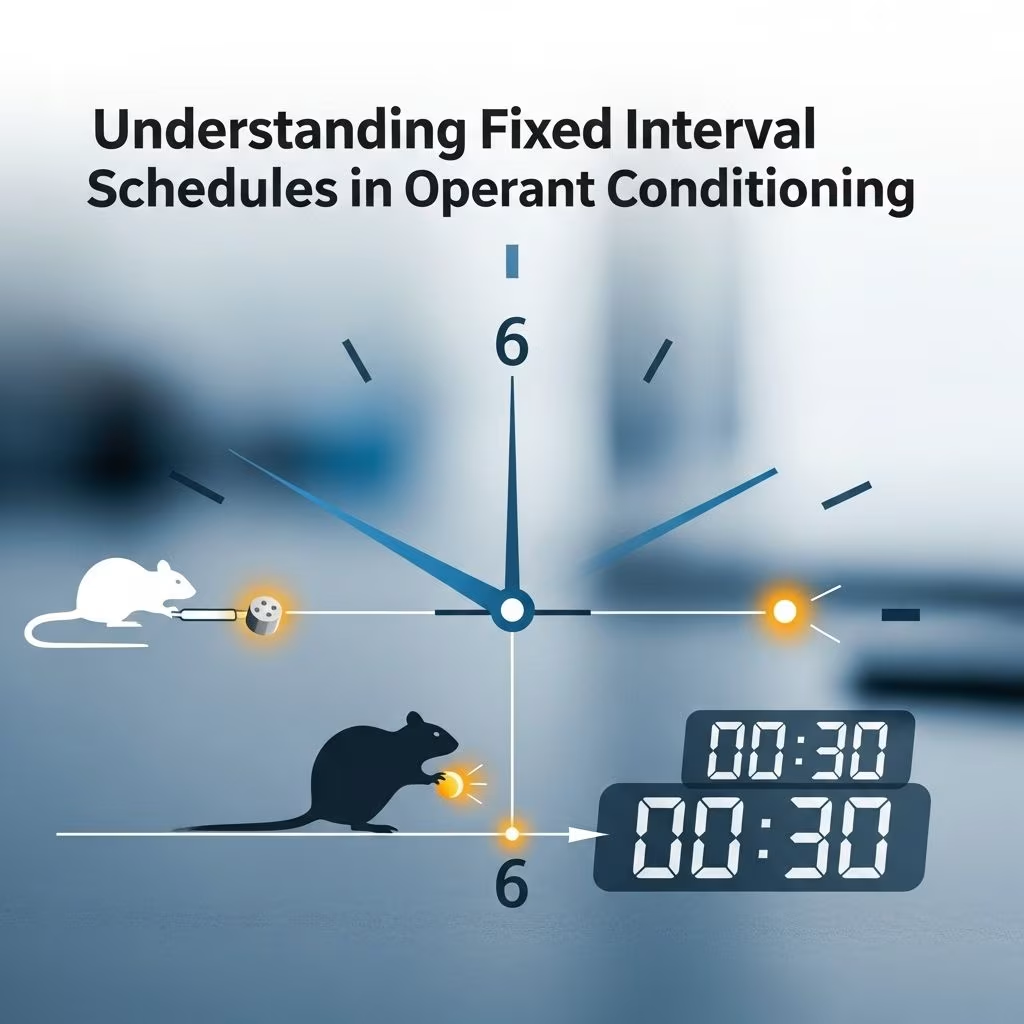
What Is a Fixed Interval Schedule?
A fixed interval schedule is a concept in behavioral psychology, specifically operant conditioning, where reinforcement—such as a reward—is delivered for a desired action only after a set, predictable amount of time has elapsed. This means that no matter how many times the behavior occurs within the interval, reinforcement is provided only after each fixed period study.com, helpfulprofessor.com.
Key Points
- The interval between possible rewards is always constant (e.g., every 5 minutes, every week).
- The first correct response after each interval is reinforced.
- If the behavior does not occur immediately after the interval, reinforcement waits for the next correct response.
How Does a Fixed Interval Schedule Work?
In a fixed interval schedule, the time period between rewards is set in advance. Once the interval has passed, the very next correct response triggers the reward. The timer then resets, and the process repeats study.com, helpfulprofessor.com.
- A trainer or experimenter chooses the interval before the training begins.
- The interval can be any length (seconds, minutes, days).
- If the participant fails to perform the behavior right after the interval, reinforcement is delayed until the desired action occurs.
This timing creates a consistent, predictable pattern for both trainer and participant, often leading to stability in behaviors over time helpfulprofessor.com.
Fixed Interval Schedules in Operant Conditioning
Operant conditioning involves learning behaviors through the consequences of those behaviors (reinforcement or punishment). Fixed interval schedules are one of four main kinds of intermittent (partial) reinforcement identified by B. F. Skinner:
- Fixed interval
- Fixed ratio
- Variable interval
- Variable ratio
Fixed intervals are typically used after an initial learning phase, where continuous reinforcement is preferred. Once a behavior is established, switching to fixed interval reinforcement helps maintain the behavior while preventing extinction helpfulprofessor.com.
Behavioral Patterns Produced by Fixed Interval Schedules
Fixed interval schedules result in unique and recognizable behavioral patterns:
- After receiving reinforcement, the occurrence of the desired behavior usually drops.
- As the next interval approaches, the rate of the behavior increases—known as the scalloping effect.
- Behaviors become clustered near anticipated reward times.
| Reinforcement Schedule | Response Pattern |
|---|---|
| Fixed Interval | Scallop: low response after reward, rapid burst near next reward |
| Fixed Ratio | Consistent, rapid responses until reward received |
| Variable Interval | Steady, moderate response rate |
| Variable Ratio | High, steady response rate (most resistant to extinction) |
Examples of Fixed Interval Schedules
- Paychecks: Employees receive payment every two weeks. Their motivation to work may increase close to the payday.
- Student study habits: When students expect weekly quizzes, they tend to study more just before each quiz.
- Medication administration in hospitals: Patients may receive pain relief every hour via IV. No benefit comes from requesting medication sooner.
- Scheduled meetings: Staff prepare work closer to regular monthly meetings.
- Child allowances: Children receive an allowance every week for completing chores, regardless of when those chores are finished within the interval helpfulprofessor.com, courses.lumenlearning.com.
Additional Everyday Examples
- Checking for mail or deliveries at known times.
- Farmers tending crops at set intervals (watering, fertilizing).
- Pet owners feeding animals on a schedule.
Advantages of Fixed Interval Schedules
- Simplicity: Easy to structure and understand for both trainer and participant.
- Predictability: Participants often adapt quickly, knowing when reinforcement is available.
- Consistency: Regular reinforcement keeps baseline motivation and performance steady over long periods.
- Useful for long-term behavior change: Especially in situations that emphasize quality over quantity.
Disadvantages of Fixed Interval Schedules
- Lower overall response rates: People or animals tend to reduce the frequency of desired behavior after receiving reinforcement until the next interval approaches.
- Scalloping effect: Motivation and performance spike just before expected reward and dip afterward, resulting in uneven patterns.
- Less resistance to extinction: If reinforcement stops, the behavior can fade relatively quickly compared to some other schedules.
| Pros | Cons |
|---|---|
| Easy to implement | Lower response rates |
| Predictable reinforcement | Scallop effect (clustering responses) |
| Suitable for long-term change | Less resistant to extinction |
Comparison With Other Reinforcement Schedules
- Fixed Ratio: Reinforcement after a set number of responses; produces higher, steadier response rates than fixed interval.
- Variable Interval: Reinforcement after unpredictable periods; leads to steady but moderate rates.
- Variable Ratio: Reinforcement after unpredictable numbers of responses; generates the highest, most persistent rates of behavior courses.lumenlearning.com, helpfulprofessor.com.
Real-World Applications of Fixed Interval Schedules
Fixed interval schedules are commonly used in workplaces, education, animal training, therapy, and parenting. Examples include:
- Workplace: Biweekly payroll systems encourage periodic bursts of productivity.
- Education: Weekly assignments or quizzes encourage students to study and complete tasks before deadlines.
- Healthcare: Patient-controlled analgesia is managed via fixed interval access.
- Parenting: Chore rewards distributed weekly encourage consistent performance.
The choice of scheduling reinforcement depends on the goals—quantity, quality, or persistence of behavior.
Limitations and Considerations
While fixed interval schedules are easy to implement, they may not always be optimal for all learning objectives. Behavioral momentum can lag in early parts of intervals. Participants may learn to “game the system,” focusing effort only when rewards are imminent. For higher engagement and sustained motivation, alternate schedules like variable ratio are often recommended helpfulprofessor.com, courses.lumenlearning.com.
Fixed Interval Schedule FAQs
Q: Do fixed interval schedules work for all types of behaviors?
A: Fixed interval schedules are most effective when quality is prized over quantity and when simple, predictable rewards are suitable. For frequent, high rates of behavior, variable ratio or fixed ratio schedules may be better choices.
Q: Why do people work harder right before a paycheck?
A: This reflects the ‘scalloping effect.’ Effort tends to increase before the anticipated reward.
Q: What is the difference between fixed interval and fixed ratio?
A: Fixed interval depends on time elapsed; fixed ratio depends on the count of actions performed.
Q: Can fixed interval schedules discourage cheating or shortcuts?
A: Yes. Because rewards follow time intervals instead of output counts, participants are less likely to cut corners to receive more frequent reinforcement.
Q: Are fixed interval schedules better for long-term behavior change?
A: Often yes, especially where steady, predictable reinforcement helps build stability or quality-focused habits over time.
Summary Table: Fixed Interval Schedule Facts
| Aspect | Details |
|---|---|
| Definition | Reinforcement delivered after a fixed time interval |
| Mechanism | First correct behavior after interval is rewarded |
| Pattern | Scalloping—bursts of activity near reward time |
| Examples | Paychecks, quizzes, medication schedules |
| Best Uses | Long-term maintenance, quality-based tasks |
| Drawbacks | Lower average productivity, less resistance to extinction |
Conclusion
Fixed interval schedules serve as a fundamental tool in psychology for reinforcing behaviors at predictable, consistent intervals. They are widely employed in various real-life contexts, offer stability, and promote quality-conscious output. Trainers, educators, and researchers should carefully weigh the pros and cons when choosing this schedule and consider alternative reinforcement systems for situations that require high frequency or persistence of behavior.
References
- https://study.com/academy/lesson/fixed-interval-examples-definition-quiz.html
- https://helpfulprofessor.com/fixed-interval-schedule-examples/
- https://fiveable.me/key-terms/ap-psych/interval-schedule
- https://courses.lumenlearning.com/waymaker-psychology/chapter/reading-reinforcement-schedules/
- https://fiveable.me/key-terms/intro-psychology/fixed-interval
- https://www.simplypsychology.org/schedules-of-reinforcement.html
- https://learningbehavioranalysis.com/schedules-of-reinforcement-2/


