


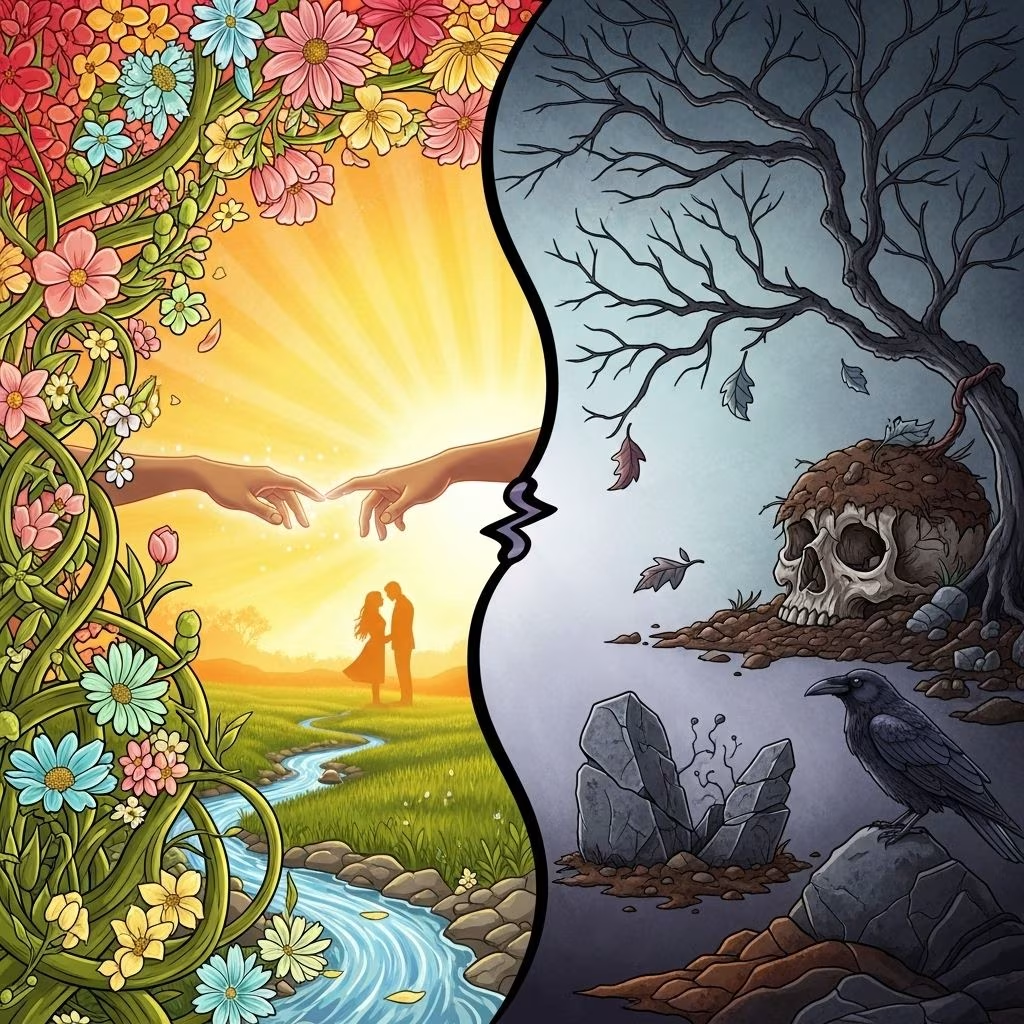
Freud’s Theory of Life and Death Instincts
Sigmund Freud’s revolutionary work in psychoanalysis brought forth many key concepts about the structure and motivations of the human mind. Among the most provocative of these are his theories of the life instinct (Eros) and the death instinct (Thanatos), which he proposed to explain the underlying forces behind our actions, desires, and sometimes self-destructive behavior.
Understanding the Duality: Life and Death Drives
According to Freud, all human behavior is powered by fundamental drives or instincts. As his thinking evolved, he categorized these drives into two broad, opposing classes. Freud referred to these as Eros (life instinct) and Thanatos (death instinct). Together, they form what Freud described as the dual drive theory, where both constructive and destructive forces compete in shaping human experience and society.
- Life Instinct (Eros): Drives related to survival, propagation, hunger, thirst, sexuality, cooperation, and creativity.
- Death Instinct (Thanatos): Drives leading towards aggression, risky behaviors, compulsion to repeat traumatic events, and ultimately, self-destruction or a return to inanimate existence.
The Life Instinct: Eros
The life instinct, also known as Eros after the Greek god of love, is the force that compels us toward preservation, pleasure, connection, and creation. Freud saw Eros as the fountainhead of all life-sustaining activities—striving not just for individual survival, but also for the perpetuation of the species and society.
- Associated with libido, or psychic energy that fuels positive, constructive behavior.
- Powers biological needs: hunger, thirst, safety, and procreation.
- Manifests in behaviors related to love, social bonding, cooperation, and the pursuit of pleasure and meaning.
- Encourages affiliation, creativity, and the drive to build or contribute to society and culture.
Examples of the life instinct include nourishing oneself, developing intimate relationships, caring for others, building communities, and striving for achievement.
The Death Instinct: Thanatos
Contrasted with Eros, Thanatos represents a darker, more controversial element in Freud’s drive theory. First introduced in his 1920 work Beyond the Pleasure Principle, Freud posited that alongside life-affirming instincts, humans are also propelled by an unconscious wish to return to a pre-living state: a drive towards aggression, destruction, and ultimately non-existence.
- Thanatos seeks to eliminate tension, reduce life to stillness, and ultimately return the organism to an inorganic state.
- Expressed through self-destructive acts, risk-taking, aggression, and compulsive repetition of negative or traumatic experiences.
- Manifests both inwardly (self-sabotage, depressive tendencies, self-harm) and outwardly (violence, aggression, hostility toward others).
Freud envisioned the death instinct as counterbalancing the life instinct, leading to a fundamental psychological conflict within every person.
Key Characteristics of Thanatos
- Associated with destructive urges and behaviors.
- Reveals itself in phenomena such as repetitive nightmares, compulsions, and an irresistible urge to repeat past traumas (repetition compulsion).
- Can be redirected outward as aggression or inward as guilt and self-punishment.
The idea that humans harbor an intrinsic wish to destroy themselves or return to an inanimate state was, and remains, one of Freud’s most controversial proposals.
Origins and Development of Freud’s Instinct Theory
Influence of Beyond the Pleasure Principle
Freud’s early work emphasized the pleasure principle: the tendency of the mind to seek pleasure and avoid pain. However, as Freud noticed behaviors in patients that could not be explained solely by the pursuit of pleasure—including compulsive repetition of trauma and self-destructive acts—he posited that a second, countervailing force must be at work.
- Freud observed soldiers reliving traumatic events in dreams, children reenacting upsetting experiences during play, and patients repeating self-destructive patterns.
- This led him to conclude that a non-pleasurable, even destructive, force was driving certain behaviors—paving the road for his formulation of Thanatos.
- Freud described the death instinct as “an urge inherent in organic life to restore an earlier state of things,” i.e., lifelessness or non-tension.
By introducing the death instinct, Freud redefined his theory of drives as a dual system juxtaposing Eros and Thanatos.
Philosophical and Historical Influences
Freud drew inspiration from philosophy, biology, and mythology. The names Eros and Thanatos are rooted in Greek mythology, representing the gods of love and death, respectively.
- Eros: God of love, fertility, and life.
- Thanatos: God (or personification) of death.
The symbolic reference underscores Freud’s belief that life and death forces are forever in dynamic tension within the psyche.
Life Instincts vs. Death Instincts: A Psychological Tug-of-War
| Aspect | Life Instinct (Eros) | Death Instinct (Thanatos) |
|---|---|---|
| Focus | Preservation, pleasure, creation | Destruction, aggression, dissolution |
| Direction | Individuation, reproduction, social bonding | Return to inorganic state, self-destruction, risk |
| Manifestation | Love, sex, empathy, nurturing, meaningful work | Hostility, violence, repetitive trauma, compulsions |
| Associated Energy | Libido | Destrudo (sometimes called mortido) |
| Examples | Parenting, cooperating, creating art, self-care | War, reckless driving, self-harm, aggression |
How Do Eros and Thanatos Influence Behavior?
Balancing the Instincts
Freud saw human behavior as a dynamic balancing act, with Eros and Thanatos exerting opposing pressures. These instincts rarely express themselves in isolation; rather, behaviors often represent a blend, with Eros channeling destructive impulses into socially acceptable or creative outlets.
- Aggression: Freud theorized that aggression arises when Thanatos is redirected outward. When contained or sublimated, this drive can fuel achievement (competitive sports, ambition, or even artistic creation).
- Self-Destruction: When Thanatos turns inward, it may manifest as guilt, self-sabotage, or depression.
- Society: Social rules, laws, and cultural norms act as moderating forces, encouraging the expression of Eros and inhibiting or channeling Thanatos in less destructive forms.
The Role of the Unconscious
Both Eros and Thanatos operate largely outside conscious awareness, emerging in dreams, slips of the tongue, and compulsive behaviors. The interplay of these drives is mediated by the ego and super-ego, which work to manage and redirect instinctual energies.
Criticisms and Controversies
Freud’s theory of life and death instincts has been the subject of ongoing debate within psychology and psychoanalysis. While some later psychoanalysts expanded upon or accepted Freud’s ideas, others critique or reject them entirely.
- Controversial and Non-Empirical: The death instinct, in particular, is seen by many as speculative, lacking direct evidence and failing to account for the full complexity of human motivation.
- Alternative Explanations: Aggression, self-destructive behavior, and risk-taking are now often explained by learning theory, neurobiology, or social context.
- Enduring Influence: Despite criticisms, Freud’s dichotomy of life and death impulses continues to inspire psychological, philosophical, and artistic explorations.
Many researchers argue that humans’ self-preservation instinct can also take paradoxical forms, such as self-sabotage under stress or trauma, but they suggest alternative psychological mechanisms at play. Nevertheless, the Eros–Thanatos framework remains deeply influential.
Practical Examples and Implications
- Repetitive Trauma: Survivors of trauma who repeatedly revisit painful memories or recreate traumatic situations may be exhibiting the pull of Thanatos through repetition compulsion.
- Risk-Taking: Abnormally risky behavior (reckless driving, extreme sports) may reflect the operation of the death instinct.
- Altruism and Care: Acts of self-sacrifice, empathy, and nurturing highlight the power of the life instinct.
- Societal Development: Civilization itself, Freud argued, provides outlets (laws, rituals, taboos) for redirecting destructive instincts into constructive tasks.
Understanding the interplay between constructive and destructive drives can offer valuable insights into addressing self-defeating cycles and cultivating healthier behavior patterns.
Frequently Asked Questions (FAQs)
What are life instincts according to Freud?
Life instincts are the drives responsible for survival, pleasure, and the continuation of life, encompassing hunger, thirst, sexuality, cooperation, and creativity. Freud referred to this as Eros.
What is the death instinct (Thanatos)?
The death instinct, or Thanatos, is Freud’s concept of an unconscious drive towards self-destruction, aggression, and ultimately, a return to an inorganic state. It is responsible for risk-taking behaviors, repetitive traumas, and aggressive impulses.
How do Eros and Thanatos affect human behavior?
Eros drives actions that foster survival, love, and connection, while Thanatos motivates destructive behaviors, risk-taking, and aggression. Human behavior often results from the interaction and balance of these two powerful instincts.
Are Freud’s views on the death instinct accepted today?
Freud’s theory of the death instinct remains controversial and is not universally accepted in contemporary psychology, with many experts favoring alternative, evidence-based explanations for self-destructive and aggressive behavior.
Can life and death instincts work together?
Yes; behaviors often reflect both drives, such as using aggressive energy for creative or competitive pursuits, demonstrating the complex interplay of Eros and Thanatos.
References
- https://psychologyfanatic.com/death-instinct/
- https://study.com/learn/lesson/freud-death-drive-thanatos.html
- https://en.wikipedia.org/wiki/Death_drive
- https://sigfreud.fandom.com/wiki/Life_and_Death_Instincts_Theory
- https://study.com/learn/lesson/eros-concept-freud-psychology.html
- https://dictionary.apa.org/death-instinct
- https://mikeslavit.com/life-instinct-versus-death-instinct/


