


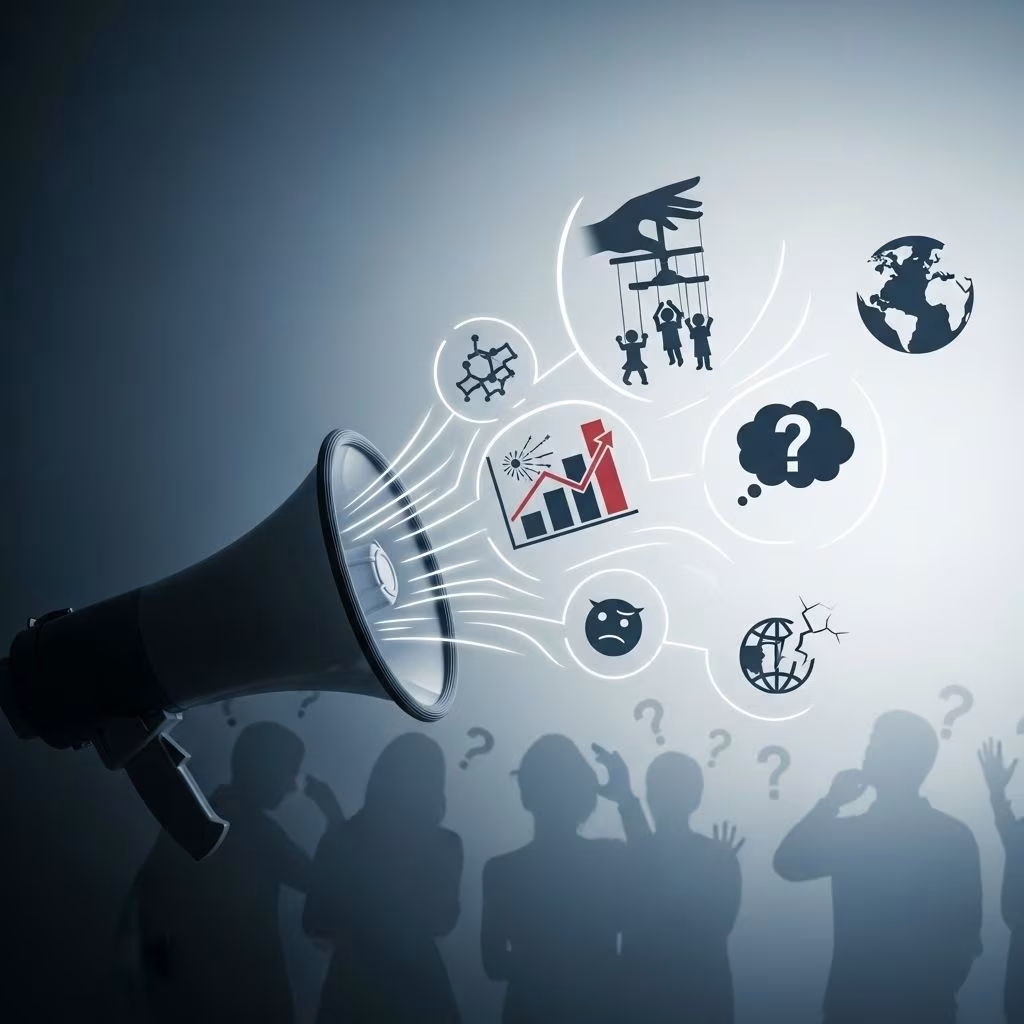
How Propaganda Works: Methods, Influence, and Impact
Propaganda is a powerful force that shapes societies, sways elections, influences wars, and even alters personal beliefs. Understanding how propaganda functions—its methods, effects, and the psychology behind its influence—arms individuals with the knowledge to recognize, counteract, and resist manipulative messages in everyday life.
What Is Propaganda?
Propaganda is a form of communication aimed at influencing the attitudes, beliefs, or actions of a target audience. It is often used to promote a specific agenda, ideology, or cause, typically by selective presentation of facts, emotional appeals, or manipulation of information . Propaganda may involve the use of truthful, partially true, or entirely false information designed to generate a particular response.
Key characteristics include:
- Deliberate and systematic message crafting
- Attempts to shape perceptions or control behavior
- Often emotional, moral, or ideological in its appeal
- Targets large groups as well as individuals
While the term is frequently associated with politics or war, propaganda is also found in advertising, social movements, and more subtle dimensions of daily life .
Brief History of Propaganda
The concept and techniques of propaganda date back centuries. Ancient empires and religious institutions used persuasive messages to consolidate power and win followers. In the modern era, the word “propaganda” itself gained widespread use during the 17th century when the Catholic Church established the Congregatio de Propaganda Fide (Congregation for the Propagation of the Faith) to promote missionary work .
During the 20th century, particularly in the World Wars, governments and military powers employed mass media—including posters, radio broadcasts, and films—to generate public support, encourage enlistment, or demonize opponents. In the digital age, the proliferation of information technologies has multiplied the reach and sophistication of propaganda techniques .
How Does Propaganda Work?
The effectiveness of propaganda relies on several psychological and social mechanisms:
- Manipulation of emotions: Propaganda exploits fear, pride, anger, and other feelings to drive immediate reactions .
- Repetition: Constantly repeating messages ingrains ideas, making them seem more true and accepted .
- Social proof and conformity: Demonstrating that ‘everyone else’ believes something (the bandwagon effect) pressures individuals to align with the majority .
- Stereotyping and scapegoating: Complex issues are simplified by blaming an out-group or enemy, reducing ambiguity and generating strong ingroup loyalty .
- Authority and credibility: Messages presented by trusted figures or institutions are more likely to be accepted .
The goal is to subtly—or overtly—direct how people interpret reality and, subsequently, how they act.
Main Techniques Used in Propaganda
- Bandwagon: Encourages people to join a cause because ‘everyone else is doing it’ .
- Name-calling: Attaching negative labels to opponents/factions to arouse prejudice without examining evidence.
- Glittering generalities: Using vague, appealing phrases like “freedom,” “progress,” or “justice” that have positive connotations but lack specifics.
- Card stacking: Selecting only certain facts or statistics that support one side of the argument.
- Plain folks: Projecting leaders or ideas as ‘just like you,’ fostering trust and relatability.
- Testimonial: Leveraging endorsements from celebrities or trusted figures.
- Fear appeals: Using threats or warnings to prompt action (“If you don’t support X, disaster will follow!”).
- Transfer: Associating positive (or negative) symbols or values with a person or idea; for example, wrapping a political message in patriotic imagery.
Types of Propaganda
| Type | Description | Example Context |
|---|---|---|
| White Propaganda | Clearly identified source and truthful information, though selectively presented | Government health advisories |
| Grey Propaganda | Source may be ambiguous; accuracy is questionable or mixed | Anonymous online rumors |
| Black Propaganda | Falsely attributed source and intentionally deceptive or false content | Fake news articles designed to discredit a rival |
| Agitative Propaganda | Designed to stir up support, passion, or action, often urgent in tone | Revolutionary calls to action |
| Integrative Propaganda | Seeks to solidify existing beliefs and maintain societal order | National holidays and rituals |
Psychology Behind Propaganda
Propaganda thrives on human psychology and predictable cognitive habits:
- Selective exposure: People gravitate toward messages that confirm their beliefs, and propaganda exploits this by reinforcing existing biases .
- Cognitive dissonance: Propaganda may resolve uncomfortable inner contradictions by providing a unifying explanation or scapegoat .
- Emotional arousal: Emotional messages override rational analysis, prompting snap judgments and action .
- Repetition and familiarity: Frequent exposure makes ideas seem credible, regardless of their truth.
Real-World Examples of Propaganda
- Political Campaigns: During elections, slogans, attack ads, and visuals evoke strong emotional responses and reinforce party loyalty.
- War-Time Posters: Governments have historically distributed compelling images and slogans to motivate enlistment, demonize enemies, or encourage conservation of resources.
- Social Media Memes: Viral memes blend humor, symbols, and slogans, making political messages appealing and easily shareable online.
- Commercial Advertising: Companies may use testimonials, exaggerated claims, or ‘bandwagon’ appeals to persuade customers.
Propaganda vs. Persuasion
| Propaganda | Persuasion |
|---|---|
| Often distorts reality or omits key facts | Aims for openness and full debate |
| Focuses on group manipulation | Targets individual critical thinking |
| Tied to a specific agenda | Supports informed decision-making |
| Relies heavily on emotional triggers | Utilizes logical and emotional appeals |
Media’s Role in Spreading Propaganda
Throughout history, the media has been central to the spread of propaganda. State and private actors use film, newspapers, television, radio, and social media platforms to amplify their messages . The rise of the internet and algorithms means propaganda now circulates at unprecedented speed, targeting specific demographics with tailored messages.
- Concentration of media ownership can limit dissenting views.
- Funding models (like advertising) may influence content.
- Reliance on official sources can perpetuate institutional narratives.
- Social media increases the impact of viral, emotionally charged, and polarizing messages.
Impact of Propaganda
- Shaping Public Opinion: Alters perceptions of events, people, or policies.
- Behavioral Influence: Can spur collective actions—rallies, boycotts, violence, or compliance.
- Polarization: Often increases societal division by amplifying extremes and stigmatizing moderate or dissenting voices.
- Spread of Disinformation: Misinformation impacts electoral outcomes, public health, and social trust .
How to Recognize and Resist Propaganda
- Check the source: Is the message from a credible, transparent source?
- Look for emotional manipulation: Notice if a message relies mainly on fear, anger, or pride rather than evidence.
- Evaluate the evidence: Are claims supported by verifiable data or just anecdotes and generalities?
- Consider omitted facts or perspectives: What is not being said? Are important counter-arguments missing?
- Be wary of absolutes and slogans: Complex issues are rarely black-and-white or reducible to one-liners.
- Diversify your information: Consult different sources to reduce the risk of information ‘bubbles’ and manipulation.
Frequently Asked Questions About Propaganda
What is the main goal of propaganda?
The primary goal is to shape beliefs, attitudes, or actions to align with the message creator’s intent—whether that means garnering support, stirring opposition, or enforcing conformity.
Are propaganda and misinformation the same?
No. Misinformation refers to false or misleading information, regardless of intent. Propaganda involves information (true, false, or incomplete) intentionally crafted to influence behavior or belief.
Can propaganda be positive?
While often associated with manipulation and deception, propaganda can sometimes promote positive objectives, such as public health campaigns or social unity. The moral evaluation depends on intent, methods, and outcomes.
Is propaganda always obvious?
No. Many forms are subtle, using repetition, emotional cues, or social proof instead of overt messaging. Effective propaganda often blends seamlessly into everyday communications and culture.
How can I protect myself from propaganda?
Develop media literacy, question strong emotional responses, seek information from multiple sources, and be persistent in critical thinking. Recognizing manipulative tactics is the first step to building resistance.
References
- NetReputation. “The Power and Impact of Propaganda”
- Wikipedia. “Propaganda techniques”
- Beyond Intractability. “Propaganda”
- Britannica. “Propaganda”
- Psychological Defence Agency. “Propaganda”
- Wikipedia. “Propaganda”
- Harvard Misinformation Review. “Histories of Media Techniques”
References
- https://www.netreputation.com/the-power-and-impact-of-propaganda/
- https://en.wikipedia.org/wiki/Propaganda_techniques
- https://www.beyondintractability.org/essay/propaganda
- https://www.britannica.com/topic/propaganda
- https://www.britannica.com/topic/propaganda/Media-of-propaganda
- https://mpf.se/psychological-defence-agency/knowledge-and-support/theme-library/propaganda
- https://en.wikipedia.org/wiki/Propaganda
- https://misinforeview.hks.harvard.edu/article/propaganda-misinformation-and-histories-of-media-techniques/


