


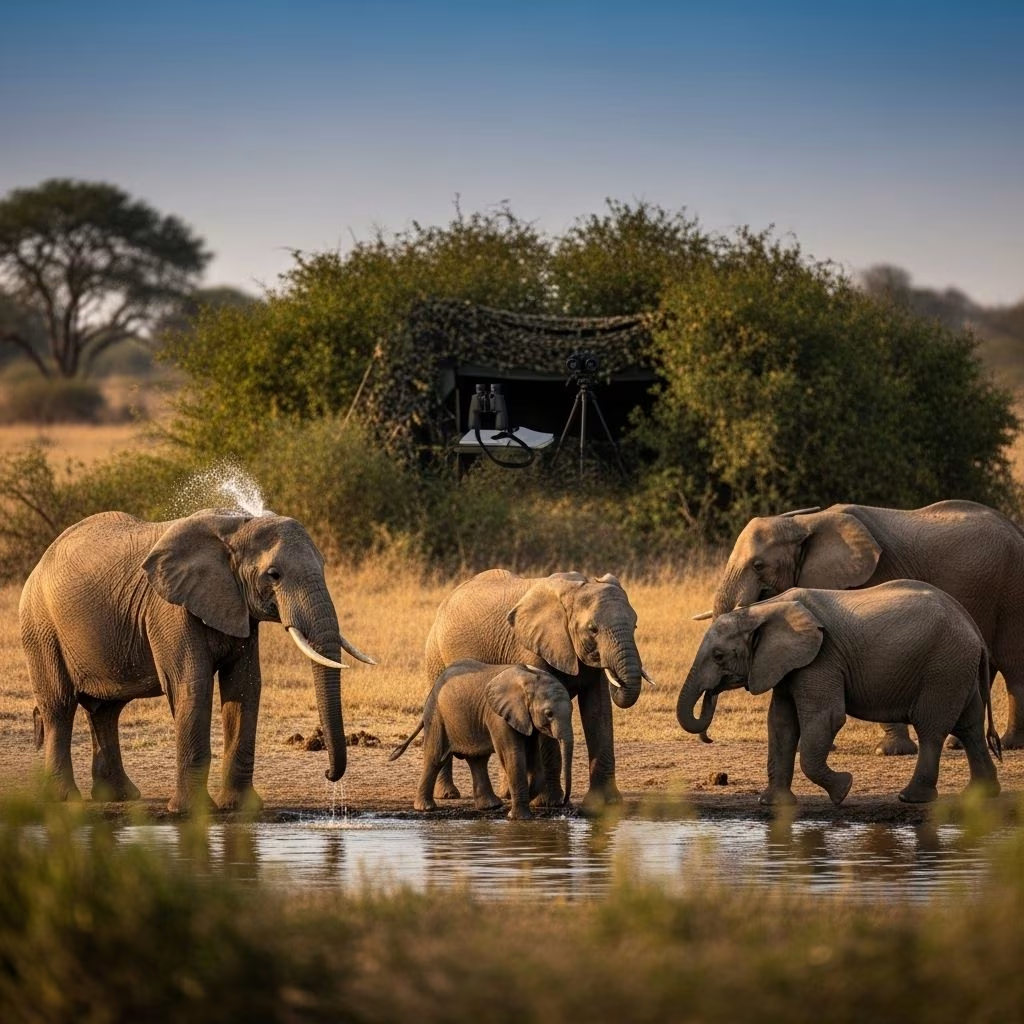
What Is Naturalistic Observation?
Naturalistic observation is a research method used in psychology and the social sciences to observe and record behaviors as they naturally occur in real-world settings, without any intervention or manipulation by the researcher. The goal is to gather authentic behavioral data that accurately reflects what people or animals do in their everyday environments—whether that’s children playing at home, shoppers browsing a grocery store, or animals interacting in the wild. This approach is often called “people watching with a purpose”.
Definition and Overview
Naturalistic observation involves systematically watching and recording subjects in their usual environments, attempting as much as possible to avoid influencing their behavior. The method is qualitative in nature, providing rich, detailed descriptions rather than numerical data. Researchers may use video recordings, audio devices, or direct observation, always striving for minimal disruption to the natural setting.
Why Use Naturalistic Observation?
There are several reasons why researchers choose naturalistic observation:
- Authentic Behavior: Since subjects are observed in their natural habitats, the behaviors recorded are more genuine and less likely to be altered by awareness of being studied.
- Holistic Insight: This method provides a broader, more holistic view of behavior, capturing interactions and contextual factors that are difficult to replicate in a lab.
- Ethical Considerations: Some behaviors or situations (e.g., reactions to natural disasters, group dynamics) cannot be ethically or practically studied in a lab, making naturalistic observation the only viable option.
- Hypothesis Generation: Observations often serve as a preliminary step, helping to identify behaviors or patterns that can later be tested in more controlled studies.
Types of Naturalistic Observation
Researchers employ different approaches depending on their goals, ethical constraints, and practical considerations:
| Type | Definition | Example |
|---|---|---|
| Overt Observation | Participants are aware they are being observed. | Studying classroom behavior with students and teachers aware of the researcher’s presence. |
| Covert Observation | Participants are unaware they are being observed. | Using hidden cameras in a retail store to study customer behavior. |
| Participant Observation | The researcher takes part in the activities being observed. | An anthropologist living with a community to study their daily rituals. |
| Non-Participant Observation | The researcher watches from the outside without joining. | A psychologist observing children at play from behind a one-way mirror. |
Applications Across Disciplines
Naturalistic observation is widely used in several fields:
- Psychology: To understand developmental milestones, social interactions, and behavioral disorders in real-life settings.
- Anthropology: To study cultural practices, traditions, and community life.
- Biology/Zoology: To observe animal behavior in the wild, as famously done by Jane Goodall with chimpanzees.
- Consumer Research: To analyze shopping behaviors or reactions to marketing changes in retail environments.
- Education: To assess classroom dynamics, teaching methods, and student engagement.
Conducting a Naturalistic Observation Study
Step-by-Step Process
- Define the Research Question: Determine what behaviors or interactions you want to observe.
- Choose the Setting: Select a natural environment relevant to the research question.
- Decide on the Observation Method: Choose between overt, covert, participant, or non-participant observation.
- Develop a Coding System: Create categories for behaviors to ensure consistent recording.
- Collect Data: Observe and record behaviors, using notes, video, or audio as appropriate.
- Analyze Data: Review recordings or notes to identify patterns or themes.
- Report Findings: Present observations, discuss implications, and suggest areas for further research.
Advantages of Naturalistic Observation
- High Ecological Validity: Behaviors are observed in real-world contexts, increasing the authenticity of findings.
- Discovery of New Phenomena: May uncover behaviors or patterns not previously documented or expected.
- Useful for Preliminary Research: Excellent for generating hypotheses that can be tested in controlled experiments.
- Captures Complex Interactions: Can document multifaceted social and environmental dynamics that are hard to simulate.
Limitations and Challenges
- Lack of Control: Inability to manipulate variables or control for confounding factors, making causal conclusions difficult.
- Observer Bias: Researchers’ expectations or interpretations may influence what is recorded or how it is interpreted.
- Reactivity: Participants may alter their behavior if they know they are being observed (the Hawthorne effect).
- Ethical Concerns: Covert observation may raise privacy issues; informed consent is often required for human subjects.
- Difficulty in Replication: Because each setting is unique, it can be hard to replicate studies exactly.
Ethical Considerations
Naturalistic observation must adhere to ethical guidelines, especially in human research. Informed consent should be obtained when possible, and privacy must be respected. In cases where covert observation is necessary, researchers must carefully weigh the potential benefits against the risks to participants.
Examples of Naturalistic Observation
“Naturalistic observation is like the difference between studying wild animals in a zoo and studying them in their natural habitat.”
- Child Development: Recording language acquisition in a child’s home environment.
- Sports Psychology: Observing athletes’ routines and interactions during training.
- Animal Behavior: Jane Goodall’s pioneering studies of chimpanzees in the wild.
- Consumer Behavior: Watching how shoppers navigate a redesigned supermarket layout.
Technological Innovations
Advances in technology have expanded the possibilities for naturalistic observation:
- Electronically Activated Recorder (EAR): A wearable device that periodically records ambient sounds, capturing spontaneous behavior without constant researcher presence.
- SenseCam: A wearable camera that automatically takes pictures at set intervals, documenting daily activities for analysis.
These tools help reduce observer reactivity and increase the richness of the data collected.
Frequently Asked Questions (FAQs)
What is the main purpose of naturalistic observation?
The main purpose is to study behavior as it occurs naturally, without interference, to gain authentic insights into real-world behaviors and interactions.
What are the differences between naturalistic and controlled observation?
Naturalistic observation takes place in real-world settings without manipulation, while controlled observation occurs in laboratory environments where variables are manipulated and controlled.
How do researchers minimize observer effect in naturalistic observation?
By remaining as unobtrusive as possible, using covert methods or technology (like EARs), and sometimes hiding their presence or purpose.
What are some ethical concerns with naturalistic observation?
Issues include the right to privacy, informed consent, and the potential for psychological harm if individuals are unaware they are being observed.
Can naturalistic observation establish cause-and-effect relationships?
Generally, no—because variables are not controlled, it is difficult to determine causality. However, it is valuable for generating hypotheses that can be tested in experiments.
Who uses naturalistic observation?
Psychologists, anthropologists, zoologists, educators, and market researchers all use this method to study behaviors in natural contexts.
Conclusion
Naturalistic observation is a powerful tool in the social sciences, offering a window into genuine behaviors that occur outside the artificial confines of the laboratory. While it comes with limitations—including ethical concerns and the inability to control extraneous variables—the method’s strengths lie in its ecological validity and potential for discovery. As technology evolves, so too do the tools available for capturing and analyzing data in natural settings, further enhancing the method’s utility for understanding the complexity of human and animal behavior.
References
- https://www.scribbr.com/methodology/naturalistic-observation/
- https://www.ebsco.com/research-starters/social-sciences-and-humanities/naturalistic-observation
- https://en.wikipedia.org/wiki/Naturalistic_observation
- https://www.simplypsychology.org/observation.html
- https://fiveable.me/key-terms/ap-psych/naturalistic-observation
- https://pmc.ncbi.nlm.nih.gov/articles/PMC3351696/
- https://dictionary.apa.org/naturalistic-observation


