


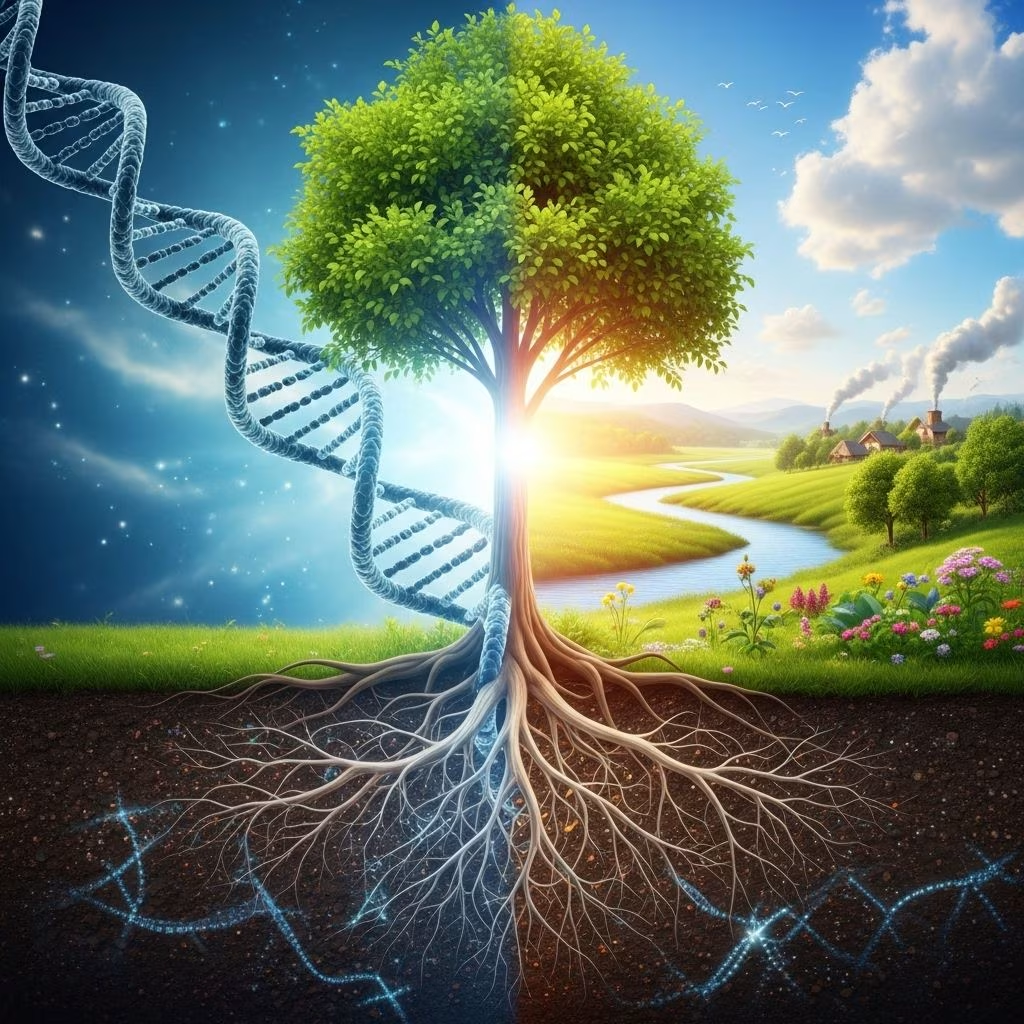
Introduction to the Nature vs. Nurture Debate
The nature versus nurture debate has stood at the crossroads of psychology, biology, and philosophy for centuries, questioning the origins of human behavior, personality, intelligence, and mental health. At its core, the debate seeks to uncover whether our traits are shaped more significantly by our genetic inheritance (nature) or by environmental influences and life experiences (nurture).
Defining Nature and Nurture
| Nature | Nurture |
|---|---|
| Genetic inheritance and biological factors present from conception | Environmental influences, such as upbringing, education, and life experiences |
| Physical characteristics, temperament, predisposition to mental illness | Learning processes, social interactions, cultural exposure |
| Pre-wiring of the brain, hereditary traits | Development through exposure, experience, and adaptation |
Nature refers to the inborn genetic blueprint encoded in our DNA. It determines our biological predispositions, such as our physical appearance, vulnerabilities to certain diseases, and perhaps even aspects of our intelligence and personality. Nurture, by contrast, encapsulates everything we encounter after conception—our family environment, social structures, culture, education, nutrition, and even events not within our control.
Historical Roots of the Debate
The tension between familial inheritance and societal influence dates back to philosophers like John Locke, who posited the tabula rasa or “blank slate” theory—suggesting humans are shaped entirely by experiences. The phrase “nature and nurture” has origins stretching to the Elizabethan era, but the modern dichotomy was popularized in the late 19th century by Francis Galton, whose work was influenced by Darwin’s theory of evolution.
- Francis Galton (1822–1911): Emphasized heredity’s role through studies in eugenics and behavioral genetics.
- John Locke (1632–1704): Promoted the “blank slate” view, laying the foundation for the nurture perspective.
- Jean-Jacques Rousseau: Supported the idea that environmental conditions can mold the individual.
Nature: The Role of Genetics
Genetics underpins the “nature” argument. Ethical and scientific inquiry into heredity has shown that DNA repositories passed from parents can influence intelligence, temperament, susceptibility to mental illness, and even life span. Through behavioral genetics, researchers have been able to quantify how much of a trait is heritable by analyzing twin and adoption studies.
- Twin studies: Monozygotic (identical) twins have been instrumental in disentangling genetic influences from environmental ones.
- Heritability estimates: These suggest certain traits—like height or risk for schizophrenia—are strongly determined by genetic factors.
- Gene mapping: Advances in genomics provide insight into the specific genes related to behavioral traits.
However, most contemporary scholars warn against oversimplifying the influence of nature, noting that one’s genetic blueprint is only part of the story and doesn’t act independently from environmental context.
Nurture: Environmental Influences
The “nurture” perspective focuses on life experiences, upbringing, education, and culture. Studies on childhood development and psychological disorders underscore the profound impact of environment. Even with genetic predispositions, environmental exposures can mediate, amplify, or buffer these effects.
- Parenting styles: Warm, responsive caregiving correlates with positive cognitive and emotional development.
- Socioeconomic status: Access to resources, nutrition, and education deeply affects developmental trajectories.
- Peer interactions: Social learning and imitation help shape personality and social competence.
- Cultural expectations: Influence values, communication, and even emotional expression.
Pivotal Research: Twin and Adoption Studies
Researchers have leaned on twin and adoption studies for decades to parse the relative contributions of nature and nurture.
- Twin studies: Compare similarities and differences between identical and fraternal twins reared together or apart.
- Adoption studies: Examine traits in adopted children relative to their biological and adoptive parents.
- Findings: Many traits, such as intelligence, academic achievement, and aggression, show evidence for both genetic and environmental contributions.
Modern Perspectives: Interplay Between Genes and Environment
The old dichotomy—where nature and nurture are mutually exclusive—has given way to a nuanced understanding. The most influential contemporary view is that genes and environment interact continuously in shaping behavior and development. This interplay is referred to as gene-environment interaction and is central to modern genetic and psychological research.
- Epigenetics: Studies how environmental factors can turn gene expression on or off without altering the DNA sequence itself.
- Gene-environment transactions: Suggest that certain environments may elicit particular genetic responses; genes can set the range of possible outcomes, but environment determines where within that range development will occur.
- Example: A child genetically predisposed to anxiety might only develop a disorder in a highly stressful environment.
This model rejects extremes of “nativism” (all nature) or “empiricism” (all nurture). Instead, most contemporary researchers seek to understand the dynamic relationship between genetic predispositions and environmental context.
Nature vs. Nurture Examples
- Intelligence: Both inherited genes and educational experiences contribute to a person’s intellectual capacities. Twin studies reveal that while genes play a substantial role, socioeconomic factors and enriched environments can raise or lower IQ scores.
- Personality: Traits like openness, conscientiousness, and extraversion have been linked to genetics, yet life events, education, and relationships have significant impact.
- Physical traits: Height and eye color are almost entirely determined by genetics, while nutrition can influence overall health and physical development.
- Mental health: A predisposition to depression or schizophrenia can exist, but its manifestation often requires environmental stressors, trauma, or other influences.
Controversies and Social Implications
The nature versus nurture debate has often intersected with sensitive social topics:
- Race and Intelligence: Historical misuse of heritability research has fueled discriminatory ideologies. Modern critics assert that environmental and socioeconomic factors are more significant than innate biological differences among groups.
- Public Policy: Studies supporting the role of environment have led to programs such as Head Start, which aim to equalize opportunities for disadvantaged children by improving early childhood conditions.
- Eugenics: In the early 20th century, hereditary views were used to justify social policies that promoted the “superiority” of certain groups, now widely discredited for their ethical violations.
Understanding that biology and environment work together can inform better public policies, health interventions, and educational practices. It underscores the need to consider both inherited susceptibility and the power of intervention and support.
Current Consensus and Future Directions
Consensus in the scientific community now centers on interactionist perspectives. No single factor can account for the complexity of human development and behavior. Instead, researchers acknowledge:
- Complexity: Genes set boundaries; environment determines outcomes.
- Variation: Individual differences arise from countless combinations of genetic and environmental factors.
- Epigenetic mechanisms: Environmental triggers can alter gene expression, reshaping developmental trajectories.
- Societal focus: Recognition that everyone has the potential to succeed, with support and opportunity playing critical roles.
Frequently Asked Questions (FAQs) about Nature vs. Nurture
- Q: What is meant by ‘nature’ in this debate?
- A: Nature refers to genetic and biological factors influencing human traits, including inherited physical and psychological characteristics.
- Q: How does nurture impact development?
- A: Nurture encompasses environmental factors—including parenting, education, social relationships, nutrition, and culture—that influence growth and development throughout life.
- Q: Can traits be shaped by both nature and nurture?
- A: Yes. Modern science shows that most traits result from a dynamic interaction between genetic predispositions and life experiences.
- Q: Does one side dominate for all human traits?
- A: No single side dominates. Some traits (like eye color) are nearly all genetic, while others (like language) are largely shaped through experience. However, both factors are always present to some extent.
- Q: Why is the nature vs. nurture debate important?
- A: It helps us understand development, informs education and health policy, guides interventions, and underlines the importance of opportunity and support in optimizing human potential.
Conclusion
The nature versus nurture debate remains a foundational question in the study of psychology, genetics, and sociology. Emerging research points to a symbiotic relationship between our genetic code and life experiences, transcending simplistic divisions. By understanding these complex interactions, we can better promote well-being, health, and learning for all individuals—recognizing the right balance of support, intervention, and acceptance.
References
- https://en.wikipedia.org/wiki/Nature_versus_nurture
- https://www.ebsco.com/research-starters/communication-and-mass-media/nature-versus-nurture-debate
- https://www.simplypsychology.org/naturevsnurture.html
- https://pmc.ncbi.nlm.nih.gov/articles/PMC2790282/
- https://michigantoday.umich.edu/2022/12/16/nature-vs-nurture-its-both/
- https://www.nottingham.ac.uk/helmopen/rlos/child/foundation/page_three.html
- https://www.psychologytoday.com/us/basics/nature-vs-nurture
- https://www.albert.io/blog/nature-vs-nurture-ap-psychology-review/


