


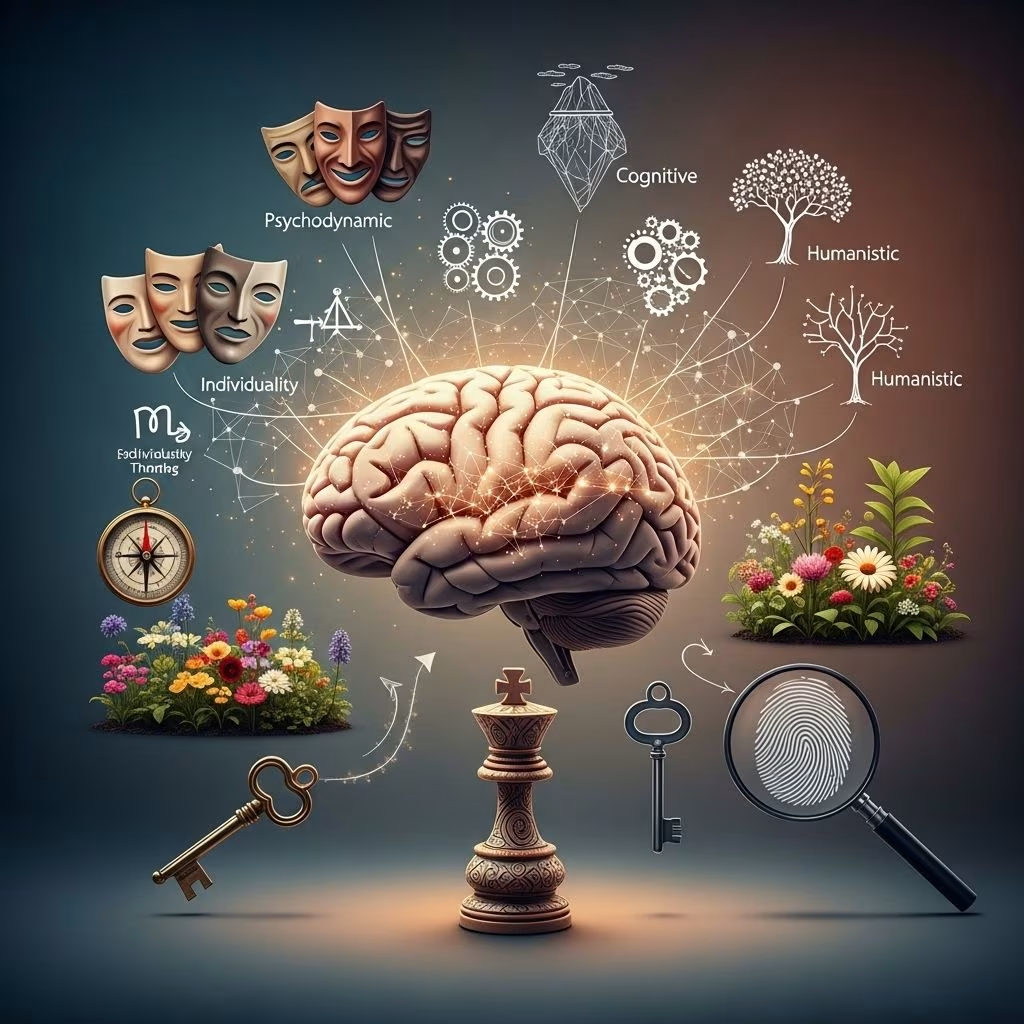
Personality psychology is a vibrant branch of psychology focused on understanding the distinct patterns of thinking, feeling, and behaving that define individuals. This field not only investigates what makes each person unique but also explores the fundamental processes and traits shared by all humans. In this article, we’ll explore the key concepts, historical evolution, major theories, and everyday implications of personality psychology.
What Is Personality Psychology?
Personality psychology examines the complex interplay of psychological traits, behaviors, emotional patterns, and underlying processes that combine to create an individual’s personality. It addresses two core questions:
- How do individuals differ from one another in consistent ways?
- What central characteristics are shared across humanity?
Personality is often described as the enduring configuration of characteristics and behaviors through which a person uniquely adjusts to life. These characteristics include traits, interests, values, emotional patterns, self-concept, and the unique ways individuals interact with their environment.
Key Definitions and Related Concepts
Understanding personality involves comparing it to related terms:
- Temperament: The biologically rooted aspects of personality observed early in childhood, often linked to emotional expression and reactivity.
- Character: The set of attributes tied to morality, self-control, and integrity, reflecting the moral dimension of one’s personality.
Personality encompasses these as well as other psychological dimensions that make someone a unique, coherent individual.
A Brief History of Personality Psychology
The formal study of personality has its roots in several intellectual traditions:
- Began with philosophical inquiries into human nature and psychiatric case studies focusing on individuals with psychological distress.
- Influenced by early theories of physiology and biology, which provided the first frameworks for understanding individual differences.
- Evolved through the work of foundational psychologists such as Gordon Allport and Carl Jung.
As psychology matured, personality research became increasingly scientific, using both qualitative and quantitative methods to explore the factors shaping individual identity.
Major Theories of Personality
Multiple theoretical approaches provide different perspectives on personality. The major theories include:
Trait Theories
Trait theories focus on identifying and measuring specific, relatively stable attributes that distinguish individuals. The most prominent of these is the Five-Factor Model (Big Five):
- Openness to Experience: Imagination, curiosity, and a willingness to engage with new ideas.
- Conscientiousness: Organization, dependability, and self-discipline.
- Extraversion: Sociability, assertiveness, and outgoingness.
- Agreeableness: Compassion, cooperativeness, and kindness.
- Neuroticism: Tendency toward negative emotions, such as anxiety and emotional instability.
Trait theorists posit that these broad traits can reliably predict patterns of behavior across diverse situations.
Type Theories
Type theories classify people into groups based on certain characteristics. Influential examples include:
- Carl Jung’s Psychological Types: Differentiating individuals by attitudes (extraversion vs. introversion) and functions (thinking, feeling, sensation, intuition).
- Myers-Briggs Type Indicator (MBTI): Expands Jung’s types into 16 combinations used in research and organizational settings.
- Keirsey Temperament Sorter: Focuses on temperament patterns and how they manifest in communication and behavior.
Type theories are commonly encountered in popular psychology and organizational contexts.
Psychodynamic Theory
The psychodynamic approach, originally developed by Sigmund Freud, emphasizes the influence of unconscious drives, childhood experiences, and internal conflicts on personality. Key ideas include:
- The mind is structured into conscious, preconscious, and unconscious levels.
- Personality develops through stages characterized by conflicts between instinctual drives and societal expectations.
- Unresolved conflicts can result in lasting personality patterns or disorders.
Humanistic Theory
Humanistic psychology views personality as the manifestation of an individual’s drive toward personal growth, self-actualization, and fulfillment. Major concepts include:
- Focus on free will, personal values, and the pursuit of meaning.
- Emphasis on the intrinsic motivation to develop one’s unique potential.
Social-Cognitive Theory
Social-cognitive theories highlight the role of cognitive processes and social learning in shaping personality:
- Behavior is shaped by interactions between personal factors (such as beliefs), the environment, and behavior itself.
- Emphasizes the importance of observation, modeling, and self-efficacy.
Biological and Evolutionary Theories
These theories examine the genetic, neurological, and evolutionary basis of personality:
- Temperament and traits are influenced by inherited biological factors and brain systems.
- Personality is shaped by processes of adaptation, natural selection, and evolutionary pressures.
Main Traits and Measurement of Personality
Personality psychologists have developed a variety of methods to assess, describe, and predict traits. The Big Five dimensions remain predominant due to their empirical support and utility. Measurement techniques include:
- Self-report inventories: Questionnaires where individuals rate how well certain descriptors apply to them (e.g., NEO Personality Inventory).
- Projective tests: Ambiguous stimuli (such as the Rorschach inkblot test) that aim to uncover unconscious aspects of personality.
- Behavioral observation: Direct assessment of how people act in specific situations.
These tools allow psychologists to systematically evaluate personality, predict behavioral trends, and inform support strategies.
| Theory | Key Focus | Main Contributors |
|---|---|---|
| Trait | Identification and measurement of traits | Cattell, Allport, Costa & McCrae |
| Type | Grouping individuals by categories or temperaments | Jung, Myers & Briggs |
| Psychodynamic | Unconscious processes and childhood experiences | Freud, Jung, Adler |
| Humanistic | Personal growth and self-actualization | Maslow, Rogers |
| Social-Cognitive | Interactions between cognitive, behavioral, and contextual factors | Bandura, Mischel |
| Biological | Genetics, brain, and evolutionary processes | Eysenck, Cloninger |
Determinants of Personality
Personality forms as a result of many interacting influences:
- Genetic inheritance: Heritable traits, temperament, and biological factors shape baseline personality characteristics.
- Environmental factors: Family environment, culture, education, and social experiences profoundly impact personality development.
- Critical life events: Trauma, achievement, loss, and pivotal experiences can cause significant changes.
- Learning and observation: Behavioral patterns acquired through learning shape personality over time.
The interplay between these factors means that while aspects of personality are relatively stable, others can change in response to life experiences or intentional efforts at self-development.
Applications of Personality Psychology
Understanding personality has practical implications across numerous settings:
- Mental Health: Diagnosis and treatment of personality disorders, planning effective psychological interventions.
- Education: Customizing teaching methods and career guidance based on personality differences.
- Business and Careers: Personnel selection, team building, leadership development, and organizational planning.
- Relationships: Enhancing communication, conflict resolution, and compatibility in personal and professional relationships.
- Self-understanding: Promoting self-awareness, emotional intelligence, and personal growth.
Personality research continues to inform new approaches to therapy, coaching, and social policy design.
Contemporary Research and Advances
Modern personality psychology utilizes advances in genetics, neuroscience, and data analysis to understand individual differences in unprecedented detail. For example:
- Genomic studies are uncovering genetic contributions to traits such as extraversion and neuroticism.
- Brain imaging is linking personality differences to neural structures and activity patterns.
- Cross-cultural research is illuminating the universal and culturally specific aspects of personality.
Frequently Asked Questions (FAQs) About Personality Psychology
Q: What is the difference between personality, temperament, and character?
A: Temperament refers to biologically based tendencies apparent early in life. Personality encompasses broader psychological patterns formed through genetics and experience. Character relates to morally relevant attributes such as integrity and self-control.
Q: Are personality traits stable or can they change over time?
A: Some traits show considerable stability, especially after young adulthood, but significant changes are possible due to life experiences, deliberate efforts, or major life transitions.
Q: How is personality measured?
A: Personality is assessed using self-report questionnaires (surveys), behavioral observation, and sometimes projective tests designed to tap into unconscious aspects of the self.
Q: What practical value does studying personality have?
A: Understanding personality can improve relationships, career satisfaction, mental health treatment, and self-awareness, as well as foster better teamwork and organizational effectiveness.
Q: What is the Big Five model?
A: The Big Five model (or Five-Factor Model) defines personality along five broad traits: openness, conscientiousness, extraversion, agreeableness, and neuroticism. It’s widely validated and useful in predicting behavior.
Key Takeaways
- Personality psychology studies individual differences and the psychological organization that underpins each person’s identity.
- Major theories include trait, type, psychodynamic, humanistic, social-cognitive, and biological perspectives.
- Personality is formed through complex interactions among genetic, environmental, and experiential factors.
- Understanding personality has practical benefits for mental health, education, workplaces, and self-growth.
References
- https://www.ebsco.com/research-starters/psychology/personality-psychology
- https://psych.la.psu.edu/about-us/research/personality/
- https://www.britannica.com/topic/personality
- https://us.sagepub.com/sites/default/files/upm-binaries/12464_01_Haslam_Ch01.pdf
- https://www.apa.org/topics/personality
- https://pubmed.ncbi.nlm.nih.gov/34516758/
- https://www.youtube.com/watch?v=dcsc_EsJmsA
- https://www.psychologytoday.com/us/basics/personality


