


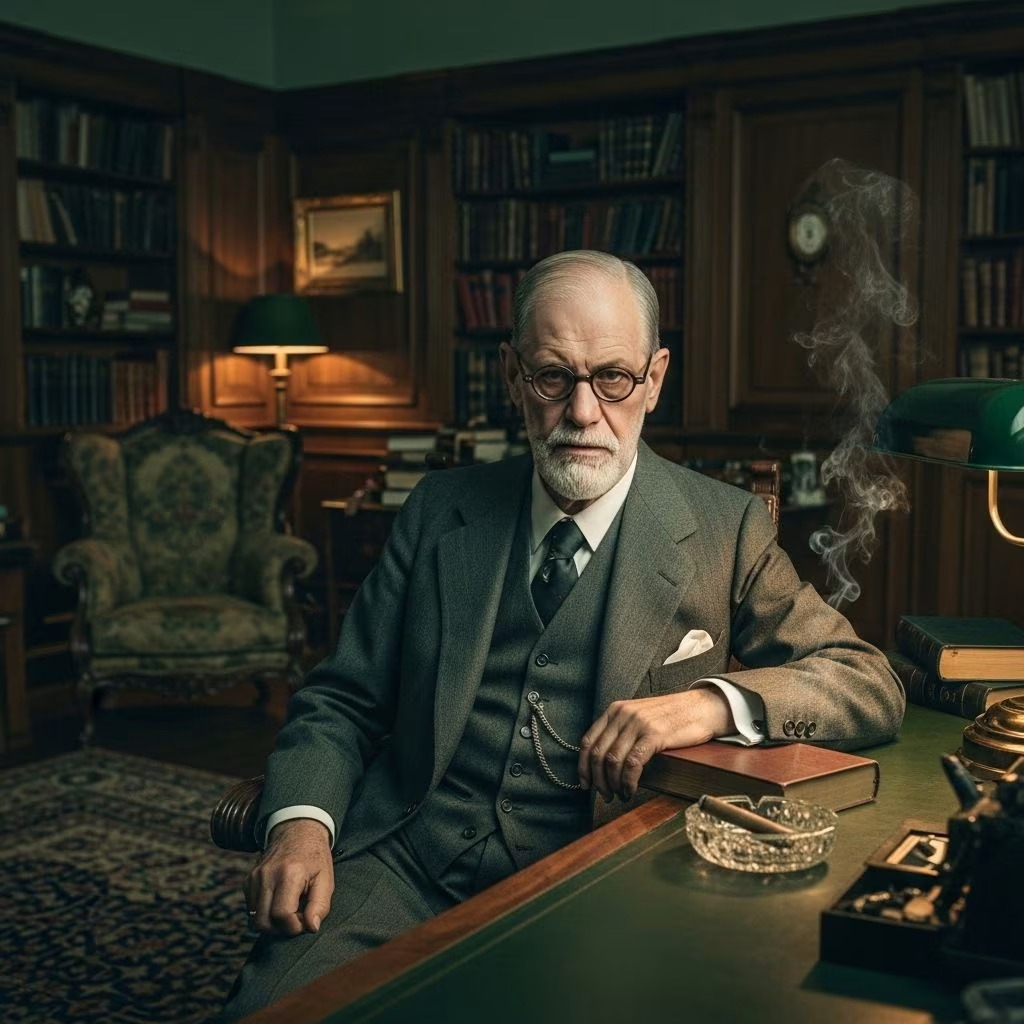
Introduction to Sigmund Freud
Sigmund Freud, born on May 6, 1856, in Freiberg, Moravia (now Příbor, Czech Republic), was a renowned Austrian neurologist and the founder of psychoanalysis. He is best known for his theories on the unconscious mind and its role in shaping behavior. Freud’s work has had a profound influence on psychology and continues to be studied and debated today.
Early Life and Education
Freud was born to Jewish parents, Jakob and Amalie Freud. He was the eldest of eight children. Freud’s early education was at the Sperl Gymnasium in Vienna, where he excelled academically. In 1873, he enrolled in the University of Vienna, initially studying law but soon switching to medicine, which he completed in 1881. After completing his medical degree, Freud worked in various hospitals and clinics, specializing in neurology.
Career and Contributions to Psychoanalysis
Freud’s career in psychoanalysis began when he was working with Josef Breuer, a Viennese physician. Together, they published Studies on Hysteria in 1895, which laid the groundwork for Freud’s psychoanalytic theory. Freud eventually developed his own distinct approach, focusing on the role of unconscious thoughts and desires in shaping behavior.
Psychoanalytic Theory
Freud’s psychoanalytic theory posits that human behavior is influenced by the unconscious mind, which contains repressed thoughts, desires, and memories. He developed techniques like free association and dream analysis to uncover these unconscious elements.
Structure of the Mind
Freud proposed a tripartite model of the mind, consisting of the id, ego, and superego. The id represents primal desires, the ego balances the demands of reality with those of the id, and the superego incorporates societal norms and morals.
Psychosexual Development
Freud’s theory of psychosexual development suggests that personality is shaped by early childhood experiences and that these experiences influence adult behavior. He outlined five stages of development: oral, anal, phallic, latency, and genital.
Dream Analysis
Freud believed that dreams are a way to access the unconscious mind. He developed techniques to analyze dreams, distinguishing between the manifest content (the actual dream) and the latent content (the underlying meaning).
Defense Mechanisms
Freud identified several defense mechanisms that the ego uses to cope with stress and unacceptable desires. Examples include repression, denial, and projection.
Major Works and Legacy
Some of Freud’s most influential works include The Interpretation of Dreams (1900), The Psychopathology of Everyday Life (1901), Three Essays on the Theory of Sexuality (1905), and The Ego and the Id (1923). His legacy extends beyond psychoanalysis, influencing fields such as sociology, anthropology, and literature.
Late Life and Death
Freud faced increasing persecution in Austria due to his Jewish heritage and was forced to flee to England in 1938. He died on September 23, 1939, in London, leaving behind a body of work that continues to shape modern thought.
Frequently Asked Questions (FAQs)
Q: What is psychoanalysis?
A: Psychoanalysis is a therapeutic technique developed by Freud that explores unconscious thoughts and desires to treat mental health disorders.
Q: What are the stages of psychosexual development according to Freud?
A: The stages are oral, anal, phallic, latency, and genital, each representing different foci of pleasure and development.
Q: What is dream analysis in psychoanalysis?
A: Dream analysis involves studying dreams to uncover unconscious thoughts and desires, distinguishing between manifest and latent content.
References
- https://www.simplypsychology.org/sigmund-freud.html
- https://en.wikipedia.org/wiki/Sigmund_Freud
- https://iep.utm.edu/freud/
- https://pmc.ncbi.nlm.nih.gov/articles/PMC8179891/
- https://www.freud.org.uk/2024/09/19/the-main-biographical-references-of-sigmund-freud/
- https://www.livescience.com/54723-sigmund-freud-biography.html
- https://achology.com/psychology/sigmund-freud-a-journey-through-his-life/
- https://socialsci.libretexts.org/Bookshelves/Psychology/Culture_and_Community/Personality_Theory_in_a_Cultural_Context_(Kelland)/03:_Sigmund_Freud/3.02:_A_Brief_Biography_of_Sigmund_Freud_M.D.


