


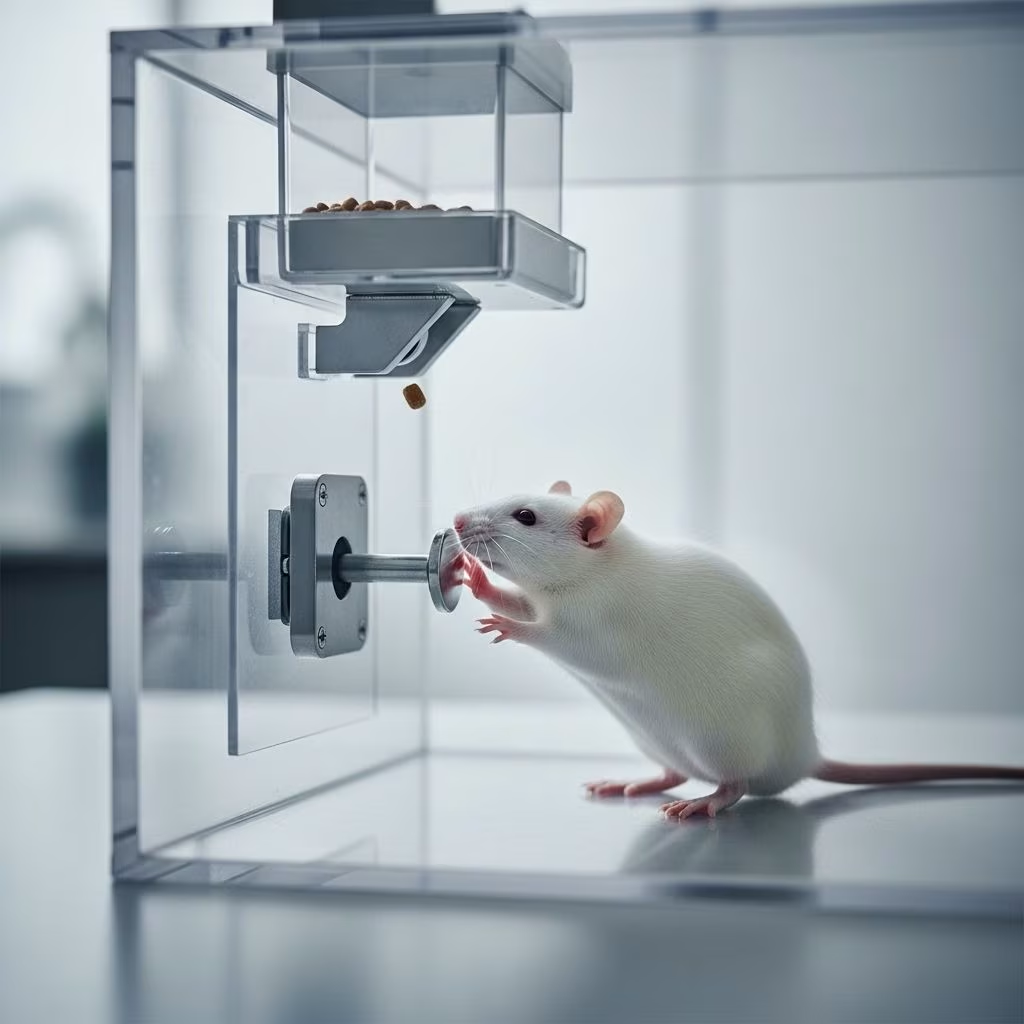
What Is a Skinner Box?
The Skinner Box, formally called the operant conditioning chamber, is a laboratory apparatus invented by psychologist B.F. Skinner in the 1930s. It was designed to investigate how animal behavior could be influenced by controlled environmental variables, providing foundational evidence for the theory of operant conditioning. The box is a small, enclosed environment equipped with devices such as levers (for rodents) or keys (for birds), stimuli (like lights or sounds), and mechanisms for delivering rewards or penalties.
Brief History and Origins
B.F. Skinner, influenced by earlier work on instrumental learning and the Law of Effect, set out to create a tool for observing and shaping animal behavior in a scientific and repeatable way. Developing the Skinner Box enabled Skinner and his colleagues to study the effects of reinforcement, punishment, and schedules of rewards with unprecedented precision. Early experiments used rats, pigeons, and other small animals placed inside the chamber to examine how behaviors could be conditioned and measured.
- The Skinner Box blocked out extraneous light and sound, reducing distractions.
- Animals had access to manipulanda (like levers or keys) and received food or water as reinforcement.
- Recording devices tallied each response, allowing systematic analysis of learning curves and behavior patterns.
Key Components of the Skinner Box
The apparatus typically includes the following features:
- Operant device: A lever (for rats) or a pecking disc (for pigeons) for the animal to interact with.
- Reinforcement dispenser: Delivers a reward, such as food or water, in response to the correct action.
- Stimuli mechanisms: Lights, sounds, or other cues to signal when responses will be reinforced.
- Recording system: Measures and records the animal’s behavior for later analysis.
How the Skinner Box Works
In a typical experiment, an animal is placed in the chamber, where it learns to manipulate a device (such as pressing a lever) to receive a reward. Initially, the behavior may occur by accident, but over time, animals quickly learn the relationship between their actions and rewards—a process Skinner called operant conditioning.
The main points in the workflow of a Skinner Box experiment include:
- Observation of baseline behavior: Animals are observed for accidental lever presses or pecks.
- Reinforcement of responses: When the correct behavior occurs, a reward is immediately delivered.
- Learning through consequences: As animals associate the behavior with positive consequences, the frequency of the action increases.
- Variations in schedules: Researchers manipulate when and how often rewards are given, observing the effects on learning and persistence of the behavior.
Key Principles and Types of Reinforcement
The Skinner Box embodies the core principles of operant conditioning. Skinner distinguished between different types of consequences:
- Positive Reinforcement: Adding a desirable stimulus (like food) after a behavior to increase its recurrence.
- Negative Reinforcement: Removing an unpleasant stimulus after a behavior, also increasing its frequency.
- Punishment: Adding an unpleasant stimulus or removing a pleasant one to decrease a behavior.
- Extinction: Withholding reinforcement, leading to a decrease in the behavior over time.
| Consequence | Description | Effect on Behavior |
|---|---|---|
| Positive Reinforcement | Reward given after behavior | Increases behavior |
| Negative Reinforcement | Unpleasant stimulus removed after behavior | Increases behavior |
| Punishment | Unpleasant stimulus applied or reward removed after behavior | Decreases behavior |
| Extinction | No reinforcement follows the behavior | Behavior decreases over time |
Schedules of Reinforcement
Skinner’s research explored not only which behaviors were learned, but the durability of the behavior depending on how and when reinforcement occurred. The main schedules of reinforcement are:
- Continuous reinforcement: The behavior is reinforced every single time it occurs.
- Partial (intermittent) reinforcement: The behavior is reinforced some of the time. This category includes:
- Fixed-ratio schedule: Reinforcement after a fixed number of responses.
- Variable-ratio schedule: Reinforcement after a variable number of responses (unpredictable, as in gambling machines).
- Fixed-interval schedule: Reinforcement after a specific period of time.
- Variable-interval schedule: Reinforcement after varying time intervals.
Behaviors established under variable or partial schedules are generally more resistant to extinction than those learned through continuous reinforcement.
B.F. Skinner’s Experiments and Discoveries
Skinner conducted a range of influential experiments using the operant conditioning chamber, often with rats or pigeons:
- Lever-pressing rats: A rat, placed in the box, learned that pressing a lever delivered a food pellet. Initially, lever pressing happened by chance, but with repeated pairings, the response frequency increased dramatically.
- Pigeon pecking: Skinner also adapted the chamber for pigeons, which pecked a disc to receive seeds. These experiments led to discoveries about shaping complex behaviors by rewarding closer and closer approximations to a desired goal.
- Superstitious behaviors: In one iconic experiment, Skinner found that pigeons often developed ritualistic or ‘superstitious’ behaviors if rewards happened to coincide with random movements, even when the rewards were actually delivered on a fixed schedule.
Significance and Real-World Applications
The insights from the Skinner Box and operant conditioning have helped shape approaches in multiple domains:
- Education: The principles inform reward systems and classroom management techniques.
- Therapy: Behavioral therapy often uses positive reinforcement to encourage desirable behaviors in children and adults.
- Animal training: Trainers use operant conditioning to shape complex behaviors in pets and performance animals.
- Workplace motivation: Understanding reinforcement underlies employee reward programs.
- Pharmaceutical research: The Skinner box setup is used to investigate the effects of drugs on behavior.
Criticisms and Controversies
Despite its foundational role in psychology, the Skinner Box and behaviorist approaches have faced criticism:
- Simplification of behavior: Critics argue that reducing learning to stimulus-response and reinforcement oversimplifies complex internal processes and motivations.
- Ethical concerns: Animal welfare advocates criticize the deprivation and confinement aspects of Skinner Box experiments, citing concerns over the animals’ psychological well-being and lack of social interaction.
- Overlooked cognition: Some psychologists note that operant conditioning ignores or undervalues the cognitive and emotional components of learning.
Legacy and Continuing Impact
B.F. Skinner’s invention of the operant conditioning chamber revolutionized scientific approaches to learning and behavior. While modern psychology increasingly recognizes the importance of cognition, emotions, and social context, the Skinner Box’s paradigm of systematic observation, experimentation, and quantification remains a touchstone for behavioral research, education, and therapy.
The device remains prominent in research and teaching, underpinning reward-based methods in child development, clinical psychology, animal training, and even organizational theory.
Frequently Asked Questions (FAQs)
What is the main purpose of a Skinner Box?
The primary purpose is to observe and measure how animal behavior can be changed or conditioned using reinforcement and punishment in a controlled environment.
How is a Skinner Box different from other learning apparatuses?
Unlike maze or puzzle boxes, the Skinner Box allows for continuous observation and automatic, precise delivery of rewards or penalties as soon as a behavior occurs.
What is operant conditioning?
Operant conditioning is a type of learning where behaviors are increased or decreased based on their consequences—either through reinforcement (adding or removing stimuli to increase behavior) or punishment (adding or removing stimuli to decrease behavior).
Are Skinner Boxes still used today?
Yes, modern researchers use computerized operant chambers to study learning, memory, drug effects, and neurological disorders in animals. The principles also influence human education and behavior therapy.
What are some real-life applications of Skinner Box principles?
Applications include reward systems in schools, behavioral modification therapies, animal and pet training, and the development of motivational systems in workplaces.
Summary Table: Skinner Box Fast Facts
| Feature | Description |
|---|---|
| Inventor | B.F. Skinner |
| Year Introduced | 1930s |
| Main Function | Study operant conditioning by manipulating reinforcements |
| Typical Subjects | Rats, pigeons, other small animals |
| Legacy | Revolutionized behaviorist research, therapy, and education |
References
- https://www.structural-learning.com/post/skinners-theories
- https://www.goodtherapy.org/blog/psychpedia/skinner-box
- https://www.simplypsychology.org/operant-conditioning.html
- https://en.wikipedia.org/wiki/Operant_conditioning_chamber
- https://www.divinestepstherapy.com/positive-reinforcement-definition-and-mechanism-explained
- https://www.webmd.com/mental-health/what-is-operant-conditioning
- https://www.berkeleywellbeing.com/b-f-skinner.html


