


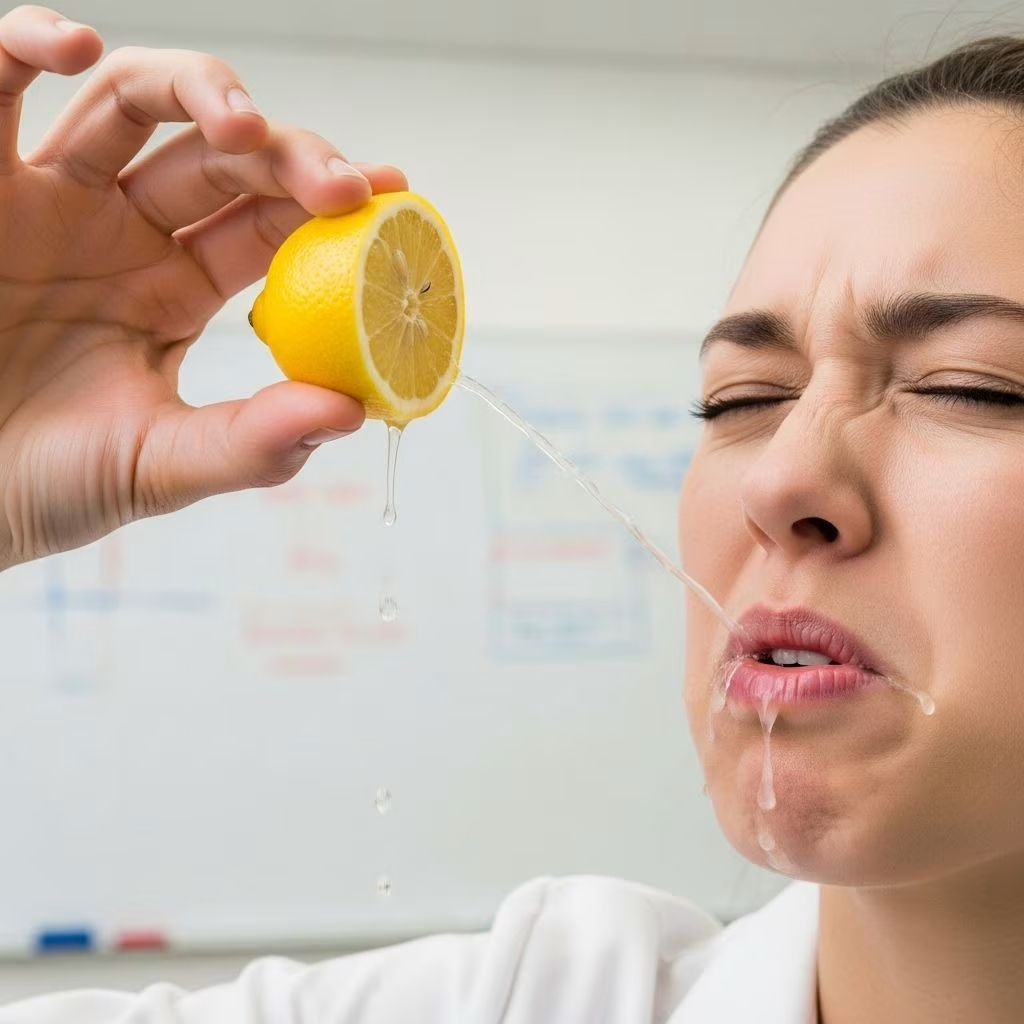
What Is an Unconditioned Stimulus?
An unconditioned stimulus (US or UCS) is any stimulus that naturally and automatically elicits a reflexive response, without requiring prior learning or association. This is a key concept in classical conditioning, a foundational theory in psychology that examines how organisms learn associations between events.
- Unconditioned stimuli trigger unconditioned responses—behaviors or reactions that are innate, automatic, and do not need to be learned.
- The response to an unconditioned stimulus is usually universal across members of a species.
- Examples: The presence of food (US) makes a dog salivate (UR), or touching a hot object (US) causes withdrawal (UR).
The Role of Unconditioned Stimulus in Classical Conditioning
Classical conditioning demonstrates how a neutral stimulus can become associated with an unconditioned stimulus and eventually trigger a similar response. Ivan Pavlov’s experiments are pivotal demonstrations of this process.
Pavlov’s Dog Experiment
Pavlov observed that dogs salivated automatically in response to food—a classic example of an unconditioned stimulus generating an unconditioned response.
- Before conditioning: Food (US) → Salivation (UR)
- Neutral stimulus (bell) initially caused no salivation.
- During conditioning: Bell + Food (simultaneously) → Salivation
- After repeated pairing: Bell (now a conditioned stimulus, CS) → Salivation (now a conditioned response, CR)
The key takeaway: the food was always the unconditioned stimulus, automatically provoking a response. Through learning, the bell (previously neutral) acquired the capacity to evoke salivation, demonstrating successful classical conditioning.
Other Examples of Unconditioned Stimuli
- The smell of food causing hunger
- A puff of air to the eye causing blinking
- Loud noise provoking startle or fear
- Alcohol causing intoxication (including inhibition and physical effects)
How Unconditioned Stimuli Differ from Other Stimulus Types
| Stimulus Type | Description | Response |
|---|---|---|
| Unconditioned Stimulus (US) | Triggers a natural, automatic reaction without prior learning | Unconditioned response (UR) |
| Conditioned Stimulus (CS) | Previously neutral; becomes associated with the US after learning | Conditioned response (CR) |
| Neutral Stimulus (NS) | Does not naturally produce a response; can become a CS through conditioning | No response until conditioning occurs |
| Discriminative Stimulus | Signals when a particular response will be reinforced (mainly in operant conditioning) | Behavioral response (if the conditions are right) |
Key Distinctions Explained
- Unconditioned vs. Conditioned Stimulus: Unconditioned stimuli cause automatic responses innately, whereas conditioned stimuli elicit learned responses following association.
- Unconditioned vs. Neutral Stimulus: A neutral stimulus has no effect until paired with a US and becomes a CS; an unconditioned stimulus always provokes an automatic reaction.
- Unconditioned Stimulus vs. Discriminative Stimulus: Discriminative stimuli belong to operant conditioning and function as cues for rewarded behavior, in contrast to the reflexive responses of US.
Unconditioned Stimulus vs. Unconditioned Response
These terms are closely connected but refer to different elements:
- Unconditioned Stimulus (US): The event or item producing the response (e.g., food, pain, loud sound).
- Unconditioned Response (UR): The automatic reaction to the US (e.g., salivation, withdrawal, startle).
Mechanics of How a Neutral Stimulus Becomes Conditioned
Through repeated pairing with an unconditioned stimulus, a previously neutral stimulus gradually acquires the capacity to produce a response on its own. The formerly neutral stimulus thus becomes a conditioned stimulus (CS), and the automatic response is termed a conditioned response (CR).
- Initial phase: Neutral stimulus (NS) alone yields no response.
- Pairing phase: NS is paired with US repeatedly.
- Acquisition: NS becomes CS, able to trigger the response independently.
This explains how environmental cues—like the sound of a bell in Pavlov’s experiment or jingles in advertising—can acquire powerful influence over behavior.
Function and Applications of Unconditioned Stimulus
Unconditioned stimuli play critical roles in both scientific research and everyday experiences:
- They enable researchers to study associative learning and behavior.
- Provide understanding of natural biological reflexes (e.g., withdrawal from pain).
- Offer foundational principles for behavior modification, therapeutic interventions, and advertising.
For example, marketers use mouth-watering images (US) to elicit cravings and positive emotions, tying those responses to their products.
Key Phenomena in Classical Conditioning
Several important processes relate to the function of unconditioned stimuli:
- Acquisition: The initial stage where the organism begins to associate the neutral stimulus with the unconditioned stimulus.
- Extinction: If the conditioned stimulus is presented repeatedly without the unconditioned stimulus, the conditioned response wanes and may eventually disappear.
- Spontaneous Recovery: After extinction, a brief reappearance of the conditioned response can occur when the conditioned stimulus is again paired with the unconditioned stimulus.
- Stimulus Generalization: The organism responds to stimuli similar to the conditioned stimulus.
- Stimulus Discrimination: The ability to differentiate between similar stimuli, responding only to the correct conditioned stimulus.
Real-World Examples of Unconditioned Stimulus
- Physical Reactions:
- Touching something hot (US) causes immediate withdrawal (UR).
- Bright light (US) results in pupil contraction (UR).
- Emotional Reactions:
- Loud noise (US) triggers a startle or fear response (UR).
- Certain smells (US) evoke positive or negative feelings (UR).
- Substance-Induced Responses:
- Alcohol (US) causes intoxication and physiological effects (UR) without the need for learning.
Issues and Ethical Concerns
While classical conditioning has provided powerful tools for understanding and influencing behavior, it raises ethical considerations especially when aversive or manipulative techniques are employed.
- Advertising: Uses conditioning principles for commercial gain, often manipulating emotional responses.
- Punishment and Aversion: Some conditioning techniques involve aversive stimuli—raises concerns about civil rights and disproportionate use (e.g., with vulnerable populations, such as children or those with disabilities).
- The importance of ethical standards and protection for vulnerable individuals exposed to behavior modification techniques.
Frequently Asked Questions (FAQs)
Q: What is the definition of an unconditioned stimulus?
An unconditioned stimulus is any event or object that naturally and automatically elicits a reflexive response without prior learning.
Q: How does an unconditioned stimulus differ from a conditioned stimulus?
An unconditioned stimulus prompts an innate, automatic response, while a conditioned stimulus triggers a learned response after association with the unconditioned stimulus.
Q: Can a neutral stimulus become an unconditioned stimulus?
No. A neutral stimulus becomes a conditioned stimulus after repeated association with an unconditioned stimulus, but it does not become an unconditioned stimulus since it does not naturally provoke a response.
Q: What is the difference between unconditioned stimulus and unconditioned response?
The unconditioned stimulus is the trigger (e.g., food), while the unconditioned response is the automatic, natural reaction to that stimulus (e.g., salivation).
Q: Is alcohol considered an unconditioned stimulus?
Yes. Alcohol triggers physiological effects such as intoxication and inhibition automatically, with no learning necessary.
Q: Why is the concept of unconditioned stimulus important in psychology?
It explains the origin of many instinctive behaviors and forms the basis for understanding learned associations in classical conditioning, with wide applications in therapy, education, and marketing.
Summary Table: Unconditioned Stimulus Concepts
| Term | Description | Example |
|---|---|---|
| Unconditioned Stimulus (US) | Triggers innate response | Food causing salivation |
| Conditioned Stimulus (CS) | Originally neutral; triggers response after learning | Bell causing salivation |
| Unconditioned Response (UR) | Natural reaction to US | Dog salivating to food |
| Conditioned Response (CR) | Learned reaction to CS | Dog salivating to bell |
Conclusion
Unconditioned stimuli are foundational for understanding instinctive behaviors and associative learning processes. Spanning classic experiments in animal behavior to practical uses in advertising and therapy, this concept remains essential in psychology for analyzing how automatic reactions are learned, modified, and harnessed. As research and application progress, ethical mindfulness is necessary to ensure responsible use of conditioning techniques.
References
- https://www.simplypsychology.org/unconditioned-stimulus.html
- https://fiveable.me/key-terms/ap-psych/unconditioned-responses
- https://fiveable.me/key-terms/ap-psych/unconditioned-stimulus
- https://www.ncbi.nlm.nih.gov/books/NBK470326/
- https://study.com/academy/lesson/video/unconditioned-stimulus-examples-definition-quiz.html
- https://dictionary.apa.org/unconditioned-stimulus


