Many people wonder what the world looks like through a dog’s eyes. While it’s commonly believed that dogs see in black and white, advances in science have revealed a far more interesting—and colorful—reality. This article will guide you through the fascinating subject of canine color vision, how it works, what colors are most visible to dogs, and how this knowledge can improve your pet’s environment and daily life.
Understanding the Basics of Dog Vision
To grasp how dogs see color, it helps to understand a little biology:
- Retina: The back part of the eye containing light-sensitive cells.
- Cones: Cells in the retina responsible for detecting color and details—and the key to color vision.
- Rods: Cells that are sensitive to light and motion but not color.
Humans typically have three types of cone cells, while dogs have just two types of cones. This sets the foundation for what’s called dichromatic vision, as opposed to the trichromatic vision most humans experience.
Are Dogs Truly Color Blind?
The term “color blind” can be misleading. While dogs don’t see the full spectrum of colors that humans do, their world isn’t just shades of gray. What’s actually happening is somewhat similar to a form of color blindness in some humans called red-green color blindness (deuteranopia). Research shows that while humans distinguish red, green, and blue well, dogs can only make out certain colors, leading to a limited palette.
- Dogs’ two types of cones are most sensitive to blue-violet and yellow-green light wavelengths.
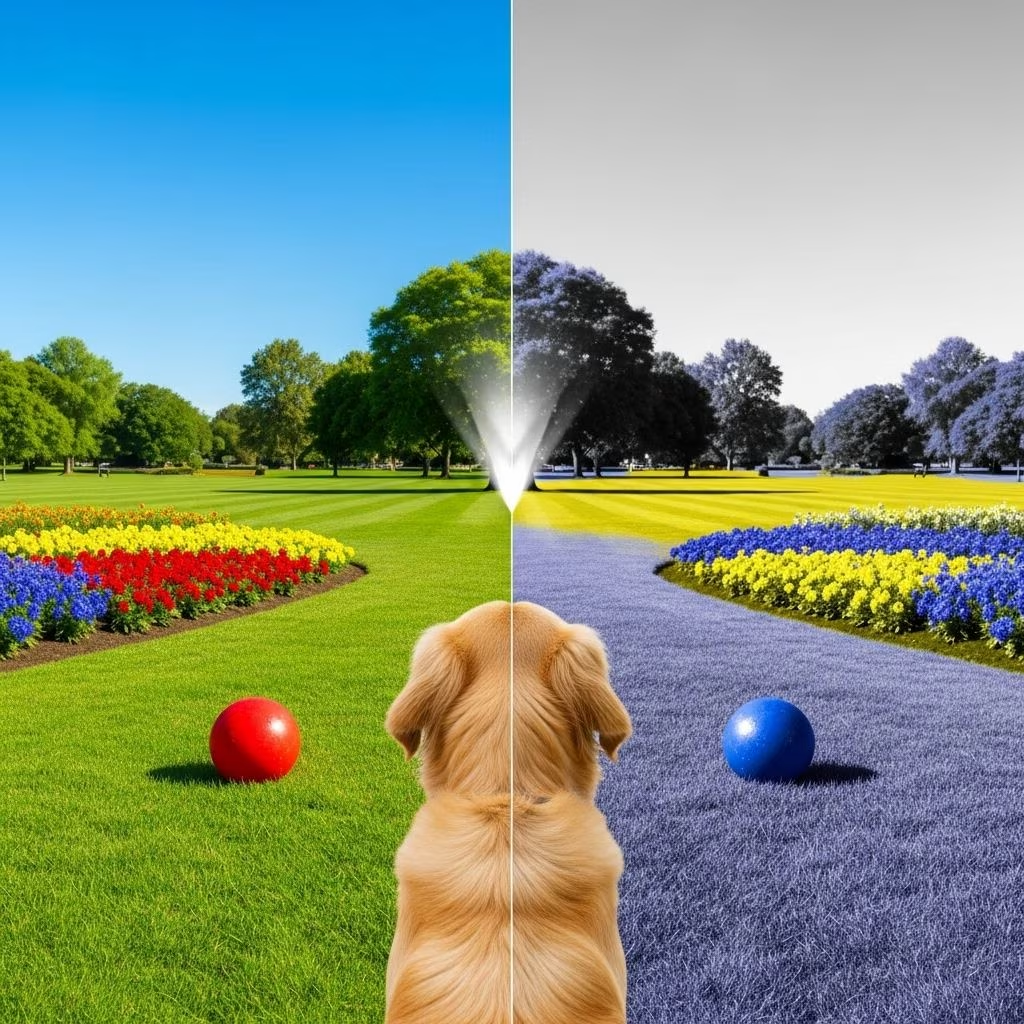
- They cannot easily distinguish red from green; both appear grayish-brown or dark to them.
- This means a bright red or green object, like a toy or a tennis ball on the grass, might “blend” in from your dog’s perspective.
How Does Dog Color Vision Compare to Human Vision?
| Feature | Dogs | Humans |
|---|---|---|
| # of Cone Types | 2 (blue, yellow) | 3 (blue, green, red) |
| Color Perception | Mainly blue and yellow; reds/greens seen as brown/gray | Full spectrum (rainbow) |
| Visual Acuity | Lower (fuzzy or blurry detail) | Higher (crisp detail) |
| Motion Detection | Very good, especially in dim light | Good, but less specialized for low light |
Summary: Dogs see a world with fewer, muted colors—primarily blues and yellows—with a strong ability to detect motion and see in dimmer lighting.
What Colors Can Dogs Actually See?
Research confirms dogs best perceive colors in the blue-violet and yellow ranges. Visualize their visible spectrum as follows:
- Blue: Looks blue to dogs.
- Yellow: Looks yellow to dogs.
- Purple: Appears much like blue (since purple contains blue wavelengths).
- Red, Orange, Green: All appear as muted, grayish, or brownish tones—difficult to distinguish from one another.
A blue tennis ball really stands out against the grass, but a red or green one might almost “disappear” for your pup.
Why the Difference?
This dichromatic vision likely evolved because dogs’ ancestors needed to hunt and detect movement more than they needed colorful detail. Their vision is tuned for tracking moving objects, especially at dawn or dusk when color perception would matter less than contrast and shape.
How Scientists Discovered Dog Color Vision
Early assumptions held that dogs could only see in grayscale, but modern research using behavioral tests has changed this understanding dramatically. Key points from scientific studies:
- Dogs were trained to recognize and select colored panels in exchange for food rewards.
- Tests controlled for brightness differences, proving dogs were responding to color, not simply lighter or darker shades.
- Results showed dogs chose colors (like blue or yellow) over differences in brightness—they notice hue even when shades are similar in darkness or lightness.
One behavioral study used versions of the Ishihara color blindness test (commonly used for humans), and dogs performed similarly to humans with red-green color blindness. This demonstrates just how closely a dog’s color perception mirrors human deuteranopia.
Common Myths About Dog Vision
- Myth: Dogs only see black and white.
This has been disproven—dogs do see some colors, though their range is limited to mostly blue and yellow. - Myth: Dogs can’t see in the dark.
While not true night vision, dogs’ eyes are adapted for low-light and motion, making them much better at seeing in dim conditions than humans. - Myth: Dogs have poor eyesight overall.
While their vision is less sharp (think “fuzzy” details), dogs are extremely good at picking up movement and navigating using contrast rather than fine detail or rich color.
How Dogs Use Color Vision in Daily Life
Even though dogs see fewer colors:
- They rely on color cues over brightness when distinguishing between objects, especially in natural daylight.
- Color helps them in tasks like fetching toys, locating treats, and navigating environments.
- Dogs’ preference for color vs. brightness can change depending on the circumstance—if there’s a strong color difference, they’ll use it, but with subtle hues, they may rely on contrast instead.
Tips for Dog Owners: Choosing Colors Your Dog Can See
Understanding a dog’s color vision can help you make better choices for toys, gear, and even your home:
- Pick blue or yellow toys: These stand out best to your dog, especially during outdoor play.
- Avoid red or green toys on the grass: They’ll be almost impossible for your dog to distinguish from the ground.
- Use color contrast: If you want your dog to find something easily, place it on a background with contrasting colors your dog can see (for example, a blue ball on brown dirt).
- Training and agility: Use blue or yellow markers, tunnels, and obstacles for canine sports—they’re easier for dogs to spot and follow.
Dog Vision Beyond Color: Other Superpowers
Dogs are more than just their perception of color. Their sense of vision is specially adapted for their needs:
- Superior motion detection: Dogs can pick up even the slightest movement, especially at a distance or in low light conditions.
- Night vision: While not as advanced as nocturnal creatures, dogs have a tapetum lucidum—a reflective layer behind the retina increasing their ability to see in dim light.
- Wide field of view: Depending on the head shape and breed, dogs can see more of their surroundings at once compared to humans.
Visualizing the Dog’s Color Spectrum
If you imagine the world through a dog’s eyes, picture a landscape painted with shades of blue, yellow, and gray. Greens, oranges, and reds merge into muted, earthy tones. This doesn’t mean their lives are dull—on the contrary, dogs process far more information through scent, motion, and sound than color.
FAQs: Dog Color Vision
Q: Do dogs see in black and white?
A: No. Dogs see some color, primarily dating from blue-violet to yellow ranges.
Q: What’s the best color for dog toys?
A: Toys that are blue or yellow are most visible and easiest for your dog to find, especially on grass or in the outdoors.
Q: Can dogs see red?
A: Not distinctly—red appears as dark gray or brown to dogs. Red and green are often indistinguishable from each other.
Q: Are any dog breeds able to see more colors?
A: No. All dogs studied so far have two kinds of cone cells and, no matter the breed, share the same basic dichromatic vision.
Q: Do dogs prefer bright objects or colorful objects?
A: Recent research shows that, if given the choice between an object’s color and its brightness, dogs commonly rely on color—especially when the difference is quite pronounced.
Q: How can I make my home visually comfortable for my dog?
A: Use blue or yellow bedding and toys, and keep commonly used items in colors your dog sees best. Ensure contrast in your yard or play area for anything you want your dog to find easily.
Final Thoughts: Seeing the World as Your Dog Does
Dogs perceive the world differently from us, but there’s vibrant beauty in their version of it. By understanding their limited—but not black-and-white—color vision, we can enrich their lives with color choices that match their view. Whether picking out a new toy, setting up training obstacles, or just imagining a backyard game of fetch, now you know which colors your faithful companion actually sees best.
References
- https://pmc.ncbi.nlm.nih.gov/articles/PMC5717654/
- https://pmc.ncbi.nlm.nih.gov/articles/PMC3730601/
- https://www.smithsonianmag.com/science-nature/new-study-shows-that-dogs-use-color-vision-after-all-13168563/
- https://www.livescience.com/34029-dog-color-vision.html
- https://ophthalmology.washington.edu/news/can-dogs-see-color-the-truth-behind-your-pets-eyesight
- https://www.apexvetop.com/blog/taking-a-closer-look-at-canine-vision