


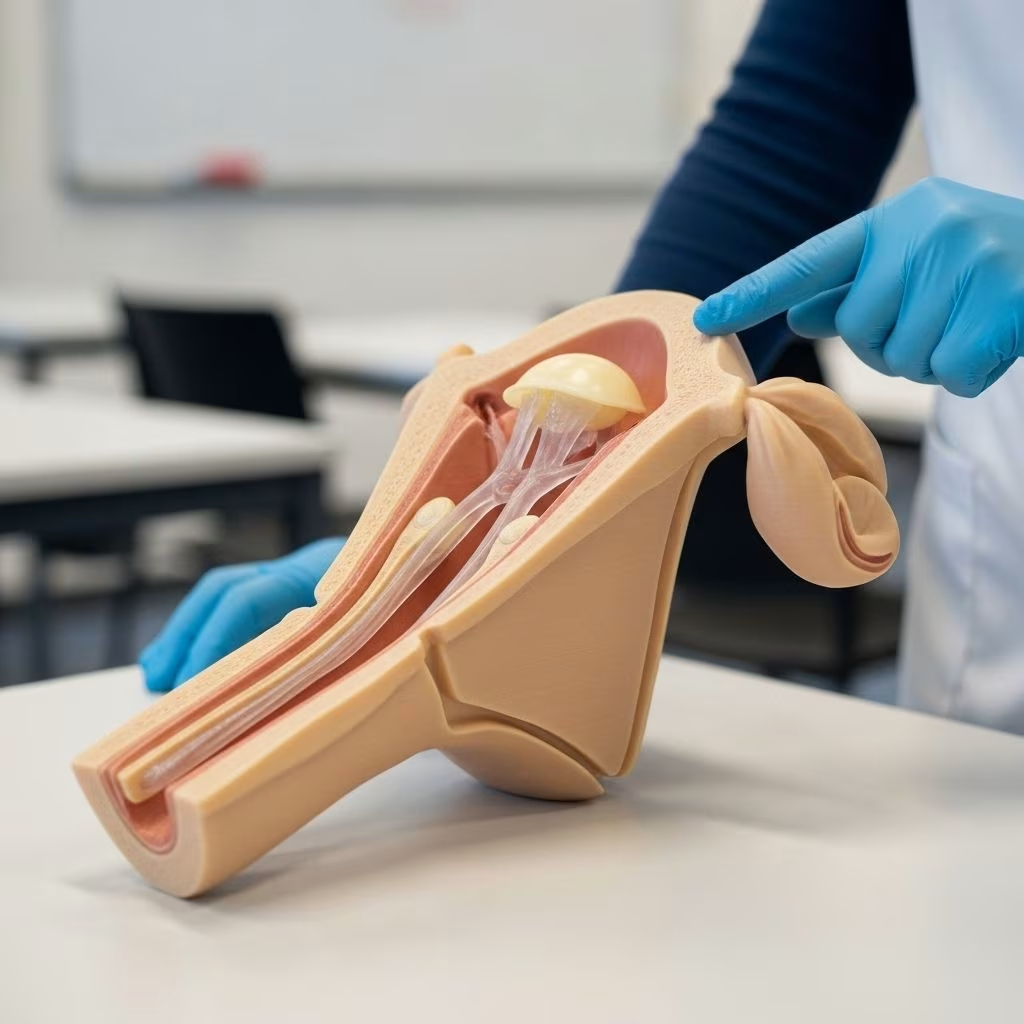
French Schools Revolutionize Sex Education With a 3D-Printed Clitoris
In a groundbreaking move, French schools have adopted a 3D-printed model of the clitoris as an essential tool in their sex education curriculum. This shift not only broadens students’ understanding of female anatomy and pleasure, but also challenges longstanding taboos and gender biases that have persisted in educational settings for generations.
Why a 3D-Printed Clitoris Is Making Headlines
Sex education has often focused on reproduction, contraception, and the male orgasm, relegating the topic of female pleasure—and the clitoris in particular—to the academic sidelines. By integrating a 3D model into classrooms, France is forcing a vital shift in how young people understand women’s sexual health, autonomy, and equality.
- Most sex ed programs emphasize reproductive health and male anatomy, often neglecting the clitoris.
- Recent surveys and gender equality reports have criticized French sex education as ‘sexist’ and incomplete.
- Taboos around teaching female anatomy and pleasure can perpetuate misinformation and reinforce gender inequalities.
Bringing Female Pleasure Into the Curriculum
The association between female sexuality and taboo has led to a culture in which young women, and society at large, know shockingly little about the functions and structure of the clitoris. Odile Fillod, a French researcher and science communicator, pioneered the movement to change this reality by designing an anatomically accurate, 3D-printed clitoris model specifically for classroom use.
According to Fillod, textbooks traditionally depict the clitoris as a tiny, bean-like structure, while in reality, it is a much larger and more complex organ that is primarily internal. Her 3D-printed model is life-sized, anatomically precise, and freely available to educators under a Creative Commons license.
The Flaws of Traditional Sex Education
- Sex ed often ignores or misrepresents female anatomy, focusing on men’s sexual function and pleasure.
- In many textbooks, the clitoris is depicted simplistically or omitted.
- French sex education was officially evaluated as ‘poor’ by gender equality councils.
- The lack of clitoral education perpetuates sexual inequality and misinformation.
The Purpose of the 3D Model
- Visualization: Helps students and teachers clearly understand the true structure and size of the clitoris.
- Accessibility: The 3D file is open-source, so any educator can download and print the model.
- Confronting cultural taboos: The tactile, 3D model makes it easier to initiate discussions around female sexual health.
- Inclusivity: Encourages conversations on LGBTQ+ issues, consent, and sexual equality in the classroom.
How the 3D-Printed Model Was Created
Odile Fillod developed the model with the support of the Fab Lab at the Cité des Sciences et de l’Industrie in Paris, one of Europe’s largest science museums. Fillod worked with designer Mélissa Richard to turn her sketches and research into a life-sized, anatomically correct 3D model. The pair made sure the model showed the entire structure, including the clitoral bulbs—components often absent from medical diagrams and schoolbooks.
The finished model was shared under a Creative Commons license, available to:
- School teachers
- Sex educators
- Therapists and health professionals
The model’s digital files are easily accessible, and some classes have already adopted them as central teaching aids.
The Design and Impact
| Feature | Benefit |
|---|---|
| Anatomically Correct | Provides accurate scientific education |
| Life-sized | Counteracts the depiction of the clitoris as simply a ‘tiny bean’ |
| Tactile 3D Form | Students learn better through touch and visual manipulation than via static 2D images |
| Open Source | Available to educators worldwide for free |
Challenges and Barriers: Why Is the Clitoris Overlooked?
Despite its importance, the clitoris has been ignored by both biology textbooks and sex-ed curricula for several reasons.
- A focus on reproduction inherently centers male orgasm and anatomy.
- The clitoris, being mostly internal, is less visible and harder to explain using standard diagrams.
- Social taboos and stigmas perpetuate silence and shame about female pleasure.
According to Fillod and other reformers, such absences reinforce the outdated notion that “practices not involving an erect penis are not ‘real’ sex.” This contributes to a culture where women’s pleasure is sidelined, and young women are less empowered to understand and enjoy their own bodies.
The Wider Impact on Gender Equality
The introduction of the 3D-printed clitoris is not merely a leap forward for health and anatomy lessons—it’s a catalyst for broader social progress. By demystifying the clitoris, French educators are:
- Advancing gender equality by asserting that female pleasure and anatomy are as important as male biology.
- Disrupting sexist stigmas by breaking the silence around women’s sexual health.
- Combating misinformation that supports sexual inequality and lack of confidence among young women.
- Encouraging healthy discussion about consent, diversity, and sexual well-being for all genders.
Fillod points out that a better understanding of the clitoris can help young women feel more body-confident and sexually autonomous—not just in France, but globally.
International Comparisons and the Future of Sex Education
France is not alone in trying to modernize sex education, but it is one of the first countries to physically integrate a 3D-printed model of the clitoris into its curriculum.
- In countries like the Netherlands, sex education begins as early as preschool, emphasizing consent, respect, and equality.
- Contrasting policies in some U.S. states still struggle to discuss female anatomy openly; there have even been cases where teachers were reprimanded for using terms like ‘vagina’ in class.
- French reforms are being closely watched by educators and advocates around the world.
The shift is about more than biology: it is about instilling an equitable, healthy, and shame-free understanding of sexuality from a young age.
Recent Movements: Beyond the Classroom
Grassroots campaigns and art collectives in France have also joined the “pro-clit” movement. For instance, the art collective Les Infemmes created a fanzine called L’antisèche du clito (“the cheat sheet of the clit”), featuring playful and educational illustrations. Such efforts underline the importance of cultural as well as curricular shifts in tackling misinformation and taboo.
Frequently Asked Questions (FAQs)
Q: What is the purpose of a 3D-printed clitoris in sex education?
A: It provides a clear, tangible model to teach students about the accurate anatomy and function of the clitoris, focusing attention on female pleasure and anatomy, topics historically neglected in education.
Q: Who developed the 3D clitoris model, and how can schools access it?
A: The model was developed by French researcher Odile Fillod and designer Mélissa Richard. It is available under a Creative Commons license, meaning any educator or therapist can freely download and print it.
Q: Why has sex education traditionally ignored the clitoris?
A: Traditional sex education centers reproduction, which historically spotlights male anatomy and orgasm. Further, the clitoris is largely internal and subject to social taboos, making it more likely to be left out of diagrams and discussion.
Q: What impact is this change having in France?
A: Early reports indicate that the inclusion of the 3D-printed clitoris is empowering young women, challenging gender stereotypes, and facilitating more inclusive, comprehensive discussions about sex and pleasure in French classrooms.
Q: Can other countries use the same approach?
A: Yes, because the 3D model is open source, any country or educator can adopt and adapt this resource, paving the way for a new standard in global sex education.
Conclusion: A Model for the Future
By bringing the 3D-printed clitoris into classrooms, French schools are challenging taboos, correcting centuries of anatomical misrepresentation, and advancing gender equality. This innovation not only improves scientific understanding but also helps to cultivate confidence, respect, and inclusivity for future generations.
As more educators around the world consider adopting France’s model, hope grows that shame and misinformation will be replaced by knowledge, equality, and respect.
References
- https://www.mic.com/articles/151725/schools-in-france-will-now-use-a-3d-clitoris-model-in-sex-ed-courses
- https://www.vice.com/en/article/talking-to-the-woman-who-designed-a-3d-printed-clitoris-876/
- https://www.attn.com/stories/10772/france-adds-3d-printed-clitoris-sex-ed-classes
- https://www.sculpteo.com/blog/2017/03/08/3d-printing-and-education-3d-printed-clitoris-by-odile-fillod/
- https://www.3dprintersbay.com/3d-printed-clitoris-for-sex-educations
- https://www.plasticstoday.com/3d-printing/how-a-3d-printed-clitoris-is-bringing-gender-equality-to-french-classrooms


