


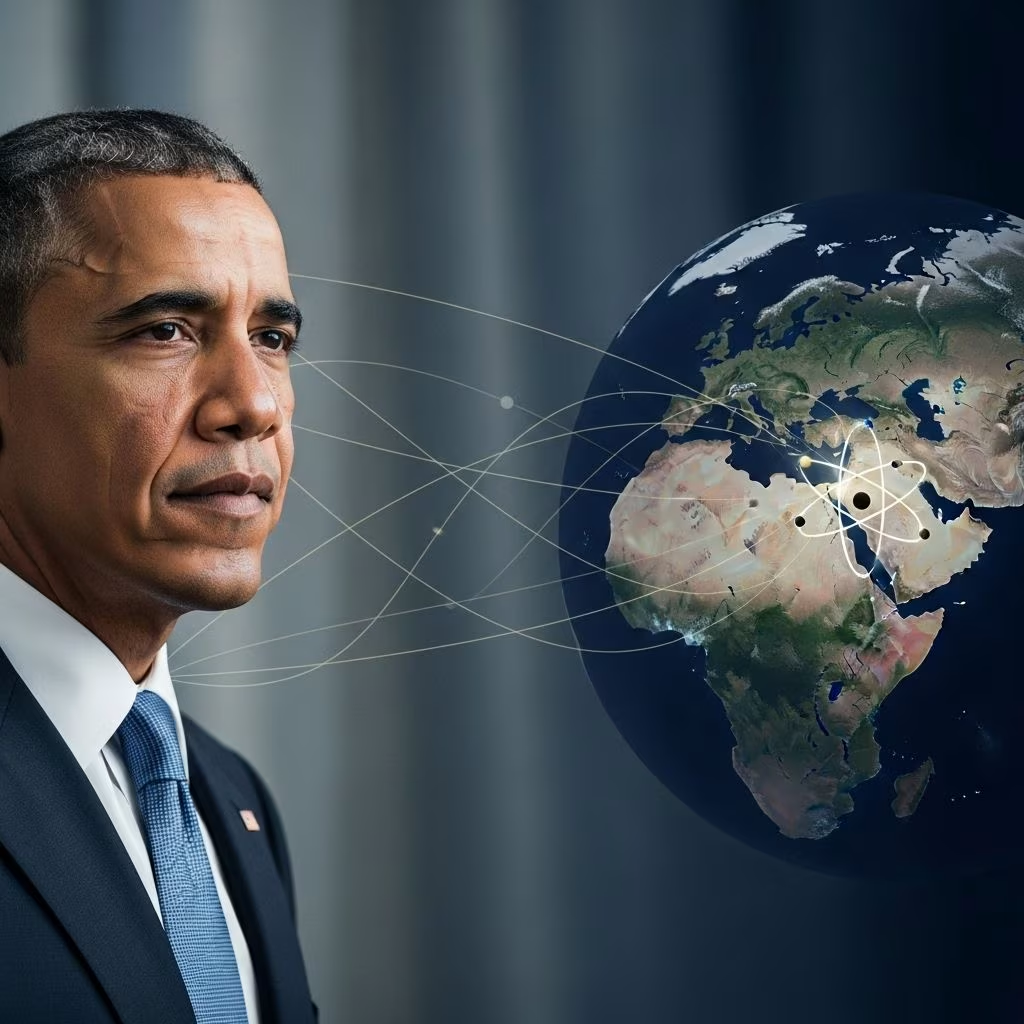
President Obama and the Iran Nuclear Deal: A Turning Point in Global Diplomatic Relations
In July 2015, President Barack Obama announced a landmark nuclear agreement with Iran, formally known as the Joint Comprehensive Plan of Action (JCPOA). This deal, reached after marathon negotiations between Iran and the P5+1 (the United States, United Kingdom, France, Russia, China, and Germany), aimed to prevent Iran from developing nuclear weapons in exchange for lifting significant economic sanctions. The agreement was not just a technical arms control pact; it was a diplomatic breakthrough that aimed to redefine U.S.-Iran relations and shift global dynamics around nuclear non-proliferation and Middle Eastern security.
The Iran Nuclear Deal: Meaning and Significance
The Iran nuclear deal was designed to constrain Iran’s ability to develop nuclear weapons while offering it relief from harsh international sanctions. President Obama positioned the agreement as a diplomatic alternative to war, emphasizing that the world had a “once-in-a-lifetime opportunity” to peacefully resolve one of the most dangerous security issues facing the international community.
- Preventing a nuclear Iran: The primary objective was to verifiably prevent Iran from obtaining a nuclear weapon.
- Opening dialogue: The deal aimed to show that adversaries could resolve complex disputes through negotiation and compromise.
- A new era of engagement: Obama argued that the agreement could serve as a foundation for a broader reintegration of Iran into the international community, potentially improving relationships with the U.S. and beyond.
“This deal demonstrates that American diplomacy can bring about real and meaningful change — change that makes our country, and the world, safer and more secure.”
– President Barack Obama, July 14, 2015
Negotiations and Context
The process leading to the nuclear deal began in 2013, building on years of tension between Iran and the West regarding Iran’s nuclear ambitions. The negotiations were complex, involving technical, political, and regional security considerations.
- International efforts: The United States worked side-by-side with the other P5+1 countries, demonstrating rare global cooperation.
- Previous containment failures: Sanctions and isolation had failed to halt Iran’s nuclear progress, which brought the world closer to potential conflict.
- Breakthrough after decades: The 20-month negotiation began with the Joint Plan of Action in 2013 and culminated in the final JCPOA agreement in July 2015.
Obama and Secretary of State John Kerry pursued the talks amid opposition at home and skepticism abroad, arguing that a negotiated solution was the only viable way to verifiably cap Iran’s nuclear program.
Key Terms and Provisions of the JCPOA
The JCPOA imposed strict, enforceable limitations on Iran’s nuclear program in exchange for phased relief from international sanctions. Its main provisions included:
- Uranium enrichment limits: Iran agreed to reduce its enriched uranium stockpile by 97% and limit enrichment to no more than 3.67% for 15 years (far below weapons-grade levels).
- Centrifuge reduction: Iran was required to dismantle two-thirds of its installed centrifuges, leaving only about 5,000 for research and civilian energy.
- Arak reactor redesign: The heavy-water reactor at Arak, capable of producing plutonium, was reconfigured so it could not yield weapons-grade plutonium.
- Inspections and verification: The International Atomic Energy Agency (IAEA) was granted “unprecedented access” to Iranian facilities for ongoing monitoring, including continuous surveillance at key sites.
- Breakout time: The time needed for Iran to obtain enough fissile material for a bomb increased from as little as 2-3 months to at least 12 months.
- Sanctions relief: In return for compliance, Iran was to receive relief from nuclear-related economic sanctions, unlocking billions of dollars in frozen assets. However, U.S. sanctions related to terrorism, human rights, and missiles remained in place.
- Sunset clauses: Key limits on nuclear activities were set to expire after 10 to 15 years, allowing Iran to gradually expand its peaceful nuclear activities under continued IAEA surveillance.
Comparison Table: Pre-Deal vs. Post-Deal Nuclear Program
| Parameter | Pre-Deal (2015) | Post-Deal (JCPOA, 2016 onward) |
|---|---|---|
| Enriched Uranium Stockpile | 12,000 kg | 300 kg |
| Uranium Enrichment Level | Up to 20% | 3.67% max |
| Centrifuges in Operation | ~19,000 | ~5,000 |
| Arak Reactor | Capable of producing plutonium | Redesigned, no weapons-grade plutonium |
| IAEA Inspections | Limited | Continuous, intrusive |
| Breakout Time | 2–3 months | At least 12 months |
Domestic and International Political Reactions
The announcement of the nuclear deal sparked immediate and passionate responses both within the United States and around the globe.
Supporters’ Perspective
- Diplomacy over war: Supporters hailed the agreement as a diplomatic triumph and a model for resolving international crises peacefully.
- Security enhancement: Many experts, arms control groups, and Democratic lawmakers praised the deal for delaying, and possibly preventing, an Iranian nuclear weapon.
- Obama administration’s stance: The administration argued that the arrangement provided the best available safeguards and that “every pathway” to a bomb was blocked for at least a decade.
Critics’ Concerns
- Sunset provisions: Detractors questioned whether the deal offered only temporary restrictions, warning that Iran might resume nuclear activities after key limits expired.
- Broader behavior: Critics argued that the agreement did not address Iran’s ballistic missile program, sponsorship of militant groups, or regional interventions, which many perceived as destabilizing the Middle East.
- Threat to allies: Israel and Gulf Arab states expressed alarm, fearing the lifting of sanctions would strengthen Iran militarily and economically.
- Congressional skepticism: A majority of Republican lawmakers and some Democrats opposed the deal, warning it did not provide for unrestricted inspections and could make the U.S. an indirect supporter of destabilizing activities.
Notable Political Reactions
| Figure | Position | Comments |
|---|---|---|
| President Barack Obama | Supporter | “Every pathway to a nuclear weapon is cut off.” |
| Prime Minister Benjamin Netanyahu (Israel) | Opponent | Called the deal a “historic mistake” for Israel’s security. |
| Sen. Mitch McConnell | Opponent | Warned of allowing a “dangerous regime” to retain nuclear infrastructure. |
| Centrists like Brent Scowcroft | Supporter | Praised the deal for arms control advancement. |
Implementation and Global Impact
On January 16, 2016, “Implementation Day” arrived as the IAEA certified Iran’s compliance with its initial obligations under the deal. Sanctions were formally lifted, and the strict monitoring and limitations took effect.
The immediate impacts included:
- Verification: The IAEA confirmed that Iran dismantled thousands of centrifuges, shipped out 25,000 pounds of enriched uranium, and altered key reactors.
- Economic relief: Iran regained access to foreign reserves and international markets, helping to boost its stagnating economy.
- Regional shifts: The opening between Iran and the West raised hopes for further diplomacy but fueled anxieties among Iranian rivals.
- U.S. nonproliferation goals: The deal was seen by many in the arms control community as a major step in global nuclear risk reduction.
Deterrence and Ongoing Oversight
- Deterrence commitment: Obama pledged that the U.S. would respond decisively to any Iranian violation, keeping “all options on the table,” including military ones.
- Monitoring: The IAEA was empowered to conduct snap inspections and monitor facilities for 15–25 years.
- Remaining sanctions: Non-nuclear U.S. sanctions, particularly over terrorism and human rights, remained active, keeping pressure on Iran beyond the nuclear file.
Legacy, Critics, and the Future of the Deal
The JCPOA’s legacy remains hotly debated. Supporters highlight its success in rolling back Iran’s nuclear program and opening diplomatic channels, while critics question its limited duration and failure to address broader regional threats.
Trump Withdrawal and Aftermath
- U.S. withdrawal: In May 2018, President Donald Trump withdrew the U.S. from the agreement, arguing it was “the worst deal ever,” and reimposed sweeping sanctions.
- Return to hostilities: The decision triggered a rise in tensions, with Iran incrementally resuming key nuclear activities restricted by the deal.
- Impact on global diplomacy: The move created rifts between the U.S. and its European allies, who continued to support the JCPOA framework.
Expert Viewpoints
- Nonproliferation achievements: Most nuclear experts agree the deal delayed Iran’s weaponization by at least a decade.
- Risks and future challenges: Some analysts argue that sunsetting provisions and unchecked missile development remain problematic.
- Uncertain future: As of 2025, Iran’s nuclear capabilities are closer to weapons-grade than during the JCPOA period, underlining ongoing challenges for nonproliferation.
Supporters continue to argue that the deal exemplifies diplomacy’s potential, while critics urge new, tougher negotiations to fully eliminate Iran’s capacity for weaponization.
Frequently Asked Questions (FAQs)
Q: What was the main goal of the JCPOA?
A: To verifiably block all of Iran’s pathways to a nuclear weapon while offering relief from nuclear-related economic sanctions.
Q: Who were the main participants in the negotiations?
A: Iran and the P5+1 countries: United States, United Kingdom, France, Russia, China, and Germany.
Q: How did the deal affect Iran’s nuclear program?
A: Iran reduced its uranium stocks, dismantled thousands of centrifuges, altered its heavy-water reactor, and submitted to rigorous IAEA monitoring.
Q: Did the deal address Iran’s missile program or regional activities?
A: No, the JCPOA focused exclusively on the nuclear program. Other U.S. sanctions targeting missiles, terrorism, and human rights remained in place.
Q: What happened when the U.S. left the agreement?
A: After the withdrawal, Iran resumed some nuclear activities, tensions escalated in the region, and diplomatic efforts to restore or renegotiate terms have continued.
Q: What is the current status of the Iran nuclear deal?
A: As of 2025, the future of the JCPOA remains uncertain. Some provisions have expired, U.S.-Iran tensions are high, and efforts for a renewed agreement continue.
References
- https://www.politifact.com/article/2025/jun/18/Iran-nuclear-deal-Obama-Trump-Israel/
- https://2009-2017.state.gov/p/nea/p5/index.htm
- https://obamawhitehouse.archives.gov/node/328996
- https://en.wikipedia.org/wiki/Joint_Comprehensive_Plan_of_Action
- https://www.britannica.com/event/Iran-nuclear-deal-negotiations
- https://www.congress.gov/crs-product/IF12106
- https://www.hks.harvard.edu/faculty-research/policy-topics/international-relations-security/explainer-how-united-states-has
- https://www.axios.com/2025/06/13/iran-israel-usa-nuclear-deal-timeline-attack-jcpoa
- https://www.fddaction.org/policy-insights/2025/04/25/the-seven-deadly-sins-of-a-bad-iranian-nuclear-deal/


