


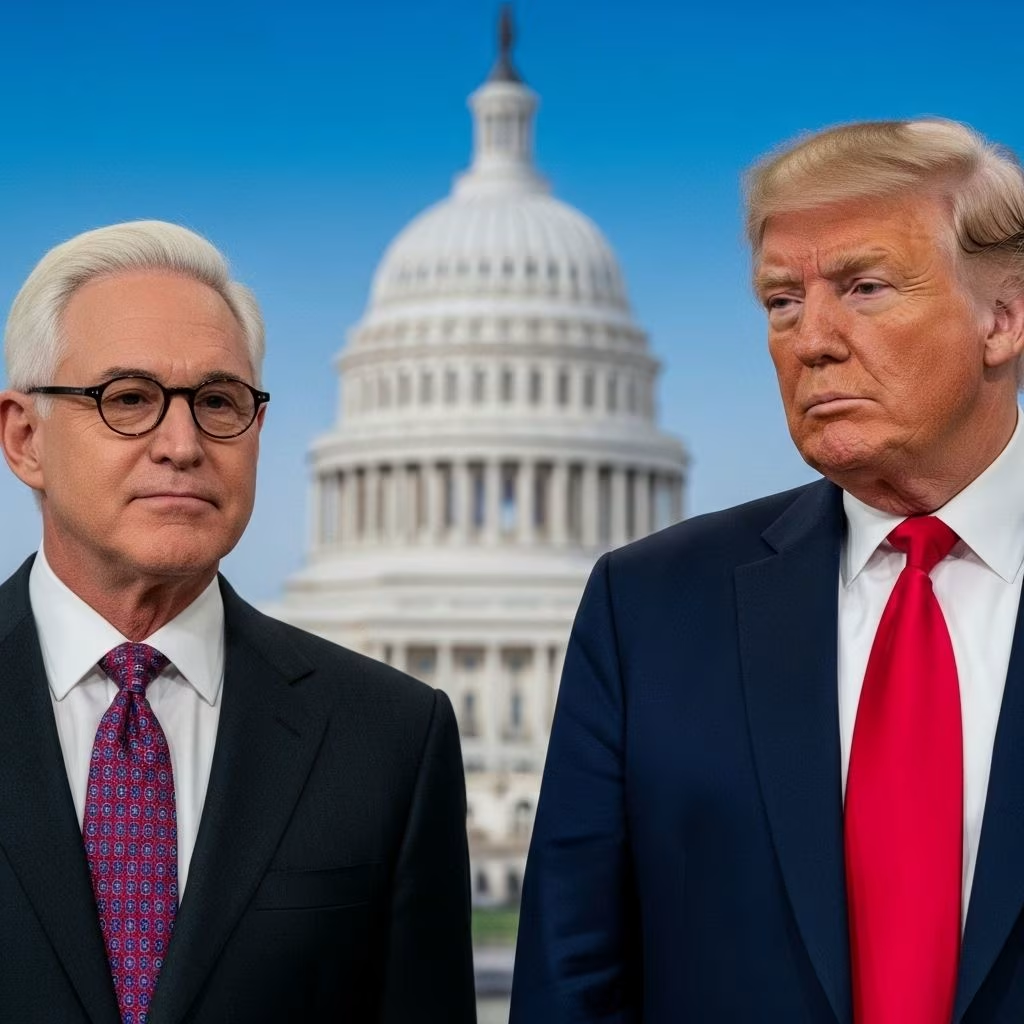
The relationship between Roger Stone and Donald Trump represents one of the most enduring and controversial partnerships in modern American political history. Spanning more than four decades, their alliance has weathered scandals, legal battles, and public scrutiny while fundamentally shaping the trajectory of American politics. Understanding this connection requires examining the origins of their friendship, the political strategies they employed together, and the ultimate consequences of their loyalty to one another.
The Origins of a Political Partnership
The story of Roger Stone and Donald Trump begins in the glittering world of 1980s New York, where power, money, and influence intersected in exclusive social circles. Both men were ambitious figures carving out their respective empires—Trump in real estate and Stone in political consulting. Their paths crossed naturally, as Stone had already established himself as a notorious political operative known for his ruthless tactics and flamboyant style.
Stone’s reputation preceded him in Republican circles. He had worked on Richard Nixon’s 1972 re-election campaign and later became a partner in the influential lobbying firm Black, Manafort, and Stone. His approach to politics was unapologetically aggressive, embracing what he called “stone’s rules” of political warfare. Trump, meanwhile, was building his brand as a real estate mogul and cultivating a public persona that would later prove invaluable in his political career.
The professional relationship between the two men solidified in the 1990s when Stone worked as a lobbyist for Trump’s casino interests. This was more than a typical client-consultant arrangement; it was the beginning of a mutual admiration society. Stone recognized Trump’s unique ability to command media attention and understood the potential political capital in Trump’s celebrity status. Trump, in turn, appreciated Stone’s political acumen and willingness to employ unconventional tactics to achieve desired outcomes.
Planting the Seeds of Political Ambition
Roger Stone wasn’t content with Trump remaining solely in the business world. As early as 1988, Stone began encouraging Trump to consider running for political office. While Trump didn’t take the leap that year, the idea had been planted. Stone continued nurturing Trump’s political ambitions throughout the 1990s, recognizing qualities in the real estate magnate that others overlooked—his media savvy, his ability to connect with certain segments of the American public, and his willingness to challenge political norms.
In 2000, Trump established a presidential exploratory committee, with Stone playing a key advisory role. Though this effort ultimately didn’t result in a full campaign, it served as an important testing ground. Trump learned valuable lessons about the political landscape, media engagement, and public messaging. Stone’s influence during this period cannot be overstated; he was essentially grooming Trump for the political stage, teaching him the unwritten rules of political combat while encouraging him to break the written ones.
Throughout the early 2000s, as Trump’s television career flourished with “The Apprentice,” Stone remained in the background, maintaining their friendship and continuing to discuss political possibilities. The show inadvertently became perfect preparation for a future campaign, allowing Trump to build name recognition and cultivate an image as a decisive leader who wasn’t afraid to say “you’re fired.”
The 2016 Campaign and Stone’s Role
When Trump announced his presidential campaign in June 2015, Roger Stone was naturally part of the team. However, their official working relationship was short-lived. By August 2015, Stone was no longer formally associated with the campaign, though the circumstances remain disputed. Trump claimed he fired Stone, while Stone insisted he resigned due to disagreements over campaign strategy. The truth likely lies somewhere in between, reflecting the complex dynamics of their relationship.
What’s undeniable is that Stone’s departure from the official campaign didn’t end his involvement or influence. He remained a vocal Trump supporter, defending the candidate on television and through social media. Stone’s unofficial status may have even provided advantages, allowing him to operate without the constraints and scrutiny that came with being an official campaign adviser. He could be more aggressive, more provocative, and more willing to push boundaries without directly implicating the campaign.
During this period, Stone made numerous claims about having knowledge of forthcoming WikiLeaks releases, including hacked emails from the Democratic National Committee and Hillary Clinton’s campaign chairman, John Podesta. These assertions would later become central to investigations into Russian interference in the 2016 election. Stone suggested he had a “back-channel” to WikiLeaks founder Julian Assange, though he later modified these claims, saying his information came through intermediaries.
The Mueller Investigation and Legal Troubles
The 2016 election’s aftermath brought intense scrutiny to the Trump campaign’s potential connections to Russian interference efforts. Special Counsel Robert Mueller’s investigation cast a wide net, examining various individuals who had been associated with the campaign. Roger Stone became a key figure in this investigation, with prosecutors believing he might represent a link between the Trump campaign and WikiLeaks, which intelligence agencies assessed was disseminating material obtained through Russian hacking operations.
In January 2019, in a dramatic pre-dawn raid that Stone claimed was excessive and designed for maximum publicity, FBI agents arrested him at his Florida home. He was indicted on seven counts, including obstruction of an official proceeding, making false statements to Congress, and witness tampering. The charges centered on his testimony before the House Intelligence Committee about his efforts to obtain information about hacked Democratic emails and his communications with Trump campaign officials.
The evidence against Stone was substantial. Prosecutors presented communications showing he had lied about his intermediary to WikiLeaks, had attempted to obstruct the congressional investigation, and had threatened a witness to prevent testimony. Text messages revealed Stone had urged the witness, radio host Randy Credico, to “do a Frank Pentangeli,” referencing a character in “The Godfather Part II” who lies to Congress to protect the Corleone family.
Trial, Conviction, and Sentencing Controversy
Roger Stone’s trial in November 2019 became a media spectacle, fitting for a man who had spent his career in the spotlight. The prosecution’s case relied heavily on documentary evidence—emails, text messages, and Stone’s own public statements. Stone’s defense argued he had simply engaged in political hyperbole and hadn’t actually lied or obstructed justice. The jury disagreed, convicting him on all seven counts.
The sentencing phase created its own controversy. Federal prosecutors initially recommended a sentence of seven to nine years, following standard sentencing guidelines for the crimes Stone was convicted of committing. However, President Trump publicly criticized this recommendation on Twitter, calling it “horrible” and “very unfair.” Shortly afterward, the Department of Justice issued a revised sentencing memo suggesting the initial recommendation was “excessive” and “unwarranted.”
This intervention sparked immediate controversy and allegations of political interference in the justice system. All four prosecutors who had worked on Stone’s case withdrew in protest, with one resigning from the Department of Justice entirely. Critics argued this represented an unprecedented politicization of federal prosecutions, with the president using his public platform to influence sentencing decisions involving a close associate. The judge ultimately sentenced Stone to 40 months in prison, along with two years of supervised release and a $20,000 fine—significantly less than the original recommendation but still substantial.
The Commutation: Loyalty Rewarded
On July 10, 2020, just days before Stone was scheduled to report to prison, President Trump granted him a full commutation. This wasn’t a pardon—it didn’t erase the conviction—but it eliminated all punishment. The 40-month prison sentence, the supervised release, the fine, and the community service hours all disappeared with a stroke of Trump’s pen.
Trump’s justification for the commutation centered on his view that Stone had been treated unfairly, caught up in what he consistently called a “witch hunt” investigation. The president argued the Mueller probe was illegitimate from its inception and that Stone’s prosecution was politically motivated. Trump praised Stone’s refusal to provide testimony against him, a quality that aligned perfectly with Trump’s well-documented emphasis on loyalty.
The commutation generated significant criticism, even from some Republicans. Senator Mitt Romney called it “unprecedented, historic corruption,” while Senator Pat Toomey termed it a “mistake.” Critics pointed out that Stone hadn’t expressed remorse for his crimes, hadn’t cooperated with investigators, and had continued to attack the judicial process throughout his trial and sentencing. They argued the commutation sent a dangerous message: that political allies of the president could commit crimes to protect him and expect clemency in return.
The Loyalty Dynamic
To understand Trump’s decision to commute Stone’s sentence, one must understand the president’s value system. Throughout his business career and presidency, Trump has consistently prioritized personal loyalty above nearly all other qualities. In his books, including “Trump: The Art of the Deal,” this theme recurs repeatedly. Trump divides the world into loyalists and enemies, rewarding the former and attacking the latter.
Roger Stone epitomizes the type of loyalty Trump values. For decades, Stone championed Trump’s political ambitions, even when others dismissed them as vanity projects. He remained publicly supportive during the 2016 campaign, even after leaving the official team. Most importantly, throughout the Mueller investigation and his own prosecution, Stone refused to cooperate against Trump. He didn’t “flip,” in the parlance Trump often uses, maintaining his silence about whatever conversations or knowledge he might have had regarding the campaign’s activities.
This loyalty wasn’t without its rewards beyond the commutation. Stone maintained access to Trump throughout the presidency, reportedly speaking with him regularly. Their friendship endured despite the legal troubles, with Trump repeatedly defending Stone publicly and privately expressing his belief that Stone was being persecuted for his association with the president.
Legal and Constitutional Implications
The Stone commutation raised important questions about presidential clemency powers and their proper use. The Constitution grants presidents broad authority to issue pardons and commutations, with very few limitations. However, this power has traditionally been exercised with some restraint, often following recommendations from the Department of Justice’s Office of the Pardon Attorney and typically after convicted individuals have served substantial portions of their sentences and demonstrated rehabilitation.
Trump’s approach to clemency broke from these norms in several ways. He rarely followed the traditional clemency process, instead responding to personal appeals, media advocacy, or recommendations from allies. His clemency decisions often benefited individuals connected to him personally or politically. Stone’s commutation fit this pattern perfectly—it came without a formal clemency petition, before Stone had served any time, and directly benefited someone who had refused to cooperate in an investigation of the president.
Legal scholars debated whether such use of clemency power, while technically legal, could constitute an abuse of power or even obstruction of justice. If a president can effectively reward associates for refusing to cooperate with criminal investigations, does this undermine the justice system’s ability to investigate presidential wrongdoing? These questions remain largely unresolved, though they highlight tensions between presidential prerogatives and the rule of law.
Stone’s Continued Influence
Following his commutation, Roger Stone didn’t retreat from public life. He remained active on social media, continued giving interviews, and maintained his role as a Trump defender and conservative provocateur. His presence in Trump’s orbit demonstrated that their relationship had survived yet another controversy, perhaps even strengthened by the ordeal.
Stone’s influence on Trump’s political approach remains evident in the confrontational style, the willingness to challenge political norms, and the emphasis on media manipulation that characterized Trump’s presidency and continues in his post-presidential activities. Stone pioneered many of the tactics that Trump successfully employed—personal attacks on opponents, inflammatory rhetoric designed to generate media coverage, and a refusal to apologize or back down from controversial statements.
The Broader Context of Trump’s Clemency Actions
Stone’s commutation wasn’t an isolated incident but part of a broader pattern of controversial clemency decisions during Trump’s presidency. Trump pardoned or commuted sentences for numerous individuals connected to his political orbit, including former campaign chairman Paul Manafort, former national security adviser Michael Flynn, and former White House strategist Steve Bannon. This pattern reinforced concerns about a two-tiered justice system where political connections provided protection from legal consequences.
Critics argued these actions demonstrated Trump’s willingness to use presidential powers to protect himself and his allies, prioritizing personal loyalty over impartial justice. Supporters countered that Trump was correcting injustices and protecting individuals who had been targeted for their political associations. This debate reflected deeper divisions about Trump’s presidency and his approach to governing.
Frequently Asked Questions
Q: How long have Roger Stone and Donald Trump known each other?
A: Roger Stone and Donald Trump have known each other since the 1980s, with their relationship spanning more than four decades. They moved in the same professional and political circles in New York, and Stone worked as a lobbyist for Trump’s casino interests in the 1990s.
Q: What crimes was Roger Stone convicted of?
A: Roger Stone was convicted on seven counts, including obstruction of an official proceeding, five counts of making false statements to Congress, and witness tampering. These charges stemmed from his testimony about his efforts to obtain information about hacked Democratic emails during the 2016 campaign.
Q: Did Trump pardon Roger Stone or commute his sentence?
A: Trump commuted Stone’s sentence in July 2020, which eliminated all punishment including the 40-month prison term, supervised release, and fines. This was different from a pardon, which would have erased the conviction itself. Trump later granted Stone a full pardon in December 2020.
Q: Why was Roger Stone’s sentencing controversial?
A: The controversy arose when federal prosecutors initially recommended a 7-to-9-year sentence, but after President Trump publicly criticized this as unfair, the Department of Justice revised its recommendation downward. All four prosecutors on the case withdrew in protest, citing improper political interference in the sentencing process.
Q: What role did Roger Stone play in Trump’s political career?
A: Stone was instrumental in encouraging Trump to pursue politics, first suggesting he run for office in 1988. He advised Trump during his 2000 exploratory committee and was part of the early 2016 campaign team. Even after leaving the official campaign, Stone remained a vocal Trump supporter and informal adviser, helping shape Trump’s confrontational political style.


