


Alpha Particles and Alpha Radiation: Structure, Sources, and Impact
Alpha particles and alpha radiation play a pivotal role in the understanding of nuclear physics, radioactivity, and the technological applications of radiation. This article explores their structure, behavior, origins, and effects—ranging from scientific discovery to implications for human health and the cosmos.
What Are Alpha Particles?
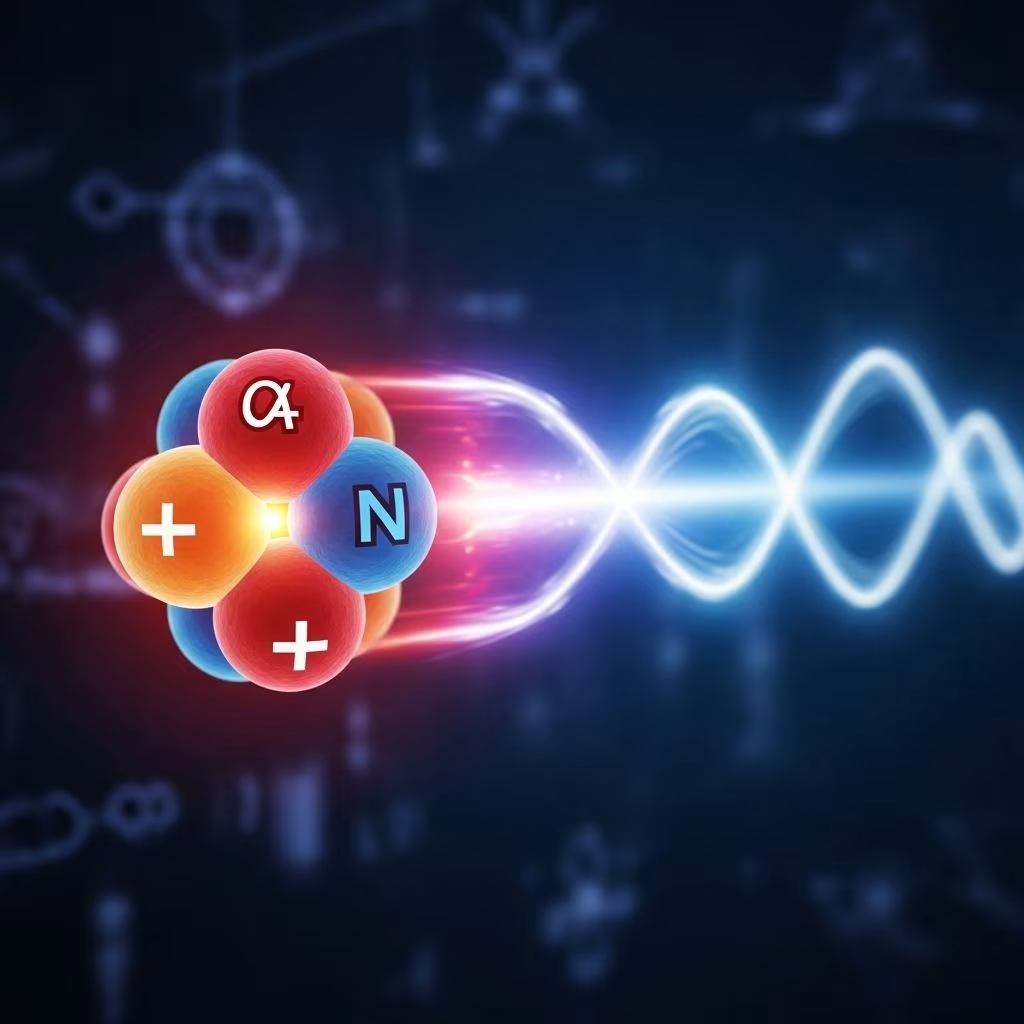
Alpha particles (also known as alpha rays or alpha radiation) are subatomic particles made up of two protons and two neutrons bound together. They are identical to the nucleus of a helium-4 atom, carrying a +2 electric charge, denoted by the symbols α, α2+, or He2+.
- Composition: 2 protons + 2 neutrons (mass number 4, charge +2)
- Symbol: α, α2+, He2+
- Spin: 0 (bosonic)
- Mass: ~4.0015 atomic mass units (amu)
| Property | Value |
|---|---|
| Composition | 2 protons, 2 neutrons |
| Symbol | α, He2+ |
| Mass | ~6.64 × 10⁻²⁷ kg (~4.0015 amu) |
| Charge | +2e |
| Spin | 0 |
When an alpha particle slows down and captures two electrons, it becomes a normal helium atom.
Discovery of Alpha Radiation
The study of alpha particles dates back to the late 19th and early 20th centuries, as scientists investigated naturally occurring radioactivity. Pioneers like Ernest Rutherford identified alpha radiation as a type of emission distinct from beta and gamma rays, noting its low penetration power and strong ionizing ability.
- 1899: Ernest Rutherford distinguishes alpha and beta radiation.
- 1908: Alpha particles are confirmed to be helium nuclei.
- Early 20th century: Alpha scattering experiments lead Rutherford to propose the nuclear model of the atom.
Properties of Alpha Radiation
Alpha radiation consists of streams of alpha particles emitted from certain radioactive materials. It is a type of ionizing radiation, capable of knocking electrons from atoms and molecules, thus ionizing them.
- Charge: +2 (high for atomic-scale interactions)
- Kinetic Energy: Typically around 4–8 MeV (million electron volts)
- Velocity: About 4–5% of the speed of light
- Penetration: Very low—stopped by a few centimeters of air, or a sheet of paper
- Ionization: Extremely high—can ionize thousands of atoms per centimeter of air
The high ionizing ability is due to the alpha particle’s double positive charge and its relatively large mass.
Production of Alpha Particles: Alpha Decay
Alpha particles are primarily produced through a process called alpha decay, a type of radioactive decay seen in heavy, unstable nuclei like uranium-238, radium-226, and polonium-210.
In alpha decay, an unstable nucleus ejects an alpha particle, reducing its atomic number by 2 and its mass number by 4:
_{Z}^{A}X → _{Z-2}^{A-4}Y + _{2}^{4}He^{2+}This process transforms one element into another (transmutation), resulting in a daughter nucleus and the emission of an alpha particle.
Sources of Alpha Particles
- Natural radioactive decay:
- Heavy nuclides, such as uranium and thorium, naturally emit alpha particles as they decay
- Radon gas in the environment is a major terrestrial contributor
- Cosmic rays:
- Helium nuclei forming part of cosmic radiation are essentially high-energy alpha particles
- Artificial sources:
- Nuclear reactors and particle accelerators can produce alpha particles at much higher energies
Long-Range Alpha Particles
Certain nuclear reactions, such as ternary fission, produce alpha particles with much higher energy than those from typical alpha decay. These “long-range” alpha particles can travel greater distances before losing energy, although they remain less penetrating than other forms of radiation.
Interaction of Alpha Particles with Matter
As alpha particles travel through matter, they lose energy rapidly due to their high charge and mass, causing extensive ionization along their path. This makes alpha radiation:
- Highly damaging at close range, especially to biological tissue if alpha emitters are ingested or inhaled
- Unable to penetrate external layers, such as human skin or even ordinary paper
Penetration Power Comparison
| Radiation Type | Penetration | Shielding Material |
|---|---|---|
| Alpha (α) | Very Low (stopped by paper/skin) | Paper, clothing |
| Beta (β) | Moderate (stopped by plastic, glass, aluminum) | Plexiglass, aluminum |
| Gamma (γ) | High (requires dense shielding) | Lead, concrete |
Biological Effects and Safety of Alpha Radiation
Externally, alpha particles pose minimal danger as they cannot penetrate the skin. However, if alpha-emitting materials enter the body (by ingestion, inhalation, or open wounds), they can cause significant biological damage. This is due to the local ionization of molecules, which can harm or kill living cells and damage DNA.
- Most concern: Radon gas in air, and alpha-emitting dust or particles that can be inhaled or ingested
- Risks: Lung cancer from inhaling radon; tissue damage if alpha emitters are ingested
- Protection: Avoiding internal contamination is the key safety measure for alpha-emitting materials
Uses and Applications of Alpha Radiation
Despite their dangers if mishandled, alpha particles have several important technological and scientific applications:
- Smoke Detectors:
- Americium-241 emits alpha particles, ionizing the air; smoke disrupts the ion current, triggering the alarm
- Medical Treatments:
- Alpha emitters can be used in targeted radiotherapy, particularly for treating certain cancers
- Scientific Research:
- Alpha particles were central to the gold foil experiment that revealed the structure of the atomic nucleus
- Used as probes in fundamental nuclear physics research
- Space Exploration:
- Alpha spectrometers on lunar and planetary missions analyze composition by detecting elements that emit alpha particles
Alpha Particles in Space: Cosmic Rays
About 10–12% of cosmic rays are helium nuclei—functionally high-energy alpha particles. These travel through space at nearly the speed of light, with energies much higher than those produced by radioactive decay. They are a significant component of the space environment and can, at high energies, penetrate substantial shielding, making them a concern for both astronaut safety and spacecraft electronics.
- Sources: Stellar explosions, cosmic ray acceleration processes
- Impact: May traverse the human body and dense materials at high energies
Alpha Particles, Nuclear Science, and the Evolution of Physics
The study of alpha particles was crucial in the development of modern atomic and nuclear physics. Key scientific milestones include:
- The Gold Foil Experiment: Alpha particles scatter off gold atoms led to Rutherford’s nuclear model, demonstrating that atoms have a small, dense nucleus
- Transmutation: Alpha-induced reactions provided the first observed case of one element changing into another, deepening understanding of the atomic nucleus
Comparing Alpha, Beta, and Gamma Radiation
| Type of Radiation | Particle/Photon? | Charge/Mass | Penetration Power | Ionizing Power | Source |
|---|---|---|---|---|---|
| Alpha (α) | Helium nucleus | +2 / ~4 amu | Very low (stopped by skin/paper) | Very high | Heavy element decay |
| Beta (β) | Electron or positron | −1 / ≈0.0005 amu | Moderate (millimeters of Al) | Intermediate | Many radioactive elements |
| Gamma (γ) | Photon | 0 / 0 | Very high (cm of Pb or concrete) | Low | Most nuclear decays |
Frequently Asked Questions (FAQs) About Alpha Particles and Alpha Radiation
What exactly are alpha particles composed of?
Alpha particles consist of two protons and two neutrons bound together—a helium-4 nucleus with a +2 electric charge.
How dangerous is alpha radiation to humans?
Externally, alpha radiation is benign, as it cannot penetrate skin. Internally, through inhalation or ingestion, alpha emitters can cause severe damage to living tissues.
How do alpha particles interact with other forms of matter?
Alpha particles ionize many atoms in a short path, losing energy rapidly and coming to a stop over a few centimeters in air or a thin sheet of material.
Where are alpha particles encountered in daily life?
They are found in smoke detectors (from americium-241), in some medical treatments, and naturally in the environment from radon gas and certain minerals.
Can alpha particles be used beneficially?
Yes. Besides their role in smoke detection, they are used in targeted cancer radiotherapy and in space missions for analyzing planetary surfaces.
Summary
Alpha particles are fundamental to our understanding of atomic structure, radioactive decay, and practical applications including smoke detection and cancer treatment. Their distinct physical characteristics—high mass, double charge, and low penetration—define their safety profile and technological uses. Ongoing research continues to reveal more about their cosmic significance and potential in fields ranging from medicine to astrophysics.
References
- https://en.wikipedia.org/wiki/Alpha_particle
- https://www.space.com/gamma-rays-explained
- https://en.wikipedia.org/wiki/Alpha_particles
- https://www.arpansa.gov.au/understanding-radiation/what-is-radiation/ionising-radiation/alpha-particles
- https://www.epa.gov/radiation/radiation-basics
- https://www.wikiwand.com/en/articles/Alpha_particle
- https://srag.jsc.nasa.gov/spaceradiation/what/what.cfm
- https://psiberg.com/alpha-%CE%B1-particles/
- https://radetco.com/alpha-particles-beta-particles-and-gamma-rays-common-types-of-radiation/
- https://www.liacoseducationalmedia.com/shedding-light-on-nuclear-radiation-episode-2-alpha-radiation
- https://www.nuclear-power.com/nuclear-power/reactor-physics/atomic-nuclear-physics/fundamental-particles/alpha-particle/characteristics-of-alpha-particles-radiation/
- https://www.universetoday.com/articles/alpha-radiation
- https://www.youtube.com/watch?v=c0Bnukwwv5E
- https://byjus.com/physics/types-of-radiation/
- https://www.ebsco.com/research-starters/physics/alpha-radiation


