


Earth: History, Composition, and the Story of Its Atmosphere
Earth is a remarkable planet—the only one known to support life. Its unique history, complex geology, and evolving atmosphere have shaped not only the natural world but have created the conditions necessary for humanity’s existence. This in-depth article guides you through Earth’s formation, layered structure, chemical composition, and the profound transformations of its atmosphere over billions of years.
Earth’s Origin and Early History
Some 4.6 billion years ago, our solar system coalesced from a cloud of dust and gas. Within tens of millions of years, gravity sculpted a series of rocky bodies, including the proto-Earth. The young planet’s early years were marked by tremendous heat, frequent collisions, and volcanic activity.
- Formation: Earth formed via accretion from interstellar material—mostly hydrogen, helium, and dust left over from previous generations of stars.
- The Hadean Eon: Intense bombardment, radioactive heating, and gravitational energy kept Earth hot and partially molten. A giant impact with a Mars-sized object later gave birth to the Moon.
- Early Atmosphere Loss: The first, thin atmosphere—mainly hydrogen and helium—was quickly stripped away by the Sun’s strong solar wind and Earth’s relatively weak gravity at the time.
Earth’s Internal Structure
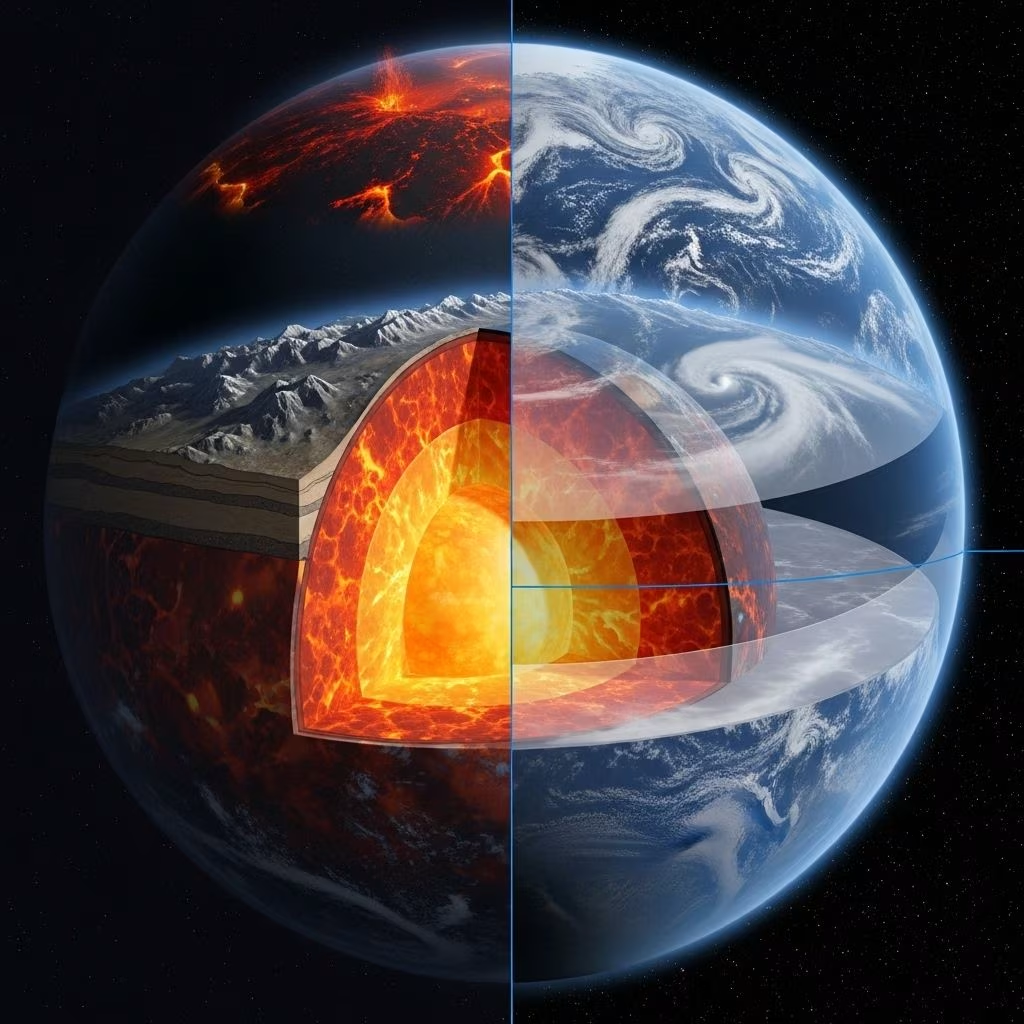
Earth’s interior can be likened to a giant, dynamic onion. Scientists study these internal layers using seismic waves and samples from volcanic eruptions and deep mines:
- Crust: The thin, outermost layer, forming continents and ocean floors. Varies from about 5 km (under oceans) to 70 km (under continents) thick.
- Mantle: A vast region of semi-solid rock extending to a depth of roughly 2,900 km.
- Outer Core: Comprised mainly of liquid iron and nickel. The movement here generates Earth’s magnetic field.
- Inner Core: A dense, solid sphere primarily of iron and nickel, reaching temperatures similar to the Sun’s surface.
Earth’s Chemical Composition
Earth’s composition is dominated by a few major elements, but its diversity in minerals and compounds sets it apart from other planets:
- Crustal Elements: Oxygen (~46.6%), silicon (~27.7%), aluminum (~8.1%), iron (~5%), calcium, sodium, potassium, and magnesium are the most abundant elements in Earth’s crust.
- Mantle and Core: Rich in silicates (mantle) and iron-nickel alloys (core).
- Trace Elements: Small amounts of other elements (including hydrogen, carbon, sulfur) play crucial roles in Earth’s processes.
Earth’s Surface: Continents, Oceans, and Plate Tectonics
Earth’s modern surface is a mosaic of moving tectonic plates floating atop the mantle. Plate tectonics shape continents, form mountain ranges, trigger earthquakes, and create volcanoes.
- Continents: Large landmasses composed mostly of lighter, granitic rocks.
- Oceans: Cover ~71% of Earth’s surface. Oceanic crust is denser and primarily basaltic.
- Plate Movements: Plates drift a few centimeters per year, reshaping continents over geologic time, explaining the distribution of fossils and certain minerals.
- Supercontinents: In Earth’s past, continents assembled and broke apart repeatedly (e.g., Pangaea, Rodinia).
Water: A Defining Feature
Water sets Earth apart from every other planet in our solar system. Liquid water appeared within the first half-billion years, likely delivered by icy asteroids and comets, and brought to the surface by volcanic outgassing.
- Oceans and Lakes: Act as heat reservoirs, regulate Earth’s climate, and serve as the cradle of life.
- Hydrological Cycle: Water circulates through evaporation, condensation, precipitation, and runoff, connecting the atmosphere, biosphere, and lithosphere.
Earth’s Atmosphere: Layers and Modern Composition
Earth’s atmosphere is a thin envelope of gases extending hundreds of kilometers above the surface, crucial to protecting life and regulating the planet’s temperature.
| Layer | Altitude Range | Main Features |
|---|---|---|
| Troposphere | 0–12 km | Weather, clouds, ~75% of atmospheric mass |
| Stratosphere | 12–50 km | Contains ozone layer, commercial jet flight |
| Mesosphere | 50–85 km | Coldest layer, meteors burn up here |
| Thermosphere | 85–600 km | Auroras, International Space Station orbit |
| Exosphere | 600 km+ | Merges with interplanetary space |
Modern Atmospheric Composition (by volume):
- Nitrogen (N2): 78.08%
- Oxygen (O2): 20.95%
- Argon (Ar): 0.93%
- Carbon dioxide (CO2): approx 0.04%
- Trace gases: neon, helium, krypton, methane, hydrogen, and water vapor (variable, ~0.4% overall)
The composition is not static—levels of greenhouse gases, ozone, and other components fluctuate over time due to both natural and human-driven processes.
Evolution of Earth’s Atmosphere: From Primordial to Present
Earth’s atmosphere has changed drastically over billions of years, shaped by geological activity, biological processes, and astronomical events.
1. The First Atmosphere
- Composition: Mostly hydrogen and helium, with trace amounts of methane and ammonia—similar to gases rife in the early solar nebula.
- High temperatures and fierce solar winds quickly stripped this atmosphere away, leaving little behind except clues in isotopic abundances.
2. The Second Atmosphere
- Formation: As Earth’s crust cooled and solidified, intense volcanic outgassing released water vapor, carbon dioxide, nitrogen, methane, and ammonia into the air. Water condensed to form oceans.
- Key Features: Thick with greenhouse gases, little to no free oxygen.
- Role of Oceans: Oceans absorbed most CO2, helping regulate the climate and acting as a medium for chemical evolution.
3. The Rise of Oxygen: The Great Oxygenation Event
- About 2.4–2.0 billion years ago, simple cyanobacteria (blue-green algae) evolved the ability to perform photosynthesis, releasing oxygen as a byproduct.
- Initially, most oxygen was absorbed by iron in the oceans, forming iron oxides. As these sinks filled, free oxygen began to accumulate in the atmosphere—the Great Oxygenation Event.
- This shift allowed for the evolution of multicellular, aerobic life and ultimately the development of the ozone layer (O3), which shields life from harmful ultraviolet radiation.
4. The Modern Atmosphere
- Balance: Maintains a dynamic equilibrium between oxygen-producing organisms (plants, algae) and oxygen-consuming organisms (animals, decomposers).
- Anthropogenic Change: Since the Industrial Revolution, burning fossil fuels and deforestation have increased CO2 and other greenhouse gases, affecting Earth’s climate and atmospheric chemistry.
- Ozone Layer Depletion: Human-made chemicals like CFCs have thinned the ozone layer, though international agreements have curbed many emissions.
Comparing Earth’s Atmosphere to Other Planets
What makes Earth’s atmosphere distinct is its composition, pressure, and ability to support life—features absent elsewhere in our Solar System.
| Planet | Main Atmospheric Components | Surface Pressure | Supports Life? |
|---|---|---|---|
| Earth | N2, O2, Ar, trace CO2 | 1 atm | Yes |
| Venus | CO2 (~96%), N2 | ~92 atm | No (extremely hot, corrosive) |
| Mars | CO2 (~95%), N2, Ar | ~0.006 atm | No (very thin, cold) |
Venus and Mars lack significant free oxygen and possess either overly dense or extremely thin atmospheres, both inimical to life.
The Role of Earth’s Atmosphere in Protecting and Sustaining Life
- Ozone Layer: Absorbs most harmful ultraviolet radiation, critical for terrestrial life.
- Greenhouse Effect: Retains heat, stabilizing Earth’s temperature and preventing extreme climate swings.
- Weather and Water Cycle: Drives atmospheric circulation, precipitation, and distribution of nutrients.
- Meteor Shield: Atmospheric friction destroys most meteoroids before they reach the ground.
Earth’s Atmosphere and Contemporary Environmental Challenges
Human activity has shaped the atmosphere dramatically in the last two centuries, with profound implications:
- Global Warming: Rising greenhouse gas concentrations—especially CO2—have warmed the planet globally, causing climate change.
- Ozone Depletion: Chlorofluorocarbons (CFCs) and related gases have damaged the stratospheric ozone, though mitigation efforts have shown signs of recovery.
- Urban Air Pollution: Industry and transportation produce smog, particulates, and harmful chemicals, impacting human health and ecosystems.
Understanding Earth’s atmospheric evolution highlights how delicate our planet’s life-supporting systems are—and the significance of preserving its balance.
Frequently Asked Questions (FAQs)
Q: Why is Earth the only known planet with breathable air?
A: Only Earth has the right balance of nitrogen and oxygen, maintained by biological activity and the planet’s size, distance from the Sun, and protective magnetic field.
Q: How did oxygen first appear in Earth’s atmosphere?
A: Oxygen was first produced as a byproduct of photosynthesis by cyanobacteria (blue-green algae) around 2.4 billion years ago, eventually accumulating after combining with dissolved iron in the oceans.
Q: What protects life on Earth from harmful solar radiation?
A: The ozone layer in the stratosphere absorbs most ultraviolet (UV) rays from the Sun, protecting living organisms from DNA damage.
Q: Has Earth’s atmosphere always had oxygen?
A: No. For over a billion years, Earth’s atmosphere contained almost no free oxygen until the Great Oxygenation Event, after which its levels rose gradually.
Q: What are the main threats to Earth’s current atmosphere?
A: Key threats include anthropogenic greenhouse gas emissions (causing climate change), destruction of the ozone layer by chemical pollutants, and general air pollution from industrialization.
References
- https://en.wikipedia.org/wiki/Atmosphere_of_Earth
- https://www.ebsco.com/research-starters/science/earths-atmosphere-historical-overview
- https://www.britannica.com/science/evolution-of-the-atmosphere-1703862
- https://pmc.ncbi.nlm.nih.gov/articles/PMC2944365/
- https://sites.lsa.umich.edu/globalchange/lectures/earths-climate-in-deep-time/
- https://scijinks.gov/atmosphere-formation/
- https://pmc.ncbi.nlm.nih.gov/articles/PMC7426726/
- https://en.wikipedia.org/wiki/History_of_Earth
- https://forces.si.edu/atmosphere/02_02_01.html
- https://www.ebsco.com/research-starters/science/earths-composition
- https://www.space.com/54-earth-history-composition-and-atmosphere.html
- https://www.britannica.com/science/geologic-history-of-Earth/Development-of-the-atmosphere-and-oceans
- https://www.worldwildlife.org/stories/a-brief-history-of-carbon-in-our-atmosphere
- https://www.visionlearning.com/en/library/Earth-Science/6/History-of-Earths-Atmosphere-I/202/
- https://australian.museum/learn/minerals/shaping-earth/structure-and-composition-of-the-earth/
- https://www.youtube.com/watch?v=v1EPy5r1m-M


