


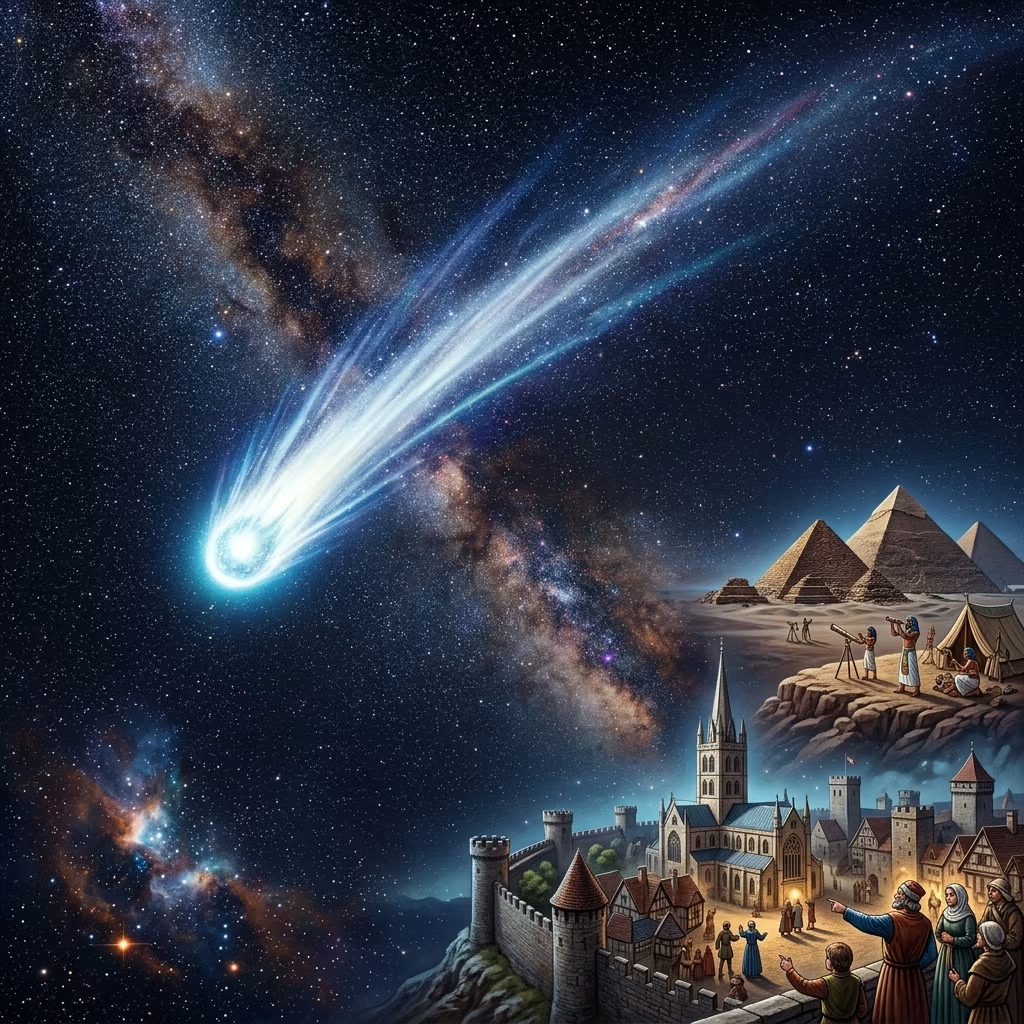
Halley’s Comet: The Legendary Visitor Through History and Space
Halley’s Comet stands as the most renowned of all known comets, a celestial spectacle visible to the naked eye that has fascinated observers for centuries. Officially designated as 1P/Halley, it is celebrated as the first comet recognized as a periodic visitor, returning to Earth’s skies at predictable intervals of around 76 years. Its passage has been chronicled throughout human history, inspiring awe in the ancient world and spawning modern scientific revelations in recent decades.
What Is Halley’s Comet?
Halley’s Comet is classified as a short-period comet, the only one of its class regularly visible to the naked eye from Earth. As the archetype of periodic comets, it completes a journey around the Sun approximately every 75 to 76 years. Its recurring visibility and brightness have made it both a harbinger in centuries past and a keystone for understanding cometary science in the space age.
- Designation: 1P/Halley
- Orbital Period: About 76 years (range: 72–80 years)
- Last Perihelion (closest approach to Sun): 1986
- Next Perihelion: 2061
- Visibility: Consistently appears bright enough to be seen with the naked eye
Halley’s periodic visits have been recognized since antiquity, but it was only in the 18th century that astronomers determined that these once-ominous apparitions were actually reappearances of the same celestial object.
Historical Sightings: A Record Through the Ages
For over two millennia, Halley’s Comet has featured prominently in the chronicles of numerous cultures. Early observations trace back at least to 240 BC in Chinese records. Its arrival often coincided with significant historical events, interpreted as omens of change.
Key moments in history include:
- 240 BC (China): One of the earliest recorded sightings
- 1066 AD (Europe): The comet depicted in the famous Bayeux Tapestry, heralding the Norman conquest of England
- 1301 AD (Italy): Inspiration for Giotto’s portrayal of the Star of Bethlehem in his frescoes
The comet’s consistent reappearances laid the groundwork for a revolutionary leap in astronomical understanding. Prior to Edmond Halley’s insight, each comet’s passage was generally believed to be a singular and unrelated event.
Edmond Halley: The Comet’s Namesake
English astronomer Edmond Halley (1656–1742) fundamentally changed the perception of comets. In 1705, using Isaac Newton’s laws of gravitation and planetary motion, Halley studied historical records and calculated the orbits of several comets observed in 1531, 1607, and 1682. He discerned striking similarities and boldly predicted their return in 1758.
- Prediction and Legacy: Halley’s accurate forecast marked the first known periodic comet and revolutionized our understanding of comets as recurring celestial objects.
- Upon its predicted return, the comet was named Halley’s Comet in his honor.
- His work inspired generations of astronomers and reinforced the power of scientific reasoning.
Understanding the Orbit and Periodicity
The orbit of Halley’s Comet is long, elliptical, and retrograde—it moves in the opposite direction of the planets around the Sun. This challenging orbit brings the cometfrom beyond the orbit of Neptune at its farthest extreme (aphelion) inwards to just within the orbit of Venus at its closest point (perihelion).
| Parameter | Value/Description |
|---|---|
| Orbital period | 76 years (average) |
| Eccentricity | 0.967 |
| Inclination | 162° (retrograde) |
| Closest approach to Sun (perihelion) | 0.59 AU |
| Farthest distance from Sun (aphelion) | 35.1 AU |
- The comet’s visibility from Earth depends on its approach, with some passages offering a brilliant sight, while others appear less dramatic.
Halley’s Comet and Its Place in Culture
Human societies have long ascribed meaning to Halley’s appearances:
- Bayeux Tapestry: Medieval artists immortalized the comet during the Battle of Hastings (1066), depicting it as a portent of change.
- Literature and the Arts: Writers and painters have alluded to Halley throughout history, an emblem of celestial wonder and sometimes dread.
- Modern Media: Its 20th-century appearances inspired popular fascination, with countless news stories, documentaries, and artistic references.
The Great Apparitions: Sightings and Influence
Each return of Halley’s Comet is unique in its spectacle and effect:
- 1910: The comet’s brilliant passage inspired widespread public excitement. Its tail swept close to Earth, and for a time people feared a celestial disaster, fueled by the discovery of cyanogen gas in the tail (although it posed no threat).
- 1986: The last return before the space age, observed globally though less bright than some earlier appearances. It was the first time a comet was visited and closely studied by spacecraft.
Scientific Missions and Discoveries
Halley’s 1986 perihelion ushered in a new era of cometary science, with numerous international missions flocking to study the comet:
- ESA’s Giotto Mission: Delivered the first close-up images of a comet’s nucleus and measured key physical and chemical properties.
- Vega 1 and Vega 2 (Soviet Union): Provided invaluable data on the comet’s dimensions, surface, and dusty environment.
- Suisei and Sakigake (Japan): Observed changes in the hydrogen coma and solar wind interactions.
- International Sun-Earth Explorer-3 (ISEE-3/ICE): Monitored the tail and plasma environment.
- Pioneer 7 and 12 (USA): Collected complementary data from afar.
Key breakthroughs from these missions:
- Confirmed the “dirty snowball” model, revealing a nucleus of ice and dust.
- Detected exceptionally dark, non-reflective material on the surface (even blacker than coal), indicating a crust of organic-rich compounds and dust covering icy layers.
- Measured volatile components like water, carbon monoxide, and carbon dioxide, which create the characteristic coma and tail.
- Witnessed the dynamic formation, structure, and ejection of the comet’s dust and plasma tails.
Structure and Composition of Halley’s Comet
The data returned from Giotto and Vega missions provided the first up-close look at a comet’s structure and surface. Halley’s nucleus is an irregular, potato-shaped body approximately 15 km long by 8 km wide, black as soot, and composed of a mixture of volatile ices and dust—aptly described by Fred Whipple’s “dirty snowball” hypothesis. Only a small fraction of the surface is icy; the rest is covered by dark, non-volatile material.
- Surface: Predominantly organic-rich, dusty crust
- Volatile Ices: Water ice, carbon monoxide, carbon dioxide, some ammonia and methane
- Outgassing: As Halley nears the Sun, ices sublimate, releasing dust and gas to form a spectacular coma (atmosphere) and ancient tail
- Coma: Can grow up to 230,000 km wide
- Tail: May extend 100 million kilometers or more and is often disconnected or altered by interactions with the solar wind
Tail and Solar Interactions
Solar heating drives the process that forms a comet’s coma and tail. As gas molecules are released, some are ionized (converted to plasma) by solar radiation, swept away by the solar wind to create a glowing ion tail. Simultaneously, dust particles scatter sunlight, forming a second, brighter tail. Sudden changes in solar wind can cause dramatic ‘disconnection events,’ when an entire portion of the tail appears to break off and drift away.
The Meteor Showers Linked to Halley’s Comet
Earth passes through streams of dust left by Halley’s Comet twice annually, producing two famous meteor showers:
- Eta Aquarids: Occur in early May, most visible from the Southern Hemisphere.
- Orionids: Visible in October, from both hemispheres. These meteors streak through the night when Earth crosses the comet’s ancient debris fields.
The Next Return: Halley’s Comet in 2061
Halley’s next perihelion is due in mid-2061. Astronomers around the world are preparing with advanced telescopes, spacecraft design, and enhanced sensing capabilities. Unlike in 1986, future generations will observe Halley’s return with the benefit of more sophisticated equipment and global collaboration.
- Expect spectacular public interest, educational initiatives, and perhaps new international scientific missions to fly by or even orbit the comet.
- Its future pass is anticipated to offer a brighter, more favorable apparition than in 1986, being closer to Earth in its orbit.
Frequently Asked Questions About Halley’s Comet
Q: Why is Halley’s Comet so well known compared to other comets?
A: It is the only short-period comet reliably visible to the naked eye and has appeared in historical records for over 2,000 years, linking generations and cultures around the world.
Q: Can we visit Halley’s Comet with a spacecraft?
A: Yes. In 1986, multiple international spacecraft, including ESA’s Giotto and Soviet Vega probes, flew by Halley for direct observation. Future missions may include even closer flybys or landers.
Q: Why does Halley’s Comet only appear once every 76 years?
A: The comet’s highly elongated (elliptical) orbit takes it far from the Sun for most of its journey, requiring about 76 years to complete one circuit and return to the inner solar system.
Q: What are meteors and meteor showers, and how do they relate to Halley?
A: As Earth passes through streams of debris shed by Halley’s Comet, tiny particles burn up in our atmosphere, producing the Orionid and Eta Aquarid meteor showers each year.
Q: Could Halley’s Comet ever threaten Earth?
A: No. Despite passing relatively close to Earth, Halley’s orbit does not intersect with our planet. It passes at a safe distance, and only its dust produces harmless meteor showers.
Halley’s Comet: A Symbol Across Time
From ancient skywatchers to modern astronomers, Halley’s Comet endures as a vivid thread in humanity’s understanding of the universe. Every passage invites a new generation to look up in wonder. With its next return slated for 2061, Halley’s legacy will continue to inspire, teach, and unite us in a shared celestial experience.
References
- https://www.space.com/halleys-comet-return
- https://en.wikipedia.org/wiki/Halley’s_Comet
- https://www.space.com/25180-capturing-comet-halley.html
- https://science.nasa.gov/solar-system/comets/1p-halley/
- https://www.nasa.gov/history/955-years-ago-halleys-comet-and-the-battle-of-hastings/
- https://en.wikipedia.org/wiki/Halley%E2%80%99s_Comet
- https://www.britannica.com/topic/Halleys-Comet
- https://theskylive.com/halley-info
- https://shelovesscience.com/the-orbit-of-halleys-comet/
- https://starwalk.space/en/news/halleys-comet
- https://www.turito.com/blog/physics/halleys-comet
- https://byjus.com/physics/halleys-comet/
- https://study.com/learn/lesson/halleys-comet-discovery-facts-orbit-return.html
- https://www.ebsco.com/research-starters/history/halleys-comet-makes-its-closest-recorded-passage-earth
- https://phys.org/news/2015-06-halley-comet.html
- https://www.britannica.com/summary/Halleys-Comet


