


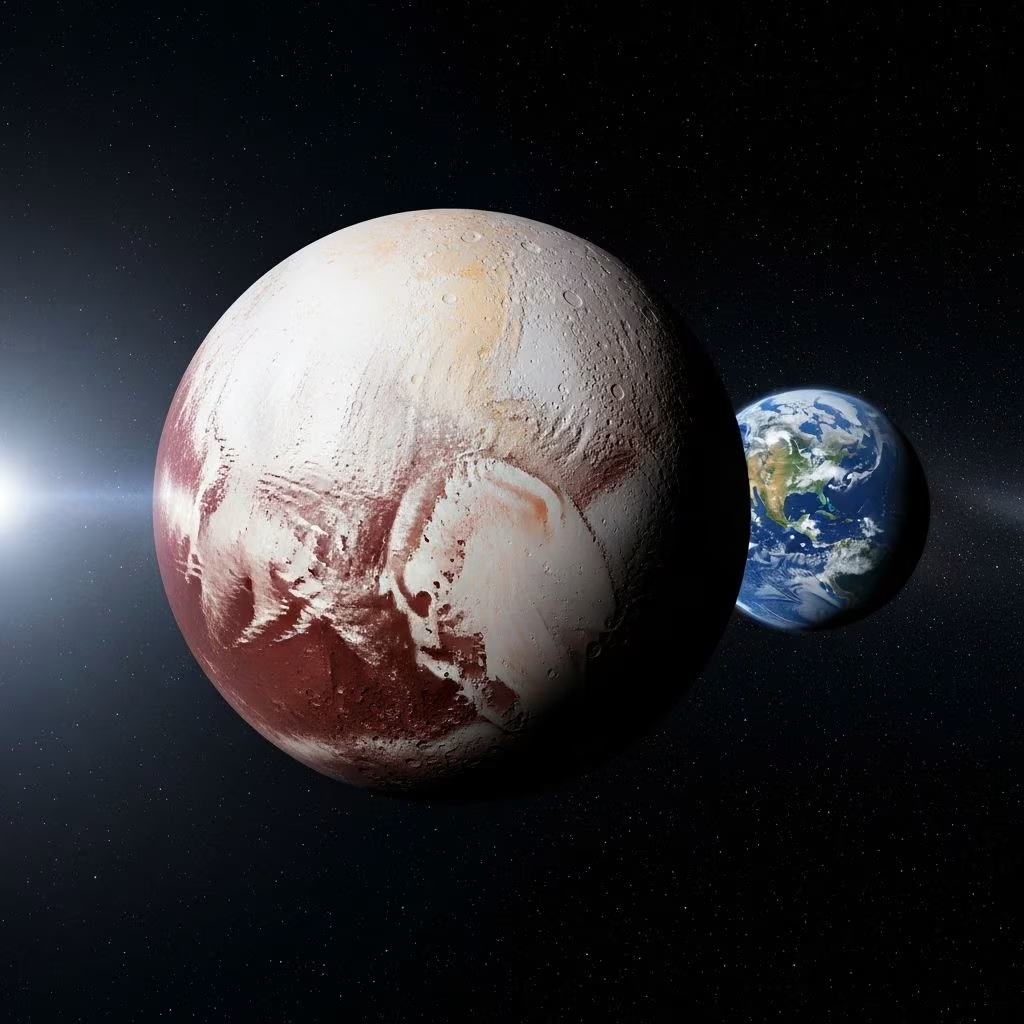
How Big Is Pluto? Unveiling the Dwarf Planet’s True Size
Pluto, once considered the ninth planet of our solar system, has long captured the imagination of astronomers and the public alike. Despite its small size and distant orbit, Pluto’s actual dimensions and characteristics have been sources of both curiosity and scientific debate for decades. The question of “How big is Pluto?” persisted for generations, until recent missions and technologies finally provided an authoritative answer. This article explores the history, significance, and the final determination of Pluto’s size, offering a comprehensive overview of its measurement, context, and place among the solar system’s icy worlds.
Contents
- Introduction: Pluto and Its Mystique
- The Quest to Measure Pluto’s Size
- Breaking the Barrier: New Horizons and Modern Measurements
- Pluto in Context: Comparisons and Scale
- Pluto’s Surface Features and Internal Composition
- Pluto and Its Moons
- Frequently Asked Questions (FAQs)
Introduction: Pluto and Its Mystique
Pluto, officially designated as 134340 Pluto, is a dwarf planet located in the Kuiper Belt—a vast region of icy bodies beyond Neptune. Discovered in 1930 by Clyde Tombaugh, Pluto held planetary status for over seven decades before its reassignment in 2006, prompting global discussion about the very definition of a planet. Though now known as the largest object in the Kuiper Belt by volume, Pluto is notably less massive than its sibling dwarf planet, Eris.
With its eccentric and inclined orbit, Pluto’s distance from the Sun varies substantially, ranging between 30 and 49 astronomical units (AU), or roughly 2.8 to 4.6 billion miles. Light from the Sun takes about 5.5 hours to reach Pluto—a reminder of just how far this icy world is from the warmth of our star.
The Quest to Measure Pluto’s Size
Since its discovery, scientists have endeavored to pin down Pluto’s size, but the task has been consistently challenging. Early estimates, hindered by limited observational technology and Pluto’s great distance from Earth, were plagued by uncertainty.
Why Was It So Hard to Measure Pluto?
- Distance: At several billion miles from Earth, Pluto is faint and challenging to study. Its small apparent size compounds the difficulty of precise measurement.
- Atmosphere: Pluto’s thin atmosphere distorts its observable edge (known as the “limb”), introducing ambiguity regarding where its surface truly lies and artificially inflating previous estimates.
- Technological Limitations: Until space-based instruments and advanced imaging became available, astronomers could only make rough calculations from blurred ground-based telescope images.
For decades, this uncertainty persisted, and each improved telescope or flyby hinted at revised size estimates, sometimes larger, sometimes smaller. The uncertainty finally ended in 2015 with a historic space mission.
Breaking the Barrier: New Horizons and Modern Measurements
NASA’s New Horizons mission finally answered the core question: “How big is Pluto?” On July 14, 2015, this pioneering spacecraft flew within 7,800 miles (12,500 km) of Pluto’s surface, capturing detailed imagery and precise data on the dwarf planet’s size and composition.
New Horizons’ Measurement Highlights
- Diameter: 2,376.6 km (about 1,473 miles), with an uncertainty of only ±3.2 km.
- Surface Area: Approximately 17,744,430 square kilometers—slightly larger than Russia or Antarctica including its winter sea ice.
- Mass: About 1.303 × 10²² kg, or 17.7% the mass of Earth’s Moon, and only about 0.22% that of the Earth itself.
- Surface Gravity: Just 0.063 g—less than 7% of Earth’s gravity (and about one-third that of the Moon).
- Escape Velocity: Around 4,363 km/h (approximately 2,711 mph)—just a fraction of Earth’s escape velocity.
These figures definitively established Pluto as the largest known object in the Kuiper Belt by diameter, though not by mass (Eris, another dwarf planet, is slightly more massive but smaller in diameter).
| Property | Value |
|---|---|
| Diameter | 2,376.6 km (1,473 miles) |
| Mass | 1.303 × 10²² kg |
| Surface area | 17,744,430 km2 |
| Surface gravity | 0.063 g |
| Escape velocity | 4,363 km/h (2,711 mph) |
Pluto in Context: Comparisons and Scale
How does Pluto measure up next to the familiar worlds of our solar system? Here’s a comparative look at Pluto’s size:
| Object | Diameter (km) | Mass (kg) |
|---|---|---|
| Earth | 12,742 | 5.97 × 1024 |
| Moon | 3,474 | 7.35 × 10²² |
| Pluto | 2,377 | 1.30 × 10²² |
| Eris | 2,326 | 1.67 × 10²² |
| Ceres | 946 | 9.39 × 10²⁰ |
- Compared to Earth: Pluto is more than five times smaller in diameter and over 450 times less massive.
- Compared to the Moon: Pluto is about two-thirds the diameter of Earth’s Moon and has roughly one-sixth of its mass.
- Compared to dwarf planets: Pluto is slightly larger by volume than Eris, but Eris is more massive.
Further, Pluto is less massive than seven moons in our solar system, including Ganymede, Titan, Callisto, Io, the Moon, Europa, and Triton.
Pluto’s Surface Features and Internal Composition
Pluto’s surface, as revealed by New Horizons, is a fascinating mix of mountains, plains, valleys, and craters:
- Mountains of Ice: Water-ice mountains soar up to 3 kilometers in height, making them roughly comparable in size to the Rockies on Earth.
- The “Heart” of Pluto: Tombaugh Regio—a heart-shaped region named after Pluto’s discoverer—is one of the most notable features. Part of this area, Sputnik Planitia, is a vast nitrogen-ice plain with almost no craters, suggesting it’s less than 10 million years old and possibly still geologically active[10].
- Surface Composition: Pluto’s exterior is a mixture of nitrogen, carbon monoxide, and methane ices, with distinct surface regions appearing in shades of white, yellow, and brown.
- Internal Structure: Scientists believe Pluto’s interior is composed of a mixture of rock and ice, with a higher proportion of ice than previously thought, owing to the more accurate size and density readings from New Horizons[10].
Pluto and Its Moons
Pluto is not alone in its corner of the solar system. It has five known moons:
- Charon: By far the largest moon, with a diameter of 1,212 km (751 miles), making it about half the size of Pluto itself. The barycenter (center of mass) of their mutual orbits lies outside Pluto, making the pair unique—sometimes regarded as a “binary” system.
- Nix, Hydra, Kerberos, and Styx: Four much smaller moons, all discovered in the 21st century, orbit Pluto at greater distances.
New Horizons also snapped detailed images of Charon, revealing its own complex surface, including canyons and plains that suggest a dynamic history.
Frequently Asked Questions (FAQs)
Q: Why did it take so long to measure Pluto’s size accurately?
A: Pluto’s distance, small angular diameter, and a thin, hazy atmosphere all made precise measurement exceptionally challenging until space probes like New Horizons could get close enough to resolve its edges and exclude atmospheric distortion.
Q: How does Pluto’s gravity compare to Earth?
A: Gravity on Pluto is about 6.3% that of Earth’s. A 100 kg person on Earth would weigh just 6.3 kg on Pluto—less than a large bag of groceries.
Q: Is Pluto larger than all other objects beyond Neptune?
A: By diameter, yes—Pluto is the largest known trans-Neptunian object, although Eris, a fellow dwarf planet, is slightly more massive but just smaller in diameter.
Q: How long would it take to drive around Pluto’s equator?
A: The equatorial circumference of Pluto is about 7,445 miles (12,000 km). Driving at 60 mph (100 km/h) non-stop would take you just over 124 hours, or about 5 days—assuming smooth terrain and no stops!
Q: What made Pluto lose its status as a planet?
A: In 2006, the International Astronomical Union redefined what it means to be a planet. Pluto was reclassified as a “dwarf planet” because it does not “clear its neighborhood” of other objects along its orbit.
Q: What is the significance of New Horizons’ findings about Pluto?
A: New Horizons provided conclusive measurements of Pluto’s size, density, and surface conditions, settling long-standing debates. It also revealed remarkable geological diversity and helped clarify Pluto’s place in the broader solar system.
Related Topics
- Comparing Pluto to other solar system objects
- The geology and chemistry of Pluto’s surface
- New Horizons mission milestones and discoveries
- The debate over Pluto’s planethood and the definition of planets
- The Kuiper Belt and trans-Neptunian objects
References
- https://science.nasa.gov/dwarf-planets/pluto/facts/
- https://en.wikipedia.org/wiki/Pluto
- https://nssdc.gsfc.nasa.gov/planetary/factsheet/plutofact.html
- https://www.britannica.com/place/Pluto-dwarf-planet
- https://www.space.com/18568-how-big-is-pluto.html
- https://www.britannica.com/science/How-Big-Is-Pluto
- https://hub.jhu.edu/2015/07/13/how-big-is-pluto/
- https://scaleofuniverse.com/en/universe/pluto
- https://study.com/learn/lesson/pluto-orbit-diameter.html
- https://starwalk.space/en/news/facts-about-pluto
- https://www.sustava.sk/en/pluto
- https://bmsis.org/dwarf-planet-pluto/
- https://www.planetary.org/worlds/pluto
- https://pluto.jhuapl.edu/Pluto/The-Pluto-System.php
- https://www.eso.org/public/portugal/news/eso8610/?lang
- https://www.astronomy.com/science/how-big-is-pluto-new-horizons-settles-decades-long-debate/
- https://www.universetoday.com/articles/how-big-is-pluto


