Understanding the New Moon and Lunar Phases
The Moon has captivated humanity for millennia, its changing appearance in the night sky marking the passage of time and inspiring countless myths. Central to this cosmic ballet is the new moon and the sequence of lunar phases that shape our view of Earth’s only natural satellite. This guide offers a comprehensive exploration of the astronomical causes, sequence, key facts, and cultural impact of the lunar cycle.
Contents
- Phases of the Moon: An Overview
- The Mechanics Behind Lunar Phases
- Sequence and Characteristics of Lunar Phases
- What Is a New Moon?
- New Moon and Calendar Systems
- Black Moon: The Rare Second New Moon
- Solar Eclipses and the New Moon
- Impact on Tides
- Cultural Significance
- Frequently Asked Questions (FAQs)
Phases of the Moon: An Overview
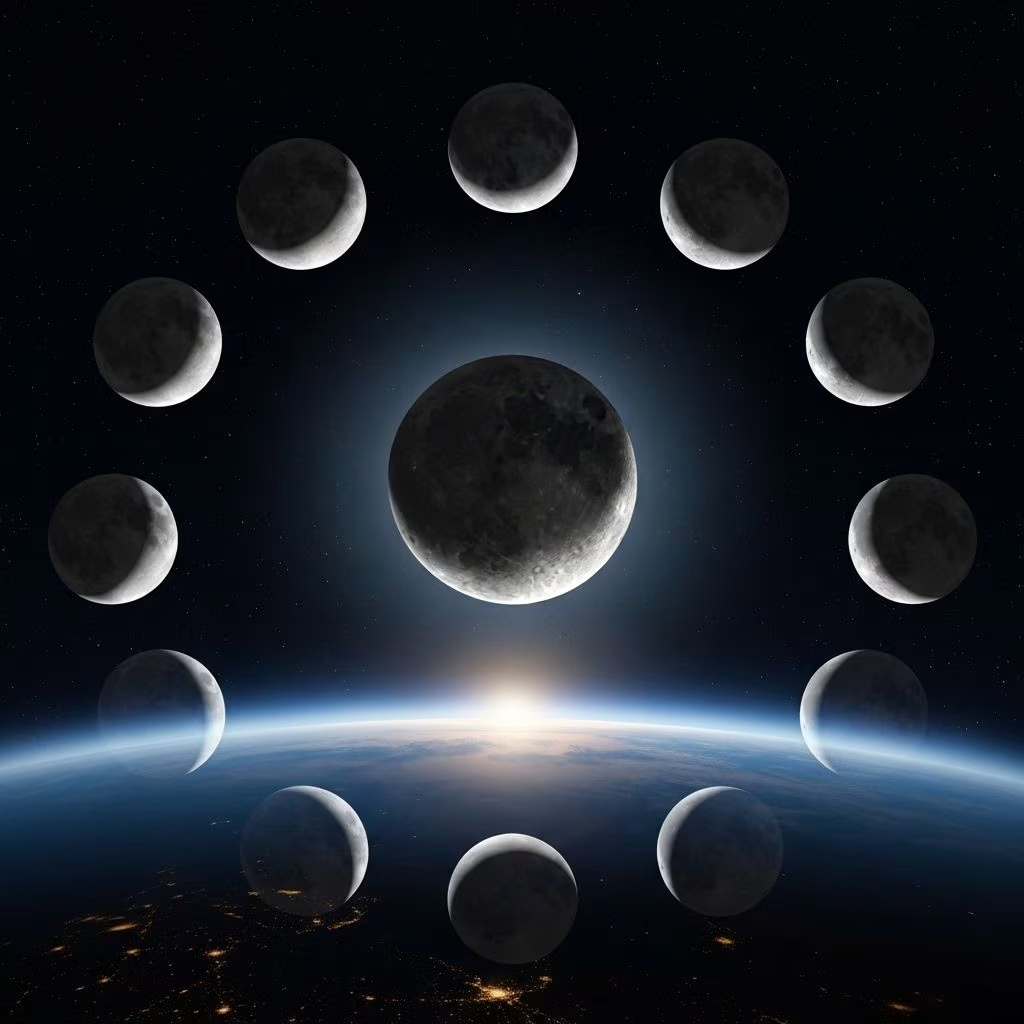
Every lunar month, the Moon goes through a regular cycle of eight distinct phases. These are divided into four primary phases, marking key astronomical moments, and four intermediate phases, which occur as the Moon moves between the primaries.
A full lunar cycle (synodic month) lasts about 29.5 days—slightly shorter than most calendar months.
Primary and Intermediate Moon Phases
- Primary phases: New Moon, First Quarter, Full Moon, Third Quarter
- Intermediate phases: Waxing Crescent, Waxing Gibbous, Waning Gibbous, Waning Crescent
| Phase | Illumination | Moonrise | Moonset |
|---|---|---|---|
| New Moon | 0% | around sunrise | around sunset |
| Waxing Crescent | 1-49% | mid-morning | early evening |
| First Quarter | ~50% | around noon | around midnight |
| Waxing Gibbous | 51-99% | mid-afternoon | before dawn |
| Full Moon | 100% | around sunset | around sunrise |
| Waning Gibbous | 99-51% | late evening | mid-morning |
| Third Quarter | ~50% | around midnight | around noon |
| Waning Crescent | 49-1% | before dawn | mid-afternoon |
The Mechanics Behind Lunar Phases
Half of the Moon’s surface is always illuminated by sunlight, but as the Moon orbits Earth, the portion visible to us changes.
The varying angle between the Sun, Earth, and Moon produces phases—from the dark new moon to the shining full moon.
- Lunar orbit: The Moon’s orbital period around Earth is about 27.3 days relative to the stars, but 29.5 days relative to the Sun (synodic month).
- Light and shadow: As the Moon progresses through its orbit, we see increasing (waxing) or decreasing (waning) amounts of its sunlit side.
- Tilt: The Moon’s orbit is tilted roughly 5° to Earth’s orbital plane (the ecliptic), which affects when eclipses occur.
Sequence and Characteristics of Lunar Phases
The lunar phases always follow the same order:
- New Moon: The Moon is between Earth and Sun; its illuminated side faces away from us.
- Waxing Crescent: A thin crescent appears, growing over several days.
- First Quarter: Half the Moon’s disk is illuminated.
- Waxing Gibbous: Most of the disk is lit, approaching full illumination.
- Full Moon: The Moon is opposite the Sun; its entire face is visible.
- Waning Gibbous: Illumination decreases after full.
- Third Quarter: Again, half the disk is visible but opposite from first quarter.
- Waning Crescent: The crescent shrinks until the cycle repeats.
What Is a New Moon?
The new moon marks the beginning of a lunar cycle. At this phase, the Moon is directly between Earth and the Sun, so its sunlit side is turned away from us. To an observer on Earth, the Moon appears nearly or completely invisible.
- Position: Moon lies between Earth and Sun.
- Illumination: The near side is in total shadow (0%).
- Visibility: Not visible—except during rare solar eclipses when the Moon blocks the Sun.
- Timing: Rises with the Sun, sets with the Sun, overhead at noon.
Key Facts About the New Moon
- The new moon occurs once every 29.5 days (the synodic month).
- It is the first phase in the lunar cycle, immediately following the waning crescent phase.
- The term ‘new moon’ refers to the start of a new lunar month.
- Because the illuminated side faces away, the new moon is invisible from Earth except during a solar eclipse.
New Moon and Calendar Systems
Historically, the new moon has been vital for measuring time. Before the advent of modern calendars, the lunar cycle was used to mark the passing of months.
- Lunar calendar: Many ancient societies structured months around the new moon.
- Synodic month: The average duration between two new moons is about 29.531 days—slightly shorter than most months.
- Religious and cultural events: Countless festivals and rituals are timed with the new moon.
Black Moon: The Rare Second New Moon
A Black Moon occurs when two new moons fall within a single calendar month—a rare event resulting from the difference between the lunar and calendar months.
- For two new moons to fit within a month, the first new moon must be on the 1st or 2nd day, and the second on the 30th or 31st.
- This phenomenon, though not scientifically distinct from a regular new moon, is popular among skywatchers.
Solar Eclipses and the New Moon
Solar eclipses can only occur during a new moon, as the Moon must be precisely aligned between Earth and the Sun.
- Alignment: For an eclipse, the Moon’s path must cross the ecliptic, the plane of Earth’s orbit.
- Why not every month? The Moon’s orbit is tilted about 5° to the ecliptic, so most new moons do not produce an eclipse.
- Types of solar eclipses: Total, partial, and annular, depending on the Moon’s apparent size and alignment.
Impact on Tides: The Role of the New Moon
The new moon phase exerts a significant gravitational influence on Earth’s oceans.
- Spring tide: The combined pull of the Moon and Sun produces higher high tides and lower low tides.
- This effect is strongest during both new and full moons.
- Spring tides are not linked to the season ‘spring,’ but to the idea of ‘springing forth.’
Cultural Significance of Lunar Phases
The lunar cycle has played a central role in cultures across the world. Here are several notable influences:
- Calendars: Many ancient calendars, including Islamic and Hebrew, remain lunar-based, starting each month with the new moon.
- Symbolism: The moon’s phases symbolize renewal, growth, culmination, and reflection in myths, literature, and rituals from many traditions.
- Festivals: Events such as Ramadan, Rosh Chodesh, and Chinese New Year are aligned with specific lunar phases.
- Navigation and agriculture: Moon phases have been used to guide planting, hunting, and travel.
Frequently Asked Questions (FAQs)
Q: Why can’t we see the new moon?
A: During the new moon, the side facing Earth is in darkness and not illuminated by the Sun, making the Moon nearly invisible from our perspective except during a solar eclipse when it blocks the Sun.
Q: How long does the new moon phase last?
A: The new moon phase, as a moment in time, lasts only briefly, but the Moon is essentially invisible for about one day before and after the precise new moon.
Q: What is the difference between lunar and synodic months?
A: A lunar (sidereal) month is the time for the Moon to orbit Earth with respect to the stars (~27.3 days), while a synodic month measures the cycle from one new moon to the next (~29.5 days), accounting for Earth’s orbit around the Sun.
Q: Can a new moon be seen during the day?
A: The new moon rises and sets with the Sun, reaching its highest point near noon—but since its illuminated side faces away, it is invisible against daylight.
Q: Why don’t we have a solar eclipse every new moon?
A: The Moon’s orbit around Earth is tilted about 5°, so most new moons occur when the Moon is above or below the plane of Earth’s orbit and doesn’t cast a shadow on Earth.
Q: What effect does the new moon have on tides?
A: The Sun and Moon combine their gravitational pull during new moon (and full moon) phases to produce spring tides—the highest high tides and lowest low tides.
Q: What is a Black Moon?
A: A Black Moon refers to the rare occurrence of two new moons in a single calendar month, similar to the Blue Moon concept for full moons.
Q: Do phases of the Moon affect human behavior?
A: While lunar phases have cultural significance and are often linked to myths about mood and activity, there is no scientific consensus that moon phases directly affect human behavior.
Key Takeaways
- The lunar phases result from changing perspectives on the sunlit portion of the Moon as it orbits Earth.
- There are eight phases in the cycle, with the new moon marking the start.
- The new moon is invisible from Earth except during rare solar eclipses.
- Lunar cycles continue to influence timekeeping, tides, and traditions worldwide.
References
- https://www.space.com/18880-moon-phases.html
- https://www.space.com/62-earths-moon-phases-monthly-lunar-cycles-infographic.html
- https://science.nasa.gov/moon/moon-phases/
- https://en.wikipedia.org/wiki/Lunar_phase
- https://en.wikipedia.org/wiki/New_moon
- https://www.youtube.com/watch?v=3lrnNUqTmGU
- https://spaceplace.nasa.gov/moon-phases/en/
- https://www.timeanddate.com/astronomy/moon/phases.html
- https://www.planetary.org/articles/the-phases-of-the-moon-explained
- https://www.timeanddate.com/astronomy/moon/new-moon.html
- https://www.britannica.com/science/New-Moon-lunar-phase
- https://spaceandtelescope.com/new-moon-all-you-need-to-know/
- https://www.kopernik.org/visitor-info/science-park/phases-of-the-moon/
- https://starwalk.space/en/moon-calendar
- https://www.youtube.com/watch?v=fcVQonhBzQ8
- https://www.skyatnightmagazine.com/space-science/why-does-the-moons-appearance-change
- https://meaningfulmoon.com/moon-phases-explained-understanding-the-lunar-cycle/
- https://astroexploring.com/blog/moon-phases-explained/