Live Updates: The September 2025 Total Lunar Eclipse
The September 2025 total lunar eclipse, the year’s most anticipated astronomical event, dazzled skywatchers across Asia, Australia, Europe, and Africa. This deep, long-duration ‘blood moon’ enthralled billions and brought the global astronomy community together for a night of real-time observation, photography, and sharing. In this live report, we provide the latest updates, detailed timelines, visibility information, stunning images, and expert commentary, capturing the excitement of this celestial spectacle as it unfolded.
What Is a Total Lunar Eclipse?
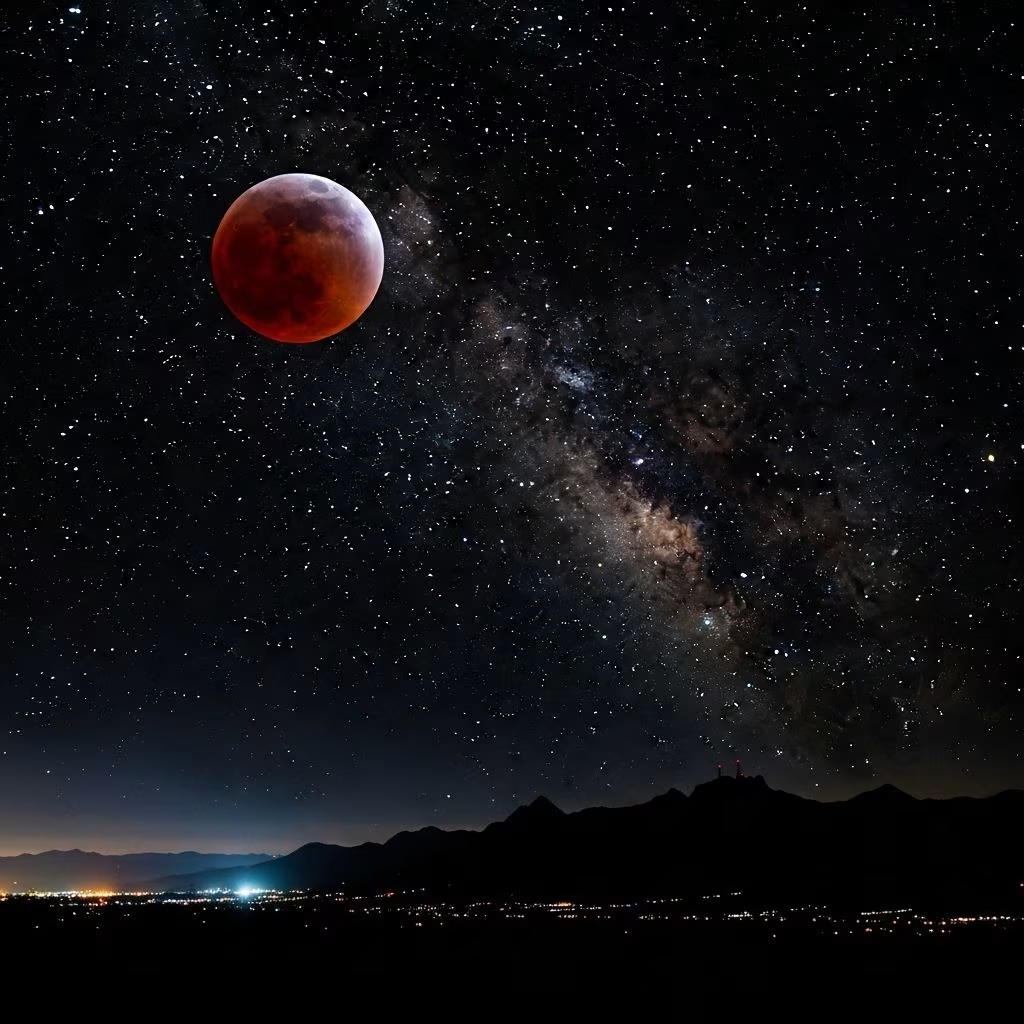
A total lunar eclipse occurs when the Earth moves directly between the sun and a full moon, casting a dark shadow known as the umbra over the lunar surface. As sunlight passes through Earth’s atmosphere, shorter wavelengths scatter, while longer, redder wavelengths bend toward the moon, giving it a striking reddish or copper hue—hence the term “blood moon.” These phenomena are both beautiful and scientifically significant, offering insights into Earth’s atmosphere and orbital dynamics.
September 2025 Lunar Eclipse: Key Facts
- Date: Night of September 7-8, 2025
- Type: Deep Total Lunar Eclipse, “Blood Moon”
- Totality Duration: 82 minutes (one of the longest of the decade)
- Peak Phase: Full moon (“Harvest Moon”)
- Visibility: Best seen in Asia and western Australia; partial phases visible in Europe, Africa, eastern Australia, New Zealand
- Next Similar Eclipse: March 2026
Eclipse Timeline and Peak Times
The event took place over several hours, with precise timing varying by location. Here is a breakdown of the major phases (all times UTC):
| Phase | Time (UTC) |
|---|---|
| Partial Eclipse Begins | 15:28 |
| Totality Begins | 17:30 |
| Maximum Eclipse | 18:11 |
| Totality Ends | 18:52 |
| Partial Eclipse Ends | 20:55 |
Tip: For the most vivid blood moon color, look up during the middle of totality, when Earth’s shadow covers the moon entirely.
Sample Local Times for Totality
- Tokyo: 02:30 to 03:52 JST (September 8)
- Beijing: 01:30 to 02:52 CST (September 8)
- Perth: 01:30 to 02:52 AWST (September 8)
- Berlin: 19:30 to 20:52 CEST (just after moonrise on September 7)
- Sydney: 03:30 to 04:52 AEST (September 8, partial eclipse only)
The Blood Moon Effect: Why Does the Moon Turn Red?
During totality, the moon passes through the deepest part of Earth’s shadow. As sunlight traverses our atmosphere, dust and molecules filter out the blues and greens, letting red and orange hues reach the lunar surface, making it glow with the characteristic “blood moon” color. This effect is intensified in deep eclipses, and this year’s event was notably dark, with 36% of the moon’s diameter inside Earth’s umbra.
Where Was the Eclipse Visible?
This total lunar eclipse delighted over 6 billion people—about 77% of the global population—granting at least partial visibility. The best views were enjoyed in Asia, western Australia, and the Pacific. Observers in Europe, Africa, and New Zealand saw some phases, especially as the moon rose or set during the event. Unfortunately, the Americas missed this spectacle entirely, occurring below the horizon.
- Asia: Ideal, entire eclipse sequence visible late at night and early morning.
- Western and Central Australia: Full eclipse visible overhead in early hours.
- Europe: Moon rose already eclipsed; partial and total phases glimpsed right after moonrise, best in the east.
- Africa: Partial viewing around moonrise; eastern regions saw more.
- America: Not visible.
Highlights: Skywatchers Share the Magic
The astronomical community, from professional observatories to backyard stargazers, flooded social media and news channels with live photos, videos, and reports. Some notable moments included:
- Stunning telescopic close-ups showing rich red coloration and fine lunar surface detail.
- Wide-angle urban skyline images with the blood moon rising over landmarks in Tokyo, Beijing, and Sydney.
- Time-lapse composites capturing the eclipse progression from illuminated lunar disc to deep copper shadow and back.
- Live webcasts from space agencies and observatories, along with crowd-sourced social media feeds under #lunarEclipse2025 and #bloodmoon.
Photo Gallery: Blood Moon Around the World
- Deep crimson moon hanging above Cyprus, casting a mystical glow.
- Shadowed lunar disc rising over Berlin’s cityscape to the awe of early evening onlookers.
- Family stargazing gatherings in neighborhoods across Asia, children observing with binoculars and telescopes.
Science Behind the Eclipse
This particular eclipse was notable for occurring just 2.7 days before lunar perigee—the closest point in the Moon’s orbit to Earth—making the lunar disc appear slightly larger and brighter than average. Totality lasted an impressive 82 minutes due to the depth and geometry of Earth’s shadow at the time, offering extended enjoyment and study opportunities for scientists and enthusiasts alike.
Why Was This Eclipse Especially Dark?
The September 2025 event was a “relatively deep” total lunar eclipse, meaning a significant portion of the moon’s diameter was immersed in the umbra, Earth’s darkest shadow. Atmospheric conditions (like volcanic dust or pollution) can alter the hue and darkness, but the geometry alone promised an especially rich, dark red spectacle this year.
Global Reactions and Social Media Buzz
Within minutes of totality, “blood moon” and #lunarEclipse2025 trended across Twitter, Facebook, and Instagram. Skywatchers shared their locations and photos, compared eclipse hues, and offered tips for future observers:
- “Never seen a redder moon! Breathtaking from Tokyo tonight.”
- “Our whole neighborhood in Perth camped out for the midnight show—absolutely magical.”
- “Caught the blood moon just as it rose over Berlin’s skyline; unforgettable view.”
How to View and Photograph a Lunar Eclipse
Lunar eclipses are safe to view with the naked eye—no special protection is required. For optimal experience:
- Seek a vantage point away from city lights for maximum brightness and clarity.
- Use binoculars or a telescope to reveal lunar surface detail within the red shadow.
- For photography, use tripods and remote shutter releases to avoid blur in low light.
- Wide-field shots can capture the moon against landmarks or horizon silhouettes.
For those with cloudy skies, numerous observatories and online platforms provided live streams and expert commentary throughout the event.
Expert Insights: What We Learned
Lunar eclipses continue to provide valuable data for scientists:
- Atmospheric Science: Analysis of the moon’s color and brightness helps estimate upper atmospheric transparency and detect particles, including those from volcanic eruptions.
- Orbital Dynamics: Exact timings and shadow geometry contribute to refining lunar and Earth ephemerides.
- Public Engagement: Events like this eclipse fuel interest in astronomy, encourage citizen science, and foster a global community of skywatchers.
Next Up: Upcoming Lunar Eclipses
If you missed this eclipse or wish to relive the experience, mark your calendars. The cycle of lunar eclipses continues:
- March 3, 2026: Another total lunar eclipse, favoring the Americas and western Europe.
- 2026–2027: Multiple partial eclipses and a dramatic annular solar eclipse (“ring of fire”) in 2026.
Check astronomy resources and skywatching guides for local timings and best viewing locations.
Frequently Asked Questions (FAQs)
Q: Why isn’t a lunar eclipse visible everywhere on Earth?
A: A lunar eclipse is only visible from the night side of Earth at the time the event occurs; the Americas were on the daytime side during the September 2025 eclipse, so it was not visible there.
Q: Is it safe to look directly at a lunar eclipse?
A: Yes, lunar eclipses are completely safe to observe with the naked eye, as the moon never becomes more dangerous to view than during its regular full phase.
Q: Why does the moon turn red during a total lunar eclipse?
A: The red color results from sunlight passing through Earth’s atmosphere. Rayleigh scattering removes the bluer light, leaving longer, red wavelengths to illuminate the moon.
Q: Was this lunar eclipse different from previous ones?
A: Yes. The September 2025 total lunar eclipse stood out for its long totality (82 minutes) and particularly dark, rich red color, due to the depth of Earth’s shadow and the moon’s proximity to perigee.
Q: When is the next total lunar eclipse after September 2025?
A: The next total lunar eclipse will occur on March 3, 2026, visible from the Americas and parts of western Europe and Africa.
Conclusion: A Night to Remember
As the shadow receded and the moon returned to its silvery brilliance, the September 2025 lunar eclipse left lasting memories and spectacular images for skywatchers worldwide. This event reinforced humanity’s shared wonder at the cosmos and underscored the enduring value of global astronomical collaboration and public science outreach. Whether through a telescope or a smartphone camera, billions united in awe as the heavens delivered another unforgettable show.
References
- https://www.space.com/stargazing/eclipses/total-lunar-eclipse-september-2025-when-and-where-to-see-the-blood-moon-lunar-eclipse
- https://www.youtube.com/watch?v=zcY1Jp5cCMM
- https://www.space.com/stargazing/solar-eclipses/noaa-goes-19-satellite-captures-partial-eclipse-space-photo-of-the-day-for-sept-23-2025
- https://www.space.com/stargazing/solar-eclipses/annular-solar-eclipse-2026-everything-you-need-to-know-about-the-ring-of-fire
- https://www.space.com/stargazing/solar-eclipses/see-moon-bite-sun-1st-photos-partial-solar-eclipse-sept-21-2025
- https://www.space.com/astronomy/moon/new-moon-of-august-2025-gets-eclipsed-today
- https://www.space.com/stargazing/lunar-eclipses/blood-moon-best-photos-total-lunar-eclipse-sept-7-2025
- https://www.space.com/stargazing/lunar-eclipses/blood-moon-1st-pictures-september-7-2025-total-lunar-eclipse
- https://www.space.com/news/live/lunar-eclipse-live-updates
- https://www.space.com/33786-lunar-eclipse-guide.html