A Rare Unveiling: A Supernova Stripped to Its Core
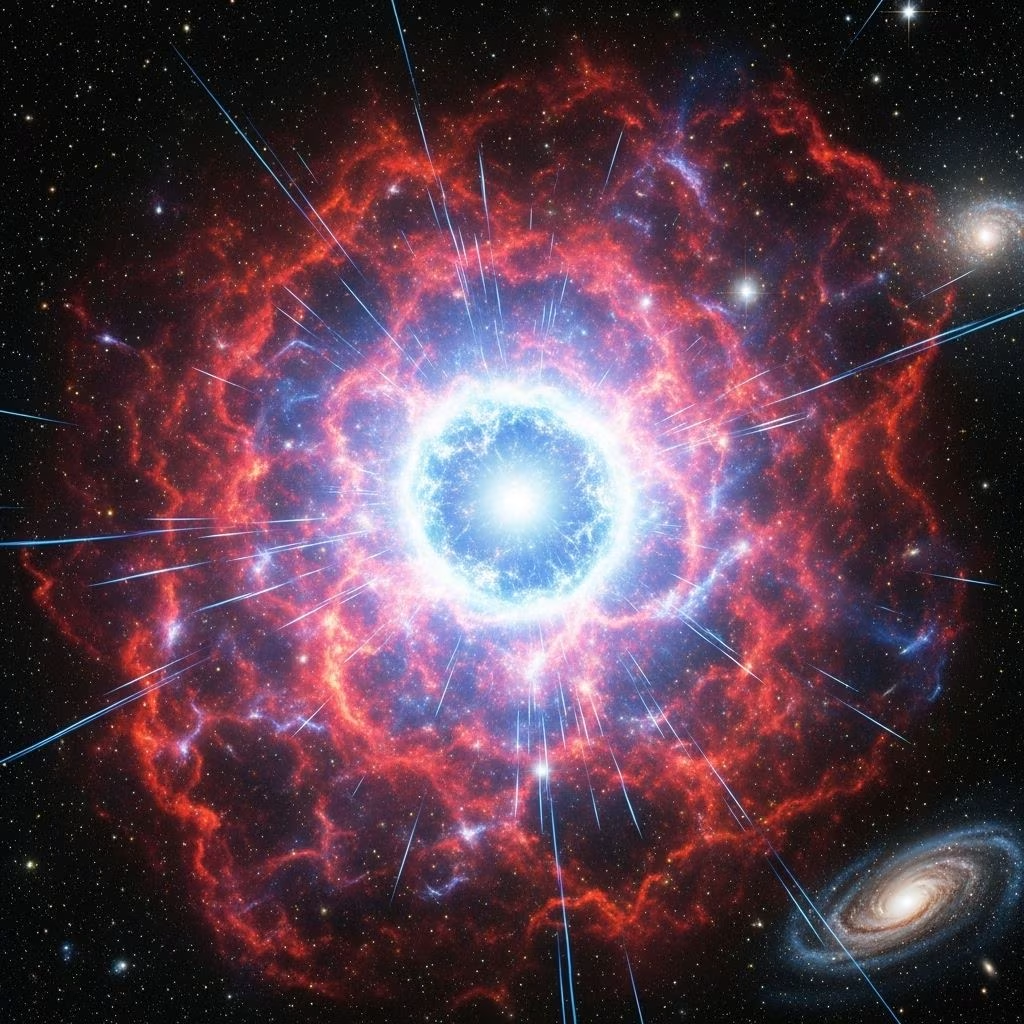
For the first time in astronomical history, scientists have observed a supernova explosion so powerful that it exposed the very heart of the dying star. This stellar event, designated SN2021yfj and located 2.2 billion light-years away, has given researchers an unprecedented glimpse into the deep, elemental structure of a massive star, upending existing theories of stellar evolution and igniting excitement throughout the astrophysical community.
The Usual Story of Stellar Death
When stars many times the mass of our sun meet their end, they erupt in cataclysmic supernova explosions. Typically, astronomers study the light from these explosions to learn about the star’s outermost layers, which are dominated by hydrogen and helium. These layers are relatively easy to detect because they exist at the surface, shining brightly in the stellar swan song. Occasionally, deeper layers comprised of elements like carbon and oxygen are briefly glimpsed, but the dense, heavy interior—laden with elements such as silicon and sulfur—is usually hidden beneath thick shells of lighter elements.
- Core-collapse supernovae: Massive stars that exhaust their fuel and experience a gravitational collapse, triggering an explosive rebirth.
- Thermonuclear (Type Ia) supernovae: White dwarf stars accreting matter from a companion, reaching critical mass and detonating.
Historically, these explosions confirm the idea that stars are layered like onions, with lighter elements incubating heavier ones deep within. Observational evidence for this stratification, while strong in theory, remained frustratingly elusive.
The Extraordinary Case of SN2021yfj
What makes SN2021yfj so radical is the near-total absence of cues from hydrogen or helium. Instead, astronomers examining its spectrum with the Keck Observatory detected the pronounced presence of heavy ions: silicon, sulfur, and argon—elements usually shielded beneath upper layers. This is a compelling and direct confirmation of stellar theories, showing the innermost skeleton of the dying star laid bare by an extreme act of cosmic exposure.
- Discovery instrument: Zwicky Transient Facility (ZTF)
- Follow-up observations: Keck Observatory, Hawaii
- Distance from Earth: 2.2 billion light-years
- Lead investigator: Steve Schulze, Northwestern University’s CIERA
Never before has such a stripped-down state been observed in a supernova. “This is the first time we have seen a star that was essentially stripped to the bone,” said Schulze. The fallout not only ratifies the onion-layer paradigm but also provides scientists an ultra-rare window into a star’s last, most secret phases before exploding.
Implications for Stellar Structure and Theory
Astrophysicists have theorized for decades that inside a massive star, nuclear fusion progresses through a sequence of shells. The lightest, hydrogen, fuses first, followed by helium, and so forth, with fusion of heavier and heavier elements taking place as each outer layer is exhausted. In the most extreme stars, this chain of reactions creates nested shells of carbon, neon, oxygen, silicon, and eventually iron. Once this process reaches iron, the star can no longer support itself, sparking the supernova explosion.
| Layer | Element | Status in SN2021yfj |
|---|---|---|
| Surface | Hydrogen | Missing/absent |
| Shell 2 | Helium | Missing/very faint |
| Shell 3+ | Carbon, Oxygen, Neon, Magnesium | Strongly depleted |
| Core | Silicon, Sulfur, Argon | Exposed and observed |
Until now, even the most energetic supernovae left at least some exterior matter intact, hiding the deepest layers. By exposing its interior, SN2021yfj has validated models about how a star’s nuclear burning advances inward, all the way to silicon and sulfur.
How Did the Star Lose Its Outer Layers?
One of the great mysteries SN2021yfj presents is the process by which the star lost virtually all its outer envelopes. Stellar theory acknowledges that massive stars can shed material through various mechanisms:
- Powerful stellar winds: Intense flows propelled by radiation pressure can peel away the less tightly bound outer layers over time.
- Binary star interactions: Many massive stars exist as close binaries, where a companion star can strip material from its partner, accelerating the loss of outer shells.
- Pre-supernova eruptions: Some stars experience violent outbursts or mass ejections in their late stages, further whittling down their bulk.
In the case of SN2021yfj, astronomers detected a shell of gas rich in helium around the site—unusual because helium is generally expelled early during supernova preparation. This anomaly has prompted speculation that:
- The star may have had a close binary companion exerting pronounced tidal forces.
- A series of catastrophic mass-loss events led to the rapid expulsion of envelope layers.
- An unprecedentedly powerful wind or eruption stripped the star further than previously thought possible.
The leading hypothesis, as stated by Schulze and his team, is that the “star simply tore itself apart.” The star’s core, under gigantic pressure and heat, could have reignited nuclear fusion stages triggering a domino of mass ejections, paving the way for a visually exposed core at the moment of collapse.
Supernova Classification: Where Does SN2021yfj Fit?
Supernovae are categorized by the spectra they produce, corresponding to the layers of elements present when the explosion occurs. The traditional scheme is as follows:
- Type I: No hydrogen lines in their spectra.
- Type II: Display hydrogen lines.
- Further subdivisions based on the presence or absence of helium, silicon, and oxygen.
Existing subtypes already reflect the stages of stripping:
- Type Ib: No hydrogen, some helium.
- Type Ic: No hydrogen, no helium—deeper stripping.
However, SN2021yfj stands apart even from Type Ic, exhibiting classic signatures of a star with its outer layers stripped entirely away to expose the silicon core. This could represent a new, as-yet-unnamed class of “extremely stripped” or “naked core” supernova.
Stellar Alchemy: Forging the Elements
Stars are cosmic factories for elements, fusing hydrogen into helium, then building up to heavier elements across millions of years:
- Hydrogen fuses to form helium over millions of years.
- Helium fuses into carbon via the triple-alpha process.
- Carbon burning leads to neon, then oxygen, then silicon—each successively faster and shorter-lived phase.
- Silicon burning, the final act before collapse, lasts merely days; it yields iron. No further energy is gained from iron fusion, so the star must collapse.
Each phase creates a distinct layer, and as the elements are fused, strong winds or companion interactions can strip these layers away. What scientists have now witnessed in SN2021yfj is the direct evidence of this process: layers peeled back almost all the way, down to the silicon shell.
Implications for the Universe’s Elemental Makeup
Supernovae do more than end stars—they seed entire galaxies with heavy elements forged in their furnaces. Observations of SN2021yfj reinforce this critical role, offering clues about where and how fundamental elements are introduced into the cosmic environment:
- Silicon and sulfur, essential for forming terrestrial planets and life, are cast out by such explosive events.
- This supernova’s unique exposure demonstrates how even core materials can be ejected into deep space, rather than being locked within compact remnants.
- Understanding the true frequency and variety of extreme core-exposing supernovae will reshape estimates of the cosmic chemical abundance.
Challenges to Existing Theory
While supporting some long-held ideas, SN2021yfj also upends others. Conventional wisdom predicted only partial stripping by winds, eruptions, or even binary companions, never to such a profound extent. The detection of helium in conjunction with near-total stripping of lighter shells suggests processes not fully accounted for in models. Future research will need to dig into:
- The frequency of such extreme mass-loss events among massive stars.
- The dynamic interactions in binary systems that may accelerate this stripping.
- The possible contribution of as-yet-unknown or unmodeled stellar instabilities.
This discovery motivates theorists to revisit stellar models and update simulations to accommodate dramatic stripping mechanisms capable of exposing a core.
Looking Forward: A New Window on Cosmic Death
The case of SN2021yfj stands as a beacon for ongoing and future sky surveys striving to capture the most fleeting and extreme cosmic events. Instruments like the Zwicky Transient Facility and Keck Observatory are at the forefront, but as next-generation observatories come online, astronomers hope to detect more examples.
- New technologies will increase sensitivity, making it possible to see supernovae even further away or at earlier evolutionary phases.
- Refined spectral analysis will allow for the detection and classification of even more nuanced types of stellar explosions.
- Broader theoretical models will need to consider a wider variety of end-of-life stellar behaviors.
By mapping these unusual events, scientists aim to map the cosmic cycle of element creation and dispersal, tracing everything from planetary formation to the emergence of life itself back to the chaotic deaths of distant, massive stars.
Frequently Asked Questions (FAQs)
Q: What makes SN2021yfj different from other supernovae?
A: SN2021yfj is the first observed supernova stripped almost completely to its inner silicon and sulfur layers, providing direct evidence of the elemental onion-like structure theorized for massive stars.
Q: How did astronomers detect the deep layers of SN2021yfj?
A: Using Keck Observatory’s spectroscopy, scientists detected ionized silicon, sulfur, and argon—elements typically buried beneath lighter, outer layers and not observed in other supernovae.
Q: What are the implications for our understanding of the universe?
A: This discovery confirms and challenges theoretical models of stellar life cycles, reshaping our understanding of how heavy elements are distributed throughout the cosmos.
Q: Could this type of supernova be common?
A: It’s currently unclear. The event is rare in observation, but future sky surveys may reveal whether such extreme stripping is more common than once thought.
Q: Why is studying supernovae important?
A: Supernovae drive the cosmic ecosystem by dispersing heavy elements necessary for planets and life, and provide valuable insight into the physics of stars and galaxies.
References
- https://www.space.com/astronomy/astronomers-discover-strange-new-type-of-supernova-this-is-the-first-time-we-have-seen-a-star-that-was-essentially-stripped-to-the-bone
- https://phys.org/news/2025-08-exposed-core-supernova-scratcher.html
- https://scitechdaily.com/astronomers-stunned-by-strange-supernova-stripped-to-its-core/
- https://www.space.com/astronomy/exoplanets/doomed-cannibal-star-could-soon-explode-in-a-supernova-so-bright-it-would-be-visible-during-the-day
- https://www.nature.com/articles/s41586-025-09375-3
- https://keckobservatory.org/sn2021yfj/