Supermoon Facts: A Complete Guide to Earth’s Biggest Full Moons
Supermoons are among the most captivating astronomical events visible from Earth. These rare occurrences turn the moon into a dramatically larger and brighter orb in the night sky, capturing the imagination of skywatchers and sparking myths and scientific inquiry alike. But what exactly causes these brilliant displays? This detailed guide explores the science, history, and awe-inspiring facts behind supermoons.
What Is a Supermoon?
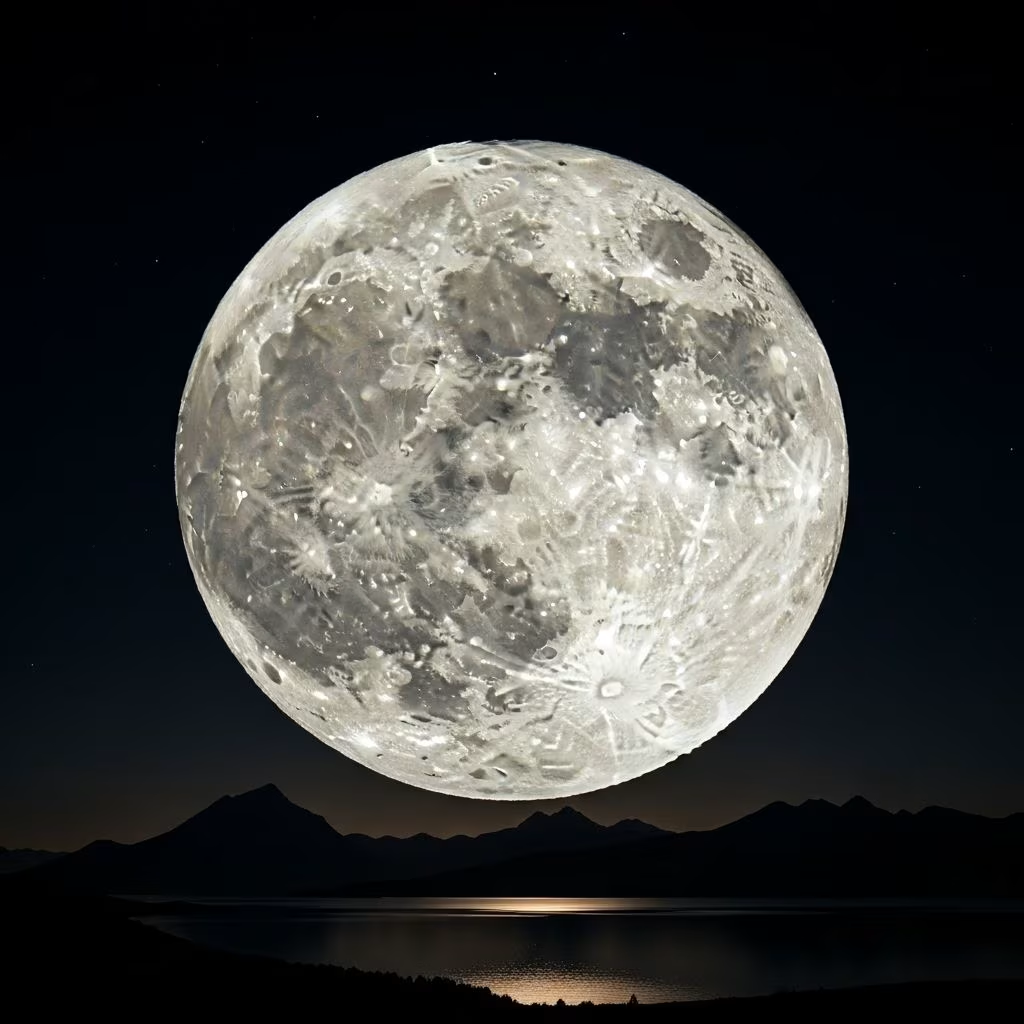
Supermoon is a popular, non-scientific term for a full moon that occurs near the Moon’s closest approach to Earth during its elliptical orbit—a point known as perigee. This makes the moon appear unusually large and bright in the night sky.
- The term was coined by astrologer Richard Nolle in 1979.
- While not an official astronomical designation, NASA and astronomers use it to describe a full moon that comes within 90% of its closest distance to Earth.
- The scientific name is “perigee-syzygy of the Earth-Moon-Sun system”—a full or new moon near perigee.
How Often Do Supermoons Occur?
Supermoons are relatively rare phenomena. Here’s how their frequency breaks down:
- Supermoons generally happen about 3–4 times per year, and always in consecutive months.
- Astronomical and tidal definitions differ slightly, but the supermoon label applies to full moons that occur within a certain closeness to perigee, typically defined as within 90%.
- Not every year offers a supermoon spectacle, and sometimes they may occur two or three months in a row.
Why Does the Moon Look Bigger?
The apparent increase in size and brightness during a supermoon is due to its proximity to Earth—but there’s more to the effect than meets the eye.
- At perigee, the Moon is up to 14% larger and 30% brighter than an average full moon[10].
- Moon Illusion: When low near the horizon, any full moon (including a supermoon) appears even bigger, a visual trick known as the moon illusion. This is caused by the human brain’s perception, not a real increase in size.
The combination of real astronomical size differences and this optical effect makes supermoons dramatic and memorable.
The Moon’s Orbit: Perigee and Apogee
The Moon’s orbit around Earth isn’t a perfect circle—it’s an ellipse. This means the Moon has moments when it is closest to us (perigee) and farthest away (apogee):
| Approximate Distance from Earth | |
|---|---|
| Perigee | 363,300 km (226,000 miles) |
| Apogee | 405,500 km (251,000 miles) |
- A supermoon happens when the full moon aligns with the Moon’s perigee.
- The position of perigee changes over time due to gravitational interactions, so the exact distance varies with each event.
Supermoon Size and Brightness
Just how “super” is a supermoon? Here are some key facts:
- Appears up to 14% larger and 30% brighter than an average full moon, though the difference can be subtle to the naked eye[10].
- The moon’s actual diameter does not change—only its distance from Earth does.
- Brightness increases by about 30%, making the lunar features stand out more sharply for observers—especially with telescopes or binoculars.
How to Watch a Supermoon
Observing a supermoon requires no special equipment. Here are some tips for getting the best view:
- Find an unobstructed horizon and watch as the moon rises—this is when the moon appears biggest due to the moon illusion.
- Use binoculars or a telescope for a closer look at lunar craters and details.
- Photograph the supermoon with reference objects like buildings or trees for dramatic effect and a sense of scale.
- Check moonrise and moonset times for your location to plan your viewing
Supermoon Effects on Earth
Besides being a visual treat, supermoons can have subtle effects on our planet:
- Tides: Supermoons amplify the strength of tidal forces, producing higher high tides and lower low tides, sometimes called “perigean spring tides”[10].
- Earthquakes and Volcanic Activity: There is no scientific evidence linking supermoons to an increased risk of earthquakes or volcanic eruptions[10].
- Impacts on Wildlife: Some researchers believe that brighter and larger full moons (including supermoons) may influence animal behaviors, especially those of nocturnal or migratory species.
Notable Supermoon Events
Supermoons have inspired headlines and excitement, especially during particularly close approaches. Some of the most famous supermoons include:
- November 14, 2016: This was the closest supermoon since 1948, coming within 221,524 miles (356,509 km) of Earth and appearing especially large and bright.
- Historical supermoons have been recorded and celebrated in cultures worldwide.
Each year, astronomers publish dates for upcoming supermoons so observers can mark their calendars.
Myths and Misconceptions
Because supermoons are visually striking, they are subject to many myths and misunderstandings. Here are the facts:
- Supermoons are not dangerous. They have no direct impact on human affairs or behavior beyond their effects on tides.
- The increase in size and brightness, while real, often goes unnoticed by casual observers compared to an average full moon.
- Supermoons do not cause natural disasters or unusual weather.[10]
Supermoon Varieties: Blood Moon, Blue Moon, and More
Supermoons can sometimes coincide with other lunar events, creating even more dramatic sky shows:
- Super Blood Moon: When a supermoon coincides with a total lunar eclipse, the moon takes on a reddish hue due to Earth’s atmosphere scattering sunlight—this is called a “super blood moon”[10].
- Super Blue Moon: If two full moons occur within a single calendar month, the second is a “blue moon.” A “super blue moon” is a rare event where this coincides with perigee[10].
- Harvest Moon & Hunter’s Moon: These seasonal names refer to the full moons closest to the fall equinox but can sometimes be supermoons as well[10].
Frequently Asked Questions (FAQs)
Q: Who invented the word ‘supermoon’?
A: The term “supermoon” was coined by astrologer Richard Nolle in 1979. It is now widely used, though not an official astronomical designation.
Q: How much bigger is a supermoon than a normal full moon?
A: A supermoon can appear up to 14% larger and 30% brighter than average, though the size difference may be subtle to the naked eye[10].
Q: How can I tell if the full moon I’m seeing is a supermoon?
A: Unless you compare photographs of the moon at supermoon and apogee, the difference is minor. Online calendars and astronomy resources usually announce supermoon dates ahead of time.
Q: Are supermoons dangerous or linked to earthquakes?
A: There is no scientific evidence whatsoever that supermoons cause earthquakes, volcanoes, or other disasters. Their main physical influence is on ocean tides[10].
Q: Can I see a supermoon every year?
A: Most years have at least one supermoon, sometimes two or more in a row, but not every year guarantees a supermoon depending on calendar definitions.
Fascinating Supermoon Facts
- The Moon’s elliptical orbit means the difference between a “minimoon” (full moon at apogee) and supermoon can approach 50,000 km in distance.
- Supermoons may appear larger when seen near the horizon at moonrise due to the Moon Illusion effect—not a real change in distance.
- Not every full moon near perigee qualifies as a supermoon; the exact cutoff can depend on the chosen definition, leading to debates among astronomers and enthusiasts.
- Supermoons throughout history have inspired art, literature, and scientific research.
How to Photograph a Supermoon
With the rise of digital photography and smartphones, documenting supermoons has never been easier. Here are some quick tips:
- Use a tripod or stable surface to prevent camera shake.
- Include foreground elements (silhouettes of trees, buildings) for striking visual context.
- Try different exposures—since the moon is bright, underexposing the shot often results in better detail.
- Use a zoom lens or telescope adapter for close-ups of lunar features.
When Is the Next Supermoon?
Supermoons receive plenty of attention in astronomical calendars. To find out when the next one will appear in your area, consult resources like official NASA announcements or major astronomical websites. Mark your calendar—these stunning full moons are truly worth witnessing!
References
- https://www.space.com/21669-supermoon-full-moon-surprising-facts.html
- https://www.space.com/34676-closest-supermoon-since-1948-surprising-facts.html
- https://spaceplace.nasa.gov/full-moons/en/
- https://science.nasa.gov/moon/supermoons/
- https://www.timeanddate.com/astronomy/moon/super-full-moon.html
- https://en.wikipedia.org/wiki/Supermoon
- https://www.rmg.co.uk/stories/space-astronomy/what-supermoon
- https://starwalk.space/en/news/what-is-supermoon
- https://www.adlerplanetarium.org/blog/5-things-to-know-about-supermoons/
- https://www.ebsco.com/research-starters/astronomy-and-astrophysics/supermoon
- https://skyandtelescope.org/observing/what-is-a-supermoon/
- https://www.educationworld.com/a_news/6-incredible-%E2%80%98supermoon%E2%80%99-facts-tell-your-students-1540592722
- https://www.nhm.ac.uk/discover/what-is-a-supermoon.html
- https://www.youtube.com/watch?v=NCsYcB1EKEc
- https://www.youtube.com/watch?v=8DJc7p1WDSE
- https://theplanets.org/the-moon/supermoon-facts/
- https://www.worldatlas.com/space/what-is-a-supermoon.html
- https://www.britannica.com/science/supermoon
- https://www.planetary.org/night-sky/what-is-a-supermoon