Time Travel: The Science, Paradoxes, and Possibilities
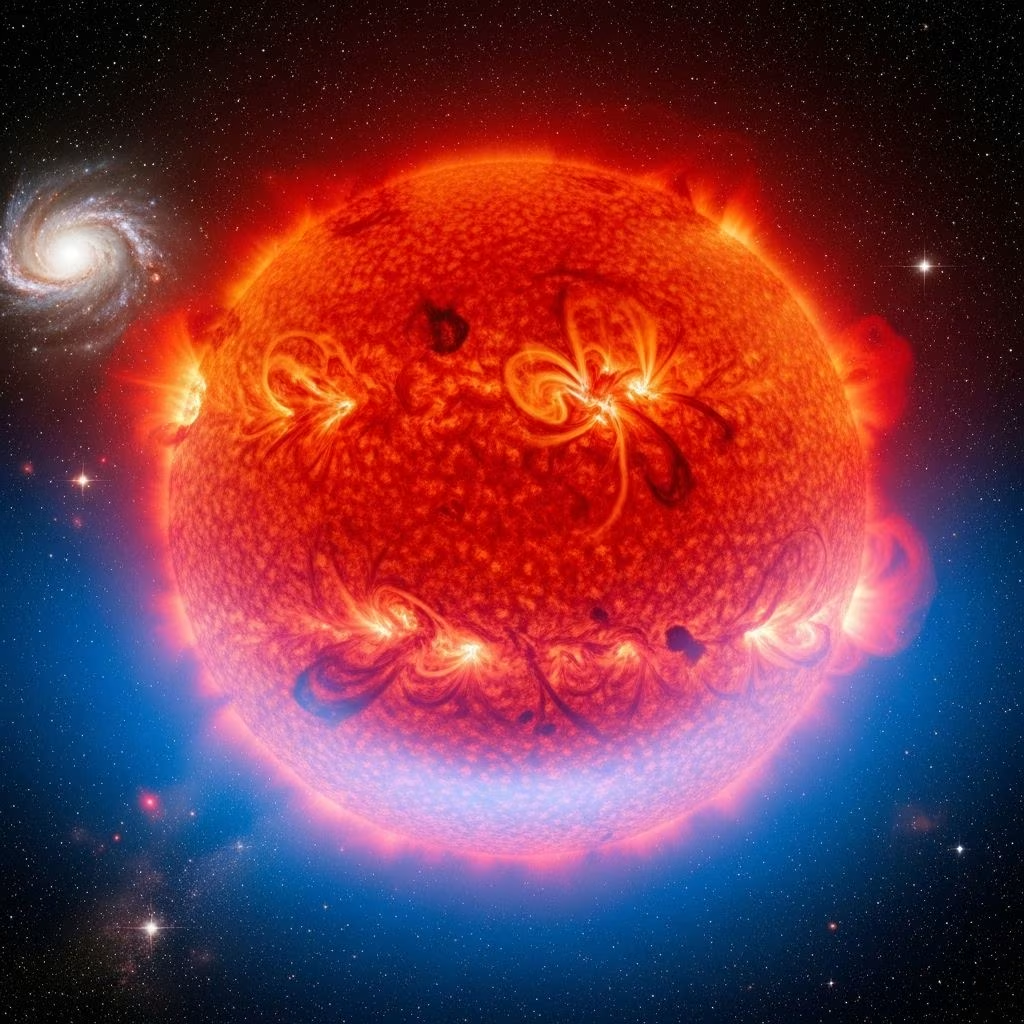
Time travel is a subject that has fascinated humans for centuries, seamlessly weaving together the realms of science fiction and scientific exploration. While popular movies and books have painted vivid pictures of adventures across different eras, experiments and theories in modern physics suggest that time travel may be more plausible—though stranger—than once imagined. This article delves into the nature of time, the foundations of time travel in physics, real-world experiments, paradoxes, and modern advances that could one day make journeys through time a reality.
What is Time Travel?
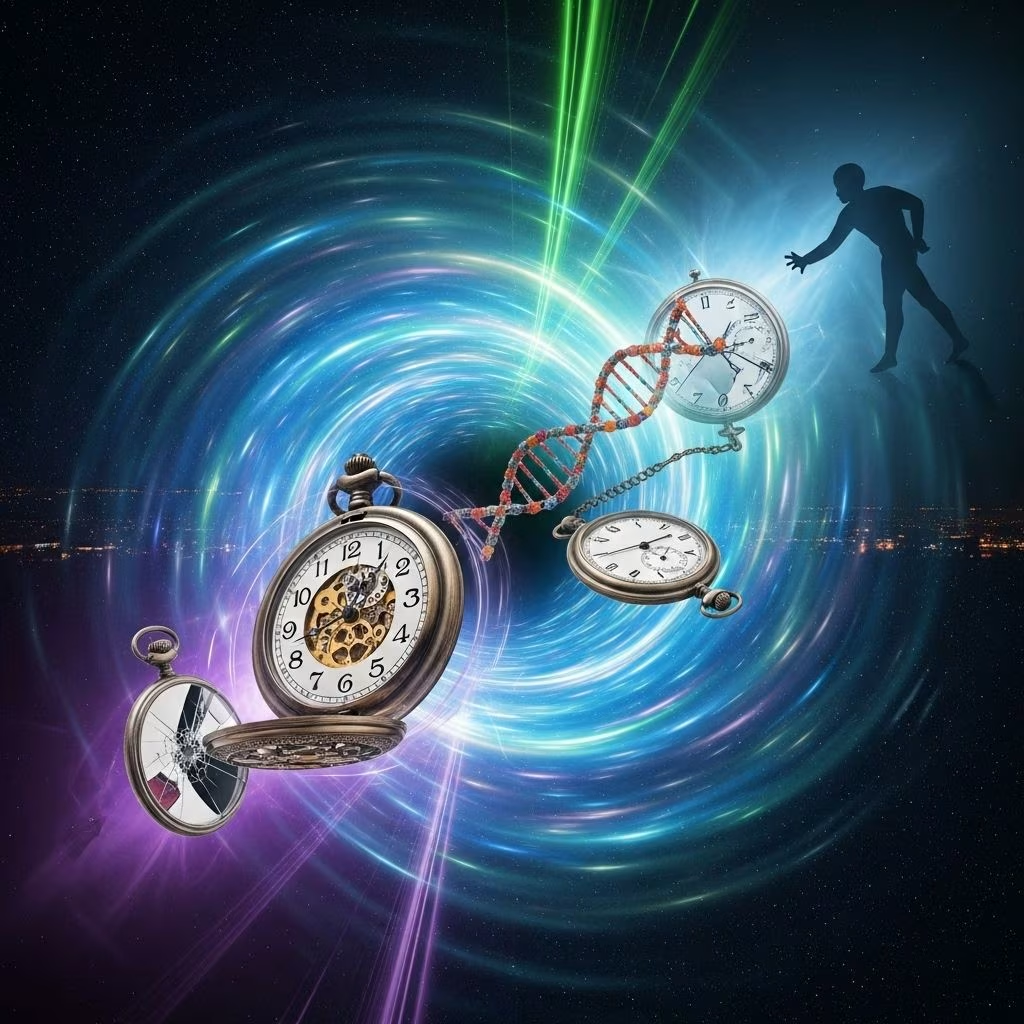
At its core, time travel describes the ability to move between different points in time, analogous to how we move between places in space. Unlike spatial movement, time seems to flow in one direction for all of us, but the theories of modern physics suggest that, under certain circumstances, this flow might be diverted or altered.
- Forward time travel: Progression into the future at a pace different from others.
- Backward time travel: Movement to points in the past, potentially encountering past events or one’s earlier self.
- Perception vs. Reality: While everyone “travels” at a constant rate (one second per second), the dream of jumping forward or backward through time has been explored both in literature and science.
The Origins of Time Travel in Science Fiction
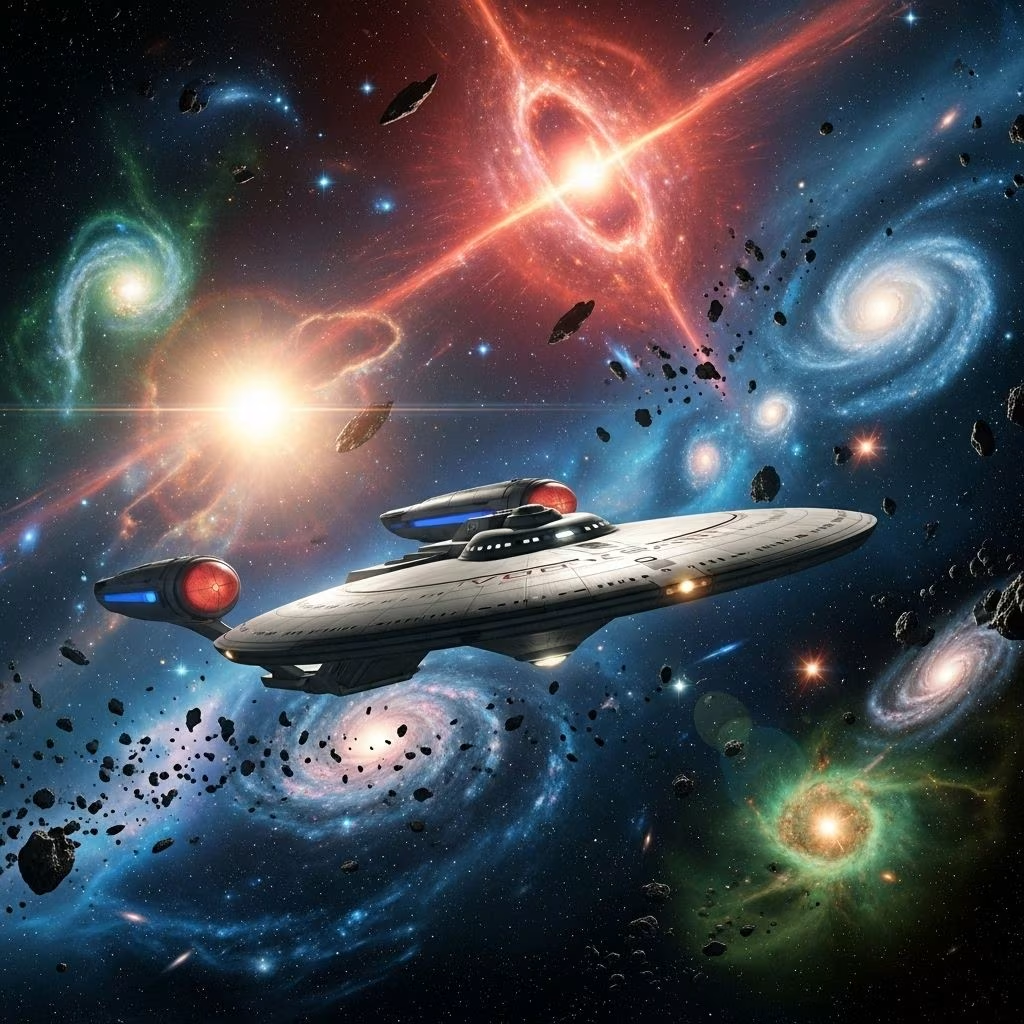
Long before modern science began to study time travel, the idea had already captivated the imagination of authors and philosophers. Works such as H.G. Wells’ The Time Machine ignited the notion of mechanical journeys through different eras, inspiring generations of stories and the popular image of time machines, wormholes, and paradoxical adventures.
Why Do We Care About Time Travel?
- The allure of correcting mistakes or reliving precious moments.
- Understanding the nature of regret and the passing of time.
- Exploring the boundaries of cause and effect.
- Imagining the impact of changing history—on oneself and the world.
These emotional and philosophical themes underpin why time travel continues to inspire both intricate stories and scientific curiosity.
Time Travel and Einstein’s Relativity
The science of time travel became plausible with the advent of Albert Einstein’s theories of relativity more than a century ago. Einstein’s insights revolutionized our understanding of time, revealing it not as a constant, universal clock but as a measurement intimately tied to speed, gravity, and space itself.
Special Relativity: Time Slows at Speed
Einstein’s special theory of relativity shows that the faster an object moves, the more slowly it experiences time relative to a stationary observer. This phenomenon, known as time dilation, isn’t just theoretical—it has been experimentally verified:
- The Hafele–Keating experiment: Two synchronized atomic clocks were tested: one remained on Earth, while the other flew around the globe aboard a jet. Upon comparison, the traveling clock lagged slightly behind the stationary one, demonstrating that high-speed travel causes measurable time dilation.
- GPS satellites: Because these satellites move rapidly in orbit and are farther from Earth’s gravity, their clocks must be precisely adjusted for these relativistic effects.
Table: Observed Examples of Time Dilation
| Experiment/Instance | Context | Observed Effect |
|---|---|---|
| Airplane atomic clocks | High-speed flight around the Earth | Slower clock relative to Earth clock |
| GPS satellites | Orbital velocity + lower gravity | Clock corrections needed to sync with ground time |
| Manned space missions | High velocity over long periods | Tiny age difference upon return |
General Relativity: Time Bends Near Gravity
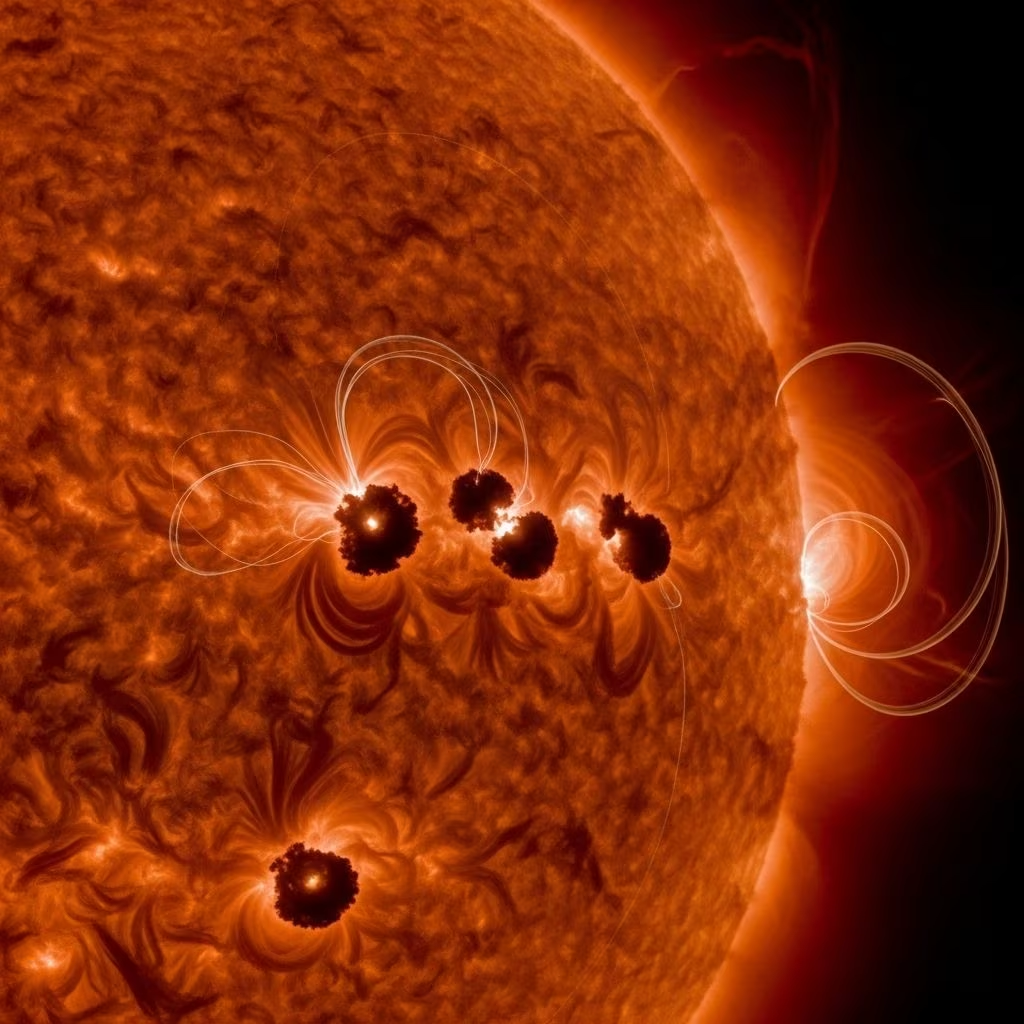
Einstein’s general theory of relativity extended these ideas to gravity. Time passes more slowly near massive objects—a phenomenon crucial to the accuracy of everyday technologies and navigation. For instance, the deeper you are in a gravitational well (such as near a planet or a star), the slower time moves relative to a higher position far from gravity.
- This effect is highly pronounced near black holes, where gravity can nearly halt the passage of time for an observer far away.
- For astronauts on the International Space Station, the opposing influences of velocity (slowing time) and reduced gravity compared to Earth (slightly speeding time up) must both be accounted for.
How Time Travel Could Happen: Theoretical Possibilities
While forward time travel—as in moving into the future at a different rate—is well-supported by relativity, getting to the past presents a much tougher challenge. Still, scientists have theorized about possible techniques that could allow time travel both forward and backward.
Wormholes: Shortcuts Through Spacetime
Wormholes are hypothetical tunnels through spacetime, connecting disparate points and potentially enabling shortcuts between past and future. Predicted by solutions to the equations of general relativity, they remain speculative, as sustaining them would likely require “exotic matter” with negative energy—something not proven to exist.
Closed Timelike Curves and New Models
Recent research has revived interest in time travel thanks to mathematical models involving closed timelike curves (CTCs)—paths through spacetime that loop back on themselves. Once believed impossible without strange and physically unrealistic conditions, new models show that CTCs might occur in more ordinary circumstances:
- Physicist John D. Norton developed a model, based on Einstein’s relativity, where spacetime shapes allow loops in time—potentially, no “strange matter” required.
- Such models reopen the door to time travel, at least mathematically.
Paradoxes and the Logic of Time Travel
Perhaps the greatest challenge to time travel—especially backward time travel—comes from paradoxes. The most famous of these is the grandfather paradox:
- If you travel back to a time before your grandfather had children and prevent his meeting your grandmother, you would never be born, so you couldn’t travel back and prevent their meeting.
Stephen Hawking famously suggested that the universe must have some mechanism to prevent such paradoxes—the Chronology Protection Conjecture.
New Perspectives: No Paradox Required?
However, research by Dr. Fabio Costa and Germain Tobar from the University of Queensland has turned that logic on its head. Their work suggests that events would self-adjust to preserve consistency, preventing contradictions without requiring paradoxes:
- Even if you intervened in the past, the universe would adjust other events so that your action would not produce an impossible outcome.
- This could mean that “free will” in the past is constrained by the requirement for consistency, but does not halt the possibility of interacting with your own past.
While largely theoretical, such ideas make backward time travel seem less logically impossible—and invite new kinds of mind-bending possibilities.
Time Travel Today: Reality in the Lab
Modern experiments and technologies already rely on relativistic effects, and in some sense, time travel—at least into the future—is an everyday reality:
- Cosmic observations: When astronomers study distant galaxies, they are literally looking back in time—their telescopes capture light that left its source millions or billions of years ago.
- Particle physics: High-energy particles accelerated to near-light speed experience time at a much slower rate than stationary particles.
- Astronauts: Prolonged spaceflight at high speeds leads to imperceptibly tiny variations in aging compared to those on Earth, effectively making spacefarers time travelers—by fractions of a second.
Challenges and Limits to Time Travel
Despite these intriguing effects, significant barriers remain to practical, macroscopic time travel:
- Energy requirements: Moving at relativistic speeds or creating the conditions for wormholes would require enormous—potentially unattainable—amounts of energy.
- Engineering unknowns: Building and stabilizing a device capable of navigating closed timelike curves or traversing wormholes presents challenges well beyond current technology.
- Causality and safety: Even models that avoid paradoxes do not eliminate concerns about causality, information loops, or unforeseen side effects.
Can We Change the Past?
Most modern models suggest that while movement through time, including into the past, may be possible within the laws of physics, the timeline would “self-heal” to avoid direct contradictions. This perspective does not preclude revisiting the past—but likely makes changing it impossible.
Time Travel in Popular Culture
No article on time travel would be complete without acknowledging how it has permeated books, movies, and art. Iconic examples include:
- The Time Machine by H.G. Wells (the original literary time travel adventure)
- Back to the Future (cinematic exploration of time loops and causal chaos)
- The Time Traveler’s Wife by Audrey Niffenegger (a human tragedy wrapped in chronology)
- Looper, Outlander, Doctor Who (diverse takes on paradoxes and consequences)
Such stories reflect humanity’s fascination with what might be, and what might have been, making time travel a perennial canvas for both drama and wonder.
Frequently Asked Questions (FAQs)
Q: Does time travel violate the laws of physics?
A: No known law absolutely forbids time travel. Einstein’s theory of relativity, in fact, predicts mechanisms—such as time dilation and gravitational time warps—that are consistent with time travel, at least into the future.
Q: Is backward time travel possible?
A: While moving forward into the future at different rates is experimentally verified, travel to the past remains hypothetical. Some mathematical models permit it via closed timelike curves or wormholes, but it has not been observed.
Q: What prevents time paradoxes?
A: New theoretical models suggest that events would self-correct to avoid paradoxes—meaning the past cannot be changed to create contradictions.
Q: How do scientists test time travel theories?
A: Experiments with atomic clocks, satellites, and high-energy particles demonstrate time dilation. Theoretical work with Einstein’s equations explores the extreme conditions that might allow more dramatic time travel.
Q: When will practical time travel be possible?
A: There is no evidence practical time travel will be available soon, if ever. The physical and technological challenges remain enormous.
Conclusion: The Future of Time Travel
Time travel remains, for now, a blend of scientific theory and fantastic imagination. Relativity proves time can branch and bend; paradoxes may not be the showstopper they once seemed; and every new discovery brings fresh wonder and more questions. Whether our journeys through time will ever go beyond atomic clocks and distant galaxies is unknown, but the science continues—and so does the human urge to understand, witness, and maybe one day chart the rivers of time.
References
- https://www.space.com/entertainment/space-books/could-time-travel-tourism-be-the-next-space-tourism-op-ed
- https://www.space.com/time-travel-origins.html
- https://spaceplace.nasa.gov/time-travel/en/
- https://en.wikipedia.org/wiki/Time_travel
- https://www.youtube.com/watch?v=bnvDdsKOWFk
- https://time.com/3951160/the-space-time-continuum/
- https://urfjournals.org/open-access/time-travel-the-universe-explained.pdf
- https://science.nasa.gov/mission/hubble/science/science-behind-the-discoveries/time-travel-observing-cosmic-history/
- https://time.com/archive/6619885/science-journey-into-space/
- https://www.metastellar.com/nonfiction/writing-advice-of-the-week/traveling-through-space-time-physics-vs-fantasy/
- https://futurism.com/new-research-shows-that-time-travel-is-mathematically-possible
- https://science.howstuffworks.com/science-vs-myth/everyday-myths/time-travel.htm
- https://www.spacecentre.co.uk/news/space-now-blog/the-cans-and-can-ts-of-time-travel/
- https://scitechdaily.com/exploring-the-reality-of-time-travel-science-fact-vs-science-fiction/
- https://sciencebriefss.com/faq/how-to-travel-through-time-and-space/
- https://www.youtube.com/watch?v=HLuODNnRr1A
- https://www.astronomy.com/science/is-time-travel-possible-an-astrophysicist-explains/