What is the Goldilocks Zone?
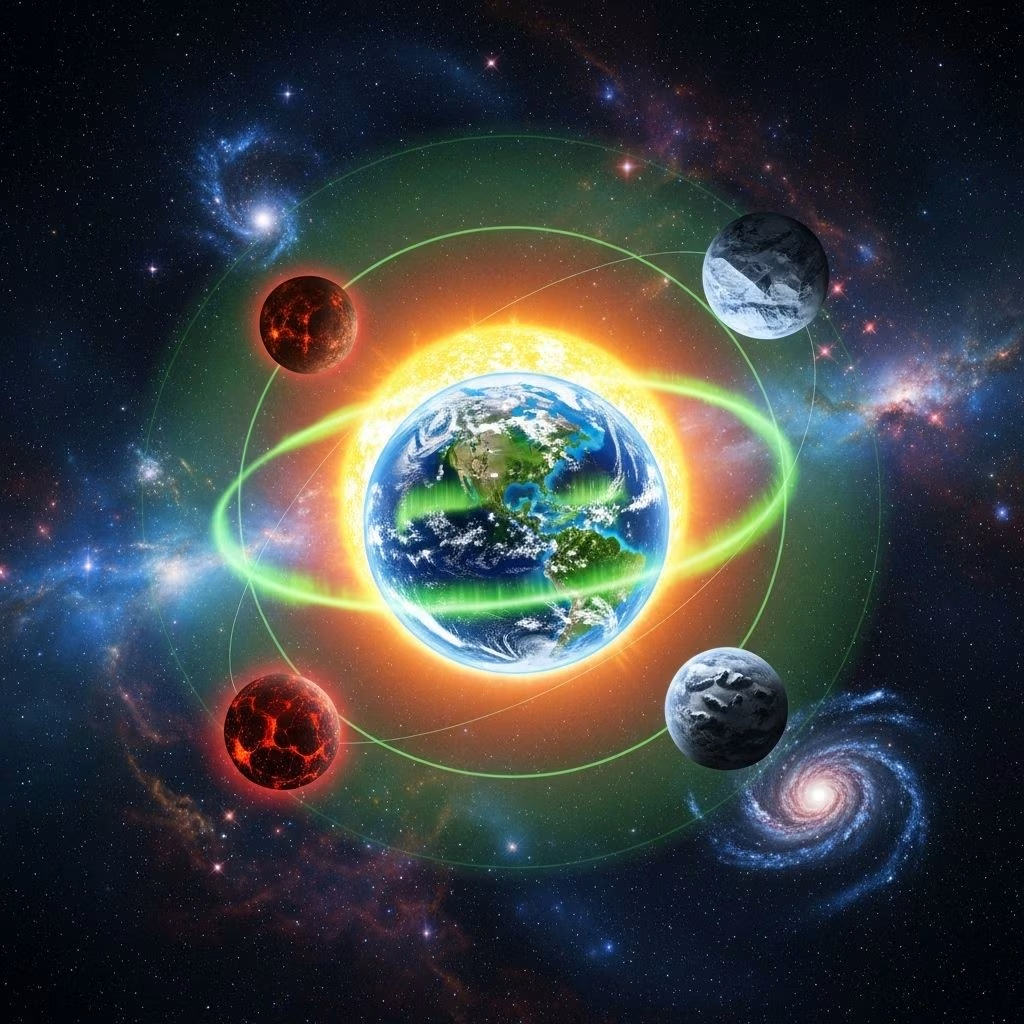
The Goldilocks zone, formally known as the habitable zone, is a region around a star where conditions are just right: not too hot and not too cold for liquid water to exist on the surface of orbiting planets. This concept is foundational to astrobiology and exoplanetary science, guiding the search for planets that might harbor life. Earth’s presence in the Sun’s Goldilocks zone is the reason our oceans remain liquid, providing a vital medium for life to flourish.
- Too close to the star: Temperatures rise, water evaporates, as seen on Venus and Mercury.
- Too far: Temperatures drop, water freezes, exemplified by Mars and Pluto.
- Just right: Temperatures allow for liquid water, like on Earth.
Origin and Evolution of the Concept
The term ‘Goldilocks zone’ draws from the English fairy tale Goldilocks and the Three Bears, where Goldilocks searches for conditions that are neither extreme nor deficient, but ‘just right’. Su-Shu Huang first coined the concept in 1959 to describe the orbital region suitable for life based on temperature and water availability. The scientific framework was further developed in Stephen H. Dole’s Habitable Planets for Man (1964) and popularized by Isaac Asimov. Over subsequent decades, planetary scientists have used increasingly sophisticated models to define the zone for a range of star types and planetary sizes.
The Science Behind Habitability
For a planet to be considered habitable:
- Surface Temperatures must support liquid water—typically between 0°C and 100°C, incorporating atmospheric effects.
- Atmospheric Composition is key; a thick atmosphere can trap heat, shifting habitable conditions outward or inward from the basic model.
- Planetary Size and Mass affect its ability to retain an atmosphere and water; rocky planets are preferred targets for habitability studies.
- Stellar Type matters: smaller, cooler stars have closer-in habitable zones; larger, hotter stars have wider regions, but may also be less stable.
Notably, the Goldilocks zone is not a guarantee of life, but it is a starting point for planetary investigation. Factors like magnetic fields, geological activity, and atmospheric chemistry further influence habitability but are harder to observe from afar.
The Role of Liquid Water
Water is central to our understanding of habitability because life as we know it on Earth originated and thrives in water.
- Liquid water acts as a solvent, enabling the complex chemistry required for biological processes.
- Extreme temperatures (either boiling or freezing) render water unsuitable for carbon-based life, limiting the scope of habitability.
- The search for new worlds thus focuses on those within the Goldilocks zone where water could exist as a liquid over geologically significant timescales.
Goldilocks Zones Around Different Types of Stars
Each star type features a different Goldilocks zone:
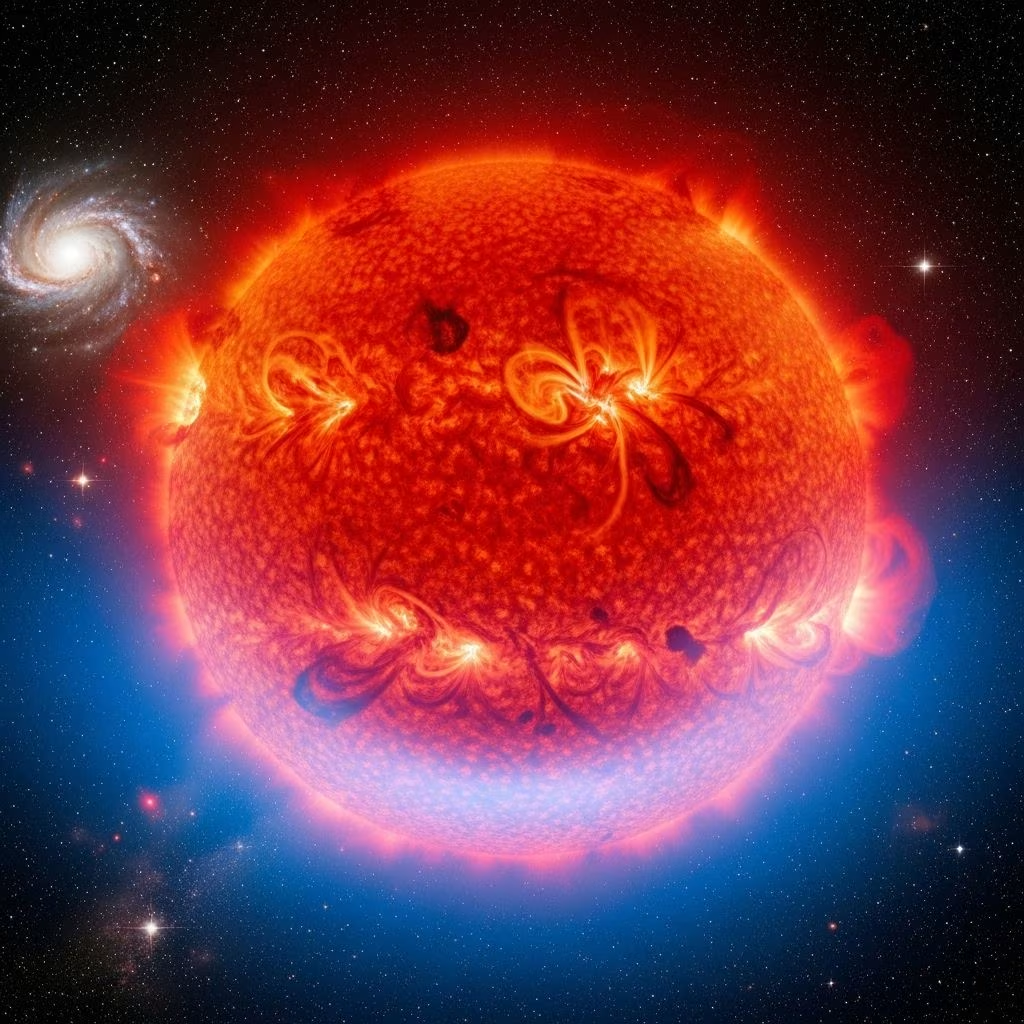
- Red Dwarf Stars: These small, cool stars have narrow, close-in habitable zones. Their abundance makes them prime targets.
- Sun-like Stars: Stars like our Sun have habitable zones at moderate distances, suited to Earth-like orbits.
- Giant Stars: Large, hot stars have wide but frequently unstable habitable zones where radiation may limit habitability.
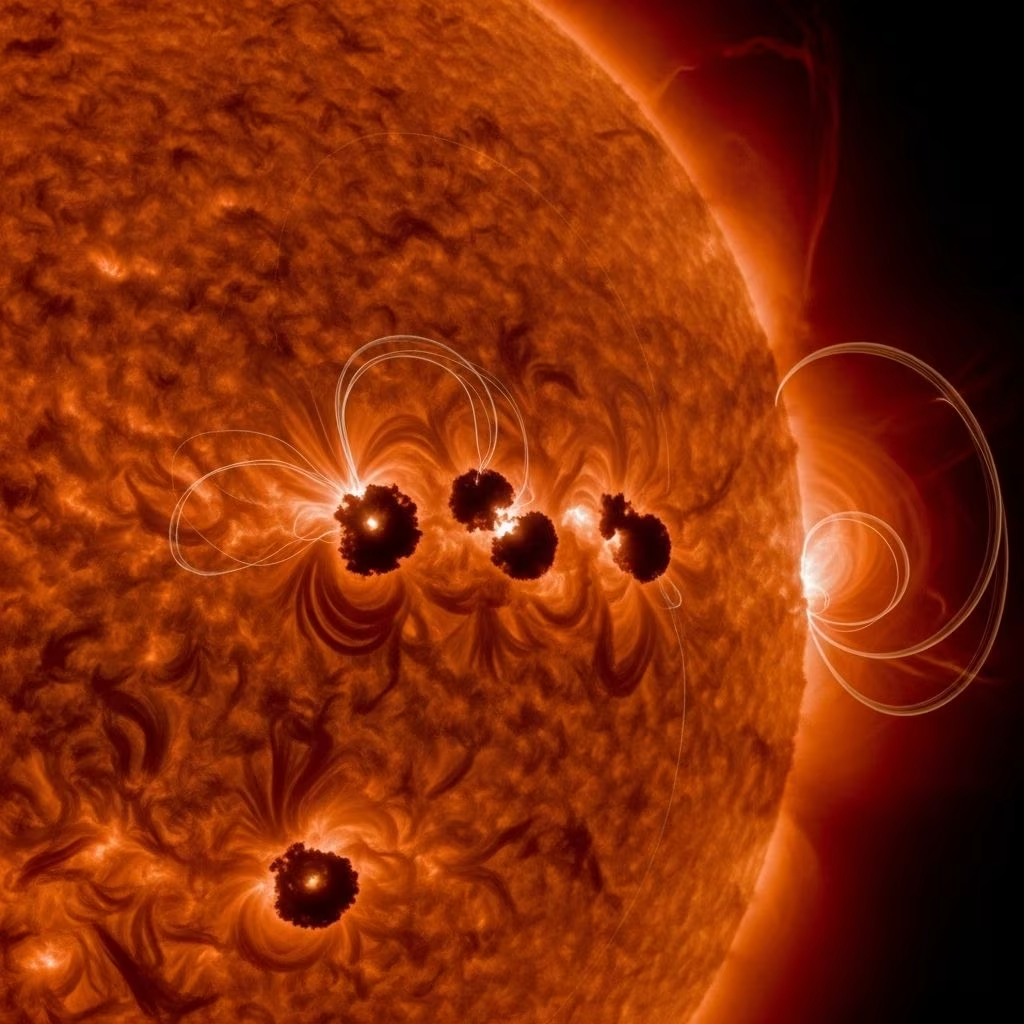
The definition of the Goldilocks zone must factor in stellar evolution as stars change brightness over their lifetimes, moving the habitable zone outward.
Recent Discoveries: Exoplanets in the Goldilocks Zone
With missions like Kepler and Hubble, astronomers have detected thousands of exoplanets, many of which reside in their star’s Goldilocks zone.
| Exoplanet | Star Type | Distance from Earth | Special Notes |
|---|---|---|---|
| TRAPPIST-1 e, f, g | Ultracool dwarf | 40 light-years | Three Earth-sized worlds in habitable zone |
| K2-18b | Red dwarf | 111 light-years | Super Earth with water vapor detection |
| Proxima Centauri b | Red dwarf | 4.2 light-years | Nearest known exoplanet in a habitable zone |
Kepler data suggest that the Milky Way may host as many as 40 billion Earth-sized planets within their stars’ habitable zones, including about 11 billion around Sun-like stars. These discoveries fuel optimism about finding life elsewhere.
Limits and Challenges of the Goldilocks Zone
While the Goldilocks zone is integral to the search for life, its limitations must be recognized:
- Planets outside the habitable zone may host life (e.g., subsurface oceans on moons like Europa), but detecting such environments is challenging.
- The presence of liquid water does not guarantee life—other essential factors such as stable climate, nutrient sources, and energy availability may be absent.
- Planetary habitability models require accurate stellar and planetary data, which is still limited for most exoplanets.
Future research may expand or redefine the Goldilocks zone as our knowledge of astrobiology grows and as missions provide new observational data.
Goldilocks Zone and Moons
Not only planets, but natural satellites (moons) in habitable zones are relevant to the emergence of life. It is hypothesized that massive moons, if present in the Goldilocks zone orbiting large exoplanets, may offer stable environments for life, potentially outnumbering habitable planets themselves.
The Search for Life in the Universe
The Goldilocks zone frames humanity’s quest to answer a fundamental question: Are we alone?
- Astronomers use spectroscopy to analyze the atmospheres of exoplanets in the habitable zone, searching for signatures of water, oxygen, methane, and other biosignatures.
- Future missions (e.g., James Webb Space Telescope) aim to improve our ability to probe these distant worlds for life-related molecules.
- Interdisciplinary collaboration between planetary science, biology, chemistry, and engineering is crucial in interpreting findings.
FAQs: Goldilocks Zone and Habitability
Q: Why is the Goldilocks Zone important in the search for extraterrestrial life?
A: The Goldilocks Zone is crucial because it defines where liquid water, a key ingredient for carbon-based life, can exist.
Q: Does the presence of a planet in the habitable zone mean life definitely exists there?
A: No. Being in the Goldilocks zone is necessary for liquid water, but life depends on many additional factors, like atmospheric chemistry, geology, and energy sources.
Q: How many planets are estimated to be in the Goldilocks zone?
A: Estimates based on Kepler data suggest about 40 billion Earth-sized planets may reside in habitable zones across the Milky Way, including roughly 11 billion around Sun-like stars.
Q: Can moons be habitable if they are in the Goldilocks zone?
A: Yes, moons with sufficient mass and the right environment in the habitable zone may be able to support life, potentially increasing the number of habitable bodies in the galaxy.
Q: Are there planets outside our solar system in the Goldilocks zone?
A: Yes, multiple exoplanets have been found in their stars’ habitable zones, including TRAPPIST-1 e, f, and g, K2-18b, and Proxima Centauri b.
Further Reading
- NASA Science: What is the habitable zone or Goldilocks zone?
- ESA/Hubble: Habitable Zone
- Wikipedia: Habitable zone
- Science News: Goldilocks Zone—the search for habitable planets
Summary
The Goldilocks zone is a vital concept in the quest for habitable worlds and extraterrestrial life. By identifying regions around stars where liquid water is possible, scientists narrow the search for environments where life might thrive. As technology advances, we continue to refine our models and broaden the criteria for habitability, drawing ever closer to answering whether Earth is the universe’s only cradle of life.
References
- https://science.nasa.gov/exoplanets/what-is-the-habitable-zone-or-goldilocks-zone/
- https://marsonearthproject.org/goldilocks-zone-the-search-for-habitable-planets/
- https://www.livescience.com/goldilocks-zone
- https://esahubble.org/wordbank/habitable-zone/
- https://en.wikipedia.org/wiki/Habitable_zone
- https://www.space.com/goldilocks-zone-habitable-area-life
- https://earthhow.com/goldilocks-zones/
- https://seas.harvard.edu/news/2019/09/goldilocks-zone-planet-size