What Is the Temperature on the Moon?
The Moon’s surface experiences some of the most extreme temperature fluctuations in the solar system. Unlike Earth, which benefits from a protective atmosphere, the Moon’s lack of atmospheric insulation leaves it exposed to searing sunlight and deep space cold. These temperature variances pose major challenges to lunar exploration and reveal important scientific insights into the Moon’s unique environment.
This article covers the full range of lunar temperatures, explains the underlying causes, compares them to Earth, explores the coldest and hottest regions, and discusses implications for astronauts and future missions.
What Causes Dramatic Temperature Swings on the Moon?
The key factors behind the Moon’s temperature extremes include:
- Lack of atmosphere: The Moon has no significant atmosphere to trap heat or insulate against the cold, so its surface temperature depends entirely on direct sunlight or contact with the cold vacuum of space.
- Slow rotation: The lunar day lasts nearly 29.5 Earth days, with about 13-14 days of unbroken sunlight followed by 13-14 days of darkness. This leads to prolonged heating and cooling cycles.
- Surface composition: The lunar regolith (soil) absorbs heat quickly but loses it just as fast, especially overnight.
- Location on the Moon: Temperatures vary significantly depending on latitude, elevation, or whether a region lies in perpetual shadow.
The Range: How Hot and Cold Does It Get?
| Location | Daytime Max (°C) | Nighttime Min (°C) | Special Regions |
|---|---|---|---|
| Equator | +120 | -130 | — |
| General Surface | 107 | -153 | — |
| South Pole (Shackleton Crater) | — | -183 | Always in shadow |
| North Pole (Hermite Crater) | — | -253 | Coldest measured in Solar System |
Daytime temperatures at the lunar equator can soar to 120°C (250°F), while nighttime highs plunge to -130°C (-208°F). In areas near the lunar poles, especially craters that never receive sunlight (“permanently shadowed regions”), temperatures drop even further:
- The Shackleton Crater at the South Pole averages -183°C (-298°F).
- The Hermite Crater near the North Pole has set a record low of -253°C (-424°F), making it the coldest known spot in the solar system.
Lunar vs. Earth Temperatures: How Do They Compare?
| Planet/Body | Mean Surface Temp (°C) | Day Extremes (°C) | Night Extremes (°C) | Atmosphere? |
|---|---|---|---|---|
| Earth | 15 | -89 to +57 | -89 to +57 | Yes |
| Moon | — | +120 | -130 | No |
| Moon (Polar Regions) | — | — | -253 | No |
Though the Moon and Earth are the same distance from the Sun, their temperatures are vastly different due to the presence of Earth’s atmosphere, which regulates heat and helps maintain more moderate conditions.
Day and Night: The Moon’s Slow Cycle
One lunar day (sunrise to sunrise) lasts about 29.5 Earth days. That means any point on the lunar surface will spend upwards of two weeks in direct sunlight, baking under the Sun’s harsh rays, followed by two weeks in darkness, rapidly losing heat to space.
During lunar daytime, the surface absorbs solar energy, becoming incredibly hot. At night, without sunlight, the temperature drops precipitously.
Because the Moon rotates so slowly, these periods of daylight and darkness are much longer than on Earth, amplifying the temperature swings.
Special Regions: The Poles and Shadowed Craters
- Polar Craters: Some craters at the lunar poles never receive sunlight due to the Moon’s low axial tilt (about 1.5°), leaving their interiors in perpetual shadow.
- South Pole – Shackleton Crater: Average temperature ~ -183°C (-298°F).
- North Pole – Hermite Crater: Minimum recorded temperature ~ -253°C (-424°F), the coldest on any body in our solar system.
- Near-Pole “Peaks of Eternal Light”: Some mountain tops near the poles are exposed to nearly continuous sunlight, experiencing ongoing heat.
These regions are scientifically valuable for researchers interested in both lunar geology and permanent sources of water ice, which can only survive in the coldest, shadowed areas.
Why Does the Moon Have No Atmosphere?
- Low gravity: The Moon’s gravity is too weak to retain significant gases.
- No magnetic field: Without a magnetic shield, solar wind strips away any escaping gases.
- Lack of geological activity: No ongoing volcanic or tectonic activity to replenish atmospheric gases.
- Result: With no protective layer, the Moon rapidly absorbs solar heat during the day and loses it to space at night.
Impact on Future Missions and Lunar Exploration
Temperature extremes pose significant engineering and health risks for any lunar mission. Spacecraft, habitats, and suits must be designed to withstand wide fluctuations:
- Thermal insulation: Multiple layers, often with reflective coatings, minimize the impact of sunlight and cold.
- Active heating/cooling: Spacesuits use internal heaters, cooling garments, and liquid heat exchange systems to maintain stable internal temperatures.
- Lunar rovers and landers: Must be equipped for extended exposure to sunlight or shade, often with battery-heated components.
- Habitat placement: Polar regions offer both risks (extreme cold) and rewards (access to water ice).
NASA’s Artemis program and private ventures are developing technologies and mission plans to address these temperature challenges. Site selection for Moon bases often considers not only thermal conditions but also sunlight availability and proximity to resources like ice.
How Do Astronauts Survive the Moon’s Climate?
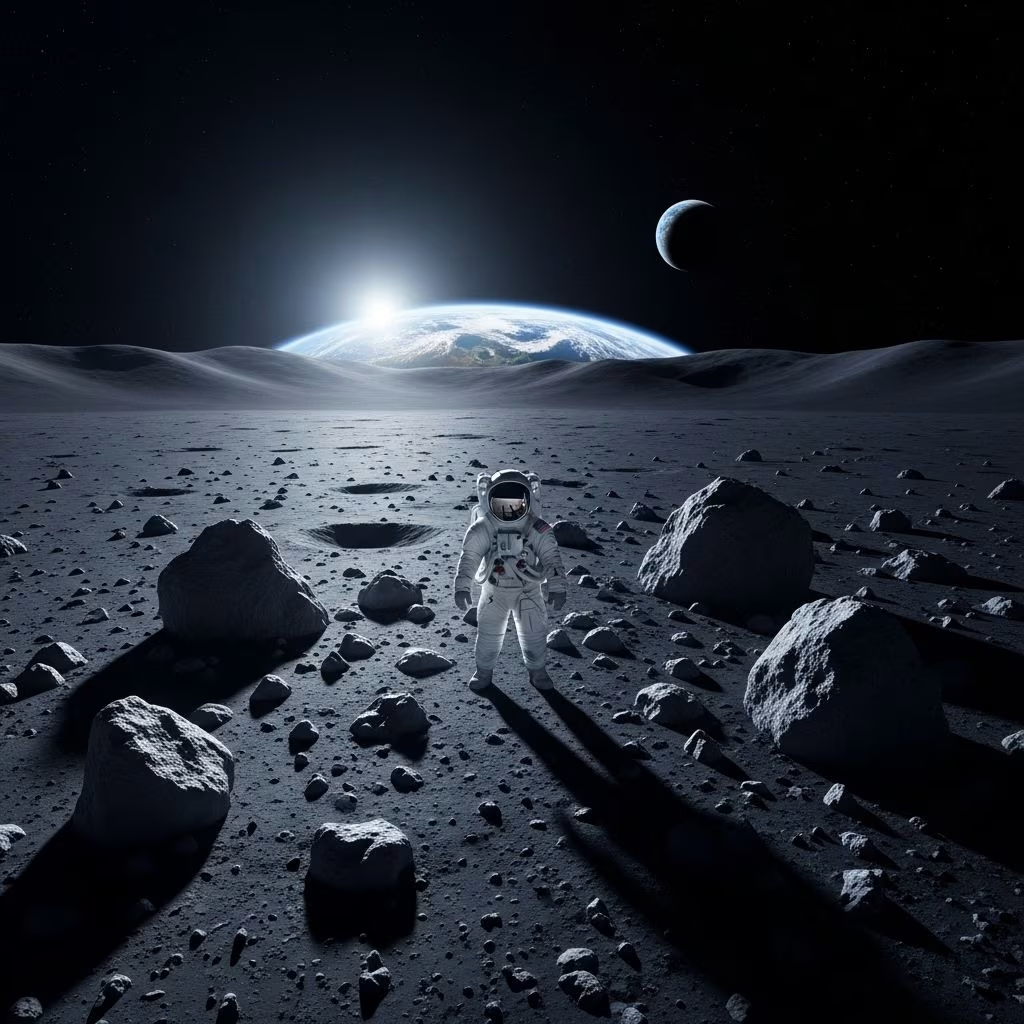
Since the Apollo missions began in 1969, twelve astronauts have walked on the Moon, facing temperatures that could kill unprotected humans within moments.
- Spacesuits: These feature up to 14 layers, including reflective and insulating materials, liquid cooling garments, and tightly regulated thermal controls.
- Lunar module life support: Provided heating or cooling as needed within landers.
- Protective equipment: Tools and vehicles on the Moon often have heating elements to avoid freezing during long lunar nights.
Why Is Understanding Lunar Temperature Important?
- Spacecraft design: All hardware must function through both extremes.
- Human safety: Protecting astronauts from rapid heating/cooling is vital.
- Resource exploration: Many scientific and practical activities depend on locating permanently shadowed regions (potential ice deposits).
- Astrobiology: Studying how objects and possible volatiles survive in such conditions informs our search for life elsewhere.
Lunar Temperature: Key Facts at a Glance
- Daytime highs at equator: +120°C (+250°F)
- Nighttime lows: -130°C (-208°F)
- Polar crater lows: -183°C to -253°C (-298°F to -424°F)
- Reason for extremes: No atmosphere, slow rotation, and surface composition
- Comparison to Earth: Much wider swings due to lack of air and fast heat loss/gain
Lunar Temperature FAQs
Q: Can you survive exposure to lunar day or night temperatures without a suit?
No. Unprotected human tissue would suffer rapid heatstroke, freezing, or severe burns in seconds. Space suits are essential for any EVA (extravehicular activity).
Q: Why does the Moon lose heat so quickly?
The lunar surface radiates heat directly into space, especially at night, because it lacks an insulating atmosphere.
Q: Do temperatures vary at different places and elevations?
Yes. Equatorial regions have the greatest swing, while polar craters remain constantly cold due to perpetual shadow.
Q: Could water exist on the Moon?
Only in the coldest, permanently shadowed polar craters. These regions can trap water ice, key for future missions.
Q: How do future missions plan to deal with such harsh environments?
By designing landers, suits, and habitats with advanced thermal controls, using site selection to find optimal conditions, and leveraging frozen resources at the poles.
Conclusion: The Moon’s Temperature—Challenge and Opportunity
The Moon’s radical temperature swings define its harsh, airless landscape and present significant engineering hurdles for humanity’s exploration and potential settlement. Understanding these extremes—why they occur, how they shape lunar geology, and how future missions must adapt—is vital for the next generation of lunar explorers. Scientific discoveries in the coldest craters and the hottest peaks will not only teach us about the Moon, but may illuminate broader mysteries in our solar system.
References
- https://www.space.com/18175-moon-temperature.html
- https://www.livescience.com/space/the-moon/what-temperature-is-the-moon
- https://www.space.com/14725-moon-temperature-lunar-days-night.html
- https://science.nasa.gov/moon/weather-on-the-moon/
- https://www.skyatnightmagazine.com/space-science/temperature-moon
- https://www.thespaceresource.com/news/2019/2/surviving-the-temperamental-moon
- https://universemagazine.com/en/how-cold-is-space-temperature-sunlight-moon-facts/
- https://www.universetoday.com/19623/temperature-of-the-moon/
- https://www.astro22.com/what-is-the-temperature-on-the-moon/
- https://coolcosmos.ipac.caltech.edu/ask/168-what-is-the-temperature-on-the-moon-
- https://arcfieldweather.com/blog/2019/7/18/715-am-there-is-no-weather-on-the-moon-but-there-are-extreme-differences-in-temperatures
- https://www.smorescience.com/understanding-the-moons-wild-temperature-swings/
- https://www.astro22.com/what-causes-the-moon-s-drastic-temperature/
- https://science.nasa.gov/wp-content/uploads/2024/01/lrolitho7temperaturevariation27may2014.pdf
- https://www.lunarsail.com/whats-the-temperature-on-the-moon/
- https://en.wikipedia.org/wiki/Moon
- https://www.astronomy.com/science/how-cold-is-it-in-outer-space/