White Holes: Cosmic Opposites and Astrophysical Enigmas
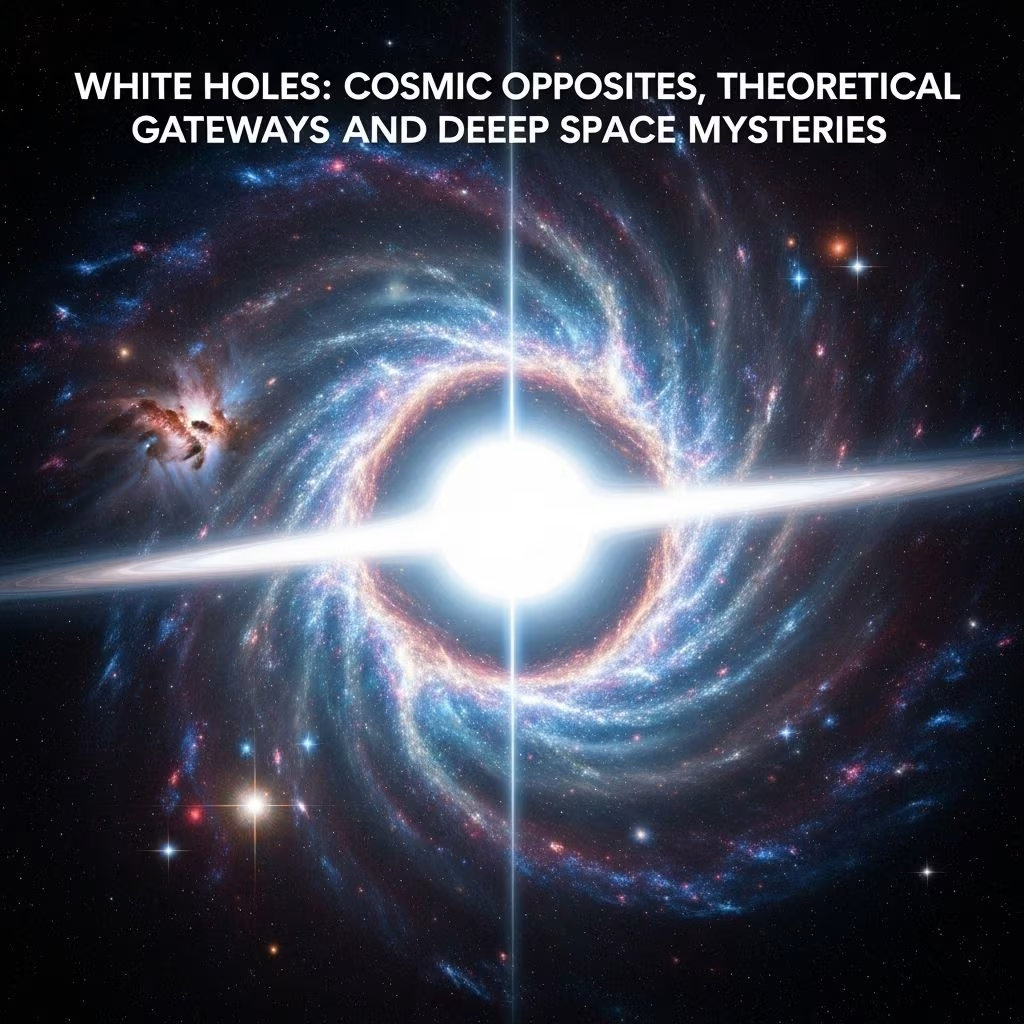
In the realm of astrophysics, white holes are one of the most intriguing and least understood theoretical constructs. Considered the precise opposites of black holes, white holes represent regions of spacetime where matter and energy are expelled rather than drawn in. Though purely hypothetical, studying white holes illuminates fundamental mysteries about the universe’s structure, the fate of matter, and the nature of spacetime itself.
Contents
- What Is a White Hole?
- White Holes vs. Black Holes
- Theoretical Foundations and Mathematical Origins
- Connections with Black Holes: Quantum Tunneling and Wormholes
- White Holes in Cosmology: Dark Matter and the Big Bang
- Observable Signatures and Search Efforts
- Critique and Challenges: Theoretical Obstacles
- White Holes in Popular Science and Culture
- Frequently Asked Questions
What Is a White Hole?
White holes are theoretical objects predicted by Einstein’s equations of general relativity. Where black holes are regions of spacetime with gravitational pulls so strong nothing can escape, white holes are their “time-reversed” counterparts—regions from which matter and energy erupt, and into which nothing can enter. In simple terms:
- Black Hole: Nothing escapes; matter and light are irresistibly drawn in past the event horizon.
- White Hole: Nothing enters; matter and light can only emerge, but never penetrate the event horizon.
At the heart of a white hole is believed to be a singularity, a point of infinite density and gravitational curvature. Rather than attracting matter, it explosively ejects it. Unlike black holes—objects now widely accepted due to compelling observational evidence—white holes have never been observed and remain hypothetical.
White Holes vs. Black Holes
| Aspect | Black Hole | White Hole |
|---|---|---|
| Event Horizon | One-way boundary; inwards only | One-way boundary; outwards only |
| Behavior | Absorbs matter and energy | Expels matter and energy |
| Theoretical Status | Observed, accepted by consensus | Hypothetical, not observed |
| Origin | Collapse of massive stars | Mathematical extension of GR equations |
| Potential Links | Could be connected to white holes via wormholes | May result from dying black holes |
Theoretical Foundations and Mathematical Origins
White holes are direct consequences of the mathematical structure underlying Einstein’s general relativity. In the Schwarzschild solution—a description of spacetime geometry around a spherical mass—reversing the flow of time mathematically transforms a black hole into a white hole. But unlike black holes, which form from collapsing stars, white holes don’t have an obvious physical formation mechanism in our observable universe.
- They arise as time-reversed black holes, meaning their behavior is inverted with respect to the arrow of time.
- Physicists speculate on scenarios where white holes could form, such as through quantum gravitational effects at the end of a black hole’s life.
- Some theoretical models propose that the Big Bang itself was a gigantic white hole event.
In quantum gravity, the notion of information conservation prompts new hypotheses. If black holes do not destroy information, what happens to it as the black hole evaporates via Hawking radiation? Could it reappear in a white hole?
Connections with Black Holes: Quantum Tunneling and Wormholes
One of the most intriguing modern ideas in theoretical physics is a potential quantum connection between black holes and white holes. Scholars such as Carlo Rovelli have introduced the concept that as a black hole evaporates and shrinks, it may undergo a quantum transition into a white hole. The process might look like this:
- As a black hole ages and loses mass, quantum effects dominate at tiny scales.
- The event horizon collapses inward until quantum gravity halts the process.
- The black hole “rebounds,” rapidly expanding as a white hole, expelling the trapped matter and energy.
- This process could resolve the longstanding black hole information paradox.
Additionally, the possibility emerges that wormholes—tunnels through spacetime—connect black holes to white holes:
- Entering a black hole may lead to emerging from a white hole at a distant cosmic location—or even another universe.
- This scenario could, in principle, enable shortcuts across spacetime, revolutionizing concepts of interstellar travel.
White Holes in Cosmology: Dark Matter and the Big Bang
White holes have been proposed as solutions to several cosmic mysteries:
- Dark matter: Some models suggest that long-lived white holes from the very early universe could constitute a significant portion of the invisible dark matter observed in galaxies.
- Origins of the universe: The explosive release of matter and energy from a colossal white hole could resemble the Big Bang itself.
- Quasars and energetic phenomena: Certain energetic astrophysical objects, such as quasars, have been proposed (though not widely accepted) as potential white holes due to their immense power output.
Researchers speculate that if white holes existed just milliseconds after the Big Bang, their remnants or gravitational influence might be detectable today. Furthermore, if primordial white holes did form, they could help explain the distribution of matter and structure in the early cosmos.
Observable Signatures and Search Efforts
Astrophysicists have attempted to identify the possible signatures of white holes that could be distinguished from other cosmic phenomena:
- Sudden bursts of matter and energy in regions of space where no prior accumulation was detected.
- Rapid ejection events not accountable by supernovae or black hole activity.
- Specific patterns in gravitational waves that might indicate the formation or dissolution of white holes.
- Unusual high-energy gamma ray bursts—occasionally theorized as potential white hole events.
To date, no observational evidence directly confirms the existence of white holes. Their detection would require observing phenomena that cannot be attributed to known astrophysical processes, making them extremely elusive.
Critique and Challenges: Theoretical Obstacles
Despite their logical basis in relativity, several challenges confront the notion of white holes:
- Instability: Some studies suggest that white holes, if formed, would quickly destabilize upon encountering even minimal external matter—endangering their longevity and detectability.
- Observational absence: No candidate white hole phenomena have been conclusively identified, even as black holes have become routine objects of study.
- Non-causal formation: Whereas black holes have known physical creation processes (stellar collapse), it remains unclear what could give rise to a white hole.
- Thermodynamic paradox: The existence of time-reversed objects challenges our understanding of entropy and causality in the universe.
Pursuing white holes as physical entities thus demands resolving deep problems in both physics and philosophy. Whether they can exist as real astrophysical objects—not just mathematical solutions—remains open to question.
White Holes in Popular Science and Culture
White holes occupy a prominent position in science fiction and popular science, often depicted as gateways to other universes or as shortcuts for interstellar travel. In speculative fiction, traversing a black hole might result in emerging from a white hole at another location—a tantalizing prospect that continues to fuel imagination.
- Popular science media, documentaries, and websites regularly discuss white holes as subjects of cosmic wonder and futurism.
- In discussions about the fate of the universe and the possibility of wormhole travel, white holes provide a speculative mechanism for transit across vast cosmic scales.
- Some educational videos and articles explore white holes’ hypothetical roles in explaining cosmic phenomena, even if mainstream science treats them cautiously.
Frequently Asked Questions (FAQs)
Q: What is a white hole?
A: A white hole is a theoretical region of spacetime which acts as the exact opposite of a black hole—nothing can enter its event horizon, but matter and energy may escape from it.
Q: Are white holes real objects in space?
A: As of now, white holes have not been observed and remain a purely hypothetical concept in physics. No astronomical evidence currently supports their existence.
Q: How are white holes related to black holes?
A: Both arise from solutions to Einstein’s field equations in general relativity. Some theories suggest that when black holes die, they might transform into white holes through quantum processes, possibly linked by wormholes.
Q: Could white holes explain dark matter?
A: Some researchers propose that primordial white holes may account for a portion of the unseen dark matter in the universe, but this idea is not widely accepted and remains highly speculative.
Q: Could the Big Bang have been a white hole event?
A: Certain cosmological models equate the Big Bang to a massive white hole, marking the sudden release of matter and energy that created the universe.
Q: Why haven’t astronomers detected white holes yet?
A: Detecting a white hole would require observing its distinguishing burst-like characteristics and ruling out all other astrophysical sources. So far, nothing observed in the cosmos fits this description conclusively.
Q: Are white holes used in science fiction?
A: Yes, white holes often serve as speculative mechanisms for travel between universes or across vast cosmic distances in science fiction stories, thanks to their mysterious and theoretically exotic properties.
White Holes: Why They Matter in Modern Physics
White holes—while unobserved—provide a fertile ground for physicists to push the boundaries of modern theory. By contemplating these cosmic opposites, scientists search for answers to fundamental questions about black hole information, wormholes, dark matter, and even the origin of the universe itself. Whether white holes exist in nature or remain mathematical curiosities, their study enhances our understanding of spacetime and the deepest workings of the cosmos.
- White holes challenge our concepts of time, entropy, and causality.
- Their link to black holes could resolve deep paradoxes in physics.
- Pushing the boundaries of theory, white holes are powerful reminders that the universe may harbor phenomena stranger than anything yet observed.
References
- https://www.space.com/could-white-holes-exist-space-mysteries
- https://www.space.com/40422-are-white-holes-dark-matter.html
- https://en.wikipedia.org/wiki/White_hole
- https://www.sciencefocus.com/space/what-is-a-white-hole
- https://www.popularmechanics.com/space/deep-space/a45755167/what-is-a-white-hole/
- https://spacefed.com/astronomy/where-there-is-black-there-is-white/
- https://www.skyatnightmagazine.com/space-science/white-hole
- https://www.youtube.com/watch?v=IutpODdk4rU
- https://thespacevortex.com/2024/07/white-holes-in-space-myth-or-reality/
- https://www.youtube.com/watch?v=S4aqGI1mSqo
- https://spaceyv.com/black-hole-vs-white-hole/
- https://www.iflscience.com/what-white-hole-32005
- https://jila.colorado.edu/~ajsh/bh/schww.html
- https://www.gaia.com/article/white-hole-theory
- https://www.astro22.com/what-exactly-is-a-white-hole-in-space/
- https://bigthink.com/starts-with-a-bang/white-holes-exist/
- https://orbitaltoday.com/2022/12/19/the-antipode-of-black-hole-is-there-a-white-hole-in-space/