


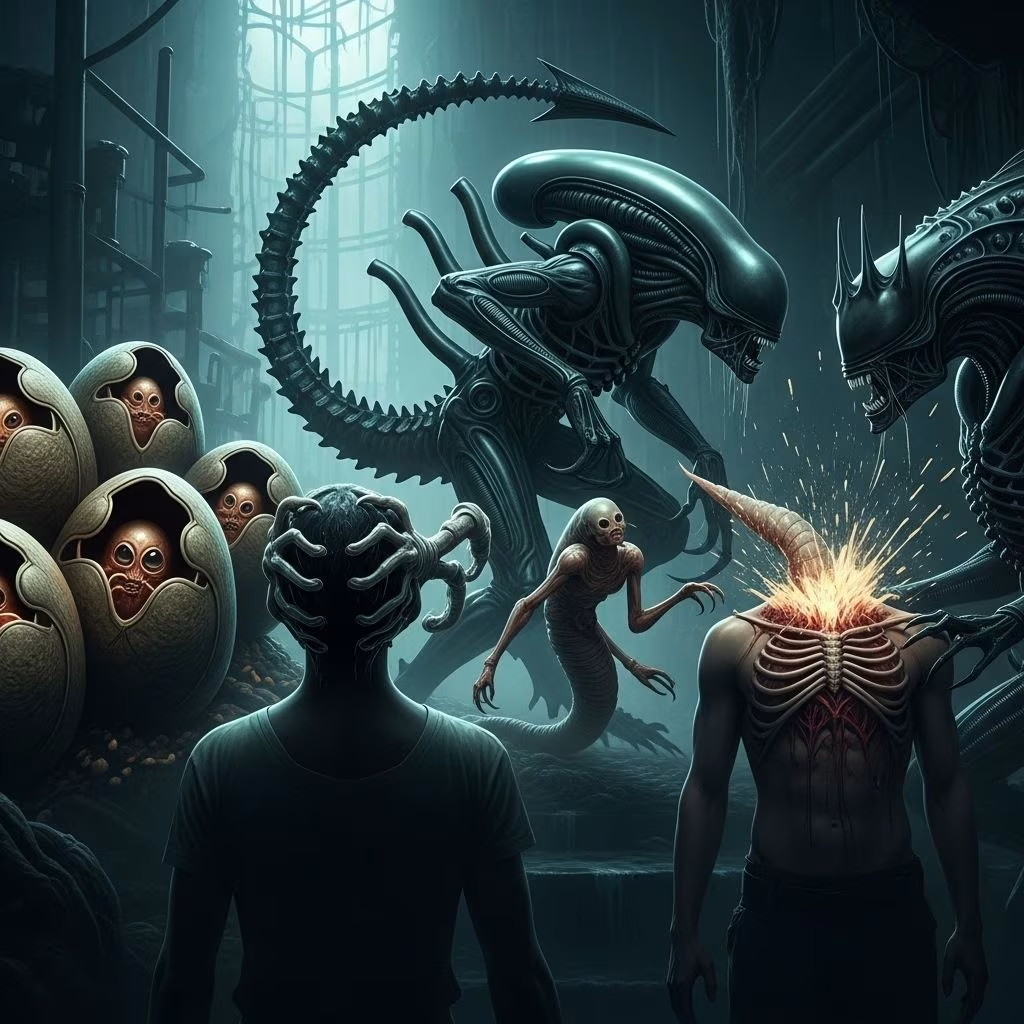
The Xenomorph, an iconic extraterrestrial horror at the heart of the Alien franchise, is infamous not just for its biomechanical terror but for a uniquely gruesome lifecycle that embodies nature’s most grotesque and efficient reproductive nightmares. This comprehensive overview explores each transformative stage of the Xenomorph species, from the mysterious ovomorph (egg) to the towering, monstrous Queen. The enduring fascination and horror stem from the subtle biological details and parasitic ingenuity revealed in every phase of its evolution.
What Is a Xenomorph?
The Xenomorph, sometimes classified as Xenomorph XX121 or Internecivus raptus, is the central antagonist of multiple Alien films, comics, games, and expanded universe media. It first appeared in Ridley Scott’s 1979 classic Alien and has been since depicted as an endoparasitoid (internal parasite that typically kills its host after development) with frightening anatomical and behavioral adaptations, capable of turning nearly any organic lifeform into an unwilling incubator for its offspring. The basis of its terror isn’t just in its killing power, but in its reproductive cycle, which is both alien and chillingly plausible.
Xenomorph Lifecycle: An Overview
- Egg (Ovomorph) – Dormant beginning, housing the parasitic facehugger.
- Facehugger – Seeks and incapacitates a host, implanting the next stage inside.
- Chestburster – Emerges violently from the host, beginning rapid independent growth.
- Adult Xenomorph (Drone/Warrior) – Full-fledged killer, hive-builder, and protector.
- Queen – Hive matriarch, capable of producing vast numbers of eggs.
- Other Forms – Variants, hybrid forms, and alternate developmental paths (optional lore).
The Egg: Ovomorph
The Xenomorph lifecycle begins with the egg, or ovomorph. Introduced in Alien (1979), these leathery, often slimy pods stand around two feet tall, lying dormant until potential hosts are detected. The eggs are most commonly produced by a mature Queen but can, according to some expanded lore, result from biological conversion processes under rare circumstances.
- Eggs can remain viable for centuries, their thick casing protecting the parasitic organism within from environmental extremes and even from decay.
- The surface of the egg is sensitive to motion, heat, and possibly pheromones. When a living organism nears, the top of the egg unfurls in a cross-shaped pattern.
- Inside lies the facehugger—a dormant, but lethal, vector for the next stage of the cycle.
- In hives, eggs may be used as traps, strategically placed to maximize the chance of infecting intruders.
Main Features of the Xenomorph Egg
- Highly Durable: Resistant to conventional weaponry and environmental hazards.
- Responsive: Reacts to touch, movement, and perhaps even chemical cues from nearby life.
- Hostile Contents: Always houses a facehugger unless already hatched.
The Facehugger
Once the egg is triggered, the facehugger bursts forth with remarkable speed. This spindly, arachnid-like creature is not designed to kill directly, but to temporarily incapacitate and impregnate a living host with a Xenomorph embryo.
- Facehuggers resemble a ghastly mix of a scorpion and octopus, sprouting eight spindly digits and a prehensile tail.
- They target the face, latching on with enough force to suffocate and paralyze the victim.
- Removal proves nearly impossible without killing either the host or the facehugger itself, thanks to the powerful grip and acidic blood coursing through its veins.
- The facehugger implants an embryo by extending a tube down the host’s throat, delivering a parasitic organism before dying and detaching.
- The process is usually quick, with the host typically regaining consciousness seemingly unharmed—until the next stage asserts itself.
Key Features of the Facehugger
- Acidic Blood: Deters removal and inflicts fatal damage if forcibly detached.
- Single Purpose: Lives solely to implant an embryo.
- Host Variability: Can infect a wide range of hosts, from humans to extraterrestrials.
- Short Lifespan: Dies immediately after successful impregnation.
The Chestburster
No stage in the Xenomorph’s life cycle is more iconic and horrific than the chestburster. After a brief, horrifying incubation period inside the host (ranging from hours to days depending on lore and species), the embryo matures and violently escapes, typically erupting through the rib cage in a spray of blood and tissue.
- The chestburster is snakelike, featuring rudimentary limbs, teeth, and unquenchable survival instinct.
- It emerges rapidly, fleeing the carcass of its now-dead host in a desperate dash for cover as it begins the next phase of metamorphosis.
- This stage is highly vulnerable, lacking armor or offensive tools—the only defense is speed and stealth.
- Within hours, or at most days, the chestburster molts and matures into its adult form by consuming proteins and chemicals from its surroundings.
The Adult Xenomorph
Now an apex predator, the adult Xenomorph is terrifyingly lethal. Its physical form depends on a combination of genetic traits inherited from both the host and pure Xenomorph DNA, but common attributes remain across variations:
- Biomechanical Exoskeleton: Extremely resistant to damage; often gunmetal black and ribbed.
- Secondary Inner Jaw: Protrudes with explosive force for close combat kills.
- Acidic Blood: Used both defensively and offensively.
- Agility and Cunning: Adults can crawl, climb, ambush, and work cooperatively with others of their species.
Main Types of Adult Xenomorphs
| Type | Description |
|---|---|
| Drone | The most common adult; hive-builder and worker, but nonetheless deadly. |
| Warrior | Larger and heavily armored; frontline defense of the hive. |
| Praetorian | Elite guards, often transition to Queen if circumstances arise. |
| Runner/Dog Alien | Arises from non-human hosts, inheriting quadrupedal movement and unique appearance. |
Adults continue to serve the hive, gather hosts, defend the Queen, and expand their territory as needed. Some possess uniquely specialized abilities based on the specifics of their host species (a concept explored in Alien 3, Alien: Resurrection, and spinoff media).
The Queen Xenomorph
At the top of the reproductive hierarchy stands the Xenomorph Queen. Towering over her progeny and exhibiting intelligence that borders on strategic genius, the Queen commands hive structure and is responsible for laying thousands of eggs throughout her life.
- Queens are physically formidable, with a distinctive crest, extra limbs, and an armored carapace.
- The Queen’s main purpose is to reproduce, often attaching herself to a giant ovipositor that continually generates eggs for as long as conditions allow.
- She also directly controls the colony, signaling lesser Xenomorphs and coordinating defense or attack strategies.
- When directly threatened, Queens can detach from their egg sac to move independently, retaining all the lethal lethality of their offspring with additional size, speed, and cunning.
- In dire circumstances, a Praetorian or specialized adult can molt into a new Queen to replenish a lost matriarch.
Notable Queen Features
- Gigantic Size: Ranging up to 4.5 meters (15 feet) tall or more.
- Hive Command: Capable of controlling hive members through pheromones or possibly telepathic cues.
- Ovipositor: Specialized reproductive organ for egg-laying.
- Extreme Aggression: Will personally enter combat if the hive or her own life is threatened.
Other Xenomorph Variants and Deviations
Throughout the Alien saga and related expanded lore, numerous Xenomorph subtypes and hybrids have been revealed. These include:
- Predalien: Resulting from a Predator host, blending Yautja and Xenomorph traits.
- Neomorph: A divergent form from Alien: Covenant, featuring translucent skin and distinct life stages.
- Deacon: An early prototype-like form seen in Prometheus.
- Genetic Hybrids: Such as the Newborn from Alien: Resurrection, arising from human-Xenomorph DNA manipulation.
Evolution and Host Adaptation
Part of what makes the Xenomorph such a terrifying antagonist is its chameleonic ability to absorb host DNA during embryonic development. This results in specific adaptations for the environment and sometimes, unique abilities or alternate forms. Quadrupedal ‘Runners’ develop from canine hosts, aquatic adaptations emerge in water-dwelling hosts, and intelligence or social behaviors sometimes morph in unforeseen ways.
- Host Influence: Every Xenomorph carries physical and behavioral quirks from its host.
- Rapid Growth: The Xenomorph attains full size with astonishing speed, usually in less than a day.
- Biological Parallels: Elements draw inspiration from parasitoid insects, such as wasps, but with a gruesome science-fiction twist.
Cinematic Legacy and the Alien Franchise
The Xenomorph and its reproductive cycle have appeared in every mainline Alien film, with each installment introducing new nuances or deviations. Highlights include:
- Alien (1979): Introduced the full ‘egg to chestburster’ lifecycle.
- Aliens (1986): Debuted the Alien Queen and expansive hive behavior.
- Alien 3 (1992): Explored alternate hosts, resulting in the quadrupedal Runner Xenomorph.
- Alien Resurrection (1997): Showcased genetic experimentation, hybridization, and the Newborn.
- Prometheus (2012) & Alien: Covenant (2017): Offered proto-Xenomorphs and evolutionary precursors (Deacon, Neomorph).
- Alien vs. Predator series and other extended universe media: Established hybrids and new reproductive scenarios, elaborating on the species’ frightening diversity.
Lifecycle Timeline Table
| Stage | Trigger/Duration | Main Activity | Outcome |
|---|---|---|---|
| Egg | Dormant for years | Wait for host proximity | Releases facehugger |
| Facehugger | Minutes–hours | Implant embryo | Dies |
| Chestburster | Hours–days | Eat, molt, hide | Matures into adult |
| Adult | Rapid growth (hours) | Kill, expand hive | Serve Queen or hive |
| Queen | Can persist for years | Lay eggs, coordinate hive | Continues cycle |
The Science and Horror Behind the Life Cycle
While fantastical, the Xenomorph’s lifecycle draws on elements from parasitic wasps, deep-sea invertebrates, and nature’s most ruthless reproductive strategies. The cycle is finely tuned for survival, host conversion, and the rapid establishment of colony dominance. This relentless biology, combined with a near-mythical resistance to weapons and an ability to adapt to nearly any environment, have made the Xenomorph a lasting symbol of existential fear.
- Adaptation: The Xenomorph’s genetic plasticity keeps it a threat across varied planetary ecosystems.
- Colony Efficiency: Hive organization and clear hierarchical structure mirror those of ants and bees, maximizing reproductive efficiency.
- Eternal Threat: With an egg or single facehugger, the cycle can begin anew, justifying the endless terror in every Alien storyline.
Frequently Asked Questions (FAQs)
Q: Can a Xenomorph egg survive indefinitely?
A: Xenomorph eggs are notoriously resilient and can potentially remain dormant and functional for thousands of years, waiting for any sign of a host.
Q: Why are Xenomorphs so hard to kill?
A: Their tough exoskeleton, acidic blood, and rapid adaptability make them extremely difficult to kill, even with advanced weaponry.
Q: What determines a Xenomorph’s appearance?
A: The host’s genetic makeup heavily influences physical traits, resulting in distinctly different Xenomorph appearances depending on whether the host is human, animal, or alien.
Q: How is a new Queen created?
A: If a colony loses its Queen, an adult Praetorian or other specialized Xenomorph can develop into a new Queen to ensure the cycle continues.
Q: Are there peaceful Xenomorphs?
A: There are no canonical depictions of peaceful Xenomorphs; their entire existence revolves around survival, reproduction, and hive expansion, often at the expense of all other life forms.
References and Further Reading
- Alien films by Ridley Scott, James Cameron, David Fincher, and others.
- Alien: The Official Movie Novelizations and expanded lore.
- AvP Central, TheGamer, and Wikipedia on Xenomorph biology and film history.
References
- https://www.youtube.com/watch?v=u2kX9xiwtrQ
- https://www.avpcentral.com/xenomorph-life-cycle-guide-to-alien-evolution
- https://www.youtube.com/watch?v=litIGkE7wsY
- https://alien-covenant.com/info/the-complete-alien-xenomorph-life-cycle-explained
- https://www.thegamer.com/xenomorph-life-cycle-explained/
- https://en.wikipedia.org/wiki/Xenomorph
- https://www.ign.com/wikis/xenomorph/Life_Cycle
- https://avp.fandom.com/wiki/Xenomorph_life_cycle
- https://aliens.fandom.com/wiki/Xenomorph
- https://www.avpgalaxy.net/alien-movies/alien-life-cycle/xenomorph/
- https://gamerant.com/alien-every-xenomorph-type-explained/
- https://www.syfy.com/syfy-wire/timeline-of-the-alien-fanchises-xenomorph
- https://demondirect.net/10895/entertainment/xenomorph-life-cycle-explored-in-alien-franchise/
- https://www.theastromech.com/2023/10/alien-biological-lifecycle-of-xenomorph.html
- https://satellitenewsnetwork.com/alien-the-xenomorph-life-cycle-explained/
- https://retroaliens.com/ultimate-guide-to-xenomorph-lore/
- https://www.deviantart.com/gavinoeldiabloguapo/art/Operation-Aliens-Xenomorph-Life-Cycle-1087271463
- https://screenrant.com/alien-movie-xenomorph-lifecycle-stage-ridley-scott-deleted/


