Understanding Juvenile Osteochondritis
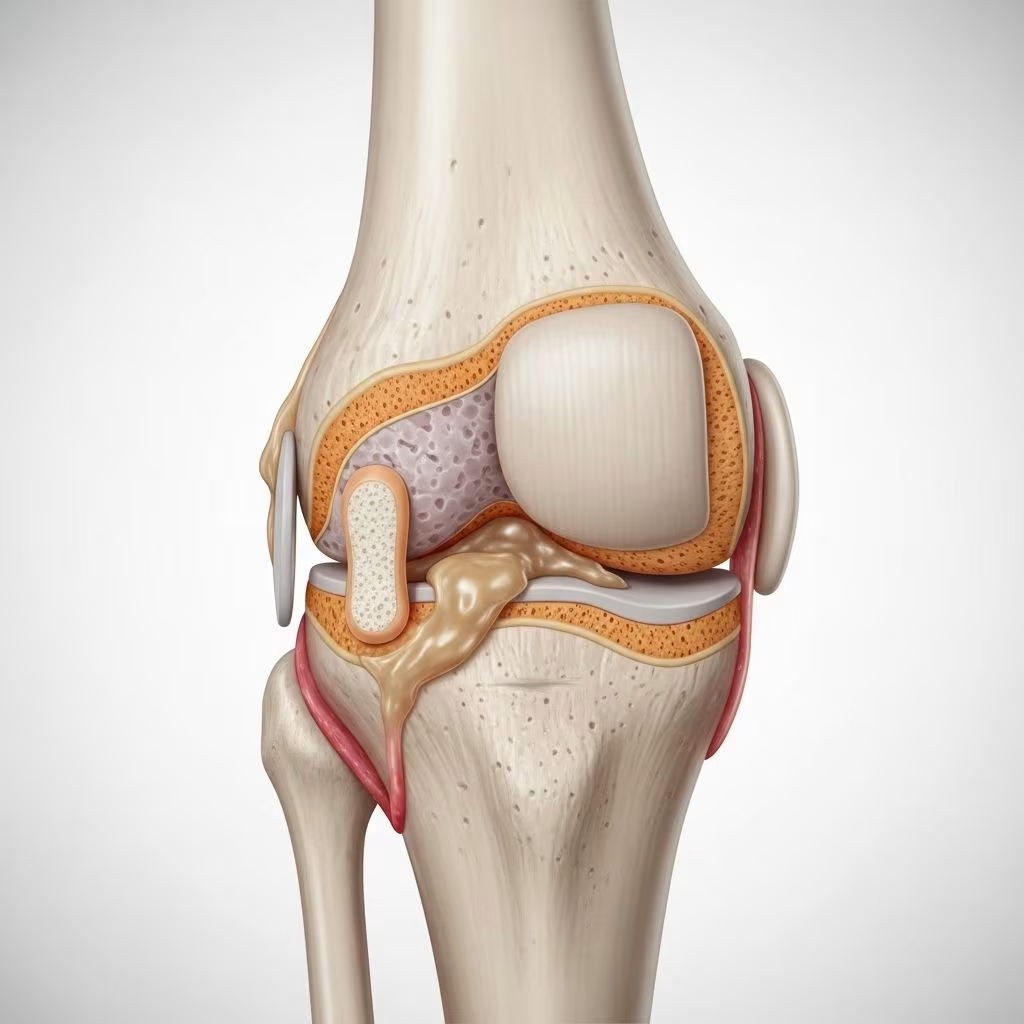
Juvenile osteochondritis is a joint disorder primarily impacting children and teenagers, especially those aged 10–15 years with open growth plates. This condition is characterized by a separation of a small piece of bone from its parent bone, most commonly at the knee joint, though it can also affect elbows, ankles, shoulders, or hips.
The disorder presents with varying degrees of pain, swelling, and mobility issues, and is most prevalent in physically active children, such as those involved in organized sports. Despite its challenging symptoms, most children recover well with appropriate management, including rest and physical therapy.
Key Features
- Commonly affects the knee joint, but may also involve the elbow, ankle, shoulder, or hip.
- Affects children and adolescents, typically those between 10–15 years.
- Often related to physical activity; more prevalent among young athletes.
- Symptoms vary; some children may be asymptomatic.
What is Juvenile Osteochondritis?
Juvenile osteochondritis (JOCD) occurs when a portion of bone beneath the joint’s cartilage becomes separated due to inadequate blood flow, injury, or other factors. This process can result in a fragment called a lesion, which may remain partially attached (stable) or detach completely (unstable), sometimes causing more pronounced symptoms and complications.
Prevalence
- Estimated incidence of 15–29 cases per 100,000 children.
- Higher risk among children actively participating in sports or high-impact activities.
Symptoms of Juvenile Osteochondritis
The presentation of symptoms is heterogeneous. Some children experience substantial discomfort, while others may show little or no sign of illness, and some cases are discovered incidentally during investigations for unrelated issues.
- Pain and swelling at the affected joint (most often the knee).
- Tenderness, especially upon physical touch or pressure.
- Reduced mobility—difficulty straightening or bending the joint fully.
- Joint locking or catching—the joint may temporarily get stuck or create a sensation of instability during movement.
- Cracking or popping sounds during movement.
- Fluctuating symptoms; pain often worsens with physical activity.
- Occasionally, the joint may “give way” during sports or daily movement.
| Symptom | Description | Occurs Most Often |
|---|---|---|
| Pain | Aching or sharp discomfort in the joint | During or after activity |
| Swelling | Visible or palpable puffiness around the joint | After intensive use |
| Locking | Joint temporarily stuck or unable to move | With certain motions |
| Reduced Mobility | Difficulty bending or straightening | Chronic or post-injury |
Causes of Juvenile Osteochondritis
The exact cause remains unknown, but current research and clinical experience suggest several contributing factors. Often, the disorder emerges through the interplay of genetics, local blood flow issues, and repetitive microtrauma associated with sports.
- Repetitive joint trauma—frequent impact or stress, especially in young athletes.
- Decreased blood flow—restricted circulation to parts of the subchondral bone limits nutrient delivery and tissue repair.
- Inflammation—chronic joint inflammation may play a role in bone and cartilage weakening.
- Genetic predisposition—family history of joint disorders increases risk.
- Abnormal bone formation (ossification)—impaired development or early closure of growth plates increases susceptibility.
In many cases, several of these factors combine, raising the risk in young individuals who participate in high-impact sports or have a family background of joint issues.
Who’s at Risk for Juvenile Osteochondritis?
- Age Group: Primarily children and teens ages 10–15.
- Active Lifestyle: Those involved in organized or high-impact sports (soccer, basketball, gymnastics, etc.).
- Genetics: Family history of similar joint disorders.
- Sex: Research suggests higher incidence in males, though both sexes can be affected.
Complications of Juvenile Osteochondritis
If left untreated or in severe cases, juvenile osteochondritis can lead to a variety of complications affecting long-term joint function and overall wellbeing.
- Persistent pain and reduced mobility
- Osteochondral defect formation—development of a gap or crack in the cartilage and bone.
- Early joint degeneration, akin to premature osteoarthritis.
- Joint instability—the joint may become loose or erratic.
- Fracture or complete detachment of the bone fragment, sometimes necessitating surgical intervention.
Diagnosis
The diagnosis of juvenile osteochondritis relies on a combination of medical history, physical examination, and imaging studies.
Early recognition is crucial for preventing further degeneration and ensuring more effective healing, especially in children who are still growing.
- Physical exam: Assessment for pain, swelling, tenderness, joint mobility, and mechanical symptoms (locking/catching).
- X-ray imaging: Used to visualize the location, size, and stability of the bone fragment or lesion.
- MRI (Magnetic Resonance Imaging): Offers detailed images of bone, cartilage, and surrounding tissue to assess fragment stability and joint health.
- CT scan: Sometimes employed for precise anatomical mapping or surgical planning.
Treatment Options for Juvenile Osteochondritis
Most cases can be managed with conservative (non-surgical) treatments, particularly in children who still have open growth plates. The goal is to promote natural healing, minimize symptoms, and prevent progression to instability or joint damage.
Primary Treatment Modalities
- Rest and reduced activity: Temporary avoidance of impact sports and high-stress activities to give the joint time to heal.
- Physical therapy: Custom rehabilitation programs improve joint strength, range of motion, and stability.
- Assistive devices: Use of crutches, braces, or splints to reduce joint stress, prevent further injury, or immobilize the joint during acute episodes.
- Pain management: NSAIDs (nonsteroidal anti-inflammatory drugs) and other medications to relieve pain and manage inflammation.
When is Surgery Needed?
- Unstable or large fragments: When the bone piece detaches or fails to heal with conservative therapy.
- Failure of non-surgical management: Persistent pain, loss of function, or lesion enlargement despite rest and physical therapy.
- Advanced joint degeneration: Signs of cracking, locking, or early osteoarthritis.
Common surgical approaches include minimally invasive procedures (such as drilling to stimulate healing), reattachment or removal of loose fragments, and restoration of the joint surface.
Prognosis and Long-Term Outlook
Most children and adolescents with juvenile osteochondritis recover well, especially with early diagnosis and attentive management. Younger children with open growth plates are likelier to heal without complications if treated before instability develops.
- Good prognosis with rest, reduced activity, and rehabilitation.
- Full return to activities is typical after healing, though high-impact sports should be reintroduced gradually.
- Long-term joint function remains excellent in the majority of cases managed early and appropriately.
- Surgical outcomes are generally positive, especially for isolated fragments or advanced lesions.
- Early treatment reduces risk of chronic pain, instability, and early-onset arthritis.
Preventive Tips for Parents and Young Athletes
- Encourage moderate physical activity and proper warm-up before sports.
- Monitor for joint pain, swelling, or unexplained mobility changes and seek medical evaluation if persistent.
- Educate children to report new joint symptoms early.
- Follow recommendations for rest and rehabilitation after sports injuries.
- Support healthy bone development with balanced nutrition, adequate calcium, and vitamin D.
Frequently Asked Questions (FAQ)
Q: Can juvenile osteochondritis heal on its own?
A: Yes, most cases in children or adolescents resolve with rest, reduced activity, and physical therapy. Lesions are more likely to heal in young individuals with open growth plates.
Q: Will my child need surgery?
A: Surgery is rarely required, comprising only persistent or severe cases in which conservative treatments have failed or bony fragments are unstable.
Q: Is it safe to return to sports after recovery?
A: Most children can return to sports and regular activities after full healing. High-impact sports should be resumed gradually and only after clearance from a healthcare provider.
Q: What long-term complications should I watch for?
A: Watch for any signs of recurrent pain, swelling, or joint dysfunction, and consult your healthcare provider if new symptoms emerge. Untreated or advanced cases may predispose to joint degeneration later in life.
Q: Can adults get juvenile osteochondritis?
A: Adults can experience the effects of osteochondritis dissecans, but the juvenile form specifically occurs in children and teens with open growth plates. Adults usually developed the condition earlier but may be diagnosed later in life.
Key Takeaways
- Juvenile osteochondritis is a largely treatable joint disorder primarily impacting active children and teens.
- Early detection and therapy lead to favorable outcomes and a full return to normal joint function.
- Consult with a pediatric orthopedic specialist if your child experiences new joint pain, swelling, or mobility issues.
- Most children recover with rest, physical therapy, and non-invasive management.
References
- https://www.healthline.com/health/knee-pain/juvenile-osteochondritis
- https://pmc.ncbi.nlm.nih.gov/articles/PMC6541052/
- https://www.medicalnewstoday.com/articles/osteochondritis-dissecans-knee
- https://www.healthline.com/health/osteochondritis-dissecans-knee
- https://www.medicalnewstoday.com/articles/juvenile-osteochondritis-dissecans
- https://www.ncbi.nlm.nih.gov/books/NBK538194/
- https://kidshealth.org/en/parents/osteochondritis-dissecans.html
- https://www.jospt.org/doi/10.2519/jospt.2010.0413
- https://orthopedicreviews.openmedicalpublishing.org/article/38829-an-update-on-osteochondritis-dissecans-of-the-knee