The Ark of the Covenant: Sacred Vessel and Biblical Mystery
The Ark of the Covenant is one of the most iconic and enigmatic artifacts in the entire biblical narrative. From its divinely commanded construction to its pivotal role in Israelite worship and warfare, the Ark stands at the heart of ancient Israel’s relationship with God. While its history is well-documented throughout much of the Old Testament, the ultimate fate of the Ark remains one of history’s greatest mysteries.
What Was the Ark of the Covenant?
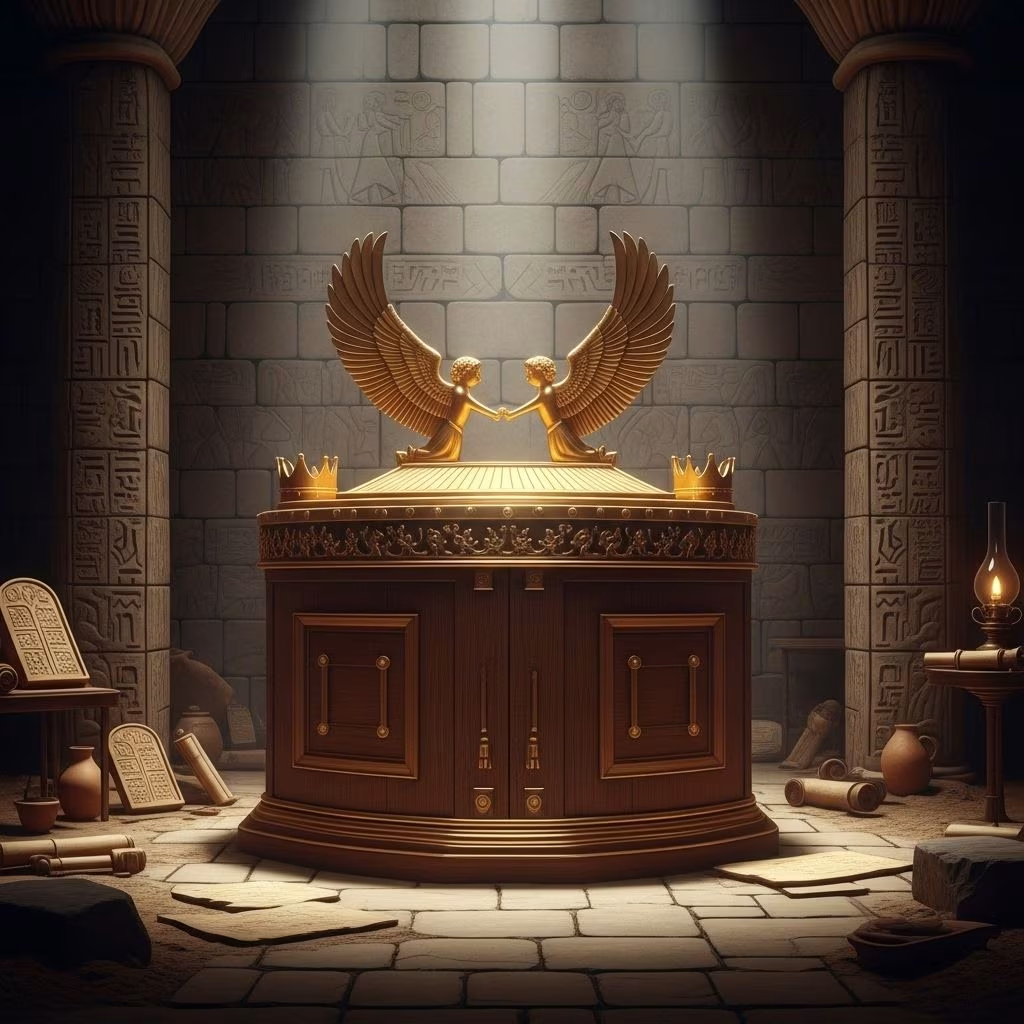
The Ark of the Covenant was a sacred chest built by the Israelites at God’s command following their deliverance from Egypt. Its purpose was to house the two stone tablets of the Law—the Ten Commandments—given to Moses on Mount Sinai. According to Exodus 25:10-22, the Ark was constructed from acacia wood and overlaid with pure gold on all sides. It featured four gold rings for transporting poles and was topped by the “mercy seat”—a golden cover with two cherubim (angelic figures) facing each other with outstretched wings.
- Material: Acacia wood, overlaid with gold inside and out
- Dimensions: Approximately 2.5 cubits long, 1.5 cubits wide, and 1.5 cubits high (roughly 3.75 x 2.25 x 2.25 feet)
- Features: Four gold rings, carrying poles, the gold mercy seat with cherubim
- Contents: Original tablets of the Law, a jar of manna, and Aaron’s rod (as mentioned in Hebrews 9:4)
The Ark of the Covenant in the Bible
After their flight from Egypt, the Israelites wandered in the wilderness for forty years. Within the first year and at Mount Sinai, God instructed Moses to create the Ark as the most sacred object of the Tabernacle (the mobile sanctuary) (Exodus 25:10-22). The Ark was not only a repository for the tablets, but also the central place where God’s presence would manifest to His people. According to the biblical narrative, God spoke to Moses “from between the two cherubim” above the Ark, establishing it as the visible sign of His covenant with Israel.
Construction and Symbolism
The detailed instructions for constructing the Ark emphasized its holiness and distinctiveness. Every aspect of its design—from its gilded wood to the figures of cherubim—pointed to God’s majesty and the necessity for careful, reverent worship. The Ark embodied the covenant relationship between God and His people, physically containing the law while also symbolizing God’s throne on earth.
- The Mercy Seat: Considered the earthly throne of God, the place of divine mercy and communication.
- The Cherubim: Angelic guardians symbolizing reverence and the holiness of God’s presence.
- The Law Inside: Signifying that Israel was governed by God’s revealed word.
The Ark’s Role in Israelite History
The Ark played a central role during key episodes in Israel’s early history, serving as a visible sign of God’s guidance, power, and presence.
The Wilderness Journey
During the forty-year period in the desert, the Ark led the procession whenever the Israelites set out from camp. It was housed within the Tabernacle, specifically in the innermost sanctum known as the Holy of Holies. Only the High Priest could approach the Ark, and only once a year, on the Day of Atonement. God’s instructions forbade touching the Ark directly; it was carried by poles inserted through gold rings.
Miraculous Crossing of the Jordan
When the Israelites reached the Jordan River as they prepared to enter Canaan, the Ark led the way. The waters parted miraculously as soon as the priests bearing the Ark stepped into the water, allowing the entire nation to cross on dry ground. Twelve stones were collected from the river to commemorate the crossing (Joshua 3-4).
The Conquest of Jericho
The Ark played a dramatic role in the Battle of Jericho. Carried around the city walls once each day for six days, and then seven times on the seventh day—always accompanied by the priests blowing trumpets—the Ark was at the heart of the procession. When the people shouted on the final circuit, the walls of Jericho fell, marking one of the most dramatic miracles in the history of Israel (Joshua 6).
The Ark at Shiloh and Other Locations
Once in the Promised Land, the Ark was housed at Shiloh, which became the main center of worship for the Israelites (Joshua 18:1). It was later kept at Bethel and, for a time, cared for by Phinehas, Aaron’s grandson (Judges 20:27-28). The Ark was regularly consulted before military actions and was seen as a point of national and spiritual focus.
The Ark as a Holy Weapon
The Ark was believed to play an active role during battles, symbolizing God’s direct involvement:
- Its presence during the defeat of the Egyptians at the Red Sea (Exodus 14).
- The miraculous fall of Jericho’s walls (Joshua 6).
- Various other military victories and supernatural acts related to the Ark’s presence.
Notable Incidents Involving the Ark
The Ark’s errant use or mishandling led to dire consequences, reinforcing its sacredness:
- The Philistine Capture: In 1 Samuel 4, the Ark was captured by the Philistines in battle. Its presence in their temple led to calamity, prompting them to return it after seven months.
- Uzzah’s Death: When King David attempted to bring the Ark to Jerusalem on a cart, Uzzah touched it and was struck dead for violating the divine command (2 Samuel 6).
The Ark in Jerusalem
King David ultimately brought the Ark to Jerusalem with great celebration (2 Samuel 6:12-17). His son Solomon later constructed the First Temple (Solomon’s Temple), placing the Ark in the Most Holy Place—the Holy of Holies—making it the focal point of worship in Jerusalem around 950 BCE.
The Ark and God’s Presence
Throughout its history, the Ark was viewed as the spiritual heart of Israelite worship. It symbolized God’s immediate presence among His people, serving as the location where atonement for sins was made through blood sprinkled on the mercy seat during Yom Kippur. The phenomenon was so profound that the Tabernacle and Temple were built around the Ark and its sanctity.
The Mystery of the Ark’s Disappearance
After the reign of Solomon, the biblical account of the Ark becomes increasingly sporadic and shrouded in mystery. The last direct mention of the Ark in the Old Testament records that King Josiah ordered the Ark returned to the temple around 622 BCE, shortly before the Babylonian invasion (2 Chronicles 35:3).
When Babylon sacked Jerusalem in 586 BCE and destroyed the temple, the fate of the Ark became unclear. The biblical lists of treasures taken from the city do not include the Ark (2 Kings 25:13-17; Jeremiah 52:17-23), and from this point, the Ark is never mentioned again in the Hebrew Bible’s historical narrative.
Theories and Legends about the Ark’s Fate
The unexplained disappearance of the Ark has led to countless theories and legends throughout history. Some of the most popular ideas include:
- Hidden Before the Invasion: Jewish tradition suggests that priests hid the Ark before the Babylonians could seize it.
- Taken to Babylon or Destroyed: Some propose the Ark was destroyed or taken as an unrecorded spoil.
- Transported to Egypt or Ethiopia: Numerous traditions suggest the Ark was carried far from Jerusalem, with one Ethiopian church, for example, claiming possession of the Ark in Aksum.
- Heavenly Symbolism: In the New Testament (Revelation 11:19), a vision includes the Ark as part of the heavenly temple—a symbol rather than a physical object.
| Theory | Description | Supporting Evidence |
|---|---|---|
| Hidden Before Babylonian Conquest | The Ark was concealed to avoid capture | Rabbinic and later Jewish traditions |
| Taken or Destroyed by Babylonians | Seized or lost during temple destruction | Lack of explicit inventory in ancient records |
| Brought to Ethiopia | Legends claim it resides in Aksum | No archaeological verification |
| Heavenly Representation | Symbolic appearance in Book of Revelation | Biblical reference; theological interpretation |
Why Does the Ark Matter Today?
The Ark of the Covenant resonates on many levels for people of faith and students of history:
- It embodies God’s covenants with humanity and symbolizes divine holiness and justice.
- Its construction and journey demonstrate the seriousness of worship and obedience.
- The mysteries surrounding its fate ignite fascination, research, and debate even in modern times.
Frequently Asked Questions (FAQs) about the Ark of the Covenant
Q: What was kept inside the Ark of the Covenant?
A: The Ark held the two stone tablets with the Ten Commandments. According to Hebrews 9:4, it also contained a jar of manna and Aaron’s rod, though whether these items were always present or symbolic is debated by scholars.
Q: Why couldn’t anyone touch the Ark?
A: The Ark was considered supremely holy; touching it directly was strictly forbidden by God. Only designated Levites could move it, using poles, to prevent contact. When Uzzah touched the Ark while steadying it, he died immediately as a result (2 Samuel 6:6-7).
Q: Where is the Ark of the Covenant now?
A: Its current location is unknown. Various traditions suggest it might be hidden in Israel, taken to Babylon, kept in Ethiopia, or lost/destroyed during the Babylonian conquest. Its disappearance is one of the Bible’s great mysteries.
Q: What happened when the Philistines captured the Ark?
A: The Philistines endured plagues and calamities until they returned the Ark to Israel. Its mere presence among them brought severe misfortune, signifying the Ark’s divine power and the danger of misusing holy things (1 Samuel 4-6).
Q: Does the Ark appear in the New Testament?
A: The Ark is referenced symbolically in Revelation 11:19, where John describes seeing the Ark in the heavenly temple. This is usually interpreted as a sign of God’s heavenly presence rather than a physical reappearance of Moses’ Ark.
The Enduring Legacy of the Ark
The Ark of the Covenant continues to fascinate scholars, religious believers, and adventurers. Its combination of theological depth, historical mystery, and cultural symbolism has secured its place as a central icon in Western religious thought. Whether as the legendary chest of the Ten Commandments or the object of ongoing searches, the Ark remains the subject of profound intrigue and reverence.
- Symbol of the Divine Presence: The Ark remains a powerful emblem of God’s faithfulness and holiness.
- Focus of Modern Exploration: From movies and literature to archaeological expeditions, the quest to uncover the Ark’s fate endures.
- Spiritual Inspiration: For many, the Ark’s story calls for deeper understanding of reverence, obedience, and the awe-inspiring presence of the divine.