


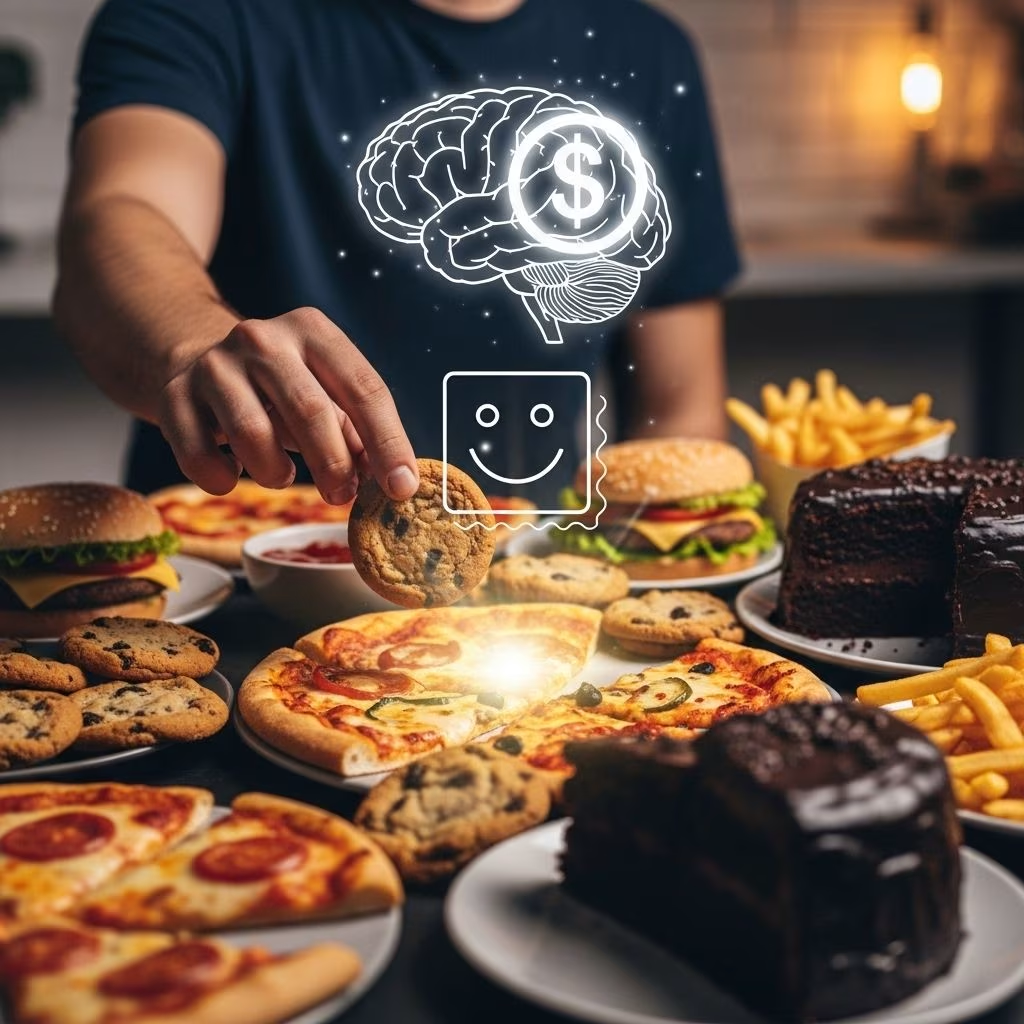
How the Overjustification Effect Fuels Overeating: What Science Reveals
Have you ever found yourself reaching for a sweet treat after a tough day, or indulging because you feel you “deserve” a reward? These moments reflect a psychological phenomenon known as the overjustification effect—a powerful driver behind modern overeating. In this article, we’ll explore the science behind overjustification, how it undermines healthy eating habits, and practical steps to regain satisfaction and control around food.
Contents
- What Is the Overjustification Effect?
- How Overjustification Leads to Overeating
- Scientific Evidence Supporting the Effect
- Why External Rewards Sabotage Eating Habits
- Overjustification Traps in Everyday Life
- Strategies: Breaking the Overjustification–Overeating Cycle
- Frequently Asked Questions
What Is the Overjustification Effect?
The overjustification effect is a psychological phenomenon in which external rewards (like praise, gifts, or treats) diminish our intrinsic motivation for behaviors we once found inherently enjoyable. When we start doing something for the reward rather than the enjoyment itself, our natural interest or satisfaction wanes.
- Intrinsic motivation: Internal enjoyment, curiosity, or satisfaction.
- Extrinsic motivation: Feeling compelled due to outside forces (such as money, social approval, or in our focus—food rewards).
The effect has its roots in early psychological research, notably with the work of Edward Deci and others, who demonstrated that people performing enjoyable activities for external rewards became less interested in those activities once the rewards were removed. Self-perception theory further explains that we infer motivation from observing our own behavior; when a reward is present, we attribute our actions to the reward rather than our own interest.
How Overjustification Leads to Overeating
Many of us grow up associating food with rewards: treats for good grades, desserts for finishing meals, snacks to soothe sadness, and celebrations centered on eating. Over time, eating shifts from being about nourishing the body to being a vehicle for external rewards or emotional regulation.
- Example: A child genuinely enjoys the taste of fruits. But when ice cream becomes the reward for finishing vegetables, their preference becomes skewed toward the treat; the intrinsic enjoyment of healthy food diminishes.
- Adult scenario: After a difficult work week, someone rationalizes eating a whole pizza as a “reward.” The act of eating is no longer connected to hunger or satisfaction but to an external justification.
This shift is subtle yet pervasive. The pleasure of eating for true hunger is gradually replaced by a need to justify indulgence. External cues (stress, reward, social events) dictate food choices, overshadowing body signals and personal enjoyment.
Scientific Evidence Supporting the Effect
Research demonstrates that when people receive rewards for a task that was initially self-motivated, their natural interest in the activity often declines. Key studies include:
- Edward Deci’s puzzles experiment (1971): Participants paid to solve puzzles spent less time engaging with them for fun once the pay stopped, compared to those never paid—their intrinsic motivation had eroded.
- Southern Methodist University study: Competence-based rewards (pay tied to outcome) preserved motivation better than mere completion rewards, showing that not all rewards undermine interest equally.
Outside the lab, research in educational and workplace settings supports the idea that unexpected or unnecessary rewards can reduce personal satisfaction and diminish ongoing engagement. The lost motivation is difficult to regain, reflecting the enduring impact of overjustification.
Why External Rewards Sabotage Eating Habits
The overjustification effect is especially insidious in the context of food for several reasons:
- Food is a primary reinforcer: Eating triggers dopamine release, reinforcing the behavior and making external rewards tied to food extra potent.
- Societal cues: Birthdays, holidays, and achievements are marked by indulgent meals, embedding the “food as reward” mindset from an early age.
- Emotional regulation: Many reach for food to cope with stress, boredom, or disappointment, using eating as an externally justified comfort strategy.
Over time, this leads to disconnection from internal cues:
- Ignoring hunger or fullness signals
- Eating in response to mood, not physical need
- Choosing highly palatable, calorie-dense foods for reward value rather than for nutrition
Table: Intrinsic vs. Extrinsic Motivation in Eating
| Intrinsic Motivation | Extrinsic Motivation |
|---|---|
| Eating for hunger or nutritional needs | Eating for a reward (e.g., dessert after a good day) |
| Enjoyment of flavors and mealtimes | Eating to manage emotions or stress |
| Satisfaction from feeling healthy | Eating because it’s socially expected (e.g., at parties) |
Overjustification Traps in Everyday Life
You don’t need to be a researcher to see the effects of overjustification in the wild. Consider these common scenarios:
- Dieting as a chore: When someone embarks on a diet solely for the “reward” of weight loss, eating healthy becomes a chore rather than a source of pleasure. As soon as the reward disappears—or gets delayed—motivation falters, often resulting in overeating.
- Food as bribe: “If you finish your vegetables, you can have dessert.” This rewards a behavior (eating vegetables) while simultaneously devaluing it (now a hurdle to something better).
- Emotional rewards: Stress at work? Many find relief in snacks, forming a connection between emotional turmoil and reward eating.
People often tell themselves, “I deserve this treat,” or “I’ve been so good, I can splurge.” These justifications are hallmarks of the overjustification trap, where reward signals overshadow actual desire, hunger, or nutritional need.
Strategies: Breaking the Overjustification–Overeating Cycle
Awareness of the overjustification effect’s power is the first step. Here are practical strategies for regaining control:
- 1. Reconnect with intrinsic pleasure.
Focus on noticing and savoring the flavors, textures, and aromas of food without judgment. Mindful eating encourages genuine enjoyment and helps distinguish between true hunger and a desire for reward. - 2. Identify external triggers.
Keep a journal of when you eat, what you’re feeling, and what justifications you give yourself. Noticing patterns helps you separate emotional or reward-driven eating from necessary nourishment. - 3. Derive non-food rewards.
Celebrate achievements and manage stress with activities unrelated to food—like a walk, calling a friend, or enjoying music. Over time, your brain learns to seek satisfaction from a broader repertoire. - 4. Rethink food rules.
Avoid making any food strictly “forbidden” or only allowable as a reward. All foods can fit in a balanced, flexible diet—removing the illicit or celebratory allure. - 5. Practice self-compassion.
If you overeat, resist the urge to punish yourself with stricter rules; this only deepens the cycle. Instead, acknowledge it as a learning opportunity and focus on the next moment. - 6. Seek intrinsic motivators.
Instead of focusing on external outcomes (like weight or appearance), investigate what internal values drive your desire for change—feeling more energetic, being able to play with kids, or enjoying sports. These motivations are more sustainable.
Example: Rewriting Your Inner Dialogue
- Old mindset: “I’ll have cake because I earned it after a long day.”
- New mindset: “Do I truly want cake, or am I seeking comfort? What else could satisfy me right now?”
Frequently Asked Questions
Q: Is rewarding myself with food always unhealthy?
A: Occasional food rewards aren’t inherently bad, but relying on them regularly can erode your ability to judge true hunger and satisfaction. Over time, it may make healthy eating less enjoyable and more of a chore, fueling cycles of guilt and overeating.
Q: How can I tell if I’m eating for external rewards versus real hunger?
A: Ask yourself whether you would choose the food if you weren’t seeking comfort or celebration. Journaling and mindful check-ins before eating can help clarify your motivation.
Q: What’s the fastest way to break free from reward-driven eating?
A: There’s no instant fix. The most effective strategy is consistent mindful eating: pay attention to flavors, fullness, and mood every time you eat. Over weeks, this fosters reconnection with intrinsic enjoyment.
Q: Do all external rewards trigger the overjustification effect?
A: Not all rewards undermine motivation equally. Tangible, expected, and task-contingent rewards (\”if you do X, you get Y\”) are more likely to lessen intrinsic motivation. Unexpected or non-contingent praise tends to be less harmful, especially when focused on effort rather than outcome.
Q: Can the overjustification effect impact other areas of my life?
A: Absolutely. It affects learning, work, exercise, and any area where habits might shift from enjoyment to obligation due to external rewards.
Key Takeaways
- The overjustification effect occurs when rewards replace our natural desire, making us less motivated and less satisfied.
- This phenomenon is a hidden driver behind many eating struggles, especially in today’s reward-oriented culture.
- Building a healthier relationship with food means moving away from “earning” indulgence and toward intrinsic enjoyment of mealtimes and body cues.
- Mindful reflection, non-food rewards, and self-compassion are powerful antidotes to the overjustification trap.
References
- https://www.structural-learning.com/post/overjustification-effect
- https://psychology.iresearchnet.com/social-psychology/control/overjustification-effect/
- https://thedecisionlab.com/biases/overjustification-effect
- https://en.wikipedia.org/wiki/Overjustification_effect
- https://www.youtube.com/watch?v=jEZEVUmOdHY
- https://sk.sagepub.com/ency/edvol/socialpsychology/chpt/binge-eating
- https://pmc.ncbi.nlm.nih.gov/articles/PMC5386788/
- https://dictionary.apa.org/overjustification-effect
- https://study.com/learn/lesson/overjustification-effect-motivation-examples.html


