


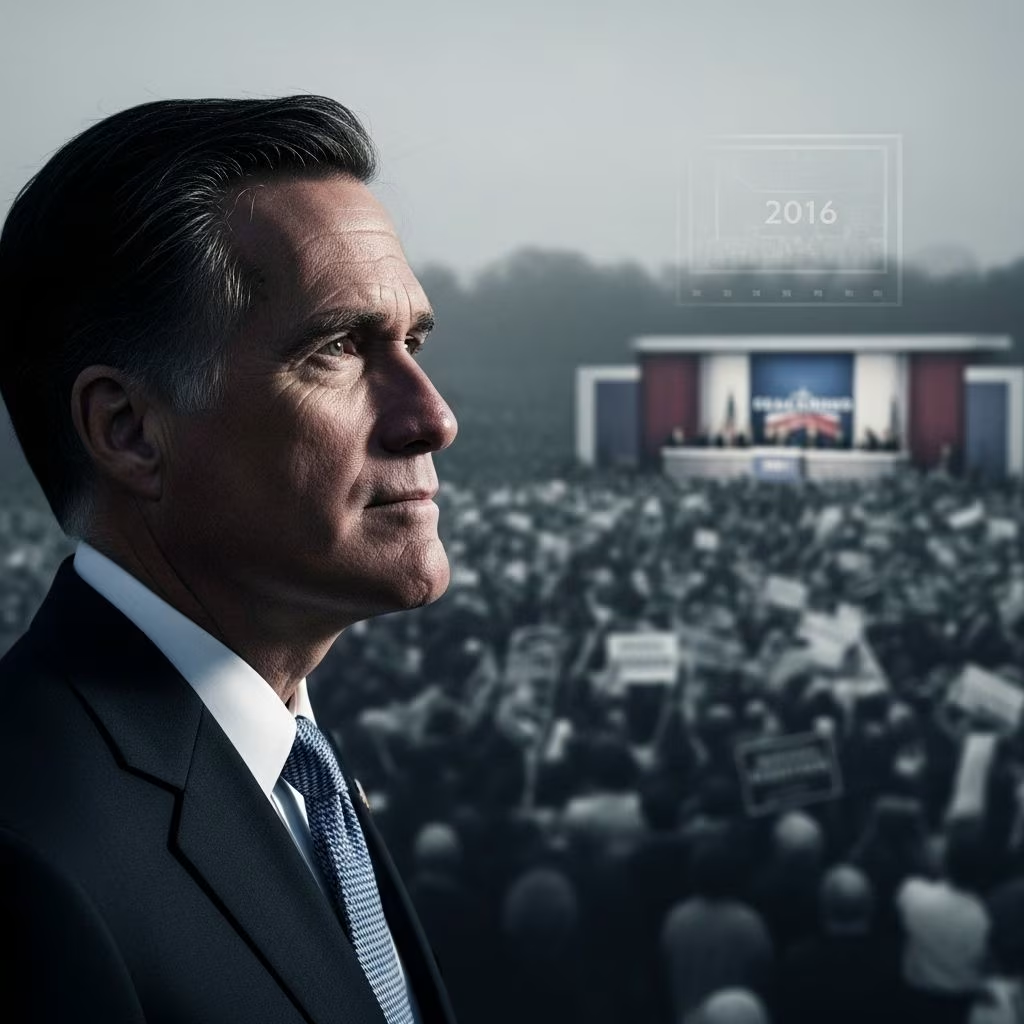
Mitt Romney and the 2016 Election: Understanding a Defining Political Relationship
In the landscape of American presidential politics, few figures have had as complicated and consequential a relationship with the 2016 election as Mitt Romney. As the Republican nominee in 2012 and the former governor of Massachusetts, Romney’s words and actions during the run-up to the 2016 campaign not only reflected the turbulence within the GOP but also helped shape how the party and America understood itself. This article unpacks his evolving stance, his efforts behind the scenes, and the enduring questions about political authenticity and party loyalty that defined Romney’s position during this pivotal moment in U.S. history.
The GOP’s Former Nominee Looks On
Romney, once the standard-bearer for the Republican Party, found himself in an unusual position as the 2016 election season heated up. Rather than being a central player, he was an influential observer—one whose public statements and political maneuvers spoke volumes about the shifting dynamics in the party. His unique standing allowed him to act as a bridge (and at times, a wedge) between the party’s establishment and its insurgent wing, led by Donald Trump.
- Romney’s 2012 candidacy had established him as the face of the mainstream GOP.
- By 2016, his caution, criticism, and interventions underscored the party’s identity crisis.
- Romney’s actions were seen by many as an attempt to save the party from what he perceived as a dangerous new trajectory.
The Early Signals of Romney’s Unease
Long before the Republican primaries heated up in earnest, political observers noted Romney’s discomfort with the direction of the party. His unease with Trump’s populist rhetoric and combative style was palpable. Romney, a man driven by both personal conviction and analytic calculation, quickly realized that the more left unchecked, Trump’s influence would reshape the party in lasting—and, to Romney, troubling—ways.
- Romney issued public statements warning about the dangers of reactionary populism.
- He maintained relationships with party insiders and rising stars, hoping to influence the primary from behind the scenes.
- His fingerprints could be found on efforts to shape debate, broker consensus, and search for alternatives to the Trump candidacy.
Romney as a Reluctant Intervener
Mitt Romney did not enter the 2016 race himself, but his presence loomed large. He publicly flirted with the idea at key moments, prompting speculation and stoking the hopes of the GOP establishment. Despite his reservations, Romney’s engagement was less about personal ambition and more about what he saw as a civic duty to safeguard the Republican legacy and American democracy.
As behind-the-scenes accounts later revealed, Romney was far from inactive:
- He engaged in extensive behind-the-scenes outreach, encouraging other candidates to consolidate against Trump.
- He met privately with influential donors and party officials, advocating a coordinated response.
- Romney explored independent or unity candidacies, even considering partnerships that most would have deemed unthinkable in earlier eras.
The Public Rebuke
Romney’s most memorable moment during the 2016 election cycle was his pointed and passionate public speech rebuking Donald Trump. Delivered in March 2016, Romney’s address was laced with a combination of moral disapproval and political warning, calling Trump a “fraud” and a “phony.” Romney’s intention was clear: to vouch for the party’s traditional values and sound the alarm about what he believed Trump’s nomination would mean for the GOP and the nation as a whole.
- The speech was a rare intervention from a former nominee so soon after his own campaign.
- Romney’s words energized anti-Trump factions but also intensified divisions within the party.
- Trump and his supporters responded with characteristic aggression, reinforcing the perception of party rupture.
How Romney Wrestled with His Political Identity
One of the underlying themes of Romney’s 2016 journey was his ongoing struggle with political authenticity. Outsiders often caricatured him as inauthentic or aloof, while supporters praised his earnestness and integrity. This tension colored both his public gestures and his private deliberations in 2016.
| Perception | Reality |
|---|---|
| Romney as a political “chameleon” | Romney as a deeply principled, sometimes misunderstood, figure |
| Romney motivated by establishment interests | Romney motivated by a sense of party stewardship and moral duty |
This gap between perception and reality became all the more pronounced as the 2016 race exposed the party’s deep fissures. Romney, more than most, felt the burden of representing a vanishing idea of Republicanism—one defined by decorum, internationalism, and a certain managerial competence.
Romney and the Media: Shaping and Being Shaped
The media played a dual role in Romney’s 2016 narrative. While he was often invoked as a symbol of “old GOP” caution, media coverage also amplified his departures from party orthodoxy. Romney’s story became a canvas upon which broader anxieties about the party’s direction were projected.
- He was frequently quoted as the conscience of the party, yet sometimes framed as out of touch.
- His op-eds and TV appearances kept him in the headlines and injected his concerns into the national conversation.
- Social media brought both support and ridicule, with memes underlining the contrast between Romney’s brand of politeness and the combativeness that now dominated the GOP.
Romney’s Private Dilemmas: To Run or Not to Run?
Even as Romney worked to push other candidates forward, he privately weighed the merit of launching his own independent campaign. Accounts from confidantes reveal that he ran the numbers, consulted with family and advisors, and seriously considered the ramifications—both personal and national—of standing in the race as a disruptor.
Key considerations included:
- The likelihood that a third-party run would siphon votes from the Democratic nominee, inadvertently helping Trump.
- Romney’s own skepticism that he could win outright as an independent in America’s two-party system.
- The desire not to further fracture a party already on the brink of open civil war.
Ultimately, Romney chose not to run, a decision that continues to provoke debate among historians and party strategists.
Pragmatism Versus Principle: Romney’s Tightrope
Throughout the 2016 primary season, Romney’s approach was defined by the tension between pragmatic political strategy and principled opposition. This struggle played out not only on the public stage but also in the efforts to broker alliances behind closed doors. Romney encouraged rivals to band together, lobbied donors to fund anti-Trump initiatives, and marshaled his own clout in pursuit of party unity.
- His efforts fell short, stymied by the self-interest and rivalry among other major candidates.
- Trump’s momentum was too great, and the party infrastructure too fragmented, to mount a successful unified resistance.
- Romney’s high-profile criticisms, while respected in some quarters, were dismissed as sour grapes by others who saw Trump’s rise as a populist correction.
The Romney Legacy in the Trump Era
As the months unfolded and the primaries concluded, Romney’s fate became intertwined with the future of the Republican Party. Though he did not run, his interventions—subtle and overt—defined the contours of intra-party resistance to Trump. Some saw Romney as a Cassandra-like figure, warning of disaster only to be ignored; others saw him as a stubborn holdout unable to adapt to new political realities.
Looking forward, Romney’s example provided both a blueprint and a cautionary tale for moderates and reformers within the party:
- His willingness to openly criticize his party’s nominee was rare and risky.
- Romney’s advocacy for a more civil, policy-centered discourse remains relevant even as the party’s populist wing solidifies its power.
- His subsequent service in the U.S. Senate, and his later condemnation of Trump’s actions after the 2020 election, underscored his enduring commitment to principle amid political tumult.
From Relationship to Reckoning: What Romney’s 2016 Stance Means Today
The story of Romney and the 2016 election is fundamentally about the struggle to define one’s role in a moment of historic political change. Was he a guardian of a lost tradition, a failed fixer, or the moral center the GOP desperately needed? The answer depends on which lessons are drawn—and by whom. What is clear is that Romney’s involvement shaped and reflected the ongoing transformations not just within a party, but within the political culture as a whole.
Frequently Asked Questions (FAQs)
Q: Did Mitt Romney consider running for president in 2016?
A: Yes. Romney actively considered the prospect, flirted with independent runs, met with political influencers such as Michael Bloomberg, and examined the implications of such a move. Ultimately, after weighing the risks and political climate, he decided against it.
Q: What motivated Romney to publicly oppose Donald Trump?
A: Romney was motivated by his conviction that Trump was unfit for the presidency and posed a threat to democratic norms and the reputation of the Republican Party. He hoped to provide the party with a moral alternative and to hold the line on values he deemed essential to the GOP and the country.
Q: How did other Republicans react to Romney’s criticisms of Trump?
A: The response was deeply divided. Some praised Romney for his integrity and courage, while others accused him of disloyalty or political opportunism. Trump’s rise had energized a populist base for whom Romney’s brand of Republicanism seemed outdated or insincere.
Q: Did Romney’s interventions have a significant effect on the 2016 Republican primaries?
A: While Romney played a role in critiquing Trump and encouraging opposition, his efforts were largely unsuccessful in changing the outcome. The resistance was undermined by rivalries among other candidates and the momentum Trump had built among primary voters.
Q: What is the longer-term impact of Romney’s actions in 2016 on his career and reputation?
A: Romney’s opposition to Trump has defined his later public service—most notably during his time in the Senate, where he was the only Republican to vote for Trump’s impeachment twice. He has become an emblem of principle for some and a symbol of outmoded politics for others.
Key Takeaways
- Mitt Romney’s relationship with the 2016 election was complex, deeply informed by his sense of duty and identity as a Republican.
- His behind-the-scenes efforts to block Trump, his public rebuke, and his private agonizing illustrate the pressures faced by party elders during moments of radical political change.
- The 2016 election remains a turning point in the evolution of both Romney’s career and the Republican Party itself.
References
Key points in this article draw on reporting and analysis from The Harvard Gazette, which details Romney’s efforts and struggles within the shifting landscape of the 2016 Republican Party, and supplementary insights from analysis at Bustle on Romney’s political activities and perceptions among Republicans.


