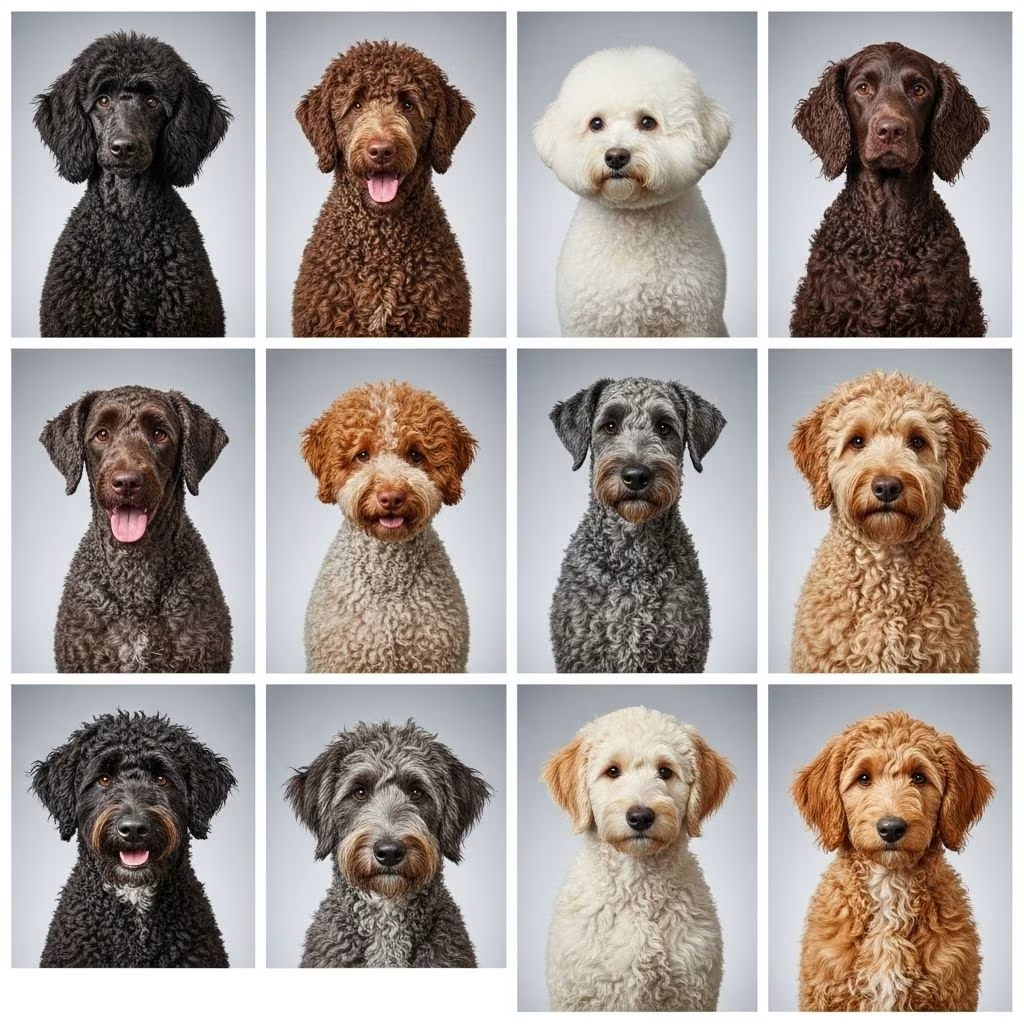
When your beloved canine companion greets you with what appears to be a wide, joyful grin, it’s nearly impossible not to smile back. That relaxed face, those soft eyes, and that endearing open-mouthed expression seem to radiate pure happiness. But this heartwarming scene raises an intriguing question that has captivated pet owners and scientists alike: do dogs actually smile in the way humans do? The answer is more complex and fascinating than you might expect, rooted in evolutionary biology, behavioral science, and the remarkable bond between humans and their four-legged friends.
Can Dogs Really Smile?
The truth about canine smiling is both surprising and nuanced. Most animal behaviorists don’t consider what we perceive as a dog “smiling” to be a true grin in the traditional human sense. The expressions we interpret as smiles in our dogs are fundamentally different from the conscious display of joy that characterizes human facial expressions. However, this doesn’t diminish the significance of these adorable looks our dogs give us.
Dogs display a variety of facial expressions that humans commonly interpret as smiles. These include wide-mouth panting after exercise or play, the relaxed posture of lying down with their tongues hanging out contentedly, and what experts call “submissive grins” – a particular expression that involves pulling back the lips to expose teeth in a non-threatening manner. Interestingly, even aggressive baring of teeth can sometimes be mistaken by inexperienced observers as a friendly greeting, though context and body language usually make the distinction clear.
Despite the scientific skepticism about true “smiling” in dogs, there’s an important correlation to consider: most of the time when dogs display these smile-like expressions, they genuinely are experiencing positive emotions. They’re happy, content, or relaxed. This natural association makes it quite reasonable for us to relate these canine expressions to human smiles, even if the underlying mechanisms differ. The expression might not be identical to human smiling, but the emotional state it represents often aligns closely with human happiness.
The Evolutionary Origins of the Canine Smile
Understanding why dogs appear to smile requires us to journey back through thousands of years of evolutionary history. The canine smile likely stems from a fascinating combination of evolutionary adaptation and dogs’ extraordinary ability to analyze and respond to human behavior. Through their long relationship with humans, dogs have become masters at understanding what makes us happy and how to elicit positive responses from us.
Most scientists believe that dogs have learned – both individually and as a species – that certain facial expressions earn them rewards from their human companions. When a dog displays what we interpret as a smile, humans typically respond in predictable ways: we smile back, make approving sounds, offer verbal praise, provide treats, or give affection. This positive reinforcement creates a powerful feedback loop. The dog learns that this particular expression generates desirable outcomes, so they repeat it more frequently. Over time, this behavior becomes ingrained, passed down through generations of domesticated canines.
Genetically speaking, the canine smile may be explained by a phenomenon called neoteny – the retention of juvenile characteristics into adulthood that occurs during domestication. When wolves were gradually domesticated into the dogs we know today, they retained many puppy-like behaviors even as adults. This includes emotional greetings, enthusiastic jumping, vigorous tail-wagging, face-licking, and yes, that adorable expression we interpret as smiling. These juvenile traits made dogs more appealing and easier to bond with for humans, creating a selective pressure that favored their continuation.
Dogs as Masters of Human Communication
What makes the dog’s apparent smile particularly remarkable is the broader context of canine-human communication. Dogs have developed an almost unique ability among animals to read and respond to human facial expressions and body language. Scientific research has revealed that dogs can distinguish between happy and unhappy human expressions, including anger and sadness. They watch the left sides of human faces more closely, which is where emotional cues tend to appear first. This sophisticated face-reading ability suggests that dogs have evolved specialized neural mechanisms for processing human emotions.
Research using functional magnetic resonance imaging (fMRI) has provided fascinating insights into how dogs process human facial expressions at a neurological level. When dogs view happy human faces, distinctive patterns of activity appear in their temporal lobes and other brain regions. This “happiness signature” is so consistent that machine learning algorithms can identify it when dogs look at joyful human faces versus other emotions like anger, fear, or sadness. Remarkably, this neural pattern mirrors similar responses found in human brains when we see happy faces, suggesting that our emotional states are genuinely represented in our dogs’ neural processing.
Dogs also seem to modulate their behavior based on the emotions they perceive in humans. If you’re sad, your dog might approach more gently or try to comfort you. If you’re excited and happy, your dog often mirrors that energy. This emotional attunement goes beyond simple behavioral conditioning – it reflects a deep, evolutionarily-shaped understanding of human psychology that few other species possess.
The Unique Bond Between Humans and Dogs
The 30,000-year history of dog domestication has created a truly unique interspecies bond. This extended coevolution has made dogs exceptionally valuable subjects for studying cross-species communication. Unlike most animals, dogs actively seek out and embrace human eye contact, using their gaze as a communicative tool in ways that even our closest primate relatives do not.
Research comparing wolves and dogs illustrates this point beautifully. When presented with an impossible task – such as opening a container they know contains food – wolves typically give up and walk away when they realize they can’t complete it on their own. Dogs, however, do something remarkable: they turn to look at nearby humans with a long, inquiring gaze, as if asking for help. This behavior demonstrates that dogs understand humans can assist them with problems and that eye contact is an effective way to solicit that assistance. This sophisticated understanding of human capability and communication is largely unique to dogs among domesticated animals.
The Power of Puppy Dog Eyes
Beyond the smile, dogs have developed another powerful facial expression: the famous “puppy dog eyes.” Research has shown that this expression, characterized by raised inner eyebrows that make the eyes appear larger and more infant-like, has a profound effect on human behavior. Studies conducted at animal shelters revealed that dogs who more frequently produced this expression were adopted more quickly than those who didn’t, regardless of other behavioral factors. No other measured behavior had as strong an effect on adoption rates.
Interestingly, when researchers investigated whether dogs intentionally use this expression to manipulate human behavior, the results were mixed. Dogs were more facially expressive when looking at humans compared to when alone, confirming that eye contact and human presence trigger these expressions. However, dogs used their sorrowful gaze equally whether food was offered or not, suggesting the behavior might not be a calculated manipulation but rather an unconscious trait that humans have inadvertently selected for during domestication. This expression may trigger our nurturing response because it resembles human sadness, but that doesn’t necessarily mean dogs have consciously learned to exploit this reaction.
What Science Can and Cannot Tell Us
While we’ve learned much about canine facial expressions, significant questions remain unanswered. The scientific study of dog smiles specifically is still in its early stages, with relatively little objective research to definitively prove what these expressions mean or whether dogs intentionally direct them at humans to communicate specific messages.
Some research, including studies published in Scientific Reports, indicates that the “relaxed open mouth” expression in dogs typically occurs in positive settings, such as when dogs are inviting one another to play. This suggests a correlation between the expression and positive emotional states. However, whether this constitutes a true “smile” in the way we understand the term, and whether dogs consciously use it to communicate with humans, remains scientifically uncertain.
The challenge lies partly in our research methodologies. Many tools used to study dog expressions are subjective, relying on human interpretation of canine behavior. Coupled with our natural tendency to anthropomorphize – to attribute human characteristics and emotions to animals – there’s a real risk of misinterpreting what we observe on dogs’ faces. We might see what we want to see rather than what’s actually there.
To answer these questions definitively, researchers need more objective techniques, such as the Facial Action Coding System (FACS) adapted for dogs. This system allows scientists to precisely measure minute facial movements and correlate specific expressions with particular situations, environmental factors, and outcomes. By systematically studying which facial movements occur in which contexts and what motivates them, researchers can build a more accurate understanding of canine communication. Unfortunately, such comprehensive studies are still relatively rare in the field of dog behavior research.
Understanding Your Individual Dog
While science works to uncover universal truths about canine expressions, individual dog owners have the advantage of intimate, long-term observation of their specific pets. Many researchers acknowledge that people who have lived with dogs for years develop a genuine ability to read their individual animal’s behaviors and emotional states accurately. This experiential knowledge is valuable, even if it’s difficult to quantify scientifically.
Every dog is an individual with unique personality traits, communication styles, and behavioral patterns. What looks like a smile in one dog might be simple panting in another. A dog’s breed, life experiences, socialization history, and relationship with their owner all influence how they communicate. By paying close attention to the contexts in which your dog displays various expressions, you can learn to distinguish between different types of “smiles” and understand what your particular dog is feeling or trying to communicate.
The Bigger Picture: Why It Matters
Whether dogs are “truly” smiling in the human sense might seem like an academic question, but understanding canine communication has practical implications for animal welfare, training, and the human-animal bond. Misreading a dog’s expressions can lead to problematic interactions. For example, some people might approach a dog showing teeth, thinking it’s smiling, when the animal is actually displaying a fear or aggression signal. Better understanding of canine body language and facial expressions can prevent bites and improve safety for both humans and dogs.
Additionally, recognizing that dogs have evolved specialized ways of communicating with humans highlights our responsibility to understand and respond appropriately to their signals. Dogs are trying to communicate with us constantly through their faces, bodies, and vocalizations. The more accurately we interpret these signals, the stronger our bond with our canine companions becomes, and the better we can meet their physical and emotional needs.
The Joy of Canine Expressions
Ultimately, whether the scientific community definitively classifies a dog’s open-mouthed, relaxed expression as a “true” smile may be less important than the role these expressions play in our relationships with our dogs. These faces bring us joy, strengthen our emotional connections, and make us more attentive and responsive to our pets. When your dog greets you with that characteristic expression – mouth open, tongue out, eyes soft – you’re witnessing the result of thousands of years of coevolution that has created one of the most successful interspecies partnerships in history.
The fact that dogs display expressions we interpret as smiles, and that these expressions typically coincide with positive emotional states in the animals, is something to celebrate. It demonstrates the remarkable plasticity of evolution and the profound ways that different species can adapt to live together harmoniously. Whether we call it smiling, grinning, or simply “happy face,” that endearing canine expression represents something beautiful: a bridge between species, built through millennia of companionship, mutual adaptation, and affection.
Frequently Asked Questions
Q: Do dogs smile to show happiness like humans do?
A: While dogs display expressions we interpret as smiles that often correlate with happiness and contentment, they don’t smile in exactly the same conscious, emotional way humans do. Their “smiles” are more likely related to learned behaviors and evolutionary adaptations rather than deliberate expressions of joy, though they frequently do indicate positive emotional states.
Q: Can dogs recognize when humans are smiling?
A: Yes, research shows that dogs can distinguish between happy and unhappy human facial expressions. Brain imaging studies reveal that happy human faces produce distinctive neural patterns in dogs’ brains, indicating they genuinely recognize and process human emotions, including smiles.
Q: Why does my dog seem to smile more when I’m happy?
A: Dogs are remarkably skilled at reading human emotions and behavior. Your dog has learned that displaying this expression when you’re happy often results in positive reinforcement like praise, treats, or affection. Additionally, dogs tend to be more facially expressive when interacting with humans they’re bonded with, particularly when those humans are displaying positive emotions.
Q: Is there a difference between a dog’s smile and aggressive teeth-baring?
A: Yes, there are important differences, though they can sometimes be confused. A relaxed “smile” involves a soft, open mouth with a loose jaw, relaxed body posture, and calm eyes. Aggressive teeth-baring typically includes a tense body, stiff posture, direct staring, raised hackles, and sometimes growling. Context and overall body language are crucial for correct interpretation.
Q: Did dogs evolve to smile specifically to communicate with humans?
A: The canine “smile” likely evolved as part of neoteny – the retention of puppy-like behaviors in adult dogs – during the domestication process. Dogs that displayed expressions humans found appealing were probably more successful at forming bonds with humans, creating evolutionary pressure that favored these traits. So while not evolved solely to smile at us, their facial expressions have been shaped by thousands of years of human-dog coevolution.
Q: Should I encourage my dog to smile?
A: If your dog naturally displays relaxed, open-mouth expressions when happy and comfortable, responding positively is fine. However, you shouldn’t try to force or train expressions that make your dog uncomfortable. Focus instead on creating positive experiences and environments where your dog naturally feels happy and relaxed, and the “smiles” will follow naturally.
References
- https://www.petscare.com/news/post/understanding-dog-smiles-expressions
- https://www.petmd.com/dog/behavior/do-dogs-smile-science-behind-looks-we-get-happy-dog
- https://www.science.org/content/article/smile-your-dog-s-brain-will-light-response
- https://www.livescience.com/65506-are-dogs-smiling.html
- https://pmc.ncbi.nlm.nih.gov/articles/PMC8614696/
- https://pmc.ncbi.nlm.nih.gov/articles/PMC10066124/
- https://wagwalking.com/daily/the-science-behind-our-love-for-cute-dog-smiles