


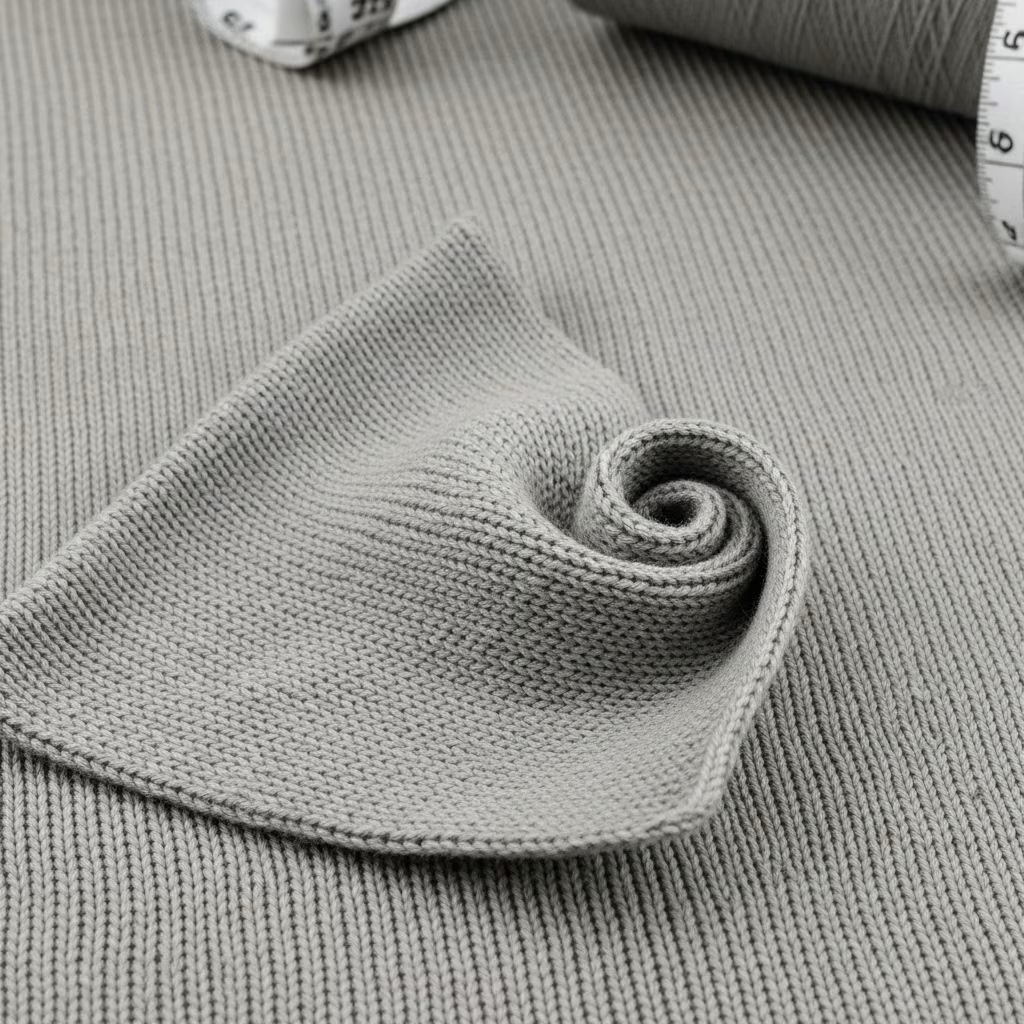
Causes and Remedies of Spirality in Knitted Fabric
Spirality in knitted fabrics is a prevalent and challenging defect that affects garment quality, appearance, and performance. This article presents an in-depth analysis of spirality: its origins in the knitting process, the interplay of material and mechanical factors, and practical methods for its reduction or elimination.
What Is Spirality in Knitted Fabric?
Spirality, also referred to as skew, is a structural distortion in knitted fabrics where the fabric wales (vertical rows) and courses (horizontal rows) are no longer perpendicular. This twisting gives the fabric a spiral appearance, particularly pronounced after processes like wetting, washing, or finishing. Spirality not only affects aesthetics but can also lead to garment misfit and seam skewing, making it a vital issue for both manufacturers and end-users.
Understanding the Origin of Spirality
Spirality develops due to a combination of yarn, knitting, fiber, and finishing parameters. The basic structure of a knitted fabric involves intermeshing yarn loops. When these loops face asymmetric forces or differences in material property, they deviate from their intended alignment, leading to angular relationships in the fabric where the wales and courses meet at angles other than 90 degrees.
Core Causes of Spirality in Knitted Fabric
Multiple intertwined factors contribute to the emergence of spirality. The most significant are:
- Yarn Twist Multiplier: The principal determinant, this quantifies the degree of twist imparted during spinning. Higher twist multipliers impart greater liveliness or torque to the yarn, which is released unevenly during knitting and finishing, causing spirality.
- Residual Torque (Twist Liveliness): Yarn stores mechanical and structural tensions from spinning. Unless properly relaxed, these tensions release in the knitted structure, tilting the loops and causing deviated wales.
- Asymmetric Loop Formation: Knitted loops are ideally symmetric, but practical differences in mechanical tension, yarn structure, and machine setup cause asymmetric loops, increasing spirality risk.
- Number of Feeders: Multi-feed circular knitting machines, while boosting productivity, can generate fabric with higher spirality, especially when many feeders are used simultaneously.
- Spinning Technology: The method used (ring, rotor, airjet spinning) affects the yarn’s physical and geometric properties. Different yarn types (e.g., ring-spun vs. open-end) impart different spirality characteristics.
- Knitting Tension & Frictional Properties: Variation in knitting tension and the frictional characteristics of yarns (including lubricant presence and the number of needle-sinker contact points) directly impact loop formation and the tendency for spirality.
- Yarn and Fiber Properties: Yarn count, modulus, fineness, and cross-section influence material response to stress. Moreover, blends of different fibers (including synthetic and natural) can reduce spirality levels compared to pure cotton due to differences in mechanical behavior during processing.
- Garment Wet Processing: Wet treatments cause fibers and yarns to swell and relax, but they can also enhance spiral distortion, as the released internal stress can increasingly twist the fabric structure.
- Machine Rotation Direction: The direction (clockwise or anti-clockwise) slightly affects the inclination of loops. Generally, spiral formation follows the movement of the machine, being left-aligned for clockwise and right-aligned for anti-clockwise movement. However, this influence is less significant compared to yarn and tension factors.
In-Depth Analysis: How Key Factors Influence Spirality
Yarn Factors
- Twist Multiplier: High twist multipliers introduce more stored torsional energy in the yarn. When knitted, this energy is released unevenly, leading to off-vertical loop configuration and spirality.
- Residual Torque: If not counteracted, the twist liveliness from yarns translates directly to angular loop displacement in the fabric. Twistless or low-torque yarns show minimal spirality.
- Fiber Blending: Mixing cotton (which tends to spiral more) with fibers of different flexural or torsional rigidity can mitigate the defect. Heat-set capable fibers are preferable as they stabilize the structure upon setting.
Knitting & Machine Factors
- Stitch Length: Longer loops tend to spiral more due to increased freedom of loop movement. Tight, compact structures are less likely to show spirality.
- Structure Type: Single jersey shows notable spirality as its structure does not arrest torque-induced movement effectively. Double jersey (interlock or rib) and some jacquard structures are less prone.
- Feeder Count & Machine Settings: Increasing the number of feeders enhances production speed but can add to the magnitude of spiral distortion. Proper tension and alignment are essential.
- Knitting Tension: Uniform and optimal tension across the knitting process is vital for balanced loop formation. Uneven tension exacerbates asymmetry, leading to spirality.
Finishing and Wet Processing Factors
- Washing and Relaxation: Relaxed, moisture-saturated fibers are prone to swell and release inner stresses, intensifying spiral twist. Repeated washing and tumble-drying can reduce the spirality angle over time as the fabric relaxes fully.
- Heat-Setting: Application of heat (via steaming or hot water) can relax or thermally stabilize certain synthetic fibers, fixing the desired loop geometry and minimizing spiral defects.
- Resin Treatment: By bonding fiber cross-links, resin treatment helps lock loop orientation. However, excessive or improper application weakens natural fibers like cotton, thus it’s used cautiously.
Summary Table: Major Causes & Their Effects
| Cause/Parameter | Explanation | Impact on Spirality |
|---|---|---|
| Yarn Twist Multiplier | High twist = more torque | Increases spirality |
| Residual Yarn Torque | Latent mechanical energy | Increases spirality |
| Fiber Blend | Combining fibers of different rigidity | Reduces spirality |
| Stitch Length | Longer stitches = looser fabric | Increases spirality |
| Knitting Tension | Even, high tension = stable loops | Reduces spirality |
| Number of Feeders | More feeders = faster but riskier | Increases spirality |
| Wet Processing | Moisture relaxes fibers | May increase spirality unless controlled |
Remedial Measures & Prevention
Minimizing or eliminating spirality involves a combination of pre-knitting, knitting, and post-knitting interventions. Effective remedies target the main contributing factors, with practical methods employed both in fabric manufacturing and finishing stages.
1. Compaction
Compacting is an advanced finishing treatment that reduces the length of fabric based on its elongation during processing. This, in turn, slightly decreases its width, helping control shrinkage and spiral distortion. There are two main types of compactors:
- Open Compactors: Work on wide width fabrics before cutting for garments, best suited for large-scale production.
- Tubular Compactors: Ideal for smaller tubes such as t-shirts or hosiery. Squeezing lines on the fabric’s sidelocks help counter spirality. However, manual straightening of wales before compaction can inadvertently reintroduce spirality.
Proper compaction aligns and stabilizes the loops, thus reducing the visible effects of spirality.
2. Resin Treatment (Cross-Linking)
Resin treatments involve applying a special chemical resin in an aqueous solution to the fabric, followed by curing at high temperatures, typically on a stenter frame. This process creates cross-links between fibers, which can lock the loop orientation and reduce fabric distortion. Key points:
- Effective for synthetic blends, but not recommended for cotton as it can degrade yarn strength.
- Formulated resins should be compatible with the fiber type to prevent fabric damage.
- Ideal for fabrics where long-term dimensional stability is required.
3. Heat Setting
Heat setting exposes the fabric to controlled steam or hot water, reducing the twist liveliness and stabilizing the fabric structure. Fibers realign themselves under heat and moisture, relaxing residual stress and locking the fabric into its final configuration. For cotton, mercerization (treatment with caustic soda) is often recommended to encourage permanent fiber relaxation.
4. Yarn Twist Balancing
Adjusting yarn twist properties at the spinning stage offers an effective way to mitigate spirality long before knitting. Using plied yarns or controlling twist direction (Z-twist vs. S-twist) can help balance the structural torque across the fabric, notably minimizing spiral distortion. Research indicates that increasing the twist factor of a ply yarn in S-direction fabrics heightens left-handed spirality, while additional twist in a single yarn can decrease it.
5. Fiber Blending and Selection
Blending cotton with synthetic fibers offering higher flexural and torsional rigidity reduces spirality. Heat-settable fibers are especially helpful, as they can lock the fabric’s geometry upon heat exposure. Therefore, selecting and engineering fiber blends suited for the intended fabric application is a preventive strategy against spirality.
6. Process Optimization
- Maintain uniform knitting tension and minimize fluctuations throughout the production run.
- Optimize stitch length for target fabric — avoid overly loose knits where possible.
- Select machine and feeder configurations that match the yarn and fabric requirements rather than prioritizing productivity alone.
- For wet processing, control the relaxations steps to allow for gradual and uniform release of stored torque.
Practical Insights for Knitters and Manufacturers
- Closely monitor and standardize machine settings, especially for tension and stitch length, before and during production runs.
- Source yarns with low twist liveliness or from spinners using modern, controlled twist technologies.
- Schedule periodic machine maintenance to avoid misalignment that can worsen loop asymmetry.
- Where possible, run fabric trials using several blends or yarn types to observe spiral behavior before committing to mass production.
- Educate finishing operators on the importance and correct application of compaction, resin, and heat treatments for best results.
Frequently Asked Questions (FAQs)
Q: What is the main cause of spirality in knitted fabrics?
A: The primary cause is the yarn twist multiplier and residual twist liveliness stored during spinning, followed by loop asymmetry introduced during knitting.
Q: Which knit structures are most susceptible to spirality?
A: Single jersey is most susceptible due to its simple, unbalanced structure. Double jersey, rib, or interlock structures resist spirality better.
Q: How does the direction of machine rotation influence spirality?
A: Machine rotation direction has minor influence; clockwise rotation favors left spirality, anti-clockwise favors right, but yarn and tension are more influential factors.
Q: Can compacting eliminate spirality completely?
A: Compaction significantly reduces spirality but may not entirely eliminate it, especially if initial yarn or tension imbalances were severe.
Q: Is resin treatment a universal solution for all fabric types?
A: No, resin treatment is generally suitable for synthetic or blended fabrics but can weaken natural fibers like cotton; thus, application should be evaluated based on fabric use.
Conclusion
Spirality remains a complex but critical issue within the knitting and garment industries. By understanding the multifactorial causes and judiciously applying preventive and remedial techniques—including yarn twist balancing, compacting, heat setting, and resin treatments—manufacturers can produce knitted fabrics with enhanced dimensional stability and consumer appeal.
References
- https://www.textiletoday.com.bd/study-on-the-important-factors-influencing-spirality-of-weft-knitted-fabric
- https://textilelearner.net/causes-and-remedies-of-spirality-in-knitted-fabric/
- https://ijiset.com/vol6/v6s11/IJISET_V6_I11_15.pdf
- https://www.fibre2fashion.com/industry-article/3815/causes-and-remedial-measures-of-spirality-in-knitted-fabrics
- https://static.fibre2fashion.com/articleresources/PdfFiles/57/5655.pdf
- https://www.inviya.com/blog/defects-of-circular-knit-fabric-and-their-remedies
- http://article.sapub.org/10.5923.j.textile.20160506.01.html


