Circling in on Paris: The Arc de Triomphe’s Story and Spirit
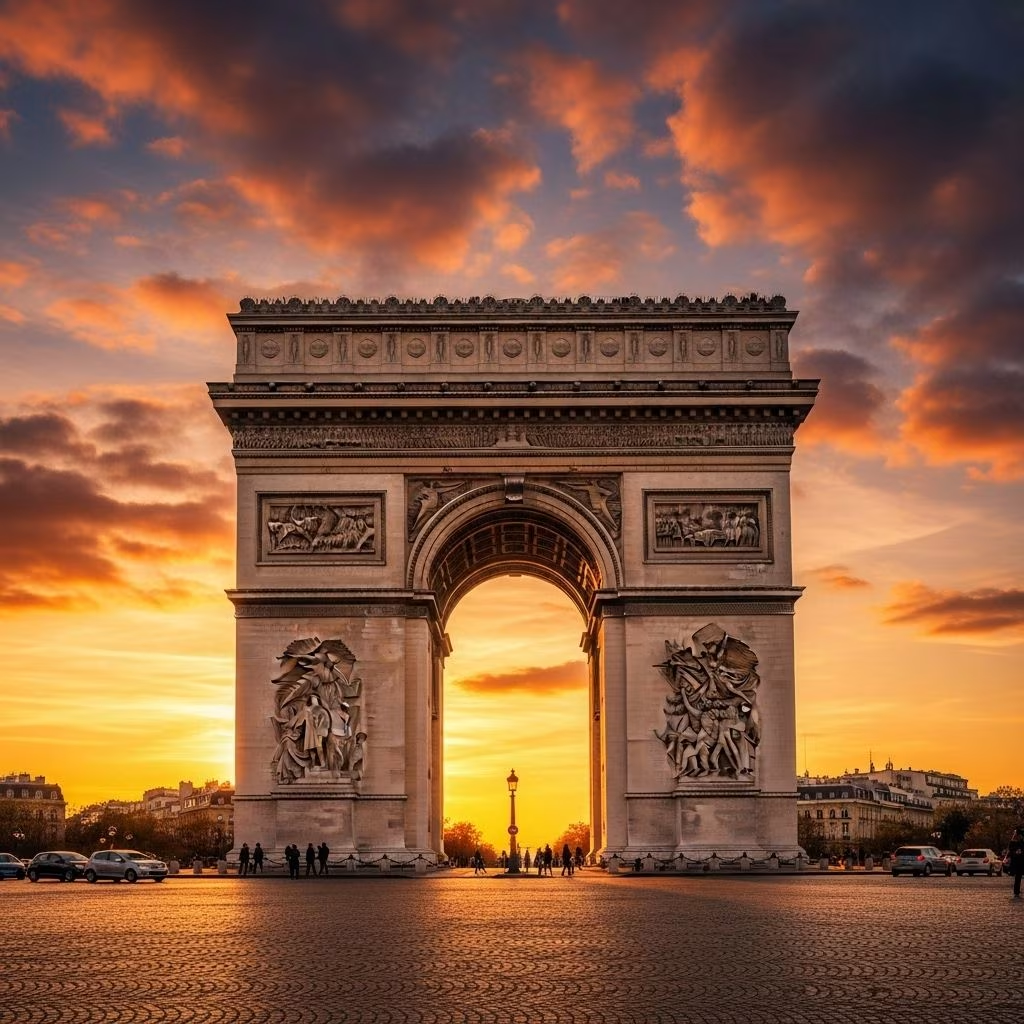
Few symbols represent Paris as dramatically as the Arc de Triomphe, a majestic arch commanding the dizzying traffic of Place Charles de Gaulle—often dubbed the world’s largest traffic circle. Beyond its architectural triumph, the Arc captures sweeping currents of French history, culture, and daily life, standing as a beacon at the western edge of the famed Champs-Élysées.
Contents
- A Monumental Welcome: Overview of the Arc de Triomphe
- Location & Cultural Significance
- Napoleon’s Vision and Historical Foundations
- Architectural Highlights and Symbolism
- The Arc as a Stage: Parisian Events & National Rituals
- Panoramic Views and the Champs-Élysées Experience
- Visiting Tips, Practicalities, and Must-Sees
- Frequently Asked Questions (FAQs)
A Monumental Welcome: Overview of the Arc de Triomphe
Dominating the junction of twelve grand avenues, the Arc de Triomphe is both an architectural and symbolic gateway to Paris. It stands 50 meters tall, projecting its presence above the constant swirl of vehicles and pedestrians, a crossroads where Parisian daily life and centuries of history intersect. The Arc was conceived as the centerpiece of Napoleon Bonaparte’s ambitions—to honor his Grand Army’s victories and to proclaim the glory of the new France.
Location & Cultural Significance
The Arc sits in the middle of the Place Charles de Gaulle (formerly Place de l’Étoile, ‘star-shaped square’), connecting Paris’s urban arteries like spokes around a hub. From its vantage:
- One can trace the path of Champs-Élysées, Paris’s iconic promenade, stretching east toward the Place de la Concorde, bustling with stylish shops, cafes, and global showrooms.
- To the west, Avenue de la Grande Armée leads to the city’s outskirts, echoing Napoleon’s military legacy.
- The Arc itself is the linchpin for public celebrations, parades, and historical commemorations, making this circle not only a navigational center but also a cultural heart of France.
Napoleon’s Vision and Historical Foundations
Commissioned by Napoleon in 1806 after his victory at Austerlitz, the Arc de Triomphe sought to imitate the ceremonial arches of ancient Rome—though on a scale more than twice their size. Napoleon envisioned it not only as a tribute to military splendor, but also as a cornerstone of a new imperial legacy, marking his place as emperor of a ‘New Rome’.
This ambitious monument became rooted in Paris’s identity, even though Napoleon never saw it completed—he died in exile, and the Arc was only finished in 1836. Its impact endured: when his body was returned from exile in 1840, the funeral procession passed beneath the newly finished Arch, a final symbolic homecoming.
Key Historical Milestones
- 1806: Construction begins, ordered by Napoleon.
- 1836: Completion under King Louis-Philippe.
- 1840: Napoleon’s remains return, passing beneath the Arc.
- 20th-21st centuries: Stage for national ceremonies, victory parades, and memorial events.
Architectural Highlights and Symbolism
The Arc de Triomphe’s imposing mass is adorned with detailed relief sculptures and inscriptions, each conveying aspects of French pride and sacrifice:
- Four Main Reliefs: Depict momentous scenes—including the Departure of the Volunteers (the Marseillaise), Napoleon’s victories, Peace, and the Resistance, each a tableau of struggle or triumph.
- Names Inscribed: The names of generals and battles from the Revolutionary and Napoleonic Wars are engraved on the pillars, immortalizing France’s military history.
- Tomb of the Unknown Soldier: Beneath the Arc lies the eternal flame at the Tomb of the Unknown Soldier, lit nightly since 1923, honoring all French soldiers who have fallen in war. The solemn ceremony, especially poignant on Armistice Day, continues to draw locals and visitors alike.
- Observation Deck: Ascending 284 steps to the rooftop terrace rewards visitors with panoramic views over Paris’s urban tapestry.
Every facet of the Arc is woven with purpose: from the mighty, toga-clad depiction of Napoleon—where Paris herself seems to kneel at his feet—to allegories of liberty and patriotism that course through its stone.
Table: Reliefs & Their Themes
| Relief | Depicts | Symbolism |
|---|---|---|
| La Marseillaise (Departure of Volunteers) | Citizen-soldiers rallying for the nation | National unity, patriotism |
| Triumph of 1810 | Napoleon crowned by Victory | Military glory, imperial legacy |
| Resistance, Peace | Soldiers defending France; aftermath of victory | Courage, sacrifice, peace achieved |
The Arc as a Stage: Parisian Events & National Rituals
The Arc de Triomphe has witnessed defining moments in Paris’s—and France’s—public life:
- Historic Ceremonies: Napoleon’s funeral, World War I and II victory parades, liberation processions led by Charles de Gaulle, and the annual Bastille Day military parade.
- Memorial Services: The nightly rekindling of the eternal flame at the Tomb of the Unknown Soldier is a uniquely moving ritual, observed every evening in tribute to France’s war dead.
- Modern Gatherings: Sporting victories, political assemblies, and spontaneous celebrations often pivot around the Arc, underscoring its potency as a symbol of national pride.
From somber remembrance to jubilant celebration, the Arc’s shadow frames the performance of Parisian identity—sometimes solemn, sometimes exuberant, always unmistakably French.
Panoramic Views and the Champs-Élysées Experience
Stepping onto the Arc’s rooftop terrace provides one of Paris’s most remarkable perspectives:
- Stunning Urban Vistas: Twelve avenues radiate from the Arch’s base, forming the famed ‘star’—with splendid avenues reaching toward sights like the Eiffel Tower, La Défense, and Montmartre.
- The Champs-Élysées: This legendary boulevard flanks the Arc. Walking east from here, visitors find a showcase of Parisian grandeur: monumental sidewalks, chic storefronts, elegant cafés, and throngs of people—from locals on parade to travelers luxuriating in the city’s pulse.
- Landmarks Aligned: Looking down the Champs-Élysées toward the Place de la Concorde, the eye is drawn past the historic Obelisk of Luxor (once the site of the Revolution’s guillotine and now a monument from ancient Egypt), culminating in the distant silhouette of the Louvre.
This sweeping boulevard unites the city’s grand monuments, yet also embodies Paris’s intimate pleasures—whether savoring a macaron or marveling at the endless promenade of people and light.
Visiting Tips, Practicalities, and Must-Sees
Planning a visit to the Arc de Triomphe doesn’t just deliver spectacular views, but a direct encounter with living history:
- Getting There: The Arc is accessible via the underground pedestrian tunnel from the north side of Place Charles de Gaulle—never attempt to cross at street level through the heavy traffic circle.
- Climbing the Arc: There are 284 steps to reach the panoramic rooftop terrace. The ascent can be a challenge, but the reward is unforgettable sightlines across Paris.
- Best Times to Visit: Evening brings a unique atmosphere, especially when the eternal flame is rekindled. Sunrise and sunset offer magical cityscapes from the top.
- Tickets & Accessibility: Entry tickets can be purchased at the site or online. Elevator access is available for visitors with mobility needs, though some areas require stair access.
- Nearby Attractions: Stroll the Champs-Élysées, continue to Place de la Concorde, and discover the Louvre further east. Explore local cafes, boutique shopping, and verdant urban parks.
Must-Experience Highlights
- Examine the intricate carvings and reliefs—each tells a story of revolution, resistance, and victory.
- Pause at the Tomb of the Unknown Soldier for quiet reflection, especially during the flame-lighting ceremony in the evening.
- Climb to the observation deck for a unique, bird’s-eye view over Paris’s architectural tapestry.
- Experience a walk down the Champs-Élysées—Paris at its grandest and most quintessentially French.
Frequently Asked Questions (FAQs)
Q: Why was the Arc de Triomphe built?
A: The Arc was commissioned by Napoleon in 1806 to celebrate the glory and victories of his army, modeled after Roman triumphal arches and meant as a monument to French patriotism and military success.
Q: Can anyone visit the top of the Arc?
A: Yes. Visitors can ascend the 284 steps (or use the elevator for accessibility) to reach the observation deck, which provides sweeping views over central Paris.
Q: What is the Tomb of the Unknown Soldier?
A: Located beneath the Arc, this memorial was established in 1921 to honor French soldiers lost in World War I. Its eternal flame is rekindled every evening at 6:30 pm in a moving ceremony.
Q: Is the Arc de Triomphe connected to other landmarks?
A: Absolutely—the Arc anchors the western end of the Champs-Élysées, opposite the Place de la Concorde and the Louvre in a historic line of Parisian monuments.
Q: What should I not miss around the Arc?
A: Don’t miss strolling the entire Champs-Élysées, exploring the Place de la Concorde and its Obelisk, and pausing at the Tomb of the Unknown Soldier. The rooftop view at sunset is a Paris highlight.
Conclusion
The Arc de Triomphe is more than stone—it is the distilled spirit of Paris, a monument where glory, remembrance, and cosmopolitan energy converge. Whether observed from a whirling taxi, climbed for a stunning view, or honored in solemn ceremony, the Arc continues to shape the rhythm and meaning of life in France’s unforgettable capital.
References
- https://www.heraldnet.com/life/rick-steves-on-the-champs-elysees-the-grand-parisian-promenade/
- https://www.ricksteves.com/watch-read-listen/read/articles/napoleon-in-paris
- https://www.ricksteves.com/watch-read-listen/video/tv-show/highlights-of-paris
- https://community.ricksteves.com/travel-forum/france/visiting-arc-de-triomphe-in-august
- https://www.ricksteves.com/watch-read-listen/video/tv-show/paris-regal-and-intimate
- https://www.ricksteves.com/watch-read-listen/read/articles/promenading-on-champs-elysees
- https://www.ricksteves.com/watch-read-listen/read/articles/paris-itinerary