How the Sun Burns and Dies: The Life Cycle of a Star
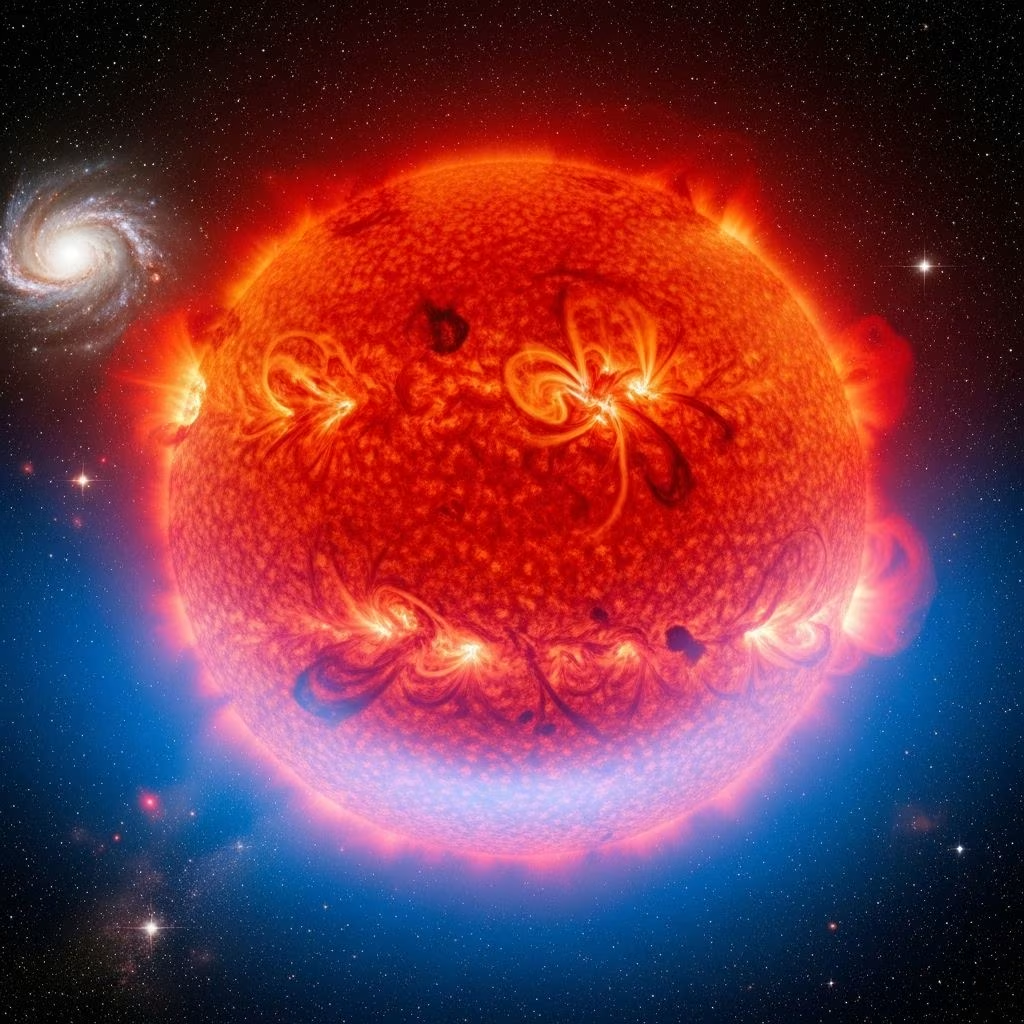
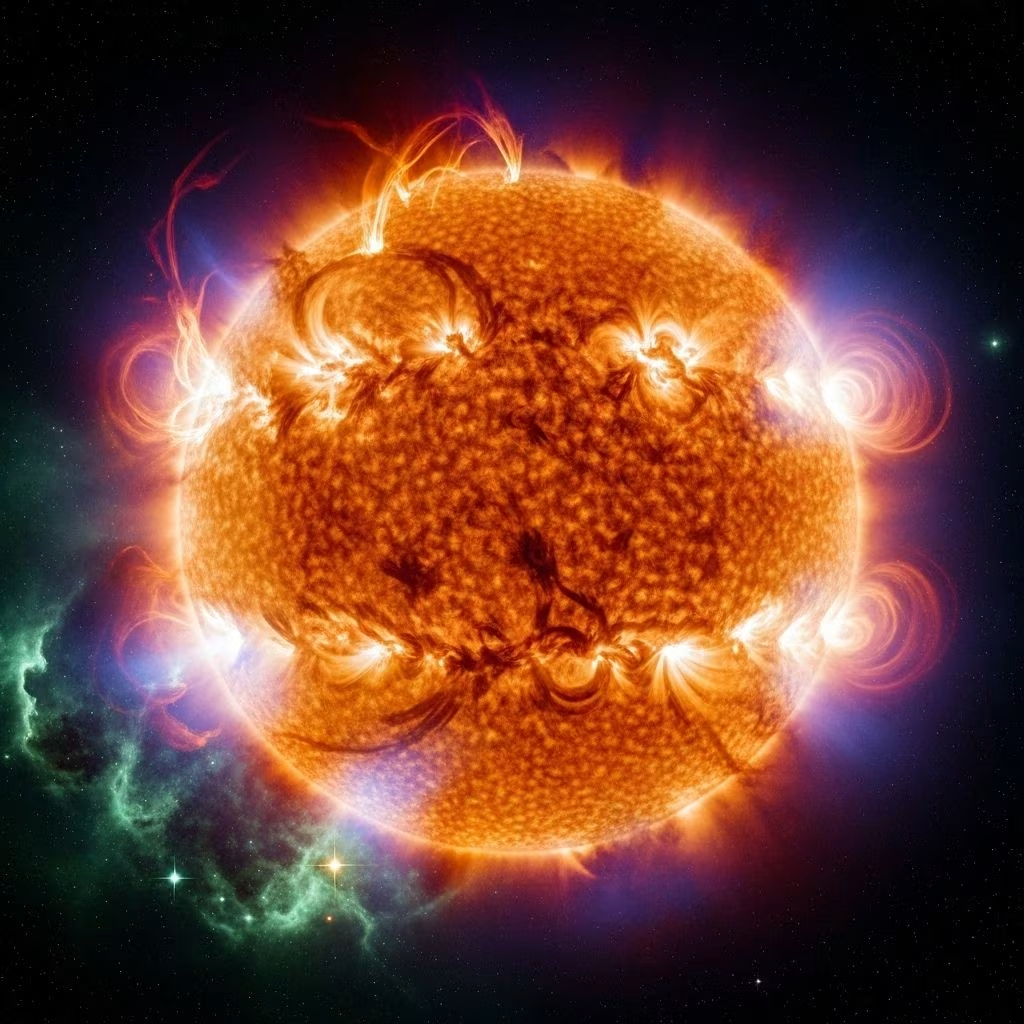
The Sun, our closest star, is a vast nuclear engine whose energy sustains life on Earth. Yet its brilliance will only last for so long. Understanding how the Sun burns, its evolutionary journey, and ultimate fate provides crucial insights not just for our solar system, but for the cosmic recycling that shapes galaxies and life itself.
What Powers the Sun?
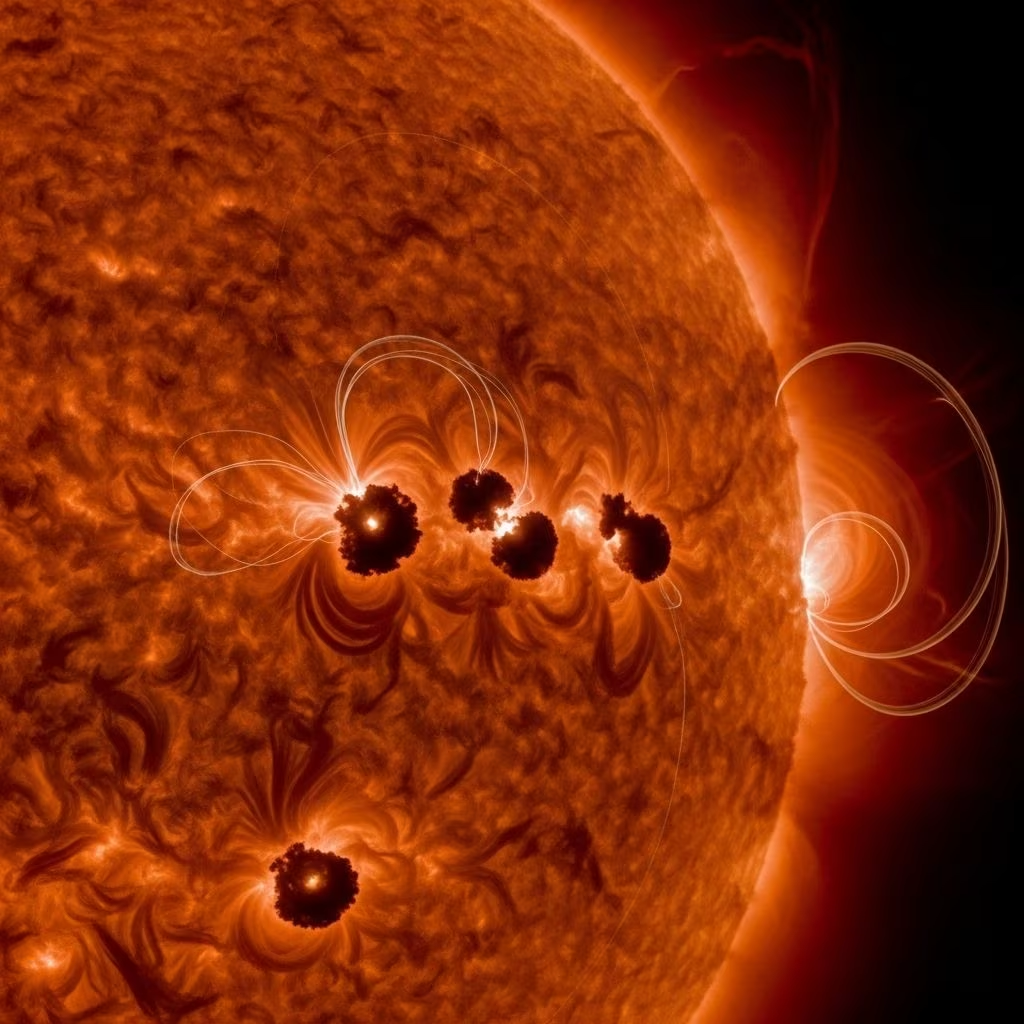
The Sun shines by converting hydrogen into helium through nuclear fusion at its core. Extreme pressures and temperatures cause atomic nuclei to collide and stick together, releasing vast amounts of energy as radiation. This process is fundamental to all main sequence stars.
- Core temperature: About 15 million degrees Celsius (27 million degrees Fahrenheit).
- Hydrogen nuclei (protons) fuse into helium, releasing energy in the form of gamma rays and neutrinos.
- This process is known as the proton-proton chain reaction, dominant in stars like the Sun.
The Life Stages of the Sun
Throughout its life, the Sun will evolve through distinct stages, each marked by changes in its core and outer layers. This evolution is governed by the consumption and depletion of its nuclear fuel.
Main Sequence: The Golden Era
The Sun is currently in its main sequence phase, steadily burning hydrogen and maintaining equilibrium between gravitational collapse and outward pressure from fusion. It has been in this stage for about 4.6 billion years and is expected to continue for another 5 billion years.
Becoming a Red Giant
Eventually, the Sun will exhaust the hydrogen at its core. As fusion slows, gravity will cause the core to contract and heat up, while the outer layers expand enormously, transforming the Sun into a red giant:
- The core contracts and heats until it can fusion helium into carbon and oxygen.
- The Sun’s diameter could reach out past Earth’s current orbit, engulfing the inner planets.
- The outer atmosphere cools and reddens, hence the term ‘red giant.’
| Phase | Estimated Duration | Key Nuclear Fuel |
|---|---|---|
| Main Sequence | 10 billion years | Hydrogen (to Helium) |
| Red Giant | ~1 billion years | Helium (to Carbon & Oxygen) |
| White Dwarf | Billions+ years (gradual cooling) | No active fusion |
The Death of the Sun: Shedding Its Outer Layers
As the red giant phase ends, the Sun will become unstable, shedding its external layers into space. This phenomenon leads to the creation of what is known as a planetary nebula—a glowing, expanding shell of gas and dust illuminated by the dying star’s ultraviolet radiation.
- The core, now made primarily of carbon and oxygen, cannot fuse further due to insufficient mass.
- Radiation pressure pushes off the Sun’s outer layers in stages—sometimes explosively, sometimes in gentle pulses.
- The resulting nebula consists of various elements, color-coded by their composition (helium glows blue, oxygen blue-green, nitrogen and hydrogen red) .
Why Are They Called Planetary Nebulae?
The name dates back to 18th and 19th-century astronomers who, using early telescopes, thought these shells resembled faint planetary disks, like Uranus and Neptune. While the name is a misnomer, the term stuck.
The Emergence of the White Dwarf
What remains at the heart of the planetary nebula is the white dwarf—a brilliant, Earth-sized stellar ember composed mostly of carbon and oxygen. It no longer supports fusion, but glows due to residual thermal energy.
- A white dwarf is incredibly dense: about the mass of the Sun compressed into a volume the size of Earth.
- Surface temperatures can exceed 200,000°C (360,000°F)
- Over eons, a white dwarf cools and dims, eventually becoming a cold, inert black dwarf (though the universe isn’t old enough for any to yet exist.)
How Do Dying Stars Shed Their Mass?
For decades, astronomers puzzled over how dying, Sun-like stars manage to push their thick clouds of gas and dust into interstellar space. Two distinct types of red giants exist—carbon-rich and oxygen-rich—each producing different outcomes:
- Carbon-rich Red Giants: These stars expel dark carbon grains, such as soot or graphite, which absorb stellar light and are propelled outward by radiation pressure.
- Oxygen-rich Red Giants (like the Sun): They form silicates and water vapor—molecules mostly transparent to starlight. How could these get ‘blown away’?
Recent research suggests that previously overlooked chemical reactions during stardust formation may create dust grains that interact with light more effectively than expected. These grains can absorb enough energy to escape the star’s gravity, solving the long-standing mystery of mass loss in oxygen-rich stars.
What Happens to the Earth?
The Sun’s transition to a red giant spells a grim future for our planet:
- As the Sun expands, it may engulf Mercury, Venus, and possibly Earth itself, vaporizing our planet in the process.
- If not swallowed, Earth’s oceans will boil away, its surface scorched by intense radiation.
- After the red giant phase, the remaining white dwarf will no longer provide energy, leaving the solar system cold and dark.
Stellar Death: A Crucible for Cosmic Life
The Sun’s fate may seem bleak, but the death of stars plays a vital role in the universe’s evolution. When Sun-like stars shed their outer layers, they enrich the galaxy with elements critical for new stars, planets, and life.
- Heavier elements formed during the star’s life—carbon, nitrogen, oxygen—are expelled, mixing into interstellar clouds.
- These clouds serve as the raw material for new stars and planetary systems, seeding future generations with the building blocks for life.
- Thus, dying stars are key to the chemical evolution of the galaxy and the origin of life-sustaining elements.
Cosmic Highlights: Notable Dying Stars
- NGC 2440: A spectacular planetary nebula about 4,000 light-years away in the constellation Puppis, home to one of the hottest known white dwarfs.
- Helix Nebula: Another iconic planetary nebula visible in Earth’s night sky, demonstrating the dramatic beauty and variety of dying stars.
Table: Sun-Like Star Life Cycle
| Stage | Duration (Approx.) | Description |
|---|---|---|
| Main Sequence | 10 billion years | Hydrogen fusion maintains stable luminosity. |
| Red Giant | 1 billion years | Outer layers expand. Helium fusion in core, hydrogen shell fusion persists. |
| Planetary Nebula | 10,000 – 50,000 years | Rapid expulsion of outer envelope creates glowing nebula. |
| White Dwarf | Billion+ years | Hot remnant cools and fades. |
Frequently Asked Questions (FAQs)
Q: How long will the Sun continue to shine as it does now?
A: The Sun is about halfway through its main sequence life and has roughly 5 billion more years before it becomes a red giant.
Q: What is a planetary nebula?
A: A planetary nebula is the glowing shell of gas and dust ejected by a dying Sun-like star, illuminated by intense ultraviolet radiation from the exposed hot core (future white dwarf).
Q: Can planets survive the death of their star?
A: Inner planets, such as Mercury, Venus, and probably Earth, are likely to be engulfed or destroyed during the red giant phase. Outer planets and their moons may survive, but will face a cold, dark future.
Q: How does stellar death contribute to life elsewhere?
A: When stars die, they release heavier elements—such as carbon, oxygen, and nitrogen—into space, enriching interstellar clouds. These clouds form new stars and planets and sow the chemical seeds of life.
Key Takeaways: The Legacy of the Sun’s Death
- The Sun, a main sequence star, burns hydrogen into helium, generating vast amounts of energy.
- In about 5 billion years, it will expand to become a red giant, potentially engulfing the inner planets.
- The Sun will eventually shed its outer layers, forming a planetary nebula, while its core becomes a white dwarf.
- Dying stars scatter essential elements throughout the galaxy, enabling the formation of planets and the emergence of life.
Further Reading
- “The Death of Stars: How the Universe Recycles Life” — Explores the broader cosmic impact of stellar evolution.
- “The Death of a Star – How Stars Work” — Technical overview of various star death mechanisms depending on stellar mass.
References
- https://www.space.com/34221-dying-sunlike-star-gas-cloud-photo.html
- https://www.space.com/3657-thinking-death-sun-stars.html
- http://web.archive.org/web/20090605231345/http:/www.space.com/scienceastronomy/solarsystem/death_of_earth_000224.html
- https://www.youtube.com/watch?v=HFORqV7FNMM
- https://www.youtube.com/watch?v=-9vOt9umOc4
- https://nasaspacenews.com/2025/03/csi-cosmic-scene-investigation-how-a-stars-death-is-still-shaping-the-universe/
- https://science.howstuffworks.com/star6.htm
- https://www.scmp.com/news/world/article/1870813/images-solar-system-vaporised-real-life-death-star-reveal-earths-ultimate
- https://www.inverse.com/science/astronomers-catch-a-glimpse-of-a-dying-star
- https://economictimes.com/news/international/us/star-that-keeps-dying-scientists-shocked-by-cosmic-explosion-defying-all-expectations-latest-scientific-discovery-space-news/amp_articleshow/123874947.cms
- https://www.timesnownews.com/technology-science/article/earth-when-sun-destroyed-discovered-planet-solar-system-future-moa-2010-blg-477lb-gravitational-microlensing-dead-star-white-dwarf/826731
- https://spaceref.com/science-and-exploration/the-messy-death-of-a-star-viewed-webb-space-telescope/
- https://www.dailymotion.com/video/x7wc7dh
- https://scitechdaily.com/planet-discovered-that-survived-its-stars-death-a-crystal-ball-into-our-solar-systems-future/
- https://science.nasa.gov/universe/the-lives-times-and-deaths-of-stars/
- https://time.com/archive/6935134/can-a-planet-survive-the-death-of-its-sun-scientists-find-two-that-did/
- https://kesq.com/news/2021/10/14/giant-planet-found-orbiting-a-dead-star-shows-what-may-happen-when-our-sun-dies/