


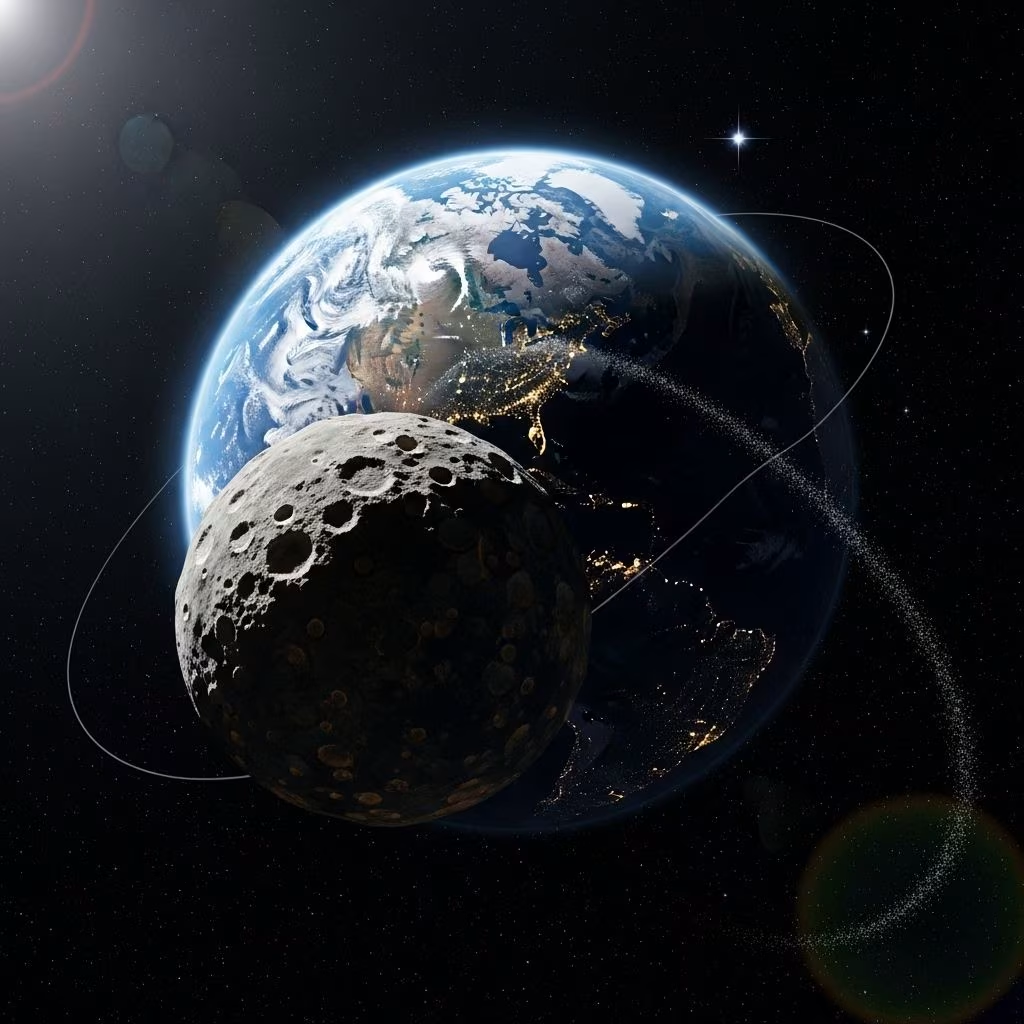
Earth to Capture a Second Moon: The Temporary Arrival of 2024 PT5
In an event that excites both astronomers and skywatchers, Earth will temporarily capture a second moon in late 2024. Known as 2024 PT5, this tiny asteroid will become a “mini-moon” for approximately two months, providing a rare and valuable opportunity to study such celestial phenomena. Though not visible to the naked eye, 2024 PT5’s journey highlights the dynamic and crowded environment of our solar system.
What is a Mini-Moon?
In astronomical terms, a mini-moon is a small object—typically an asteroid—temporarily captured by a planet’s gravitational pull and held in orbit for a finite period before eventually resuming its original path around the sun. Unlike regular moons, these natural satellites are:
- Much smaller (generally several meters to tens of meters in diameter),
- Not permanent, typically staying only weeks or months,
- Often detected only with professional-grade astronomical equipment.
While Earth’s only long-term moon formed around 4 billion years ago and is 2,159 miles (3,474 km) in diameter, mini-moons like 2024 PT5 are fleeting cosmic visitors, offering a “second moon” status only temporarily.
The Arrival of Asteroid 2024 PT5
On September 29, 2024, Earth began capturing asteroid 2024 PT5 as a temporary satellite. According to calculations from NASA’s Jet Propulsion Laboratory Horizons system, this event commenced at 15:54 EDT (19:54 UTC) and is expected to conclude by 11:43 EDT (15:43 UTC) on November 25, 2024.
This means that for nearly two months, Earth will have a second natural satellite orbiting it, albeit one much smaller and dimmer than our regular Moon. The object’s orbit during this period will resemble a “horseshoe” or looping arc, characteristic of temporary captures by a planet’s gravity.
Where Did 2024 PT5 Come From?
Asteroid 2024 PT5 is part of the mysterious Arjuna group of asteroids, a relatively understudied population of objects that:
- Follow orbits remarkably similar to Earth’s path around the sun,
- Maintain an average distance from the sun of about 93 million miles (150 million kilometers),
- Occasionally approach Earth at low velocities, increasing the likelihood of temporary capture.
The Arjuna objects are considered near-Earth objects (NEOs), and their gentle, Earth-like orbits make them excellent candidates for gravitational interaction with our planet. 2024 PT5 typically follows the sun in this “second asteroid belt,” but its trajectory has now brought it close enough for Earth’s gravity to seize it—at least, for a limited time.
Orbit and Astronomical Details of 2024 PT5
The orbital behavior of 2024 PT5 during its mini-moon status is both fascinating and instructive for planetary scientists:
- Average Orbit Distance: About 2.8 million miles (4.5 million kilometers) from Earth during closest approach.
- Velocity Relative to Earth: Traveling at approximately 2,200 miles per hour (3,540 km/h).
- Size: Around 37 feet (11 meters) across.
- Duration in Orbit: Nearly two months, from September 29 to November 25, 2024.
- Orbit Pattern: A looping or horseshoe path (not a smooth or stable orbit like the Moon’s).
| Feature | Earth’s Moon | 2024 PT5 |
|---|---|---|
| Diameter | 2,159 miles (3,474 km) | ~37 ft (11 m) |
| Avg. Distance from Earth | 238,855 miles (384,400 km) | ~2,800,000 miles (4,500,000 km) |
| Visibility | Easy for naked eye | Invisible to unaided eye |
| Orbit Duration | Permanent | ~2 months |
How Rare Are Mini-Moons?
Mini-moon events are uncommon but not unheard of:
- Earth has had previous temporary “second moons”—such as 2006 RH120 (captured in 2006 for several months), and possibly 2022 NX1 (briefly captured in the 1980s and again in 2022).
- The fleeting nature and small size of these objects make them difficult to detect without advanced astronomical surveys.
- 2024 PT5 itself was discovered by NASA’s Asteroid Terrestrial-Impact Last Alert System only on August 7, 2024, highlighting the ongoing potential for new discoveries.
These events are rare because the vast majority of asteroids either pass by Earth or do not slow down enough to be temporarily captured by Earth’s gravity. Even when they are, these objects rarely stay for more than a few months before the gravity of the Sun or a close pass with Earth flings them back into independent solar orbit.
Can We See 2024 PT5?
For most people, the answer is no. 2024 PT5’s small size and great distance make it too faint to observe with the naked eye, and even amateur telescopes would struggle to spot it. Only professional-grade astronomical telescopes—often using advanced tracking and imaging techniques—will be able to observe 2024 PT5 during its brief stay in Earth’s orbit.
- Casual observation: Not possible; 2024 PT5 is too small and dim.
- Professional observation: Feasible with large telescopes, particularly for research groups tracking near-Earth objects.
This makes 2024 PT5 an observational challenge and a treasure for astronomers leveraging high-powered optics and sensitive detectors.
Significance of Mini-Moon Events to Science
The temporary capture of objects like 2024 PT5 has important implications for several areas of planetary science:
- Understanding Near-Earth Objects: Each mini-moon is a representative of the near-Earth asteroid population, providing clues about their orbits, composition, and frequencies.
- Planetary Defense: Mini-moons serve as reminders of the dynamic and often unpredictable population of small bodies in near-Earth space—vital for impact risk assessment and mitigation planning.
- Asteroid Capture Dynamics: Observing the capture, orbit, and eventual release of 2024 PT5 helps refine theoretical models about gravitational interactions between planets and small bodies.
- Astrobiological and Resource Research: Future missions to mini-moons (even if brief) could provide opportunities for sample return or study of primordial solar system material.
These fleeting moons also underscore the enormous gaps in our knowledge—many such objects remain undiscovered, and every new find expands our understanding of the solar system’s complexity.
Frequently Asked Questions (FAQs)
Q: What exactly is 2024 PT5?
A: 2024 PT5 is a small asteroid, roughly 37 feet (11 meters) wide, that normally orbits the sun close to Earth’s own path. For about two months in 2024, Earth’s gravity temporarily captures it as a “mini-moon” before it returns to solar orbit.
Q: Why won’t 2024 PT5 stay as Earth’s moon?
A: The object’s speed and orbital direction make its capture only temporary. After circling Earth in a horseshoe path, it will be pulled away by solar gravity or influenced by Earth’s gravity in such a way that it resumes orbit around the sun.
Q: Is 2024 PT5 dangerous to Earth?
A: No. Its closest approach is about 2.8 million miles away—many times farther than the Moon itself. There is no risk of impact.
Q: Will we see 2024 PT5 in the night sky?
A: No. The asteroid is simply too small and dim to be observed without large professional telescopes.
Q: Has Earth captured mini-moons before?
A: Yes, though rarely. Other known temporary moons include 2006 RH120 (about six months in 2006-2007) and possibly 2022 NX1. Most such objects are detected only by automated sky surveys.
Q: Why is the capture of 2024 PT5 scientifically important?
A: These events give researchers a real-world laboratory to study asteroid orbital dynamics, test detection methods, and better understand gravitational interactions, potentially benefiting future asteroid deflection strategies and space exploration missions.
Key Takeaways on Earth’s Second Moon
- Earth will briefly have a second moon—the mini-moon 2024 PT5—between September 29 and November 25, 2024.
- 2024 PT5 is a 37-foot-wide asteroid from the Arjuna group; it will remain a faint and fleeting presence, invisible to most observers.
- Its temporary capture highlights the dynamism and unpredictability of our solar system and the importance of continual sky survey efforts.
- Although rare, mini-moons are scientifically valuable and offer insights into planetary gravity, asteroid populations, and potential future space exploration targets.
Further Reading
- NASA Jet Propulsion Laboratory’s Near-Earth Object Program
- Discoveries and monitoring of the Arjuna asteroid group
- Studies of temporary satellite capture and release mechanisms
References
- https://www.space.com/earth-will-capture-second-moon-sept-2024
- https://www.youtube.com/watch?v=jikzv9wtZnA
- https://www.youtube.com/watch?v=qICDinCg6Zw
- https://www.space.com/earth-mini-moon-asteroid-2024-pt5
- https://phys.org/news/2024-09-earth-capture-moon-weekend-nasa.html
- https://www.cbsnews.com/news/earth-second-mini-moon-2024/
- https://www.earth.com/news/its-official-earth-now-has-two-moons-captured-asteroid-2024-pt5/
- https://www.indiatoday.in/visualstories/science/when-did-earth-get-a-second-moon-and-why-is-it-disappearing-188623-21-11-2024
- https://www.earth.com/news/2024-pt5-mini-moon-say-goodbye-to-earths-second-moon-we-barely-got-to-know-you/
- https://www.dawn.com/news/1861220
- https://www.environewsnigeria.com/earth-captures-asteroid-gets-second-moon/
- https://www.fas37.org/wp/the-earths-2nd-moon/
- https://www.axios.com/2024/09/19/moon-earth-two-visible
- https://time.com/7022535/earth-second-moon-temporary/
- https://studyfinds.org/earth-getting-second-moon/
- https://www.businesstoday.in/visualstories/news/earths-second-moon-will-be-visible-from-next-week-here-is-how-you-can-watch-it-173477-24-09-2024
- https://www.newindianexpress.com/xplore/2024/Sep/25/earths-second-moon


