Earth’s rotation is so fundamental to life as we know it that we rarely give it much thought. Yet, if our planet were to halt its spin—suddenly or gradually—the effects would devastate everything from the global climate to the structure of the continents. This article explores, from the immediate to the long-term, what would actually unfold if the Earth stopped spinning.
Earth’s Rotation: The Basics
Earth completes a full rotation on its axis every 24 hours, giving us night and day. This rotation not only defines the passage of time but also affects our weather, ocean currents, and even the shape of our planet.
- At the equator, the Earth’s surface moves at an incredible speed of about 1,670 kilometers per hour (1,037 miles per hour).
- This motion is responsible for the Coriolis effect, which shapes wind and ocean current patterns.
- The planet’s rotation causes a slight bulge at the equator, meaning Earth isn’t a perfect sphere but an oblate spheroid.
Immediate Effects: Sudden vs. Gradual Stop
If the Earth Suddenly Stopped Spinning
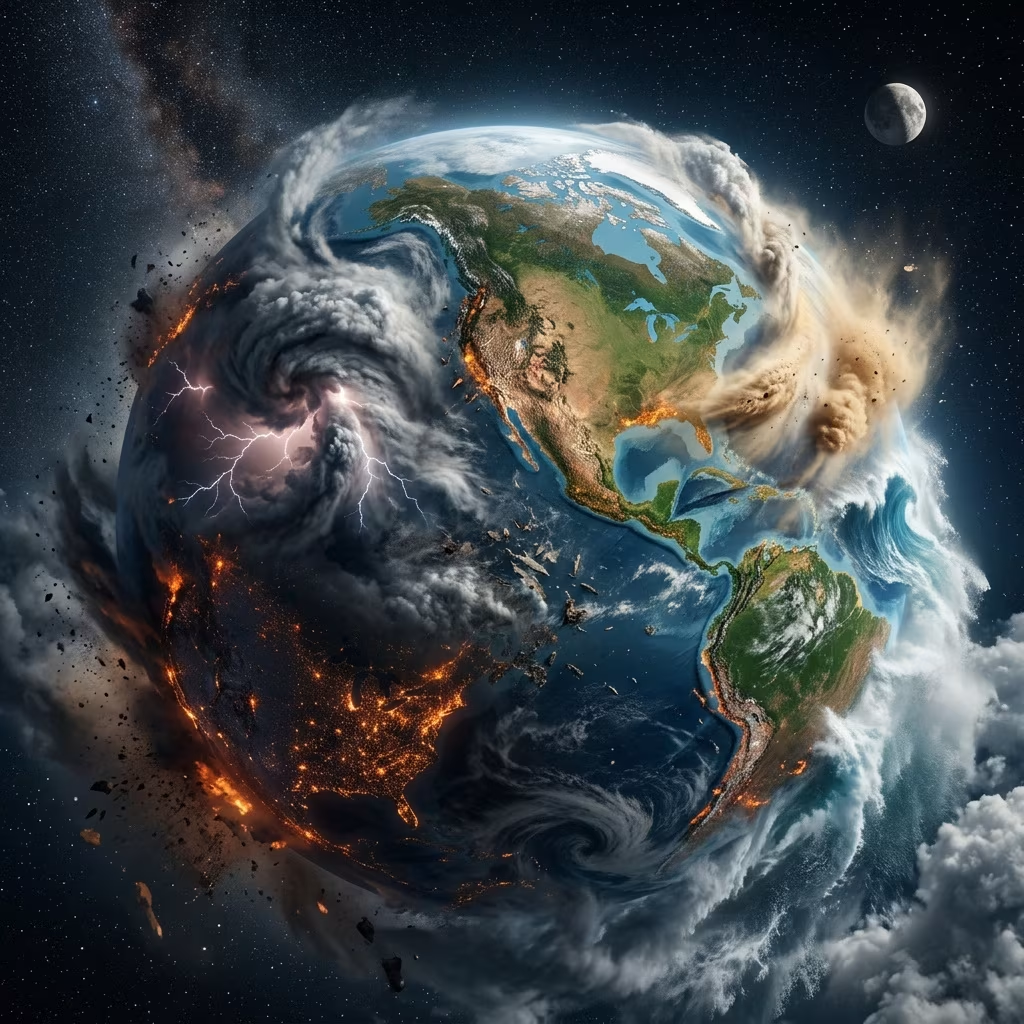
In the impossible scenario where Earth halts its rotation in an instant, inertia would wreak unimaginable havoc:
- Everything not attached to bedrock—air, oceans, buildings, people—would be hurled eastward at over 1,000 mph. Jet engines could never match such speeds.
- Supersonic winds would flatten forests and cities alike, with shockwaves echoing around the world.
- Tsunamis of unprecedented size would sweep over continents as water continued its rush eastward, far beyond current storm surges or natural disasters[10].
- Human-built structures would be obliterated, and most surface life would struggle to survive the chaos.
If the Earth Stopped Spinning Gradually
- Winds and water would have more time to adjust, but.
- No more traditional day-night cycle; half of the world would experience months-long daylight, while the other faces prolonged night[10].
- Climatic zones would change drastically, and survival strategies for both wildlife and humans would become complex and uncertain.
Geographic and Geologic Changes
Our planet’s shape and geography would undergo dramatic transformation if rotation ceased.
- Earth’s shape would become more spherical, as the bulge at the equator—maintained by outward centrifugal force—disappeared.
- Oceans currently deeper at the equator would start to migrate toward the poles, flooding formerly temperate and arid regions while exposing the now-flattened equator[10].
- Some coastal cities would vanish underwater, while others—previously oceanfront—could become landlocked.
| Region | Current State | Change After Stopping |
|---|---|---|
| Equator | Bulged, water-heavy | Dries out as oceans move poleward |
| Pole Regions | Covered in ice, less ocean | Floods as water migrates toward the poles |
| Continents | Current coastlines | Massively altered, many deltas and cities submerged |
Climate and Atmospheric Turmoil
Earth’s rotation powers the global climate engine. Its cessation would bring multiple new extremes:
- The Coriolis effect—which sets wind directions and helps spins up hurricanes—would vanish. As a result, atmospheric flows would no longer curve, and powerful, stationary wind systems could develop.
- Giant worldwide storms would likely form in new, unpredictable patterns.
- The familiar rhythm of sunrise and sunset would be lost. Instead, each point on Earth would experience six months of daylight followed by six months of night, similar to current conditions near the poles but extended everywhere[10].
- Without the moderating influence of constant rotation, temperatures during the day would soar, while night would bring deep freezes.
Resulting climate effects:
- Extreme temperature swings—mass heat by day, severe cold by night
- Possible expansion of deserts, polar ice caps, and chaotic monsoon cycles
Biodiversity and Evolutionary Impact
Animals, plants, and even microbes have evolved to cope with the regular cycling of day and night, weather patterns, and stable environments. Stopping Earth’s spin would disrupt these beyond recognition:
- Many species would die out quickly due to inability to adapt to prolonged darkness or light, new temperature regimes, and food chain instability[10][12].
- Ocean life could collapse as nutrient cycles are interrupted by shifting currents and temperature gradients.
- Some adaptable or extremophile organisms might survive, but mass extinction would be the likely short-term result.
- Farming, fisheries, and all human food production systems would face unpredictable conditions, threatening global sustenance.
Gravity and Centrifugal Force
Earth’s rotation creates a small outward “centrifugal force” that slightly counteracts gravity, especially at the equator.
- With rotation gone, gravity would feel stronger, especially at the equator, where you’d gain up to about 0.3% more weight as the outward force vanished[12].
- The planet’s weight distribution would shift, affecting how continents resist geological stress—and potentially increasing earthquake and volcanic activity as the crust adjusts.
- “Islands” of higher ground could arise at old equatorial bulges, but vast areas would be submerged or eroded as new seas form.
Earth’s Magnetic Field and Solar Radiation
Earth’s magnetic field forms thanks to the movement of molten iron in the outer core, driven partly by rotation. This field shields the planet from charged solar and cosmic particles.
- Ending rotation would eventually still the core’s convective motion, weakening or eliminating the magnetic field over time[10].
- Radiation exposure at the surface would increase dramatically; the solar wind could strip away our atmosphere, mirroring the fate of Mars.
Oceans and Atmosphere: Redistribution and Instability
Without rotational energy, both water and air masses would gradually migrate according to gravity and solar heating alone:
- Oceans would slosh toward the poles, flooding much of what is now temperate land and forming massive new polar seas.
- The equator, flattened by redistribution, might see exposure of deep continental crust never before seen by life.
- Atmospheric pressure and density would also change, as altitude levels normalize across the globe, creating new wind systems and changing precipitation patterns.
- Loss of rotational inertia would lead to static mega-currents in the atmosphere, amplifying weather extremes.
Day-Night Cycle and Human Survivability
The loss of rotation would mean every location spends half a year in daylight, half in night:
- During the “day-season,” surface temperatures, especially at the equator, would spike to extremes—leading to water evaporation and possible desertification.
- During the “night-season,” lack of sunlight would bring intense cold, risking freezing oceans and farmlands alike.
- Human habitations would require advanced climate control or underground shelters to survive prolonged, intense heat and cold.
The Long-Term Fate of a Motionless Earth
Over thousands to millions of years:
- Earth would settle into a spherical shape, and much of today’s life would be replaced by new species adapted to the extreme, stagnant climate zones.
- The magnetic field would fade, exposing the surface to more radiation and greater atmospheric loss.
- If the atmosphere thinned dramatically, water and surface conditions would become ever more Mars-like, imperiling any lingering life on the surface.
- Eventually, Earth might resemble a frozen or scorched world, where only deep-ocean or subterranean life could survive.
Could the Earth Ever Stop Spinning?
In reality, physics dictates that it is virtually impossible for Earth to suddenly cease rotating. While tidal interactions with the Moon are slowly causing Earth to spin more slowly over millions of years, the process is extremely gradual—by the time the planet ever “locked” its rotation with the Moon, the Sun would likely have consumed Earth as it expands into a red giant. Thus, our doomsday scenario remains firmly theoretical[10].
Frequently Asked Questions (FAQs)
Q: Would gravity change if the Earth stopped spinning?
A: Gravity itself wouldn’t change, but without centrifugal force, people at the equator would feel slightly heavier due to the full effect of Earth’s mass pulling inward.
Q: Would we all fly off the planet if it stopped?
A: If rotation stopped suddenly, unanchored objects—including people—would be thrown eastward at the current rotational speed, causing catastrophic global destruction, but we would not “fly off” into space.
Q: Why don’t we feel the Earth spinning right now?
A: We are moving at the same rate as the planet, along with its surface and atmosphere, so we do not perceive rotation without external reference.
Q: Could any force stop the Earth from spinning?
A: Only an astronomical-scale collision (such as with a massive rogue planet or star) could stop Earth’s rotation abruptly. No internal physical process is capable of such a feat in any reasonable time frame.
Q: What are the most devastating consequences for humanity?
A: The collapse of global infrastructure—due to floods, atmospheric chaos, and crop failures—would pose the greatest threats, followed by exposure to cosmic radiation and mass extinction.
Key Takeaways
- Earth’s steady spin supports the delicate balance required for life, regulating day-night cycles, climate, and global geography.
- Any cessation—especially sudden—would have catastrophic effects, from continent-scale tsunamis and winds to climate collapse and loss of the magnetic field.
- It is, however, a highly improbable science fiction scenario, useful for understanding our planet’s complex systems and their fragility.
References
- https://www.space.com/what-would-happen-if-earth-stopped-spinning
- https://www.skyatnightmagazine.com/space-science/what-happen-earth-stopped-rotating
- https://www.astronomy.com/science/what-would-happen-if-earth-stopped-spinning/
- https://www.youtube.com/watch?v=gp5G1QG6cXc
- https://www.esri.com/about/newsroom/arcuser/what-would-happen-if-earth-stopped-spinning
- https://science.howstuffworks.com/science-vs-myth/what-if/what-if-earth-stopped-spinning.htm
- https://www.youtube.com/watch?v=qUxZ4T6IMIM
- https://www.sciencefocus.com/planet-earth/the-thought-experiment-what-would-happen-if-the-earth-stopped-spinning
- https://legacy.geog.ucsb.edu/what-would-happen-if-the-earth-stopped-spinning/
- https://www.britannica.com/topic/What-Would-Happen-if-Earth-Stopped-Rotating
- https://byjus.com/physics/what-if-the-earth-stopped-spinning/
- https://www.vedantu.com/physics/what-happens-if-the-earth-stops-rotating
- https://timesofindia.indiatimes.com/etimes/trending/what-will-happen-if-the-earth-stops-spinning/photostory/107124145.cms
- https://www.vedantu.com/physics/what-if-the-earth-stopped-spinning
- https://www.space.com/what-if-earth-stopped-spinning
- https://www.indiatoday.in/science/story/what-happens-if-earth-stops-spinning-for-just-one-second-2495264-2024-01-30
- https://www.thomasnet.com/insights/what-would-happen-if-the-earth-stopped-spinning/
- https://timesofindia.indiatimes.com/science/what-happens-when-earth-stops-spinning-science-explains/articleshow/123696087.cms