How Far Away is Mars?
Mars, the fourth planet from the Sun, has intrigued humanity for centuries. Known as the Red Planet, its distance from Earth is not constant, resulting from the orbital mechanics of both worlds.
At present, Mars is about 350 million kilometers (217 million miles) away from Earth, though this distance is subject to significant fluctuation over time. These changes are rooted in both planets’ elliptical orbits around the Sun.
Why Does Mars’ Distance from Earth Change?
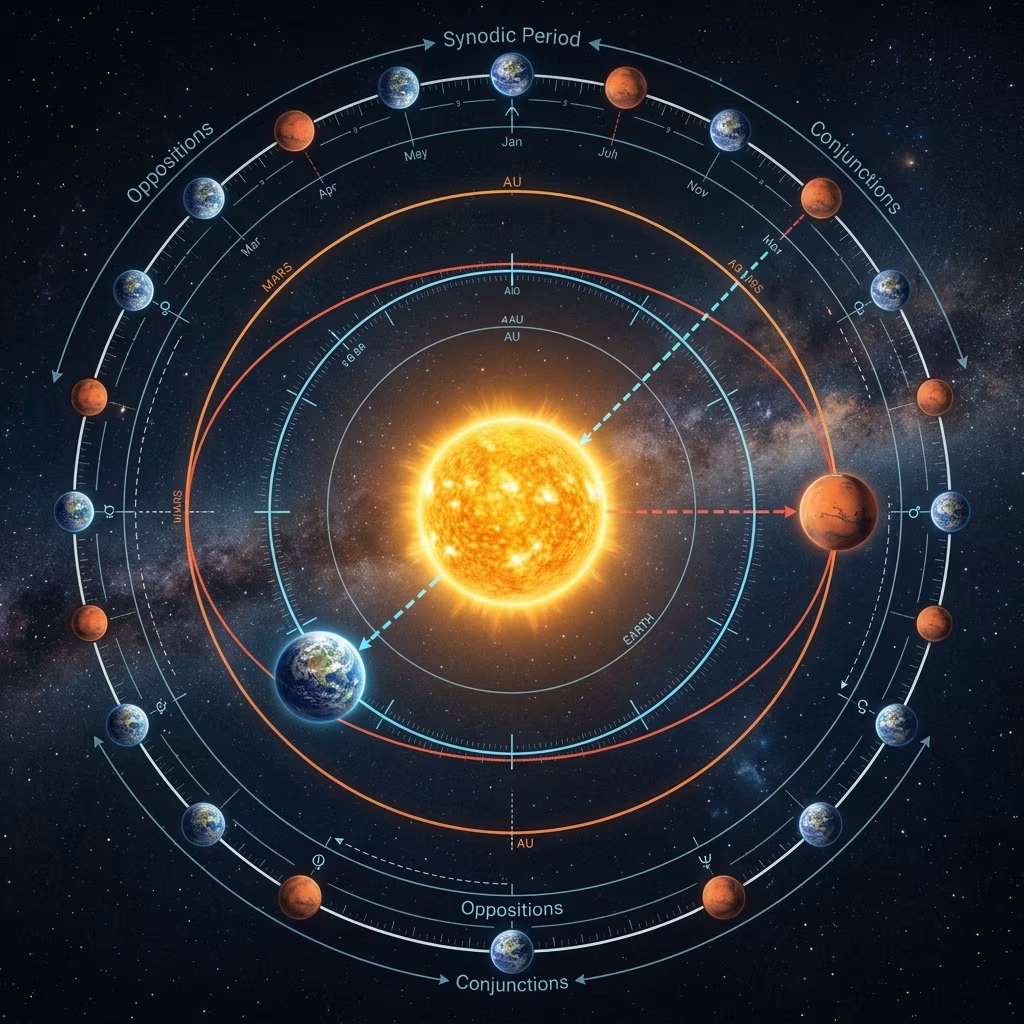
One of the main reasons for the changing distance between Earth and Mars is their respective orbits. Both planets follow elliptical paths, but Mars’ orbit is more oval-shaped in comparison to Earth’s nearly circular orbit.
- Closest Approach (Opposition): Mars comes within about 57.6 million kilometers (35.8 million miles) of Earth when both planets are on the same side of the Sun. This is called opposition and occurs approximately every 26 months.
- Farthest Distance (Conjunction): When Mars and Earth are on opposite sides of the Sun (called conjunction), they can be as far apart as 401 million kilometers (249.1 million miles).
- Average Distance: The average distance between Mars and Earth is about 225 million kilometers (140 million miles).
Earth completes its orbit in one year, while Mars takes about 687 Earth days. Their variable speeds and positions result in the changing physical distance between the two planets.
Table: Mars’ Distance from Earth
| Alignment | Distance (km) | Distance (miles) |
|---|---|---|
| Closest Approach (Opposition) | 57.6 million | 35.8 million |
| Farthest Distance (Conjunction) | 401 million | 249.1 million |
| Average Distance | 225 million | 140 million |
The Orbit of Mars: A Deeper Look
Mars orbits the Sun at an average distance of 1.524 Astronomical Units (AU), or roughly 228 million km (142 million miles). Its orbit is notably more eccentric (oval-shaped) than Earth’s, with an eccentricity of 0.0934 compared to Earth’s 0.0167. This eccentricity is only surpassed by Mercury among the major planets.
- Orbital period: One Martian year is approximately 687 Earth days.
- Speed: Mars travels at an average speed of 24 km/s along its orbit.
- Perihelion: Closest Mars gets to the Sun: 1.381 AU (206 million km).
- Aphelion: Farthest Mars gets from the Sun: 1.666 AU (249 million km).
How Mars’ Orbit Changes Over Time
Mars is currently experiencing a long-term increase in its orbital eccentricity. Over millennia, these changes alter perihelion and aphelion distances, subtly shifting how close Mars might get to Earth during opposition.
- Minimum eccentricity was 0.079 about 19,000 years ago.
- Maximum eccentricity projected to peak at 0.105 in about 24,000 years.
Mars, Earth, and Oppositions: The Closest Encounters
Opposition refers to the moment when Mars and the Sun are on directly opposite sides of the Earth in the sky. This marks the shortest distance between Mars and Earth during their respective orbits. Not every opposition is equal, however, since Mars’ elliptical path and its position within the orbit can make some oppositions much closer than others.
- Opposition occurs every 26 months (about 2 years and 2 months), on average.
- The closest oppositions (called perihelic oppositions) can bring Mars within 56 million km of Earth.
- These rare close encounters occur in cycles of every 15 or 17 years.
During opposition, Mars appears particularly bright and large in the night sky, making it a prime time for observation and for sending spacecraft to the planet.
Light Travel Time: Communications and Exploration Challenges
Beyond the sheer physical distance, another factor influences our interactions with Mars: the time it takes for signals or light to travel between the two planets.
- When Mars is at its closest, light takes about 3 minutes and 2 seconds to travel from Earth to Mars.
- When Mars is at its farthest, the light travel time can be up to 22 minutes.
- At present (September 2025), it’s around 19 minutes and 29 seconds for light to cover the current Earth-Mars distance.
This delay affects communications between Earth and Mars-bound probes, rovers, or future human explorers, requiring careful planning for operational autonomy.
Mars’ Position in the Night Sky
Mars can often be seen as a bright, reddish object in Earth’s night sky, but its apparent brightness and size change dramatically depending on its distance from Earth. At opposition, Mars can rival Jupiter in brilliance, while at conjunction it fades and shrinks, often becoming difficult to spot with the naked eye.
- At closest approach, Mars reaches an apparent magnitude of -2.7.
- At its greatest distance, Mars dims to around -0.5 magnitude.
- Surface features, such as the polar ice caps and dust storms, are best visible near opposition.
Factors Affecting Travel to Mars
The distance between Earth and Mars is a critical consideration for space travel. Shorter distances during opposition result in faster, more energy-efficient spaceflight routes.
- Shortest journey times: Take advantage of oppositions—missions launched at these times require the least energy.
- Travel duration: Typical robotic missions take about 6 to 9 months one-way, depending on the spacecraft’s speed and trajectory.
- Manned missions: Future missions planning to send humans to Mars will also launch during favorable windows to minimize travel time and risks.
Frequently Asked Questions (FAQs)
Q: Why does Mars get closer and farther away from Earth?
A: Both planets follow elliptical orbits at different speeds around the Sun, meaning their relative distance changes continuously. Mars’ orbit is more elongated than Earth’s, creating greater variability between closest and farthest points.
Q: What is an astronomical unit (AU), and how does it relate to Mars?
A: An astronomical unit is the average distance between Earth and the Sun, about 149.6 million kilometers. Mars’ average distance from the Sun is about 1.524 AU.
Q: How often do Mars oppositions occur, and why are they important?
A: Mars oppositions occur roughly every 26 months. These events are when Mars is closest to Earth, making it appear brightest and largest, and minimizing travel time for spacecraft.
Q: Are there times when Mars is not visible from Earth?
A: Yes, during conjunctions when Mars is behind the Sun as seen from Earth, it’s not visible and its distance is at its maximum.
Q: Why do scientists plan Mars missions around oppositions?
A: Launching missions during opposition makes journeys more efficient, provides optimal communications, and allows for greater payloads due to shorter, less energy-intensive travel windows.
Mars: A Moving Target for Exploration
The dynamic relationship between Earth and Mars means the Red Planet is not a fixed destination but a moving target for astronomers, scientists, and future explorers. Its ever-changing distance poses both opportunities and challenges for observation and exploration.
- Robotic Missions: Most Mars missions have exploited close approaches to maximize success.
- Future Crewed Missions: Aspirations for human travel to Mars hinge on precise calculations of the Earth-Mars distance and alignment.
- Ongoing Curiosity: Mars remains a focal point for science, given its relative proximity, unique geology, and potential for ancient life.
Conclusion: The Incredible Journey Between Earth and Mars
Mars’ distance from Earth exemplifies the dynamic complexity of our solar system. The interplay of orbital mechanics, solar positions, and cyclical oppositions highlights not only how far away Mars can be—but also how close this neighboring world comes on its regular astronomical rendezvous.
For astronomers and aspiring explorers alike, understanding these cosmic distances is the first step in bridging the gap between worlds—and unlocking the mysteries that await on the Red Planet.
References
- https://www.nasa.gov/hrp/hazard-distance-from-earth/
- https://theskylive.com/how-far-is-mars
- https://theskylive.com/mars-info
- https://science.nasa.gov/mars/facts/
- https://starlust.org/how-far-away-is-mars-now/
- https://lovethenightsky.com/how-far-away-is-mars/
- https://en.wikipedia.org/wiki/Orbit_of_Mars
- https://study.com/academy/lesson/mars-distance-earth-fact-measurement.html
- https://www.universetoday.com/articles/distance-from-earth-to-mars
- https://en.wikipedia.org/wiki/Mars
- https://www.youtube.com/watch?v=un38v2ofyL8
- https://www.nao.ac.jp/en/astro/sky/2016/05-topics03.html
- https://orbitaltoday.com/2022/08/12/the-mystery-of-the-red-planet-how-far-away-is-mars-from-earth-and-how-long-will-it-take-to-get-there/
- https://www.loveyoutomarsandback.com/spaceblog/marsdistancetoearth
- https://globaldatabase.ecpat.org/pdf/textbooks/Citations:J4L8/HomePages/How-Far-Is-Mars-From-Earth.pdf
- https://globaldatabase.ecpat.org/files/papersCollection/PDF_Files:I8F8/HomePages/How_Far_Is_Mars_From_Earth.pdf
- https://consensus.app/questions/distance-from-earth-to-mars/