What Is Area 51?
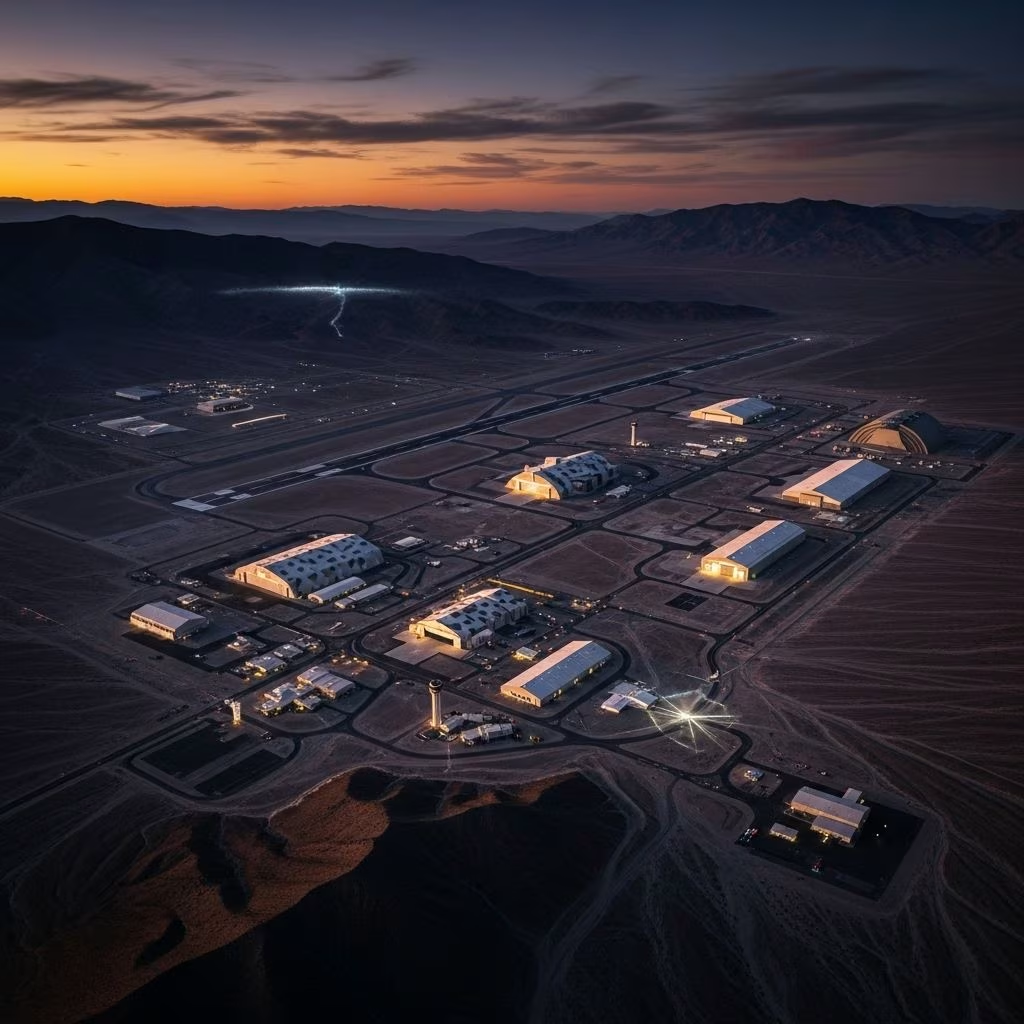
Area 51 is the most notorious secretive military installation in the United States, often linked with UFOs, mysterious aircraft, and government cover-ups. Officially named Homey Airport (ICAO: KXTA), Area 51 sits within the vast Nevada Test and Training Range, roughly 85 miles northwest of Las Vegas. Its remote desert location, intense security, and total lack of public access have fueled rumors and fascination for over half a century.
Origins and Location
Constructed in 1955 as a testing site for the U-2 reconnaissance plane, Area 51 sits on the dry bed of Groom Lake. Over time, this top-secret facility has hosted many landmark programs, from the A-12 Oxcart to stealth jets. Groom Lake’s isolation, flat terrain, and clear skies made it ideal for testing next-generation aircraft far from prying eyes.
- Alternate names: Dreamland, Paradise Ranch, Watertown Airstrip, and Homey Airport.
- Size: Area 51 is part of a 2.9 million acre range run by the US Air Force and used for classified research.
- Security: The restricted airspace above Area 51 is known as R-4808N. Unauthorized entry is met with swift armed response and steep legal penalties.
The Birth of Secrecy: The U-2 and Cold War Spy Planes
In the 1950s, as the Cold War intensified, the CIA searched for an isolated place to develop and test a cutting-edge reconnaissance aircraft. Area 51’s remoteness and existing use for nuclear tests made it the perfect home.
- First major project: The U-2 spy plane, capable of flying above enemy radar, was tested and launched from Area 51 starting in 1955.
- With the U-2’s success, subsequent Black Projects—including the A-12 Oxcart (predecessor to the SR-71 Blackbird) and later the F-117A Nighthawk stealth fighter—were developed under strict secrecy.
- The base was never marked on standard maps, and any discussion of its use or existence was denied by officials for decades.
When Did Area 51 Become Linked to Aliens and UFOs?
The public’s obsession with aliens at Area 51 stems from the secretive nature of its projects, a series of high-profile events, and the cultural context of postwar America. The mythology traces back to two main developments:
- The Roswell Incident (1947): Decades before Area 51 rose to fame, a so-called “flying saucer” was reported crashed in Roswell, New Mexico. Staff soon swapped stories of secret alien bodies and government cover-ups, creating a blueprint for later conspiracy theories.
- UFO sightings over Nevada (1950s–60s): When advanced planes like the U-2 and Oxcart were test flown at high altitudes and unusual speeds, people below reported strange lights and craft. The U-2, for example, flew far higher than any commercial plane of that era. Military secrecy prevented public explanations, so rumors circulated unchecked.
The Government’s Silence and the Spread of Conspiracies
For decades, the U.S. government refused to confirm Area 51’s existence, fueling speculation and distrust. This environment bred wild theories:
- Many theorized that the government stored alien ships recovered from Roswell and other crashes at Area 51—or even conducted secret tests on extraterrestrial bodies.
- Others posited that the base was the site of meetings with alien visitors, or of reverse-engineering projects to build new weapons from advanced, otherworldly technology.
- Only in 2013 did the CIA finally acknowledge Area 51, releasing declassified documents describing its role in spyplane research, not alien life.
Key Events That Cemented the Myth
- 1989 – Bob Lazar’s Claims: A man named Bob Lazar alleged, in a now-famous television interview, that he worked on extraterrestrial spacecraft at a facility near Area 51 called “S-4.” While these claims are unsubstantiated and widely questioned, they sparked a wave of popular books, television shows, and movies that forever cemented Area 51’s link to UFO lore.
- 1994 – The Environmental Lawsuit: Families of civilian workers sued the U.S. Air Force, alleging injury from hazardous materials at Groom Lake. During the trial, secret documents were released referring to “Area 51,” one of the earliest public uses of the name by officials.
- 2019 – “Storm Area 51” Internet Event: A viral internet movement jokingly urged people to invade the base to “see them aliens.” While ultimately peaceful and playful, it highlighted the enduring fascination with uncovering hidden government truths.
What Actually Happens at Area 51?
Most available evidence points to extremely advanced aeronautical testing as the core function of Area 51. The base has supported a wide array of historic and secretive aircraft:
- U-2 and A-12 Oxcart: High-altitude, high-speed reconnaissance craft, essential for American intelligence during the Cold War.
- Stealth Technology: The first stealth jets, including prototypes of the F-117 Nighthawk bomber, were assembled and tested at Area 51 under extreme secrecy.
- Foreign Aircraft Testing: The U.S. has used Area 51 to test Soviet MiGs and other foreign planes, gleaning insights for combat training and defense technology.
- Drone Development: Modern unmanned aerial vehicles (UAVs) and other classified projects continue to be tested out of sight of the public on the base’s enormous, highly restricted ranges.
The Culture of Secrecy
- No-fly zone: Even military pilots outside the program are forbidden from entering the airspace above Area 51.
- Extreme security: The perimeter is patrolled by anonymous security (nicknamed “camo dudes” by enthusiasts) and is monitored by ground sensors and cameras.
- No public tours or flyovers: The closest you can get is a distant view from Tikaboo Peak or the dirt roads around the base—where warning signs threaten trespassers with prosecution.
- Cover stories: When observed, flights were explained away as weather balloons or civilian aircraft to avoid revealing the existence of spy programs, inadvertently fueling further suspicion.
Area 51’s Ongoing Role in Pop Culture
Area 51’s shroud of secrecy, coupled with government denials and unanswered questions, has provided endless fuel for speculation in movies, TV shows, books, and video games. Its image as a place of “alien autopsies” and “cosmic secrets” often overshadows its very real contributions to national security and scientific progress.
- Hollywood depictions: Films like “Independence Day” and “Paul” feature the base as headquarters for government alien cover-ups.
- Conventions and festivals: The nearby town of Rachel, Nevada, hosts annual UFO conferences and attracts tourists hoping for a glimpse of unusual activity.
- Internet legends: From message board rumors to memes, Area 51 is an ever-renewing symbol of government secrets and the human thirst for knowledge beyond the visible.
What Is Known – and Unknown – Today
| Known Facts | Persistent Mysteries |
|---|---|
| Located on Groom Lake, Nevada | Exact technologies tested currently |
| Began as a CIA-initiated base for U-2/A-12 | Nature of ongoing classified projects |
| Mainly used for aerospace experimentation | Any connection to extraterrestrial phenomena |
| Heavily restricted and secured | Real reach and scope of the base infrastructure |
| Declassified in part by CIA in 2013 | Existence of tunnels or underground complexes |
Impact of Area 51 on Modern Conspiracies
Area 51 is a nexus for the UFO subculture and modern conspiracy thinking. Polls reveal that over half of Americans believe the government is hiding information about UFOs and likely knows more than it reveals. This distrust is not simply a product of fantasy—it’s rooted in decades of deliberate official secrecy, disinformation, and avoidance of public scrutiny.
Visiting the Area: Reality and Restrictions
While the base itself is tightly guarded, visitors flock to the region around Area 51, seeking evidence of military tests or otherworldly phenomena. The nearby Extraterrestrial Highway, and the tiny outpost of Rachel, Nevada, with its UFO-themed restaurants and gift shops, serve as pilgrimage sites for the curious.
- No entry: Trespassing on the base is illegal and strictly enforced.
- No public access: The closest legal opportunities for a view of the area are on public land still a great distance from the facility.
- Pop culture hotspots: Roadside attractions and alien-themed events keep the Area 51 legend alive for new generations.
Frequently Asked Questions (FAQs)
Q: What is the real purpose of Area 51?
A: Area 51 was established to support the U.S. military’s most secretive projects, primarily high-tech reconnaissance aircraft. The base continues to conduct classified operations tied to advanced national defense technology.
Q: Why is Area 51 associated with aliens?
A: The secretive nature of the base, its location near the site of frequent UFO sightings, and decades of government denials led to speculation that it harbored extraterrestrial technology or even living beings.
Q: Is there any evidence of aliens at Area 51?
A: No credible evidence has ever surfaced. The U.S. government insists the base’s activities are limited to military testing, and experts attribute UFO sightings to classified aircraft.
Q: Can you visit Area 51?
A: No, Area 51 is restricted. However, tourists can visit the surrounding area, drive the so-called Extraterrestrial Highway, and stop at UFO-themed attractions.
Q: When did the government admit Area 51 existed?
A: The CIA officially confirmed the existence and general history of Area 51 in 2013 through declassified documents focused on Cold War spy plane development.
Conclusion: The Enduring Fascination with Area 51
Decades of secrecy, technological breakthroughs, and the explosion of popular culture speculation have elevated Area 51 from a Cold War necessity to a global icon of mystery and intrigue. Whether seen as the crucible of military innovation or the epicenter of extraterrestrial conspiracy, one truth endures: Area 51 is the ultimate symbol of humanity’s endless quest to uncover the unknown.
References
- https://www.britannica.com/story/what-is-known-and-not-known-about-area-51
- https://www.britannica.com/video/Area-51-military-air-force-base-alien-video/-242011
- https://en.wikipedia.org/wiki/Area_51
- https://www.militarytimes.com/off-duty/military-culture/2023/01/26/how-area-51-became-a-hotbed-for-conspiracy-theories/
- https://www.skyatnightmagazine.com/space-science/area-51
- https://www.federaltimes.com/off-duty/military-culture/2023/01/26/how-area-51-became-a-hotbed-for-conspiracy-theories/
- https://content.time.com/time/specials/packages/article/0,28804,1860871_1860876_1861006,00.html
- https://www.youtube.com/watch?v=3J7MSme6IEA
- https://www.kunr.org/news/2019-09-20/whats-the-history-of-area-51
- https://history.osu.edu/news/what-most-likely-going-area-51-chris-nichols-explains
- https://www.youtube.com/watch?v=PCn7di9NTtw
- https://en.wikipedia.org/wiki/UFO_conspiracy_theories
- https://spyscape.com/article/unlocking-the-mysteries-of-area-51
- https://www.foxnews.com/science/area-51-top-conspiracy-theories?msockid=0d9cd3c4ba6269282a44c5cfbb97682c
- https://www.landofgeek.com/posts/area-51-theories-explained
- https://sites.smith.edu/fys169-f19/2019/12/12/was-the-area-51-raid-onto-something-sadly-no/