General relativity is the foundation of modern gravitational physics and cosmology. Proposed by Albert Einstein in 1915, this theory replaced the Newtonian picture of gravity as a force with a radically new vision: gravity is the bending and warping of spacetime produced by mass and energy. Today, general relativity governs our understanding of black holes, the expansion of the universe, gravitational waves, and much more.
What Is the General Theory of Relativity?
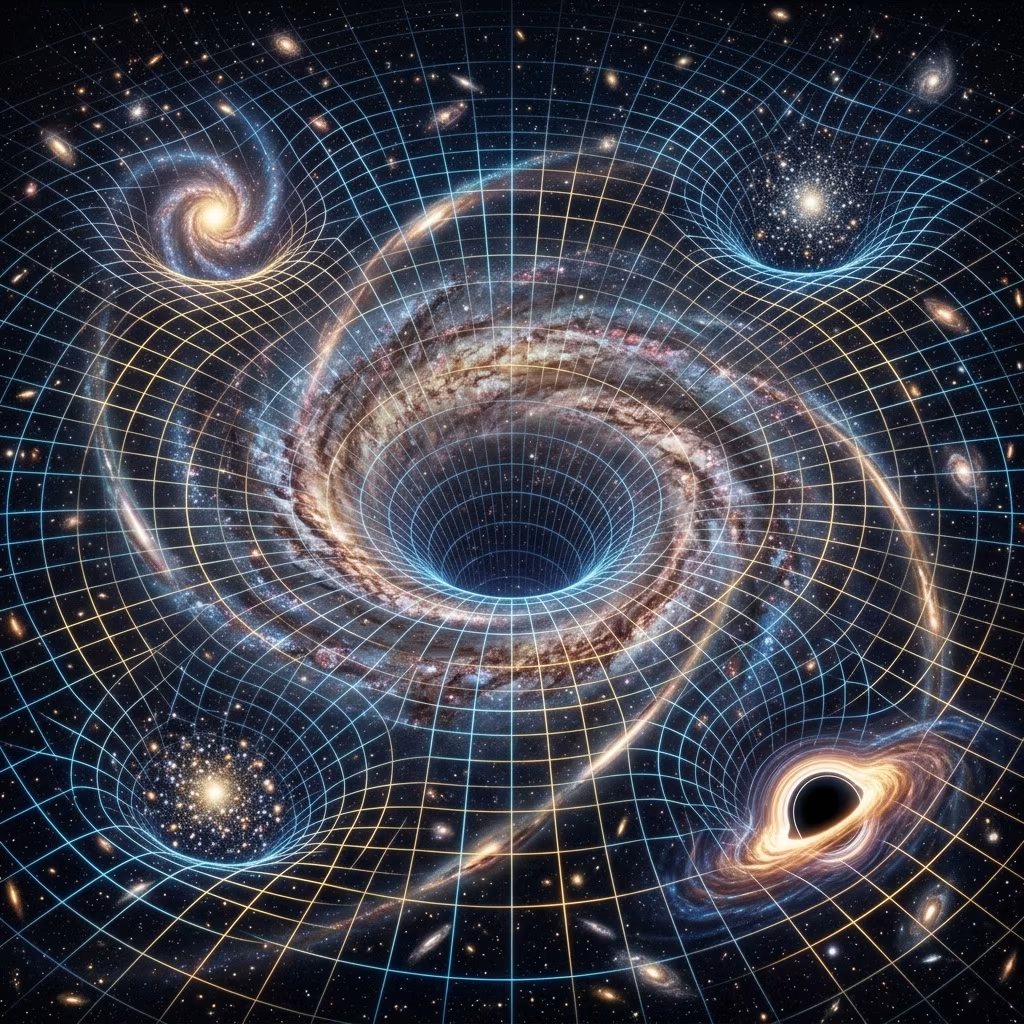
General relativity, or the general theory of relativity, is a theory of gravitation that describes gravity not as a force, but as a geometric property of four-dimensional spacetime. According to Einstein, mass and energy tell spacetime how to curve, and that curvature tells objects how to move.
- It expands on Newton’s law of gravity, providing more accurate predictions especially in situations involving massive bodies or strong gravitational fields.
- Describes the universe as a fabric of space and time warped by matter and energy.
- Objects moving through this warped spacetime follow paths called geodesics, which appear as straight lines in curved space.
- Gravity is not a traditional force but the experience of following a curved path in spacetime.
This shift in perspective has allowed physicists to explain a vast array of phenomena from planetary motion to black holes and the history of the universe itself.
Key Principles Behind General Relativity
At the core of general relativity are several key principles that distinguish it from earlier theories of gravity:
- Equivalence Principle: The effects of acceleration are indistinguishable from the effects of gravity. If you are in a sealed elevator, you cannot tell (without looking outside) whether the force you feel is due to gravity or because the elevator is accelerating upwards.
- Curved Spacetime: Massive objects, like planets and stars, curve the four-dimensional spacetime around them. This curvature influences the motion of everything—whether it’s a rock or a beam of light.
- Universality: All objects, regardless of mass or composition, experience gravity the same way because they respond to spacetime curvature, not a force.
These principles are encapsulated mathematically in the Einstein field equations, which relate the curvature of spacetime to the mass-energy content present.
Spacetime: The Fabric of Reality
Einstein’s insight starts with the interconnectedness of space and time. Instead of treating space and time as separate, fixed backgrounds, general relativity unifies them into a single entity: spacetime.
- Every event in the universe is positioned by four coordinates: three for space (x, y, z) and one for time (t).
- When mass or energy is added, spacetime warps and curves.
- The greater the mass, the greater the curvature around it.
This curvature is what causes the orbits of planets and the bending of light near massive objects.
General vs. Special Relativity: What’s the Difference?
| Special Relativity | General Relativity |
|---|---|
| Deals with non-accelerating (inertial) reference frames | Deals with all reference frames, including accelerating ones and gravitational fields |
| Space and time are combined into spacetime | Spacetime itself can be curved and dynamic |
| No explanation for gravity | Gravity is explained as spacetime curvature |
Special relativity (1905) only applies when gravitational effects are negligible, while general relativity (1915) covers the universe’s full complexity, including how gravity warps space and time.
How Does Gravity Work in General Relativity?
Classically, Isaac Newton described gravity as a force between two masses acting at a distance. Einstein showed that this was an approximation. In his view, all masses and energy curve the spacetime around them, and objects simply follow the most natural paths in this curved space, called geodesics.
- Imagine a stretched sheet with a heavy ball placed at its center. Roll a marble near the ball, and it curves around the indentation. This two-dimensional analogy helps us visualize, but the real distortion involves four dimensions.
- Anything that moves—including light—follows the straightest possible path in curved spacetime.
Thus, orbits of planets, the fall of an apple, and the motion of galaxies are all due to the geometry of spacetime, not an invisible pulling force.
Experimental Tests and Confirmations
Einstein’s predictions have been verified by many experiments and observations. Here are some landmark confirmations:
- Gravitational Redshift: Light escaping from massive bodies loses energy, causing its wavelength to stretch (shift toward red). This was confirmed by solar eclipse experiments and satellite-based observations.
- Perihelion Precession of Mercury: Mercury’s orbit shifts slightly more than Newton’s laws predict. General relativity’s corrections fit the observed precession perfectly.
- Deflection of Light by Gravity: During the 1919 solar eclipse, astronomers confirmed starlight passing near the sun was bent by exactly the amount general relativity predicted.
- Gravitational Lensing: Massive objects can bend light from more distant objects, causing multiple images or arcs. This is routinely observed in astronomy.
- Gravitational Waves: Ripples in spacetime caused by accelerating masses (like merging black holes) were first directly detected in 2015 by LIGO.
Each of these tests increases our confidence in the theory. So far, all precise measurements have agreed with general relativity.
Einstein’s Field Equations: The Heart of the Theory
The core mathematics of general relativity are the Einstein field equations. They are a set of highly complex equations that relate the geometry (curvature) of spacetime to the energy and momentum present.
“Space tells matter how to move; matter tells space how to curve.”
This interplay between geometry and mass-energy is at the heart of all general relativistic effects, from orbiting planets to cosmology.
Consequences and Predictions of General Relativity
Einstein’s framework made many bold predictions that have led to some of the most exciting discoveries in physics:
- Black Holes: Massive objects can collapse space to a point of infinite density, creating an event horizon from which nothing can escape – not even light.
- Gravitational Lensing: Gravity can bend light, acting as a natural lens that magnifies and distorts the images of distant objects.
- Gravitational Time Dilation: Time runs slower close to strong gravitational fields. Astronauts on the International Space Station age slightly slower than people on Earth due to this effect.
- Gravitational Waves: Energetic events like black hole mergers send ripples through spacetime, stretching and squeezing space itself.
- Cosmic Expansion: The theory provided the framework for modern cosmology, predicting that the universe is expanding from an initial hot, dense state (the Big Bang).
General Relativity in Modern Technology
While the effects of general relativity seem remote, they have practical impacts even in our daily lives.
- Global Positioning System (GPS): Precise satellite navigation relies on correcting for both special and general relativistic effects—otherwise, GPS locations would be wildly inaccurate.
- Astronomy and Astrophysics: Understanding the life cycles of stars, the structure of galaxies, and the fate of the universe depends on general relativity.
Unanswered Questions and Limitations
Despite its successes, general relativity is not the last word in physics. There are major puzzles and places where the theory is still being tested or challenged:
- Quantum Gravity: General relativity is a classical theory and does not incorporate quantum mechanics. Unifying gravity with the other fundamental forces is one of theoretical physics’ greatest challenges.
- Singularities: At the centers of black holes and the Big Bang, densities and curvatures become infinite, indicating the theory’s breakdown.
- Dark Matter and Dark Energy: Most of the universe’s mass-energy is invisible and unexplained. Whether these are new forms of matter and energy or signs of modifications to gravity itself remains to be seen.
Historical Timeline: Major Milestones in General Relativity
- 1907: Einstein’s “happiest thought”—freely falling is indistinguishable from being weightless—leads to the equivalence principle.
- 1915: Einstein presents the field equations of general relativity.
- 1916: Prediction of gravitational waves in Einstein’s papers.
- 1919: Eddington’s expedition during a solar eclipse confirms deflection of starlight.
- 1960s: Discovery of quasars and pulsars, black holes enter mainstream astronomy.
- 2015: LIGO detects gravitational waves from a black hole merger.
Black Holes: From Theory to Reality
Perhaps the most dramatic consequence of general relativity is the black hole:
- When a massive star exhausts its fuel, gravity can overcome all other forces, collapsing matter into a singularity.
- An event horizon forms—a point of no return for anything, even light.
- Observed indirectly by their effects: emission from gas spiraling in, gravitational lensing, motions of stars nearby, and most dramatically, through gravitational waves.
- The first “image” of a black hole, the shadow of the monster in galaxy M87, was released by the Event Horizon Telescope in 2019.
General Relativity and Cosmology
On the grandest scales, general relativity underlies the science of cosmology:
- Predicts an expanding universe, in agreement with observations of distant galaxies.
- Leads to the conclusion that the universe had a beginning—a hot, dense state known as the Big Bang.
- Explains the cosmic microwave background—the afterglow of the Big Bang.
- Shapes our models of cosmic inflation, dark energy, and the large-scale structure of the cosmos.
Frequently Asked Questions (FAQs)
Q: What is the main idea behind general relativity?
A: The main idea is that gravity is not a force, but rather the effect of objects moving through curved spacetime produced by mass and energy.
Q: How was general relativity first confirmed?
A: The 1919 solar eclipse expedition led by Arthur Eddington showed that starlight passing near the Sun was bent by the amount Einstein had predicted.
Q: Do we see general relativity’s effects in daily life?
A: Yes. GPS satellites must account for the warping of time due to both special and general relativity to remain accurate.
Q: What are gravitational waves?
A: Gravitational waves are ripples in spacetime generated by violent cosmic events like merging black holes. They were first directly detected in 2015.
Q: Is general relativity compatible with quantum mechanics?
A: Not yet. Reconciling general relativity with quantum physics remains one of the greatest challenges in theoretical physics.
Summary and Continuing Legacy
General relativity remains one of humanity’s most profound achievements—connecting geometry to physical reality, revealing the shape of space and the nature of gravity, and underpinning our most ambitious explorations of the universe. Its legacy continues as we probe deeper, from black holes to the Big Bang, and search for a deeper theory that will unite it with the quantum world.
References
- https://en.wikipedia.org/wiki/General_relativity
- https://www.space.com/17661-theory-general-relativity.html
- https://www.youtube.com/watch?v=tzQC3uYL67U
- https://sites.pitt.edu/~jdnorton/teaching/HPS_0410/chapters/general_relativity/
- https://www.youtube.com/watch?v=eNhJY-R3Gwg
- https://en.wikipedia.org/wiki/Introduction_to_general_relativity
- https://profoundphysics.com/general-relativity-for-dummies/
- https://www.energy.gov/science/doe-explainsrelativity
- https://byjus.com/physics/relativity/
- https://pweb.cfa.harvard.edu/research/science-field/einsteins-theory-gravitation
- https://www.britannica.com/science/general-relativity
- https://study.com/learn/lesson/general-theory-relativity-overview-equation-examples.html
- https://www.cfa.harvard.edu/research/science-field/einsteins-theory-gravitation
- https://brilliant.org/wiki/general-relativity-overview/
- https://www.marxists.org/reference/archive/einstein/works/1910s/relative/relativity.pdf
- https://www.vedantu.com/physics/theory-of-relativity
- https://www.vedantu.com/physics/general-relativity