Earth’s Temporary Second Moon: Asteroid 2024 PT5 Takes the Stage
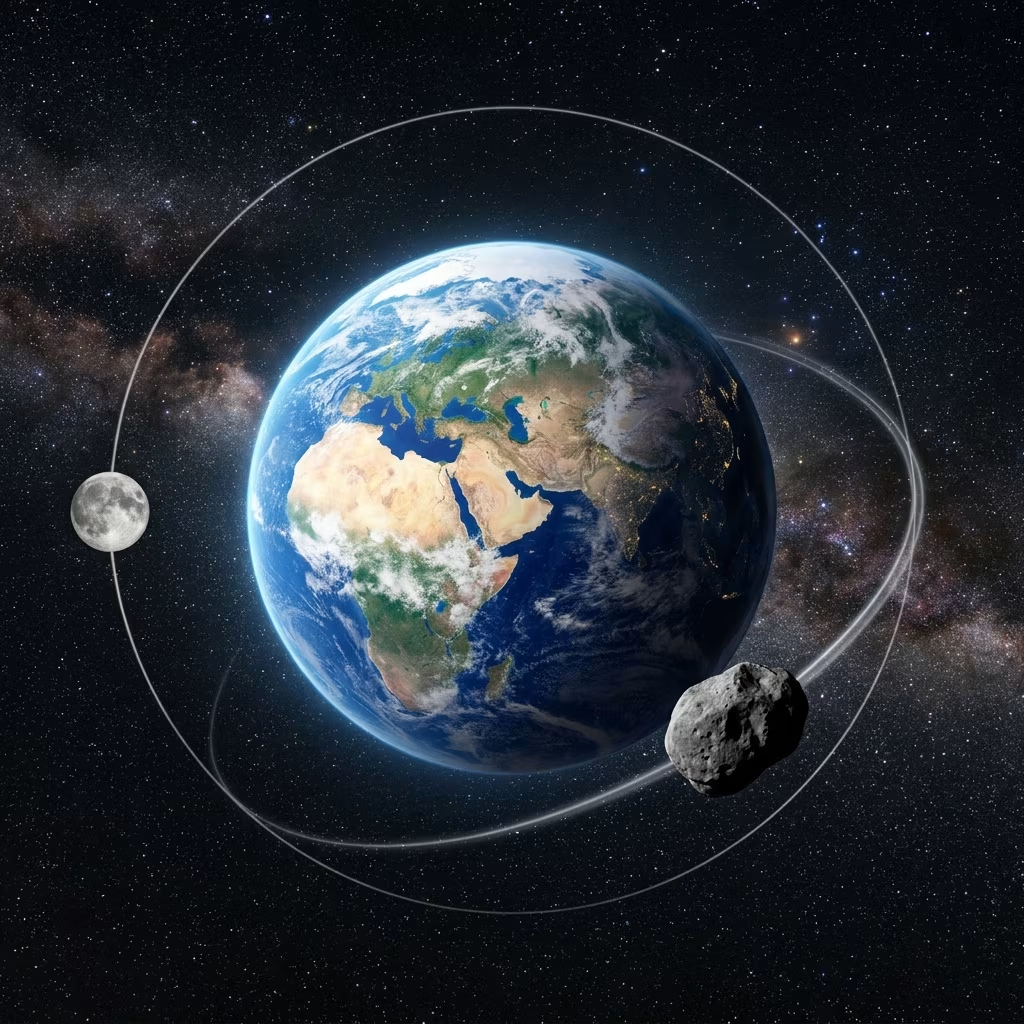
For about two months in late 2024, Earth played host to an extraordinary visitor: the asteroid 2024 PT5, dubbed a “mini-moon.” This brief celestial partnership offered scientists and space enthusiasts alike a rare opportunity to study the dynamics of planetary capture, Near-Earth Objects (NEOs), and the solar system’s intricate choreography. The arrival and departure of this asteroid illuminates not only the complex gravitational interactions that govern our celestial neighborhood but also the excitement and mystery that tiny visitors like 2024 PT5 inspire.
What Is a Mini-Moon?
A mini-moon refers to a small asteroid or object temporarily captured by Earth’s gravity, entering orbit before eventually escaping back into space. Unlike Earth’s permanent natural satellite—the Moon—these objects are usually small, irregular, and their visits are fleeting. Mini-moons are rare but not unprecedented; previous examples include 1991 VG, 2006 RH120, 2020 CD3, and 2022 NX1.
- Mini-moons typically range in size from a few meters to tens of meters across.
- Captures are brief due to unstable orbits and perturbative forces from the Sun and other planets.[10]
- The term “mini-moon” is informal; astronomers refer to these objects as temporarily captured orbiters (TCOs).
Discovery and Arrival of Asteroid 2024 PT5
Asteroid 2024 PT5 was discovered in August 2024 by astronomers monitoring near-Earth space. With an estimated size comparable to a school bus (several meters in diameter), the asteroid presented itself as one of the largest mini-moons observed to date.
- Discovery date: August 2024
- Entry into orbit: September 29, 2024
- Departure from Earth’s vicinity: November 24–25, 2024
- Distance from Earth: About 1.5 million kilometers (roughly four times the average lunar distance)
Despite its temporary, unstable orbit, 2024 PT5 proved captivating for scientists wishing to study both its movement and its possible origins.
How Mini-Moons Are Captured
The mechanics of mini-moon capture are dictated by orbital resonance and the interplay of gravitational forces primarily from Earth, but also from Jupiter and the Sun.[11]When a NEO like 2024 PT5 passes close enough and at the right velocity, Earth’s gravitational pull can trap it momentarily. These encounters are more likely for small, slow-moving objects.
- Mini-moons often arrive via trajectories altered by encounters with larger planets (e.g., Jupiter).
- Radiation pressure from the Sun and gravitational “tugs” destabilize the orbit, causing ejection after a short period.
- The object’s path can help scientists understand historical impacts, resonance phenomena, and potential for future captures or impacts.[11]
Asteroid 2024 PT5: Origin and Scientific Significance
While many small NEOs are fragments of larger asteroids, 2024 PT5 is believed to be even more intriguing: new research suggests it is likely a fragment ejected from the Moon during an ancient impact.
| Feature | Description |
|---|---|
| Size | Approximately 4–10 meters (school bus–shuttle sized) |
| Origin Theory | Lunar ejecta—fragment from the Moon thrown off by an ancient collision |
| Orbit Duration | About 57 days |
| Closest Distance | 1.5 million km (four lunar distances) |
| Scientific Opportunity | Study lunar-origin rocks, analyze NEO behavior, improve planetary defense tracking |
- 2024 PT5’s composition and spectral signature suggest it contains minerals commonly found on the lunar surface.[12]
- Its orbit and velocity are consistent with historical simulations of lunar ejecta.
- The chance to observe a lunar-origin asteroid up close is rare, enhancing its scientific value.
Tracking and Observational Campaigns
During its brief stay, global observatories and space agencies, including NASA, coordinated to monitor 2024 PT5’s path, composition, and behavior.
- Telescopes collected photometric and spectroscopic data to confirm its lunar-like mineralogy.
- Radar imaging produced detailed orbital maps, helping refine models of TCO behavior.
- Space agencies tested planetary defense systems, improving early-warning protocols for future NEOs.
- Astronomers also documented the asteroid’s departure, creating a photographic record of the event.
This coordinated effort illustrates the importance of rapid, collaborative observation for transient objects whose windows for study are narrow.
Mini-Moons—A History of Earth’s Temporary Companions
Though rare, Earth’s history contains several documented mini-moon captures:
- 1991 VG (captured in 1991-1992): Discovered by James V. Scotti, temporarily orbited Earth, origin debated.
- 2006 RH120 (2006-2007): Remained for over a year, subsequently escaped into solar orbit.
- 2020 CD3 (2020): Stayed for about three years before departure.
- 2022 NX1 (2022): Another short-lived capture, studied for natural origin.
2024 PT5’s arrival reaffirms mini-moon captures as a recurring, if rare, feature of Earth’s gravitational sphere. Each one provides a new laboratory for planetary scientists and offers a distinct chance to probe small object dynamics and potential resource or impact risk.
Orbital Mechanics: Why Do Mini-Moons Leave?
The orbital fate of temporary moons like 2024 PT5 is dictated by three primary forces:
- Solar gravity: The pull of the Sun’s gravity disrupts small object orbits.
- Planetary perturbations: Jupiter’s and Earth’s shifting gravitational influences nudge objects into escape trajectories.
- Radiation pressure: Small, low-mass objects are susceptible to being pushed out by solar radiation.
Because their entry vectors rarely match Earth’s orbital speed and direction, most mini-moons are unable to settle into stable, multi-year orbits. After a few weeks or months, they escape back into heliocentric paths, sometimes becoming NEOs elsewhere in the solar system.
Scientific Value: What We Learn from Mini-Moons
Mini-moons provide astronomers with unique opportunities:
- Testing planetary defense tracking and early-warning systems.
- Studying object origins and composition—especially if lunar or Martian rocks are present.
- Refining models of small body orbital mechanics and short-term captures.
- Offering insights into impact rates, asteroid mining, and resource utilization.
- Providing public outreach and engagement with astronomy through high-profile celestial events.
Potential Risks and Public Perception
Media reports sometimes raise concerns over Earth’s temporary moons posing a threat. However, objects like 2024 PT5 are far too small to cause significant harm, and their orbits are closely tracked by international agencies.[13] For planetary defense planning, these events are valuable low-risk rehearsals.
Did 2024 PT5 Pose a Threat?
- No collision risk calculated; the asteroid remained well outside the orbital range of the International Space Station and geostationary satellites.
- Closest approach was at a safe distance, and modeling showed no perturbative risk to Earth or its Moon.
Asteroid 2024 PT5: Departure and Legacy
On November 24–25, 2024, 2024 PT5 escaped Earth’s gravity, returning to its solitary journey around the Sun. Astronomers bid farewell to this temporary moon, having gathered a wealth of data to analyze for years to come.[14]
- Images captured by ground telescopes commemorated the exit.
- The event sparked public interest in planetary science and transient celestial phenomena.
- Future mini-moon events will benefit from improved observational protocols tested on 2024 PT5.
Frequently Asked Questions (FAQs) About Asteroid 2024 PT5
Q: What is asteroid 2024 PT5?
A: 2024 PT5 is a small Near-Earth asteroid, roughly the size of a school bus, temporarily captured by Earth’s gravity in late 2024.
Q: How long did 2024 PT5 stay in orbit around Earth?
A: It orbited Earth for about 57 days, from September 29 to November 24–25, 2024.
Q: Was there any danger posed by 2024 PT5?
A: No, the asteroid maintained a safe distance and posed no collision risk to Earth or its satellites.
Q: Why are mini-moons scientifically interesting?
A: They help astronomers study gravitational mechanics, object composition, origins, and test planetary defense systems.
Q: Is it true that 2024 PT5 could be a piece of the Moon?
A: Yes, recent evidence suggests it originated as lunar ejecta—a fragment sent off by a past impact on the Moon’s surface.
Key Takeaways: Earth’s Celestial Rendezvous with a Mini-Moon
- Asteroid 2024 PT5 brought new scientific opportunities during its brief orbit around Earth.
- Mini-moons are rare, temporary companions that help us understand our dynamic solar system.
- The suspected lunar origin of 2024 PT5 marks a milestone in planetary science.
- No threat was posed, with the event closely monitored by observatories worldwide.
- As 2024 PT5 returned to space, it left behind data, excitement, and anticipation for future visitors.
References
- https://www.space.com/mini-moon-2024pt5-asteroid-depart-image
- https://www.space.com/earth-mini-moon-asteroid-2024-pt5
- https://en.wikipedia.org/wiki/2024_PT5
- https://www.astronomy.com/science/earth-gets-a-new-mini-moon-this-weekend/
- https://science.nasa.gov/blogs/planetary-defense/2024/10/02/nasa-to-track-asteroid-2024-pt5-on-next-close-pass-january-2025/
- https://www.youtube.com/watch?v=ZkBys9EfPYM
- https://news.web.baylor.edu/news/story/2024/newly-discovered-asteroid-2024-pt5-becomes-earths-temporary-mini-moon
- https://www.iac.es/en/outreach/news/scientists-confirm-lunar-origin-near-earth-asteroid-2024-pt5
- https://www.cbsnews.com/news/earth-second-mini-moon-2024/
- https://www.atlasobscura.com/articles/mini-moon-2024-pt5
- https://www.youtube.com/watch?v=8hfAUF4TbKo
- https://www.jpl.nasa.gov/news/study-finds-earths-small-asteroid-visitor-likely-chunk-of-moon-rock/
- https://www.theweathernetwork.com/en/news/science/space/tiny-asteroid-2024-pt5-to-be-new-mini-moon-of-earth-for-nearly-2-months?_guid_iss_=1
- https://www.earth.com/news/2024-pt5-mini-moon-say-goodbye-to-earths-second-moon-we-barely-got-to-know-you/
- https://yaledailynews.com/blog/2024/10/14/earths-newest-neighbor-2024-pt5-mini-moon/
- https://www.earth.com/news/earth-has-lost-its-mini-moon-2024-pt5-may-have-come-from-our-main-moon/
- https://www.popularmechanics.com/space/moon-mars/a62264514/mini-moon-2024-pt5
- https://www.livescience.com/space/asteroids/earths-latest-minimoon-could-be-a-chunk-of-our-planets-permanent-moon-and-its-about-to-leave-us-behind