Parallel Universes: Unlocking the Mysteries of the Multiverse
For centuries, humanity has gazed at the night sky and wondered if ours is the only universe. Modern physics, cosmology, and even mathematics challenge this assumption. Could it be that our universe is but one of countless others existing side by side? The concept of parallel universes—also known as the multiverse—occupies a central place in the frontier of scientific thought, raising profound questions about reality, our place in the cosmos, and the very nature of existence.
What Is the Multiverse?
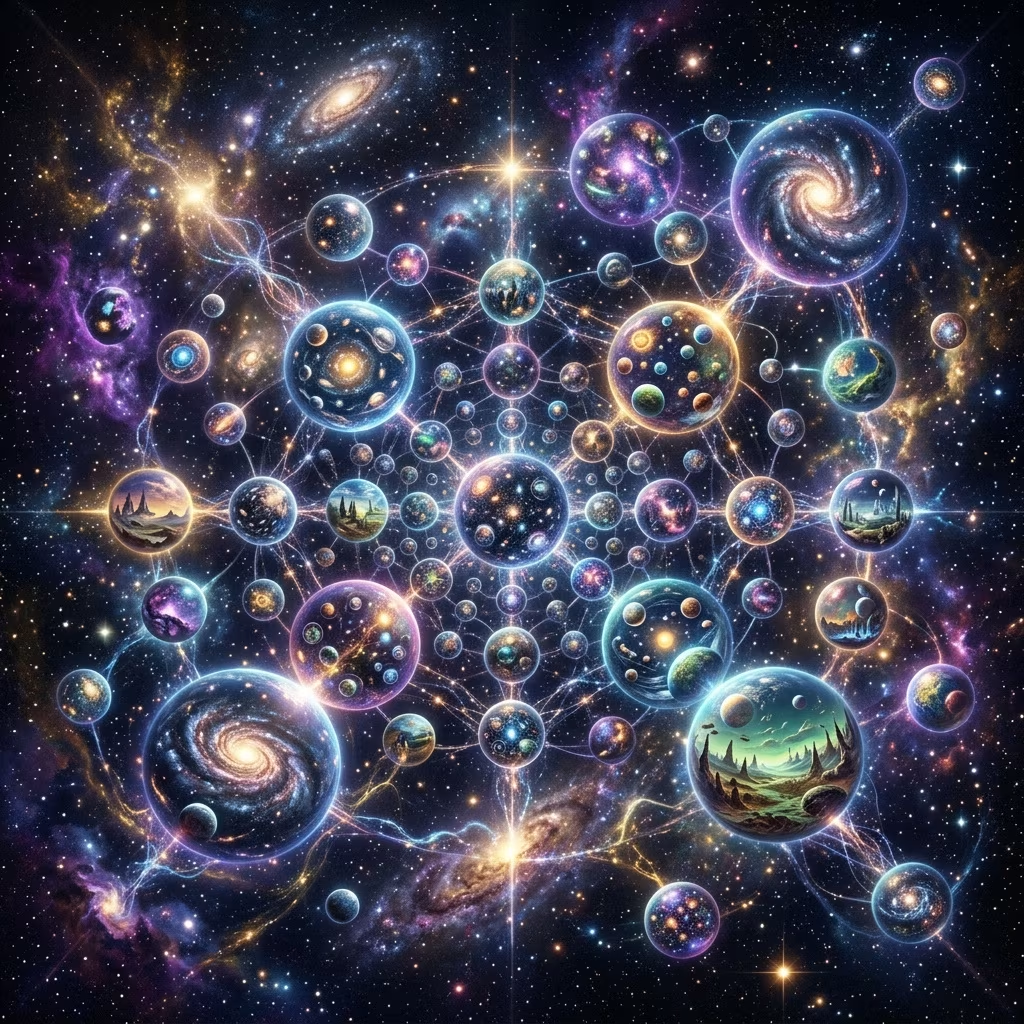
The multiverse is a scientific hypothesis proposing that our universe is not unique or isolated. Instead, it exists among many universes, each with its own laws of physics, histories, and possibilities. These other universes may be vastly different or eerily similar to our own, and together, they constitute what scientists call the ‘multiverse.’ Individual universes within the multiverse are often referred to as parallel universes.
- Parallel universes: Distinct universes within the multiverse hypothesis.
- Multiverse theory: Suggests multiple universes, each potentially with different physical constants and properties.
- Observable universe: Refers to the portion of the universe we can observe, not the entire cosmic structure.
Why Do Scientists Consider Parallel Universes?
Several strands of modern physics and cosmology suggest the possible existence of parallel universes. These scientific threads include:
- Quantum mechanics: The strange rules governing particles at the smallest scales hint at new forms of reality.
- Cosmic inflation: The rapid expansion of space after the Big Bang could have created many ‘bubble universes.’
- String theory and higher dimensions: Theoretical physics allows for dimensions beyond our perception, where alternate universes might reside.
- Anthropic principle: The idea that multiple universes could explain why our universe has the right conditions for life.
Let’s examine the main theoretical frameworks for parallel universes, starting with the simplest and moving toward the most speculative.
Levels of Parallel Universes
In the early 2000s, physicist Max Tegmark categorized the concept of the multiverse into four ‘levels’ based on how these parallel universes might come to be and how different they could be from our own. Here, we explore the four main levels most frequently discussed by cosmologists.
Level 1: Worlds Beyond Our Cosmic Horizon
Level 1 Parallel Universes are the least exotic and stem from the vast size and uniformity of space. The key assumptions are:
- Space is either infinite or so unimaginably large that it contains all possible arrangements of matter.
- Given enough space, patterns start to repeat—even exact duplicates of Earth and ourselves might exist, far beyond the reach of our telescopes.
We are unable to see these other ‘universes’ since the speed of light limits how far we can observe—the ‘Hubble volume’ defines this cosmic horizon. But beyond this volume, other regions could exist, identical or quite different from ours, simply because of the rules of probability in an infinite cosmos.
Key Features of Level 1:
- Universes obey the same physical laws as ours.
- Differences are only in the arrangement of matter.
- Other universes remain inaccessible due to speed-of-light limitations.
Level 2: Infinite Bubbles from Cosmic Inflation
Level 2 Parallel Universes emerge from the theory of cosmic inflation—the ultra-fast expansion of space that followed the Big Bang. If inflation never completely stops, new ‘bubble universes’ could keep forming, growing entirely disconnected from one another.
These bubbles—each a separate universe—could possess different fundamental physical constants and even different numbers of spatial and temporal dimensions. While we can never communicate with or visit these other universes (they’re receding faster than light), their existence is a logical outcome of inflationary cosmology.
Notable Theories Supporting Level 2:
- Eternal Inflation: Quantum fluctuations in the early universe’s vacuum energy produce endless bubbles, each becoming its own universe with unique properties.
- Ekpyrotic Theory: A speculative theory where two branes (multidimensional surfaces in string theory) collide in multiple places, creating many universe ‘pockets,’ just as a flapping sheet touches a mattress in multiple spots.
- Chaotic Inflation: An offshoot where initial energy conditions vary across bubble universes, meaning some could start with different rules entirely.
Level 2 universes are probably forever inaccessible, divided from us by a vast inflationary sea.
Level 3: The Many Worlds of Quantum Mechanics
Level 3 introduces the Many-Worlds Interpretation (MWI) of quantum mechanics. Physicist Hugh Everett III proposed that every time a quantum decision point is reached (for example, a particle can go left or right), the universe splits into branches: one where the particle goes left, another where it goes right.
This means that, every moment, new parallel universes are splitting off from ours, each reflecting a different possible outcome of every quantum event. All possibilities are realized—but in different universes.
Key Points about Level 3:
- Every quantum event creates a branching of the universe.
- Results in a vast, ever-diverging set of realities.
- Provides a possible solution to quantum paradoxes but remains controversial and debated among physicists.
Level 4: Other Mathematical Structures
Perhaps the most radical is Level 4, which suggests that all logically possible mathematical structures actually exist as their own universes. These universes do not just have different arrangements of matter or physical constants—their fundamental laws and even logic could be alien to us.
This idea implies an unbounded plurality of realities, only some of which can support sentient observers like us. Many scientists question whether Level 4 parallel universes are a scientific concept or a philosophical speculation.
Comparing the Levels of Parallel Universes
| Level | Description | Physical Laws | Accessibility |
|---|---|---|---|
| Level 1 | Regions beyond our cosmic horizon | Same as ours | Forever inaccessible |
| Level 2 | Bubble universes from inflation | Different constants, possibly dimensions | Completely isolated, unreachable |
| Level 3 | Quantum branching universes (Many-Worlds) | Same as ours; different outcomes per branch | Unobservable, but exist simultaneously |
| Level 4 | Universes with different mathematical structures | Entirely different; maybe incomprehensible to us | Purely theoretical |
Is There Any Evidence for Parallel Universes?
Theories of parallel universes are compelling but controversial. While mathematics supports their possibility, direct observation or measurement is elusive. The cosmic microwave background, gravitational waves, or exotic particle interactions (such as those sought by experiments like ANITA) have yet to provide conclusive evidence of interactions with other universes. However, some unexplained phenomena (such as certain anomalies in the cosmic background radiation) keep the debate alive, though most such claims to date are met with skepticism or alternative explanations.
Much of the scientific community adopts a cautious stance: Until and unless repeatable, testable evidence for parallel universes emerges, the multiverse remains an elegant—but unproven—solution to cosmic riddles.
Philosophical and Cultural Implications
The multiverse and parallel universe hypotheses have profound philosophical implications. They challenge:
- Uniqueness: If other versions of ourselves exist, what does it mean for identity and free will?
- Fine-tuning: The ‘anthropic principle’ suggests we observe a universe suited for life simply because we are here to ask the question—in a multiverse, many universes with different laws exist, but we are present only where life is possible.
- Philosophy and science: When does an idea move from philosophy to physics—and can we ever test the multiverse concept?
Popular culture has embraced parallel universes, spawning countless books, films, and television series that imagine alternate realities, time travel, and choices replayed with different outcomes.
Frequently Asked Questions (FAQs)
Q: Are parallel universes a proven scientific fact?
A: No. Parallel universes remain a theoretical concept. While several mathematical frameworks suggest their existence, there is currently no direct observational evidence.
Q: What are some scientific reasons to suspect parallel universes might exist?
A: Theories such as cosmic inflation, quantum mechanics (many-worlds interpretation), and certain string theory models provide mathematical frameworks that predict or allow parallel universes. However, these predictions have yet to be backed with observable proof.
Q: Could humans ever interact with or travel to these alternate universes?
A: Currently, there is no known way to access parallel universes. Most are thought to be fundamentally separated from our own, either by vast stretches of space, differences in fundamental laws, or existing in entirely different realms of possibility.
Q: Do parallel universes explain the existence of life?
A: The multiverse supports the anthropic principle: In a vast or infinite range of universes with different initial conditions, some will happen to have the right properties for life—and we unsurprisingly find ourselves in one of those.
Summary: Is the Multiverse Real?
The question of whether parallel universes are real takes us to the very frontiers of science and philosophy. Theories abound, but direct evidence is still out of reach. For now, the multiverse remains a powerful hypothesis, spurring investigation and debate. As research in cosmology, quantum physics, and astronomy pushes forward, the line between speculation and scientific discovery may one day blur, revealing the true nature of reality itself.
References
- https://www.space.com/truth-behind-nasa-mirror-parallel-universe.html
- https://www.space.com/37273-parallel-and-multi-universe-theory.html
- https://en.wikipedia.org/wiki/Multiverse
- https://www.dummies.com/article/academics-the-arts/science/physics/the-theory-of-parallel-universes-193290/
- https://www.ignaciodarnaude.com/textos_diversos/Tegmark,Parallel%20universes,Scientific%20American.pdf
- https://bigthink.com/starts-with-a-bang/evidence-parallel-universe/
- https://www.dummies.com/article/the-theory-of-parallel-universes-193290
- https://science.howstuffworks.com/science-vs-myth/everyday-myths/parallel-universe.htm
- https://bigthink.com/starts-with-a-bang/parallel-universes-real/
- https://www.theghoulsnextdoor.com/single-post/parallel-universes
- https://www.universetoday.com/articles/parallel-universe
- https://futurism.com/the-science-behind-parallel-universes
- https://theenlightenmentjourney.com/is-there-a-parallel-universe-exploring-alternate-realities/
- https://cosmosmagazine.com/science/physics/what-is-cosmos-doing-sporting-a-cover-story-on-parallel-universes/
- https://futurism.com/worlds-without-end-the-many-kinds-of-parallel-universes