SpaceX Crew-10 Astronauts Safely Return to Earth After Nearly Five Months on ISS
After almost five months aboard the International Space Station (ISS), the SpaceX Crew-10 mission has successfully completed its journey, bringing its four-member international crew back to Earth. The mission, a collaborative effort under NASA’s Commercial Crew Program, underscores ongoing advancements in crewed orbital flight and multinational scientific research in low Earth orbit.
Mission Overview: SpaceX Crew-10’s Historic Return
Launched on March 14, 2025, SpaceX Crew-10 was the tenth operational crew rotation under NASA’s Commercial Crew Program and marked the sixteenth crewed orbital flight of a Dragon spacecraft. The crew, consisting of two NASA astronauts, a Japanese astronaut from JAXA, and a Russian cosmonaut from Roscosmos, spent close to five months conducting vital research and maintaining ISS activities before making their return journey to Earth. Their return was meticulously coordinated, culminating in a smooth re-entry and splashdown, closely monitored by SpaceX and NASA ground teams.
Meet the Crew-10 Astronauts
| Position | Name | Affiliation | Spaceflight Experience |
|---|---|---|---|
| Commander | Anne McClain | NASA | Second spaceflight |
| Pilot | Nichole Ayers | NASA | First spaceflight |
| Mission Specialist 1 | Takuya Onishi | JAXA | Second spaceflight |
| Mission Specialist 2 | Kirill Peskov | Roscosmos | First spaceflight |
Each crewmember brought a distinct background in aerospace operations and leadership, contributing to a truly global team focused on advancing space science and technology.
Mission Launch and Journey to the International Space Station
SpaceX Crew-10 launched atop a Falcon 9 rocket from Launch Complex 39A at NASA’s Kennedy Space Center in Florida at 7:03 p.m. EDT (23:03 UTC) on March 14, 2025. This flight, initially delayed due to a hydraulics issue with ground support systems, went off successfully on its second attempt.[10]
- Spacecraft: Crew Dragon Endurance
- Flight Duration: Nearly five months in orbit
- Mission Objective: Conduct science experiments, maintenance, outreach, and enhance international cooperation aboard the ISS
Following a flawless liftoff, the Falcon 9’s first stage returned safely to Cape Canaveral Space Force Station, while the Crew Dragon performed precise maneuvers to dock autonomously at the ISS’ Harmony module.[10]
Key Mission Milestones
- Docking: Crew Dragon docked to the ISS on March 15, 2025.
- Integration: Crew-10 joined Expedition 72/73, initiating collaborative science and maintenance tasks.
- Return Prep: Upon nearing mission end, Crew-10 handed over operations to the incoming rotation before undocking from the ISS.[10]
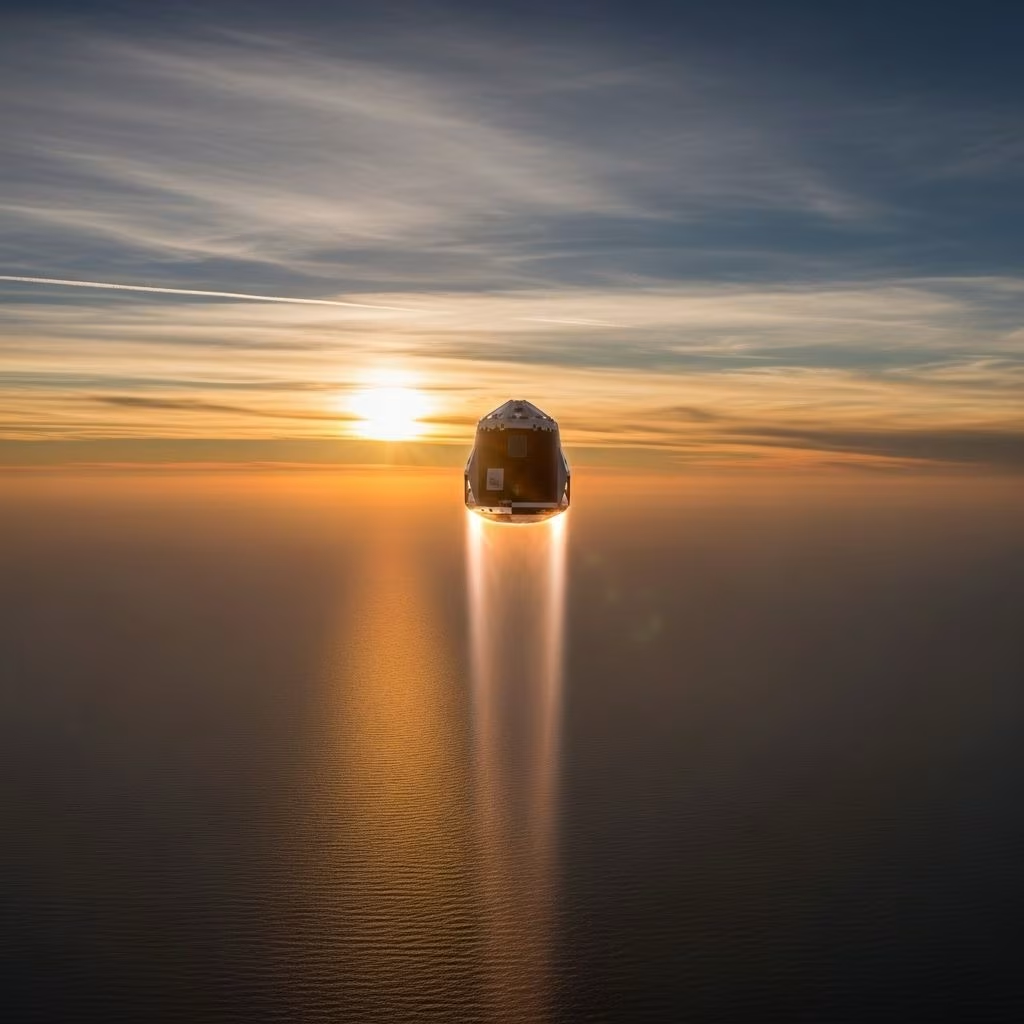
- Earth Re-entry and Splashdown: Spacecraft completed automated de-orbit, atmospheric re-entry, and safely splashed down, where recovery teams were on standby.
Science, Research, and International Collaboration
The core of Crew-10’s mission was continued scientific experimentation and technology demonstration in microgravity, vital for preparing humanity for future long-duration spaceflights, including Artemis missions to the Moon and, eventually, Mars.
- Biological & Medical Research: Studying the effects of microgravity on the human body, cellular biology, and potential therapies for diseases affecting astronauts and people on Earth.
- Materials Science: Investigating novel materials that could be used in harsh environments, both in space and on Earth.
- Tech Development: Testing next-generation life support systems, automation, and AI-driven monitoring.
- International STEM Outreach: Engaging with schools and the public to inspire future space explorers and scientists.
These experiments were conducted in close cooperation with partner agencies, including JAXA and Roscosmos, reinforcing the truly multinational nature of the ISS.
Global Partnerships and the Value of Crew Rotation Missions
NASA’s commercial crew rotations, such as Crew-10, enable ongoing science while maintaining the vital U.S. commitment to the ISS. They also deepen partnerships by integrating astronauts from Japan and Russia, demonstrating peaceful international cooperation in space exploration.
- Cross-cultural teamwork leads to more innovative problem-solving.
- Joint research programs maximize unique agency strengths, benefiting humanity as a whole.
- Shared goals include advancing science, fostering economic opportunities, and building the foundation for deep-space exploration.
Return to Earth: A Smooth and Monitored Descent
Preparations for re-entry involved meticulous checklists and coordination between the astronauts, space station controllers at NASA’s Johnson Space Center, and SpaceX’s mission control in Hawthorne, California. Crew Dragon undocked autonomously and began its descent.
- Undocking Procedure: Autonomous disengagement from the ISS following all safety protocols.
- De-orbit Burn: Crew Dragon fired thrusters to reduce orbital velocity, targeting its splashdown zone.
- Atmospheric Re-entry: The spacecraft’s heat shield protected the astronauts from extreme temperatures during descent.
- Parachute Deployment: Parachutes slowed the final descent before a controlled splashdown in the Atlantic Ocean.
- Recovery: SpaceX and NASA teams quickly recovered Crew Dragon and its crew upon landing.
The Crew’s Initial Post-Landing Activities
After landing, each astronaut underwent immediate medical checks to ensure they had readjusted to Earth’s gravity. The effects of re-entry after long microgravity exposure can range from disorientation to muscle weakness. Data from their recovery further informs health protocols for future long-term space travelers.
Why Crew-10’s Mission Was Significant
- Milestone for Commercial Spaceflight: Crew-10 reinforced the reliability of SpaceX’s Dragon for human space transport.
- Scientific Progress: Research published from Crew-10’s experiments will impact fields from medicine to materials engineering.
- International Cooperation: Continued joint activities among NASA, JAXA, and Roscosmos foster trust and technical strength for future interplanetary missions.
- Foundational for Artemis Missions: Extended ISS missions prepare astronauts for the physical and mental demands of lunar and Martian flights.
Frequently Asked Questions (FAQs)
Q: Who were the Crew-10 astronauts?
A: Anne McClain (NASA, Commander), Nichole Ayers (NASA, Pilot), Takuya Onishi (JAXA, Mission Specialist), and Kirill Peskov (Roscosmos, Mission Specialist).
Q: How long did SpaceX Crew-10 spend in space?
A: The mission duration was nearly five months aboard the International Space Station.
Q: What did Crew-10 accomplish during their time on the ISS?
A: Crew-10 conducted multidisciplinary scientific experiments, tested new space technologies, and participated in routine maintenance and international outreach efforts with partner agencies.
Q: How do astronauts re-adapt to life on Earth after months in microgravity?
A: On landing, astronauts receive medical assessments to address issues such as muscle atrophy and balance disturbance. Ongoing rehabilitation helps restore strength and coordination.
Q: What is the significance of international participation in missions like Crew-10?
A: The involvement of multiple space agencies on Crew-10 highlights the collaborative spirit of modern spaceflight, combining expertise and resources to enhance scientific returns and technical success.
Legacy and the Future of ISS Crew Rotations
As SpaceX Crew-10 sets a precedent for smooth crew transfers and successful returns in NASA’s Commercial Crew Program, its legacy lies in enhancing international relationships, refining spaceflight technologies, and inspiring the next generation of scientists and explorers. The knowledge and experience gained are crucial building blocks for ambitious goals—returning to the Moon and one day landing humans on Mars.
- Continued Innovation: Lessons from Crew-10 advance spacecraft safety, reliability, and mission sustainability.
- Expanding Commercial Opportunities: Public-private partnerships like Crew-10 drive economic growth within the space sector.
- Human Presence in Space: Each rotation ensures a constant human presence, facilitating continuous scientific inquiry and technology testing.
References
- Wikipedia – SpaceX Crew-10
- NASA – SpaceX Crew-10 Mission Launch
- Space.com – Crew-10 Astronauts Return
- [10] NASASpaceFlight – Crew-10 Launch Details
References
- https://en.wikipedia.org/wiki/SpaceX_Crew-10
- https://www.nasa.gov/mission/nasas-spacex-crew-10/
- https://www.youtube.com/watch?v=7bWFT5mOZc4
- https://www.nasa.gov/news-release/nasas-spacex-crew-10-launches-to-international-space-station/
- https://www.space.com/space-exploration/international-space-station/spacex-crew-10-astronauts-undocking
- https://www.spacex.com/launches/mission/?missionId=crew-10
- https://www.space.com/space-exploration/international-space-station/spacex-crew-10-astronauts-return-to-earth-from-international-space-station
- https://www.youtube.com/watch?v=EqT3nDbwETc
- https://www.af.mil/News/Article-Display/Article/4121368/air-force-major-pilots-nasas-spacex-crew-10-mission/
- https://www.nasaspaceflight.com/2025/03/crew-10-launch/
- https://www.spacex.com/launches/
- https://spaceanddefense.io/nasas-spacex-crew-10-heads-to-international-space-station/
- https://www.spacelaunchschedule.com/space-news/what-you-need-to-know-about-nasas-spacex-crew-10-mission/
- https://www.nasaspaceflight.com/2025/08/crew-10-return/
- https://www.friendsofnasa.org/2025/03/nasas-spacex-crew-10-mission-overview.html
- https://nss.org/crew-10-launches-to-the-international-space-station/
- https://www.friendsofnasa.org/2025/03/nasas-spacex-crew-10-mission-extra.html
- https://www.asdnews.com/news/aerospace/2025/03/15/nasas-spacex-crew10-launches-international-space-station
- https://newspaceeconomy.ca/2025/03/14/nasas-spacex-crew-10-launches-to-international-space-station/
- https://www.miragenews.com/nasas-spacex-crew-10-mission-key-details-1421238/