


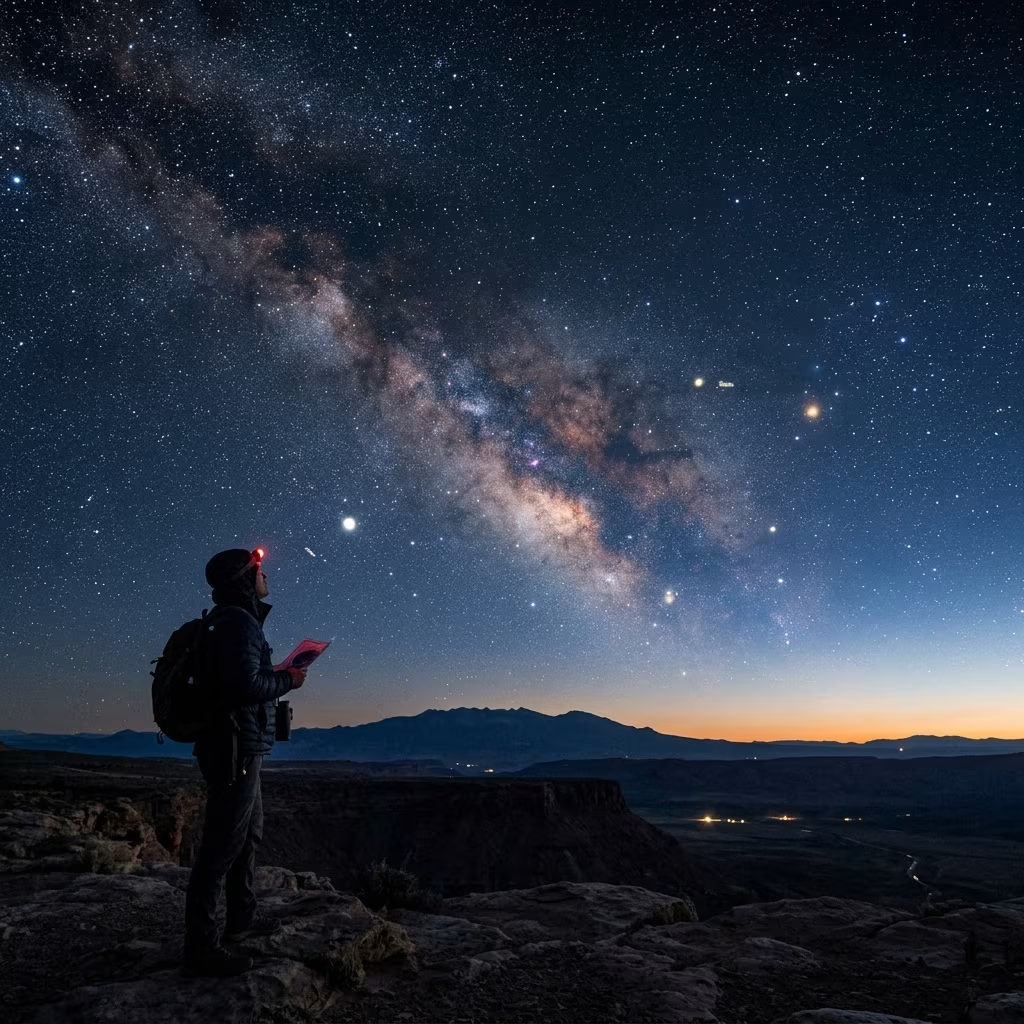
Visible Planets Guide: Observing the Solar System with Your Eyes
Many of the most brilliant ‘stars’ you see in the night sky are not stars at all—they are planets in our solar system, visible to the naked eye. This guide explores how, when, and where to see planets without a telescope, offering practical tips for spotting Mercury, Venus, Mars, Jupiter, Saturn, and information on Uranus and Neptune for those with binoculars or small telescopes.
What Are the Naked-Eye Planets?
The classical naked-eye planets are five in number—Mercury, Venus, Mars, Jupiter, and Saturn. These brightest wanderers traverse the night sky along the ecliptic (the Sun’s path) and have been observed by people since ancient times.
The outer planets Uranus and Neptune require optical aid but can be found with basic equipment.
How to Find & Identify Planets in the Sky
Amateur astronomy is a remarkably accessible hobby. Contrary to popular belief, you do not need expensive telescopes to begin planet-spotting. The five naked-eye planets are bright enough to see even from a suburb or city center, provided you know where to look.
- Look for the brightest, steady dots in the sky: Venus and Jupiter shine more brightly than almost any star. Mars often sports a reddish hue. Unlike stars, planets do not twinkle—they shine with a steady light.
- Planets follow the ecliptic: Scan the sky along the imaginary path the Sun takes across the sky (the ecliptic) after dark. All planets stay close to this path.
- Compare against the stars: Over consecutive nights, planets noticeably change position relative to background stars, since they orbit the Sun at different speeds, hence their name from the Greek ‘planetes’ (wanderers).
- Use star maps or astronomy apps: Interactive planetarium apps like Stellarium, Star Walk 2, or SkySafari can pinpoint planet locations relative to your horizon at any date and time.
The Magnitude Scale: Planet Brightness
| Planet | Typical Apparent Magnitude* | Naked-eye visible? |
|---|---|---|
| Venus | -4.3 | Yes |
| Jupiter | -2.7 | Yes |
| Mercury | +0.2 | Yes (Low horizon, hard) |
| Saturn | +0.5 | Yes |
| Mars | +0.7 | Yes |
| Uranus | +5.7 | Only in very dark skies (binoculars suggested) |
| Neptune | +7.8 | Binoculars/telescope required |
*Smaller (or negative) magnitudes are brighter. For comparison, Sirius (brightest night-time star) is magnitude -1.44, and the full Moon is -12.6.
Tips for Spotting Each Planet
- Mercury: Difficult to spot because it hugs the Sun’s glare, look for it very low in the west after sunset or east before sunrise during favorable “elongations” (when it appears farthest from the Sun in the sky).
- Venus: The brightest object after the Sun and Moon; often called the ‘Evening Star’ or ‘Morning Star’, easily visible close to the horizon after sunset or before sunrise. Venus never strays far from the Sun.
- Mars: Noticeably reddish, Mars can rival the brightest stars during close approaches. Look for it high in the midnight sky during oppositions, when it is closest to Earth.
- Jupiter: Shines bright all night when in opposition, rising in the east after sunset. A small telescope or even binoculars will reveal its four largest moons—Io, Europa, Ganymede, and Callisto—aligned like tiny stars beside the disk.
- Saturn: Bright, but less so than Jupiter or Venus; golden-white and steady. Telescopes show its famous rings. Saturn is highest in the sky around local midnight during opposition.
- Uranus and Neptune: Uranus can occasionally be glimpsed as a dim star in very dark skies. Both are best sought with binoculars or a telescope and a good finder chart or app.
Planet Viewing Schedule: When to See Each Planet (2025 Example)
Visibility of planets changes throughout the year as they orbit the Sun. Here’s a sample guide for September and October 2025, suitable for most years with minor date changes:
| Planet | September 2025 | October 2025 |
|---|---|---|
| Mercury | Not visible | Southwest, just after sunset (Oct 18-28) |
| Venus | Visible all month (evening) | East/southeast before sunrise, visible till Nov 20 |
| Mars | Too faint | Too faint |
| Jupiter | East before sunrise, all month | East before sunrise, all month |
| Saturn | Southeast after midnight, west pre-dawn | Southeast after sunset, all month |
| Uranus | East before sunrise, all month | South before sunrise, all month |
| Neptune | West after sunset | Southeast after midnight, west pre-dawn |
Times and visibility direction can vary by latitude and year. For the most accurate predictions, use an astronomy app that takes your location and date into account.
Why Are Planets So Bright?
Planets reflect sunlight rather than emitting their own. The combination of proximity to Earth and reflective cloud cover (like on Venus or Jupiter) can make planets much brighter than most stars, even though the actual star is vastly more luminous if compared up close.
Why Do Planets “Wander” the Sky?
Unlike stars, planets shift their position among the star patterns, or constellations, from week to week. This wandering, which fascinated ancient astronomers and led to the term “planet,” is due to their movement around the Sun at different speeds and distances.
Essential Tools and Resources
- Red light flashlight: Preserve night vision when reading charts.
- Apps and software: Stellarium, Star Walk 2, SkySafari, Sky & Telescope’s online maps, or printed star wheels.
- Binoculars: For a better view of Jupiter’s moons, Saturn’s rings, and more faint planets.
- Tripod and chairs: For comfortable, extended viewing.
Planet-by-Planet Observing Tips and Features
Mercury
Closest planet to the Sun, always near the horizon at dawn or dusk. Mercury goes through rapid cycles of visibility a few times each year. Spotting it is a rite of passage in observational astronomy.
Venus
The brightest planet, often visible for weeks at a time. Its thick, reflective clouds make it shine steadily. Venus exhibits phases (like the Moon) when viewed through a telescope.
Mars
The “Red Planet” is unmistakable when bright, with a pale orange-red color. Mars shines brightest once every 26 months, during its closest approach to Earth (opposition).
Jupiter
The solar system’s giant. Even small binoculars reveal its four main moons, which shift position nightly. Jupiter sports visible belts and zones, and telescopes can sometimes show the Great Red Spot.
Saturn
Famously encircled by its spectacular rings—visible even in a modest backyard telescope. Saturn’s major moon, Titan, is also easy to spot with optical aid.
Uranus
The first planet discovered by telescope; visible to the unaided eye under pristine conditions, but binoculars or telescopes are highly recommended.
Neptune
Neptune is always dim, appearing as a tiny blue disk through a telescope. It cannot be seen without optical aid, but is a satisfying challenge for experienced stargazers.
Why You Don’t Need a Telescope
The five brightest planets are often more prominent than any star—and all you need is a clear night and a good view toward the ecliptic. Telescopes deepen the experience (especially for Saturn’s rings and Jupiter’s bands), but the thrill of recognizing planets by eye is open to anyone.
Bonus: How to Distinguish Planets from Stars
- Planets shine with a steady, non-twinkling light (except near the horizon).
- Planets move relative to constellations. Check their position from night to night—they will shift compared to the fixed background of stars.
- Brightness and color clues: Venus (blazing white), Mars (faint red/orange), Jupiter (bright white), Saturn (soft yellow-white).
- They align with the zodiac constellations.
Frequently Asked Questions (FAQs)
What are the five naked-eye planets?
Mercury, Venus, Mars, Jupiter, and Saturn can all be seen without a telescope under normal sky conditions.
Why can’t I always see every planet?
Planet visibility depends on their position in their orbits. Sometimes a planet is too close to the Sun’s glare, below the horizon, or on the far side of the Sun as seen from Earth.
How do I tell planets apart from stars?
Planets generally appear steadier (not twinkling) and visibly brighten/move compared to stars. They’re also typically brighter—especially Venus and Jupiter—and follow the ecliptic.
Can I see Uranus and Neptune?
Uranus can occasionally be seen with the naked eye under extremely dark skies; Neptune requires binoculars or a telescope.
Are there apps to help find planets?
Yes. Popular options include Stellarium, Star Walk 2, SkySafari, and Night Sky. Many are free and show you what’s in your sky right now.
Is it ever dangerous to search for planets?
Never look directly at the Sun or use binoculars/telescopes on the Sun without a certified solar filter—this will cause permanent eye injury. Mercury and Venus, being close to the Sun, should only be sought when the Sun is below the horizon.
Further Resources and Tips
- For personalized sky charts by location and date, visit astronomy apps or websites with planetarium functions.
- Join a local astronomy club or attend public stargazing events for advice and telescope viewing.
- Check the moon phase: A bright moon can outshine faint planets, so look during moonless periods if possible.
- Use red lights and avoid bright screens to protect your night vision while skywatching.
With a bit of practice, you’ll soon recognize the five wandering worlds as easily as our ancestors did. Happy planet hunting!
References
- https://www.space.com/39240-when-to-see-planets-in-the-sky.html
- https://www.space.com/solar-system-planets-visible-grand-tour-livestream
- https://theskylive.com
- https://www.nakedeyeplanets.com
- https://starwalk.space/en/news/how-to-see-planets-tonight-guide
- https://www.adlerplanetarium.org/blog/how-to-identify-planets/
- https://www.skyatnightmagazine.com/space-science/planets-solar-system-guide
- https://www.farmersalmanac.com/visible-planets-guide
- https://www.universetoday.com/articles/guide-to-space
- https://www.timeanddate.com/astronomy/night/
- https://science.nasa.gov/solar-system/planets/
- https://astronoscope.com/pages/solar-system-guide
- https://science.nasa.gov/skywatching/
- https://scienceillustrated.com/space/seven-planets-at-the-same-time-how-to-spot-the-rare-phenomenon-in-the-sky
- https://www.skyatnightmagazine.com/advice/skills/astronomy-guide-viewing-planets-night-sky
- https://theskylive.com/planets-visible-tonight
- https://starwalk.space/en/news/what-is-planet-parade


