What Is the Sun Made Of?
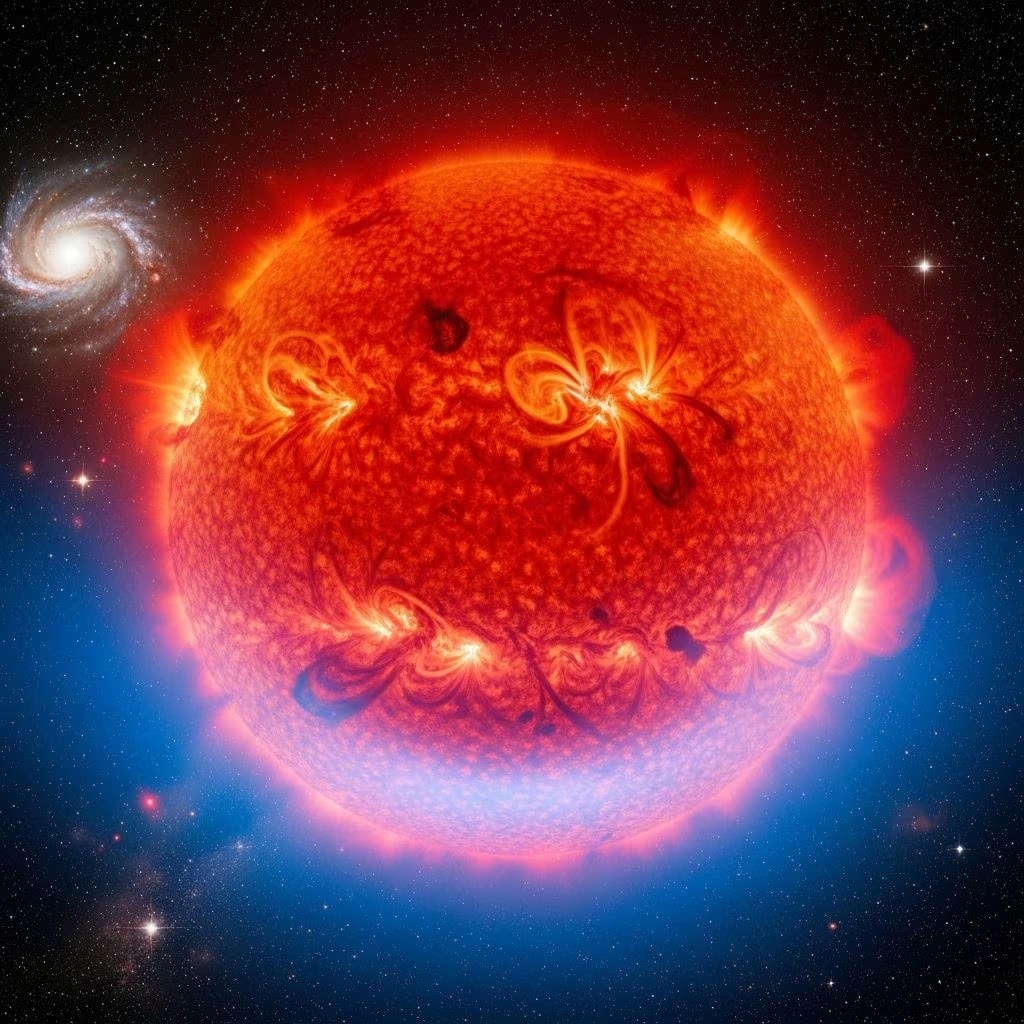
The Sun is the powerhouse at the center of our solar system, shining with energy produced by nuclear fusion. Its immense gravity holds the planets and other bodies in orbit, and its luminosity is essential for life on Earth. But what exactly is the Sun made of, and how is it structured? This article explores the Sun’s composition, layers, formation, and its dynamic influence on the solar system.
The Sun at a Glance
- Age: Approximately 4.6 billion years
- Type: Yellow dwarf star (G-type main-sequence star)
- Diameter: ~1.39 million kilometers (864,600 miles)
- Average Distance from Earth: ~149.6 million kilometers (93 million miles)
- Mass: ~330,000 times that of Earth (99.86% of solar system’s mass)
- Main Elements: Hydrogen (about 74%), Helium (about 24%), Heavier elements (<2%)[10]
The Sun’s Chemical Composition
The Sun’s chemical makeup sets it apart as a stellar body. Most of its mass comprises hydrogen and helium, with traces of heavier elements—collectively called \”metals\” in astronomy, though this includes elements like oxygen and carbon, not just metals in the traditional sense.
Breakdown of Solar Composition (by Mass)
| Element | Approximate Fraction (Photosphere) |
|---|---|
| Hydrogen | ~74.9% |
| Helium | ~23.8% |
| Oxygen | ~1% |
| Carbon | ~0.3% |
| Neon | ~0.2% |
| Iron | ~0.2% |
| Other elements | <1% |
These values are observed in the Sun’s photosphere, the visible \”surface\” of the Sun, and represent its current stage in life. The proportions change subtly as the Sun ages[10].
Formation of Chemical Elements
- Hydrogen and helium formed during Big Bang nucleosynthesis in the Universe’s infancy.
- Heavier elements, such as oxygen and iron, were produced in earlier generations of stars and expelled into interstellar space via supernovae and stellar winds.
- Our Sun inherited its material from this enriched interstellar medium during its formation about 4.6 billion years ago.
The Structure of the Sun: Layers Revealed
The Sun is not a solid mass but a layered sphere of plasma. Each layer has unique characteristics and roles in energy production and transport. The Sun’s structure is typically divided into six primary layers:
- Core
- Radiative Zone
- Convective Zone
- Photosphere (visible surface)
- Chromosphere
- Corona (outer atmosphere)
Diagram of Solar Layers
(A visual diagram would typically be inserted here to illustrate the layers, with the innermost core surrounded by the radiative and convective zones, then the photosphere, chromosphere, and finally the corona[10].)
The Sun’s Layers Explained
1. Core
The core forms the Sun’s central region. Extending to about 138,000 kilometers from the center, it contains the highest density and temperature, reaching up to 15 million °C (27 million °F)[10].
- Primary site of nuclear fusion: Hydrogen atoms fuse to form helium, releasing energy as radiation and neutrinos.
- Helium content: The core is approximately 64% helium by mass due to continuous fusion, with hydrogen constituting ~35%—as hydrogen is consumed, helium increases[10].
- Density: ~150 g/cm³, extremely dense compared to typical Earth materials.
2. Radiative Zone
Surrounding the core, the radiative zone extends up to about 500,000 kilometers from the center.
- Energy transfer method: Energy moves outward by radiation—photons are absorbed and re-emitted, bouncing and scattering, taking up to 170,000 years to reach the next layer.
- Mostly hydrogen and helium: About 75% hydrogen, 24% helium by mass.
- Temperature: Drops gradually from the core outward, remaining above 2 million °C.
3. Convective Zone
This zone begins where temperatures fall below what’s necessary for efficient radiative transport (<2 million °C).
- Energy transfer method: Convection—giant bubbles of hot plasma rise, cool, and sink, similar to boiling water.
- Layer thickness: Extends up to the photosphere.
- Composition: Dominated by hydrogen and helium[10].
4. Photosphere
The photosphere is the Sun’s visible surface, marking the boundary of the Sun as seen from Earth.
- Temperature: Around 5,800 °C (10,000 °F)—cooler than inner layers.
- Thickness: About 500 kilometers.
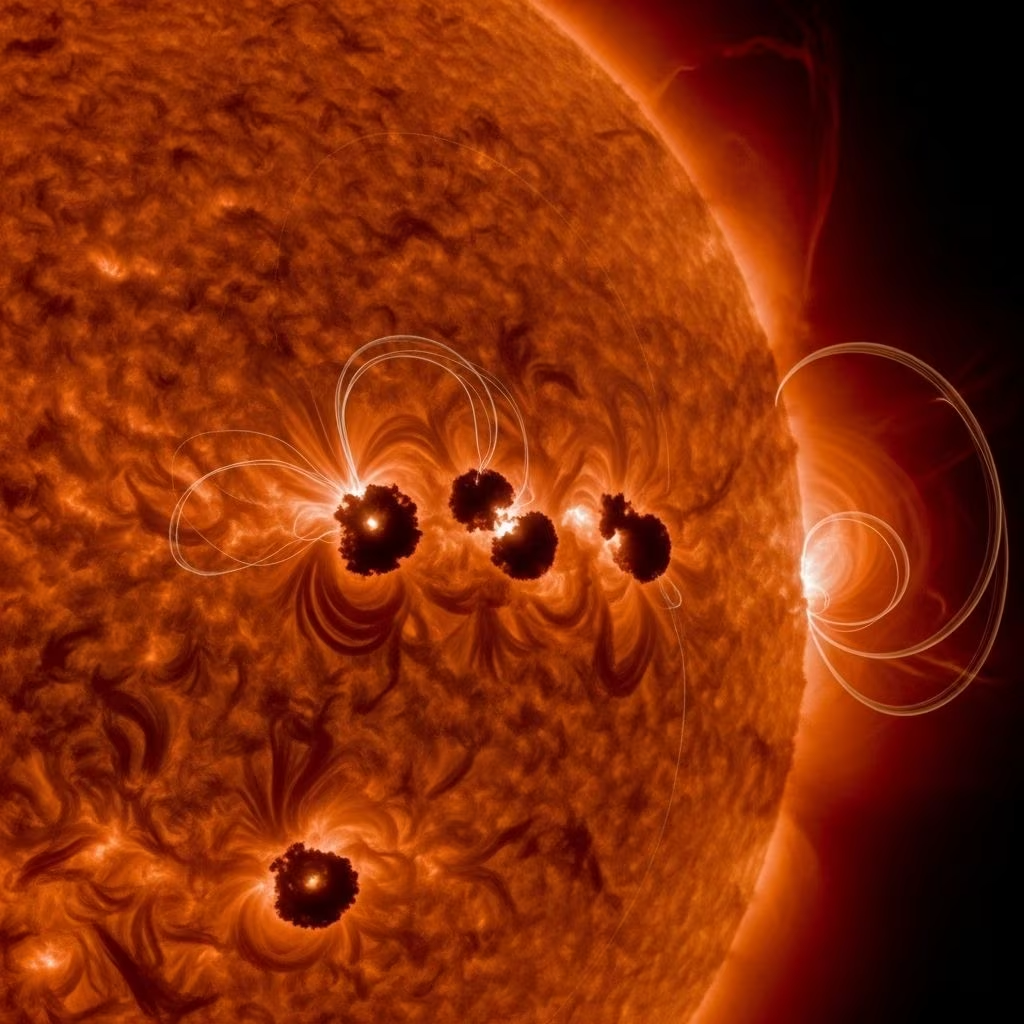
- Features: Sunspots and granulation; dark cooler patches visible due to magnetic activity.
- Solar Composition: Most composition measurements are made here via spectroscopy.
5. Chromosphere
Above the photosphere is the chromosphere, a reddish layer visible during total solar eclipses.
- Temperature: Ranges from ~4,500 °C near the photosphere to ~25,000 °C outward.
- Thickness: About 2,000 kilometers.
- Features: Spicules and prominences; dynamic jets and magnetic activity.
6. Corona
The outermost layer, the corona, is the Sun’s expansive atmosphere.
- Temperature: Surges unexpectedly to over 1 million °C—hotter than inner layers.
- Visibility: Only visible during a solar eclipse or with specialized coronagraphs.
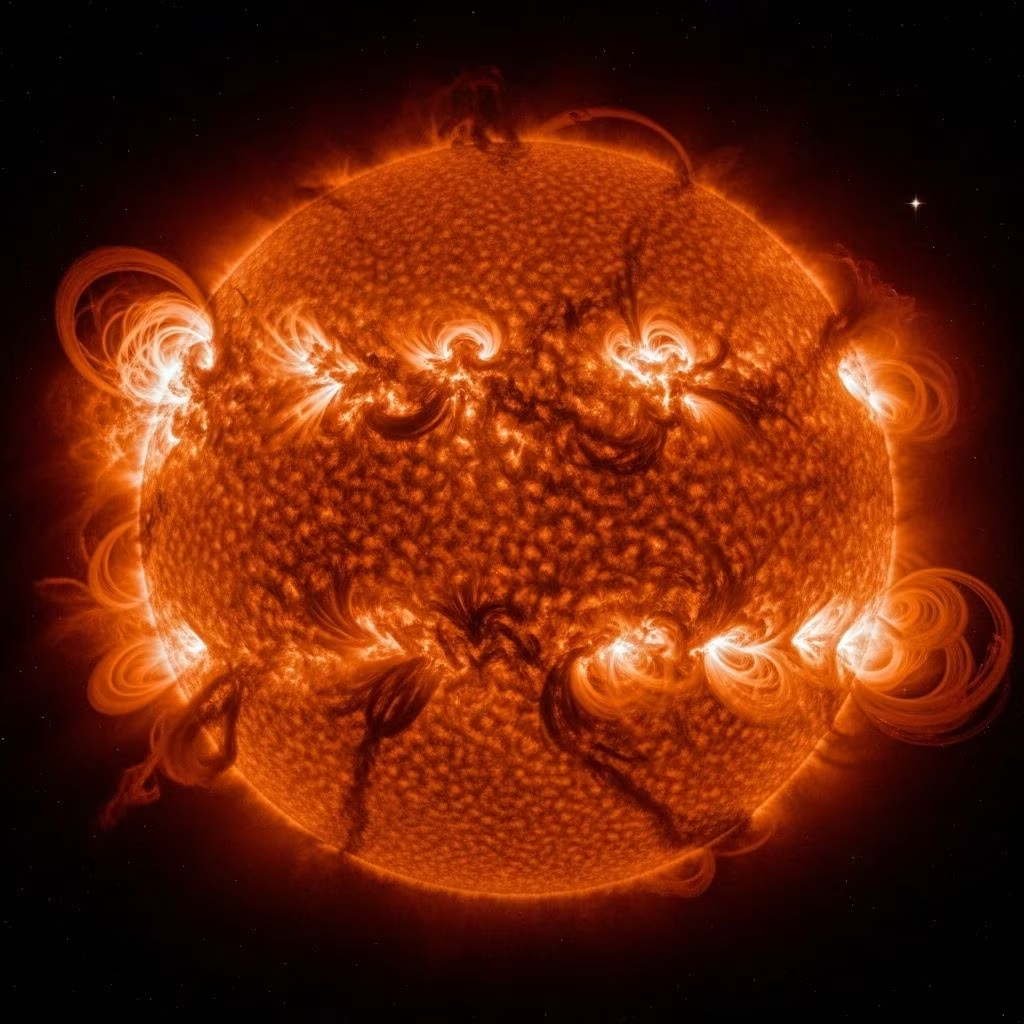
- Features: Streamers, plumes, and loops shaped by magnetic fields.
- Solar Wind: Material from the corona escapes as solar wind, forming the heliosphere that envelops the solar system.
Solar \”Metallicity\”: The Sun’s Trace Elements
In astronomy, all elements heavier than helium are termed metals.
- Collective metal content: Less than 2% of the Sun’s mass.
- Key species: Oxygen, carbon, neon, nitrogen, magnesium, iron, sulfur, silicon.
- Role: These elements shape solar evolution and influence planet formation.
- Solar metallicity (Z): Describes the fraction of mass in metals. The current metallicity in the photosphere is estimated at around 1.3–1.5%.
How Is Solar Composition Measured?
Astronomers study the Sun’s composition using spectroscopy—the analysis of light to identify elements present.
- Elemental fingerprints: Each element absorbs light at characteristic wavelengths, leaving lines in the solar spectrum.
- Helioseismology: The study of sound waves traveling through the Sun’s layers also helps determine its internal composition and structure.
- Solar probes: Satellites like SOHO and Parker Solar Probe gather direct data from the Sun’s outer atmosphere.
Evolution of the Sun’s Composition
- Early Sun: Initially, about 71% hydrogen, 27% helium, 1.5% heavier elements.
- Fusion: Hydrogen is gradually converted to helium in the core, increasing the core’s helium content (now about 60%).
- Photosphere changes: Over billions of years, the photosphere’s metallicity has dropped slightly (by about 16%) compared to the starting mix, due to the migration of elements inward.
In approximately 5 billion years, helium buildup will trigger the Sun’s transformation into a red giant, marking its next evolutionary phase.
Why Is the Sun So Hot?
The Sun’s heat and luminosity result from nuclear fusion in its core.
- Process: Four hydrogen nuclei fuse to create one helium nucleus, releasing energy in the form of gamma rays and neutrinos.
- Energy flow: This energy is transported outward through the radiative and convective zones and eventually radiates into space from the photosphere.
- Evidence: This process is confirmed by theoretical models and observations of neutrinos on Earth.
The Sun’s Role in the Solar System
The Sun’s gravity anchors all planets, asteroids, and comets, while its energy determines Earth’s climate and makes life possible.
- Source of energy: Provides warmth and light.
- Solar wind: Defines the shape and extent of the heliosphere, protecting inner planets from cosmic radiation.
- Solar activity: Drives phenomena such as sunspots, solar flares, and the auroras on Earth.
Frequently Asked Questions (FAQs)
Q: What is the Sun mainly made of?
A: The Sun is primarily composed of hydrogen (~74%) and helium (~24%), with less than 2% heavier elements like oxygen, carbon, and iron[10].
Q: How do scientists know what elements are in the Sun?
A: Scientists use spectroscopy to analyze sunlight, identifying the unique absorption lines each element produces.
Q: Is the Sun getting heavier over time?
A: The Sun’s mass actually decreases slowly over time as it loses material via solar wind and radiates energy away, but fusion changes the makeup of elements inside.
Q: What will happen to the Sun when it runs out of hydrogen?
A: In about 5 billion years, the Sun will exhaust the hydrogen in its core, expand into a red giant, and eventually shed its outer layers, leaving behind a white dwarf.
Q: What are metals in the Sun?
A: In astronomy, \”metals\” refer to all elements heavier than helium, including carbon, oxygen, iron, and neon.
Conclusion: The Sun’s Dynamic Nature
Understanding what the Sun is made of reveals not just the makeup of our star, but also the origins and dynamics of the solar system. With a heart of hydrogen fueled by fusion, layers of plasma, and a corona that shapes our space environment, the Sun remains a subject of rich scientific inquiry and inspiration. Its enduring energy continues to fascinate and support life on Earth, reminding us of our cosmic origins and future destiny.
References
- https://en.wikipedia.org/wiki/Sun
- https://courses.lumenlearning.com/suny-astronomy/chapter/the-structure-and-composition-of-the-sun/
- https://imagine.gsfc.nasa.gov/science/objects/sun1.html
- http://hyperphysics.phy-astr.gsu.edu/hbase/Tables/suncomp.html
- https://science.nasa.gov/sun/facts/
- https://cesar.esa.int/upload/201807/the_suns_structure_booklet.pdf
- https://courses.lumenlearning.com/suny-ncc-astronomy/chapter/the-structure-and-composition-of-the-sun/
- https://www.mpg.de/18652392/new-calculations-of-solar-spectrum-resolve-decade-long-controversy-about-the-sun-s-chemical-composition
- https://byjus.com/physics/layers-of-sun/
- https://study.com/learn/lesson/structure-sun-anatomy-diagram.html
- https://www.youtube.com/watch?v=WIbr-ja1a-g
- https://spaceweather.ssl.berkeley.edu/the-suns-structure/
- https://www.turito.com/learn/physics/the-sun-grade-6
- https://www.space.com/14745-sun-composition.html
- https://openstax.org/books/astronomy-2e/pages/15-1-the-structure-and-composition-of-the-sun
- https://openstax.org/books/astronomy/pages/15-1-the-structure-and-composition-of-the-sun
- https://sites.uni.edu/morgans/astro/course/Notes/section2/solarcomp.html