The Biggest Things in the Universe: A Cosmic Perspective
When contemplating the vastness of space, it’s natural to wonder: What is the biggest thing in the universe? The answer leads us beyond familiar stars and galaxies into realms of unimaginable scale, where entire clusters and superclusters of galaxies arrange themselves into colossal cosmic webs, walls, and blobs. Understanding these structures not only redefines the limits of size but also provides crucial insights into the formation and evolution of the cosmos.
What Do We Mean by ‘The Biggest’?
The word “object” has a specific meaning in astrophysics. Normally, an object is something held together by its own gravity—a planet, a star, or a galaxy. However, on cosmic scales, astronomers increasingly consider vast, loosely-bound structures, such as clusters, superclusters, and filaments. These may not all be bound in the classical sense, but they are the largest coherent features ever observed.
- Object (in physics): A self-gravitating, bound structure (e.g., a planet, star, or individual galaxy).
- Structure (in cosmology): An assembly of galaxies and galaxy clusters, possibly not bound, but forming identifiable features (such as walls, filaments, or blobs).
Discovering Cosmic Titans: From Blobs to Walls
Multiple discoveries in the last decades have unveiled cosmic structures so immense that they challenge our understanding of the universe’s evolution. Among these, the most extraordinary include the Lyman alpha blobs, galactic protoclusters, and vast filaments like the Sloan Great Wall and Hercules–Corona Borealis Great Wall.
Lyman Alpha Blobs: The Enormous Amoeba of Space
One of the most striking examples of a colossal structure is a recently discovered, amoeba-shaped formation comprised of galaxies and giant gas bubbles, called Lyman alpha blobs. This enormous entity spans approximately 200 million light-years across and contains galaxies packed four times denser than the universal norm, all strung along three intertwining filaments. Some of the embedded gas bubbles exceed 400,000 light-years in diameter—nearly twice that of the Andromeda galaxy.
- Formed about 2 billion years after the Big Bang, these structures represent some of the earliest and most massive galaxy-building events.
- The origin of Lyman alpha blobs is debated: they may result from supernova explosions blowing out gas shells, or from gas cocoons destined to birth new galaxies.
Scientists believe such rare, dense cosmic features are precursors to today’s largest galaxy clusters—offering clues to the early universe’s architecture.
Galactic Protoclusters: Toward the Most Massive Bound Objects
When considering “the most massive object” in the gravitational sense, we look to galactic clusters and protoclusters. Recent discoveries include SPT2349, a spectacular galactic protocluster observed when the universe was just one-tenth its current age (about 1.4 billion years post–Big Bang). This structure crams more than 14 massive galaxies into a space not much larger than our Milky Way, destined eventually to merge into a single, titanic galaxy and then into an immense galaxy cluster.
- SPT2349 contains around 50 additional galaxies and is predicted to outweigh prior record-holders, such as the El Gordo Cluster, whose mass is equivalent to 3 quadrillion Suns.
- The presence of such a massive structure so early in cosmic history was not anticipated by computer models, prompting new investigations into galaxy formation physics.
Cosmic Filaments & Walls: The Universe’s Colossal Skeleton
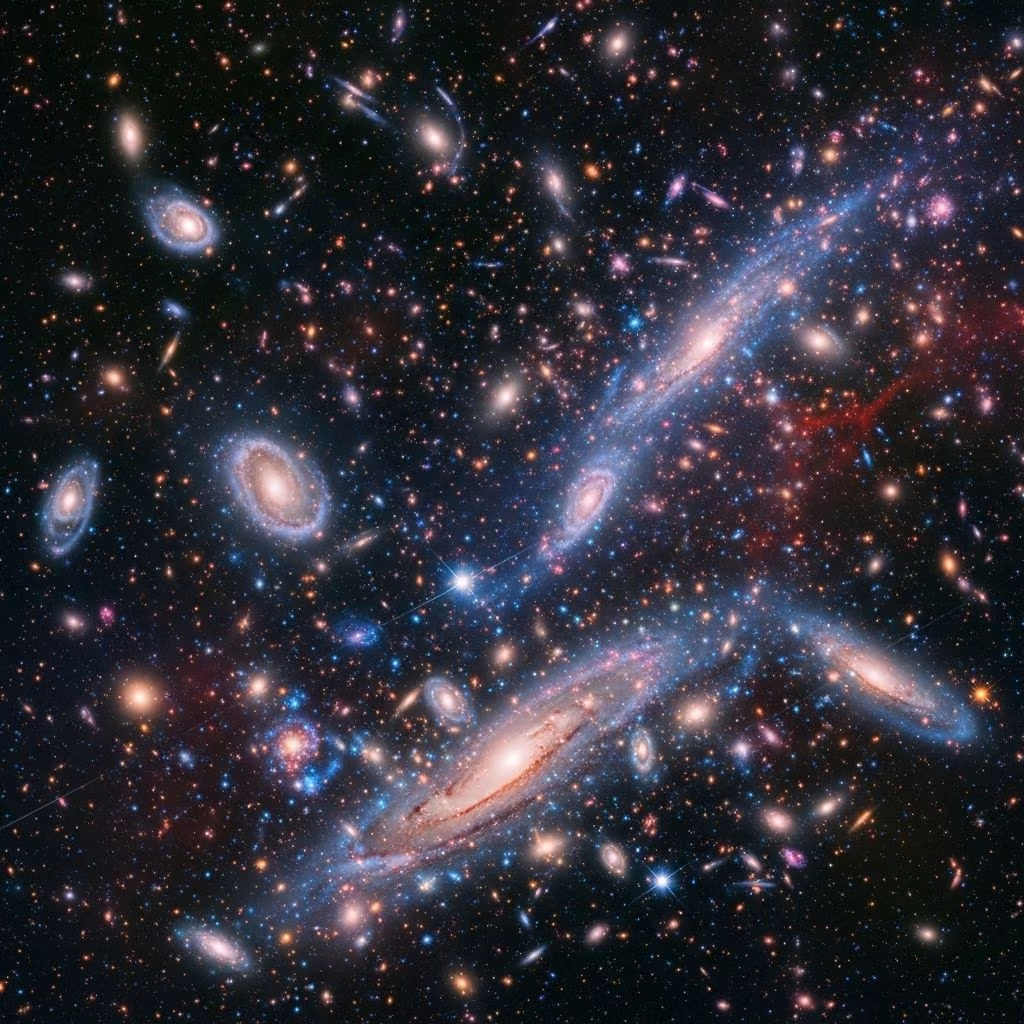
On even grander scales, galaxies aggregate into superclusters and arrange themselves into filaments, walls, and voids, forming the so-called cosmic web:
- Sloan Great Wall: A giant wall of galaxies, stretching over 1.37 billion light-years, is one of the largest observed structures in the local universe.
- Hercules–Corona Borealis Great Wall: Currently regarded as the largest contiguous structure yet identified, this filament is about 10 billion light-years long and consists of galaxy clusters, dark matter, dust, and gas.
These cosmic walls and filaments defy simple definitions of “objects” but are the most gargantuan arrangements ever observed, stretching across vast swathes of space and containing billions of galaxies.
Table: Comparing Universe’s Largest Structures
| Name | Type | Size | Composition | Discovery Highlights |
|---|---|---|---|---|
| Lyman Alpha Blob | Blob/Filament | ~200 million light-years | Galaxies, massive gas bubbles | Early universe, denser than average |
| SPT2349 Protocluster | Galaxy Protocluster | N/A (cluster in formation) | ~50 galaxies, dark matter, gas | Most massive/compact early structure |
| El Gordo Cluster | Galaxy Cluster | Millions of light-years | Hundreds of galaxies, gas, dark matter | Mass: 3 quadrillion solar masses |
| Sloan Great Wall | Filament/Wall | 1.37 billion light-years | Many galaxy clusters, dark matter | Largest feature in the local universe |
| Hercules–Corona Borealis Great Wall | Supercluster Wall | ~10 billion light-years | Billions of galaxies, dust, dark matter | Largest known structure |
How Astronomers Detect Such Immense Structures
Discovering cosmic giants is a formidable task. Astronomers use powerful observatories—such as the Subaru and Keck telescopes for optical and infrared light, and the Atacama Large Millimeter/submillimeter Array (ALMA) for radio wavelengths—to survey vast regions of the sky and identify over-densities of galaxies or telltale emissions from gas clouds. Cutting-edge computer simulations help them understand how such imprints arose from minute perturbations after the Big Bang.
- Structures are mapped by observing concentrations of galaxies or by detecting specific light signatures, such as Lyman-alpha emission from hydrogen gas.
- Gravitational lensing, the deflection of light by mass, also exposes invisible dark matter accompanying these structures.
Origins: How Do the Universe’s Largest Objects Form?
In the standard model of cosmology, the universe began with a nearly uniform sea of matter and radiation. Slight fluctuations—quantum ripples stretched by cosmic inflation—seeded regions where gravitational attraction slowly accumulated material. Over billions of years, these formed stars, galaxies, clusters, and ultimately interconnected filaments and walls. The process follows a simple rule: where matter density is higher than average, it continually attracts more, building up ever-larger structures.
- Lyman alpha blobs may trace sites of vigorous star and galaxy formation in the early universe.
- Protoclusters capture the assembly of galaxies into gravitationally bound clusters, some merging into even larger entities over time.
- The largest walls and filaments are thought to be the result of billions of years of hierarchical merging and accretion.
Why Do Such Large Cosmic Structures Matter?
The discovery of these enormous features is vital for several reasons:
- Testing Cosmological Models: Some structures may be so large or formed so early that their presence challenges current models of structure formation, possibly hinting at unknown physics or the need for new theoretical frameworks.
- Probes of Dark Matter and Dark Energy: Mapping where galaxies cluster informs theories about the distribution and nature of dark matter and the overall shape and fate of the universe.
- Windows Into the Early Universe: Observing ancient, massive structures lets astronomers watch galaxy and cluster formation unfold in real time, billions of years in the past.
Frequently Asked Questions (FAQs)
Q: What is the ‘biggest object’ in the classical sense?
A: If defined as a self-gravitating entity, the largest would be the most massive galaxy clusters, such as El Gordo or the forming cluster SPT2349. These structures contain hundreds of galaxies and enormous amounts of dark matter and hot gas.
Q: What’s the difference between a ‘blob’, a ‘wall’, and a ‘cluster’?
A: A ‘blob’ refers to a huge, often irregular region rich in gas and galaxies (like the Lyman alpha blob). A ‘cluster’ is a gravitationally bound group of galaxies. A ‘wall’ is a vast filament of interconnected clusters and galaxies, sometimes stretching across a significant portion of the observable universe.
Q: Are there limits to how large cosmic structures can get?
A: Cosmological theory predicts a ‘homogeneity scale’—around a few hundred million light-years—beyond which the universe should appear smooth. Yet, features like the Sloan and Hercules–Corona Borealis Great Walls, and the recently identified Quipu, challenge our understanding of these limits.
Q: Why are these massive structures important for science?
A: Their discovery tests and sometimes strains our fundamental physical theories. Each new record-breaker can prompt refinements in how we think the universe evolved, including the roles of dark matter, dark energy, and cosmic inflation.
Q: Could there be even bigger structures waiting to be found?
A: Absolutely. As observational technology and computational simulations advance, astronomers continue to discover structures even larger than those catalogued today. Each new cosmic giant reshapes our map of the universe’s grandest scales.
Conclusion: Our Expanding Notion of Cosmic Scale
The pursuit of the universe’s biggest thing—whether it’s a blob glowing with primordial light, a dense galactic protocluster, or a wall stretching halfway across the observable cosmos—remains central to modern astronomy. These discoveries continually push the boundaries of human understanding and inspire new generations to explore the unknown vastness that surrounds us.
References
- https://www.space.com/2671-newfound-blob-biggest-universe.html
- https://www.space.com/40559-biggest-object-in-universe.html&rut=02bd47d8f0ac24d168e5fc4ab08ad42e796c13e530acd4d248065d17880982e2
- https://www.youtube.com/watch?v=milGLbH3Ukg
- https://www.youtube.com/watch?v=G0H3nu18HIc
- https://www.physicssayswhat.com/2018/01/19/biggest-thing-in-the-universe/
- https://www.skyatnightmagazine.com/space-science/what-are-the-biggest-objects-in-the-universe
- https://www.sciencefocus.com/space/what-is-the-largest-known-celestial-body
- https://www.livescience.com/largest-objects-in-universe.html
- https://www.universetoday.com/articles/what-is-the-biggest-thing-in-the-universe
- https://www.sciencealert.com/astronomers-declare-the-boss-great-wall-the-biggest-thing-in-ever-found-in-the-universe
- https://www.dailymotion.com/video/x9igw62
- https://everything-everywhere.com/the-largest-known-things-in-the-universe/
- https://sciencealert.com/astronomers-declare-the-boss-great-wall-the-biggest-thing-in-ever-found-in-the-universe
- https://science.slashdot.org/story/04/05/25/190253/the-universe-is-pretty-big
- https://en.wikipedia.org/wiki/List_of_largest_cosmic_structures
- https://list25.com/25-largest-things-in-the-universe/
- https://www.vice.com/en/article/the-biggest-things-in-the-universe/