September 2025 Space News: Missions, Discoveries, and Cosmic Events
September 2025 continues to be a defining moment for space exploration, research, and discovery. Private spaceflight is surging forward, major cosmic events are captivating astronomers, and new findings are transforming our understanding of the universe and our place in it. This comprehensive roundup covers all the essential news, missions, launches, sightings, and hidden wonders revealed by scientists this month.
Headline Space News
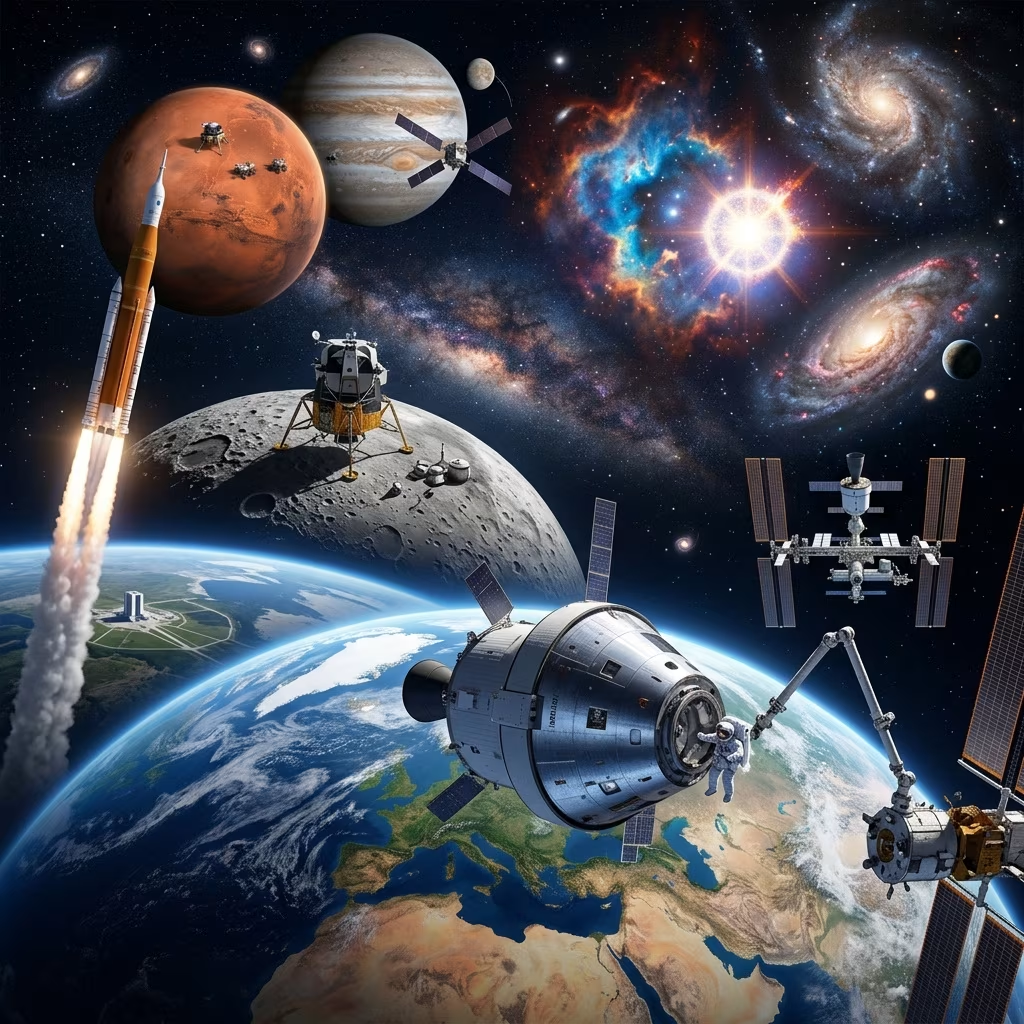
- Artemis 2 Astronauts Name Their Spacecraft ‘Integrity’: NASA’s historic lunar crewed mission moves one step closer as the Artemis 2 crew announces the official name of their Orion spacecraft: Integrity. With the spacecraft’s systems checked and flight training underway, the four-member team—Reid Wiseman, Victor Glover, Christina Koch, and Jeremy Hansen—is prepping for the first human trip around the Moon in over half a century. NASA reiterates that the Artemis 2 mission is set for launch in late 2025, aiming to pave the way for future lunar landings and a sustainable Artemis program.
- Closest Technologically Advanced Aliens May Be 33,000 Light-Years Away: Astrobiology takes a measured step back as new research suggests the nearest civilization capable of communicating using radio or similar technology could be over 33,000 light-years from Earth. The analysis factors in the probability of life, technological development, and the Milky Way’s scale—dashing popular hopes for imminent contact but underscoring the uniqueness of our place in the cosmos.
- AI Revolutionizes Weather Forecasting for the World’s Farmers: Artificial intelligence-driven models are now advancing weather forecasting with unprecedented precision, particularly benefiting global agriculture. The adaptation of deep learning enables quick, localized predictions, helping farmers around the world manage crops and respond to climate variables more effectively than ever before.
- SpaceX Takes On Space Weather: SpaceX expanded its launch manifest with three specialized probes designed to map the solar system’s edge and scrutinize solar and geospace weather. The data will inform both basic science about our solar bubble and practical understanding of space weather’s impact on communications, satellites, and deep-space missions.
Missions & Launches
- Artemis 2: Final Preparations
- NASA’s Artemis 2 astronauts report readiness for every scenario as they approach their Moon mission. Training now includes helicopter landings that simulate lunar terrain navigation, preparing astronauts for real-world lunar surface operations if needed.
- The official naming of the Orion spacecraft as ‘Integrity’ highlights the crew’s commitment and the anticipation surrounding the first human moonshot since Apollo 17 in 1972.
- EscaPADE Mission Heads to Mars
- The Escape and Plasma Acceleration and Dynamics Explorers (EscaPADE) mission’s twin spacecraft successfully arrived in Florida ahead of their launch atop Blue Origin’s New Glenn rocket. Once in orbit, these explorers will study how solar wind strips the Martian atmosphere, providing critical data on planetary evolution and habitability[11].
- This mission is a vital milestone for the NASA SIMPLEx program and for Blue Origin, marking the reusable New Glenn booster’s second flight and a bold step toward routine planetary science missions[11].
- Russian ‘Noah’s Ark’ Returns
- A unique Russian bioscience satellite returned to Earth after carrying 75 mice and 1,500 flies, testing survivability and health in orbit. The experiment provides insights relevant to space medicine and future long-duration missions.
- IMAP Spacecraft Final Checks
- NASA’s Interstellar Mapping and Acceleration Probe (IMAP) spacecraft is being packed and prepped for its science mission to map the heliosphere’s boundaries and study incoming particles from interstellar space.
- SpaceX Starlink and Solar Weather Probes
- Continuing its drive for connectivity, SpaceX launched 24 new Starlink satellites from California, using a brand-new Falcon 9. The launch supports global broadband and emphasizes SpaceX’s launch cadence and hardware reusability.
- Three additional probes were sent skyward to map space weather and the solar system’s edges, helping Earth better predict solar storms and protect vital infrastructure.
Discovery & Science Highlights
- Asteroid Bennu’s Presolar Stardust
- Samples from asteroid Bennu reveal presolar stardust—particles older than the solar system itself. These ancient grains help scientists unlock secrets about the formation of stars and planets, casting light on our cosmic origins and the ongoing evolution of the solar nebula.
- Runaway Pulsar Shocks Astronomers
- Astronomers identified a ‘forbidden’ pulsar, seemingly ejected from a supernova explosion into a sparse area of the Milky Way. This discovery challenges models of stellar death and supernova dynamics, offering a rare chance to study these forces in an isolated setting.
- Partial Solar Eclipse Caught by GOES-19
- The NOAA GOES-19 satellite captured a rare, detailed view of September’s partial solar eclipse from space—contributing to solar monitoring and eclipse prediction. The images help improve our understanding of solar activity’s effects on Earth’s atmosphere.
- Cosmic Distance: Alien Civilizations
- Advanced alien life is likely very far away. Recent studies place the nearest possible technologically advanced civilization at an eye-watering 33,000 light-years, reiterating both the rarity and preciousness of life as currently observed on Earth.
Skywatching & Celestial Events
- Spot the International Space Station (ISS)
- Throughout September, skywatchers across many regions can see the ISS streak across the evening sky. Its bright passage is visible to the naked eye, appearing like a fast-moving, non-blinking star, typically traveling west to east. NASA’s ‘Spot the Station’ app provides visibility times for specific locations[11].
- Stargazing Challenges and Deep Sky Delights
- This month, the National Space Centre (UK) launched stargazing challenges for amateur astronomers. Popular targets include the Moon, classic star patterns, meteor showers, and challenging deep-sky nebulae and galaxies. With longer nights in the Northern Hemisphere, September is ideal for sky observation[11].
- Saturn’s Colossal Moon Shadow
- On September 4th, Titan—Saturn’s largest moon—cast a dramatic shadow across the ringed planet, a rare event captivating both professional and amateur astronomers with telescopes capable of resolving the spectacle.
- Comet 3I/ATLAS: A Once-in-a-Lifetime Flyby
- The interstellar comet 3I/ATLAS passed the sun this month, presenting a unique chance for spacecraft to investigate an object from beyond the solar system. Scientists tracking the visitor in real time reported extraordinary compositional details, enhancing our understanding of interstellar wanderers.
- Space Art and Outreach
- Pop culture met astronomy when Magic: The Gathering’s ‘Edge of Eternities’ expansion showcased stunning space art, drawing input from leading astrophysicists to ensure real cosmic phenomena inspire card designs.
Space Technology & Trends
- AI in Space Science and Forecasting
- AI’s impact on weather forecasting goes beyond Earth—it is vital for predicting solar storms, mapping geospace, and safeguarding satellites. With fast-learning models, researchers now adapt to incoming data streams from new missions, integrating space weather intelligence into routine planning for launches, astronaut EVA safety, and infrastructure resilience.
- Nuclear Propulsion for Mars
- Ambitious researchers and engineers envision nuclear-powered rockets dramatically shortening the journey to Mars. Current work focuses on developing safe, efficient propulsion systems that could allow crew and cargo to travel between Earth and Mars faster than ever before, revolutionizing interplanetary travel.
- Reusable Rockets: Blue Origin and SpaceX Competition
- September 2025 highlights fierce competition in reusable launch vehicles. Blue Origin’s New Glenn aims to match SpaceX’s record by perfecting landings on sea-based platforms. Both companies continue to drive down the cost of reaching space, enabling new science, communication, and exploration missions[11].
Frequently Asked Questions (FAQs)
Q: When is the Artemis 2 mission expected to launch?
A: Artemis 2 is currently scheduled for launch in late 2025, marking the first human journey around the Moon since Apollo 17.
Q: Can I see the International Space Station this month?
A: Yes! Throughout September, the ISS is visible from many locations as a bright, fast-moving object in the night sky. Use NASA’s Spot the Station app for timings[11].
Q: What’s special about the EscaPADE Mars mission?
A: EscaPADE consists of twin spacecraft designed to study how the solar wind affects the Martian atmosphere, providing insights into Mars’ habitability and atmospheric loss[11].
Q: Are we any closer to finding extraterrestrial life?
A: New analysis suggests the nearest technologically advanced aliens could be 33,000 light-years away, making contact unlikely in the near future.
Q: What advances are being made for future Mars missions?
A: Scientists are actively researching nuclear-powered rockets and new spacecraft designs to make Mars missions safer and faster, while robotic orbiters like EscaPADE are expanding our understanding of the Red Planet.
September 2025: Space News Highlights at a Glance
| Date | Event / Mission | Description |
|---|---|---|
| September 4 | Titan’s Shadow on Saturn | Colossal shadow from Saturn’s moon Titan crosses the planet, offering rare observation opportunities. |
| September 24 | GOES-19 Solar Eclipse Images | NOAA’s satellite delivers detailed images of partial solar eclipse from space. |
| September 25 | Artemis 2 Crew Readiness | NASA’s lunar astronauts confirm preparedness, name their Orion spacecraft ‘Integrity’. |
| September 29 | EscaPADE Mars Launch | Twin spacecraft to study solar wind’s effect on Martian atmosphere, launching on New Glenn[11]. |
| Throughout September | ISS Sightings & Stargazing | Public encouraged to spot the ISS and participate in stargazing challenges[11]. |
Further Reading & Resources
- For daily space news, mission coverage, and live streams, visit the world’s leading astronomy and space websites.
- NASA and NOAA provide updates on mission progress, launch schedules, and skywatching tips on their official sites and social media.
- Pioneering public programs and podcasts such as the National Space Centre’s Space NOW expand the conversation on space issues and citizen science challenges[11].
References
- https://www.space.com/news/archive
- https://www.space.com/news
- https://www.astronomy.com/observing/sky-this-month-september-2025/
- https://science.nasa.gov/mars/the-mars-report/2025-september-special-edition/
- https://spaceflightnow.com/2025/09/
- https://www.spacecalendar.com
- https://spaceflightnow.com
- https://science.nasa.gov/solar-system/whats-up-september-2025-skywatching-tips-from-nasa/
- https://wtop.com/the-space-place/2025/09/whats-up-in-the-sky-for-september-2025-zodiacal-light-milky-way-and-autumnal-equinox/
- https://www.spacecalendar.com/september-22-28-2025-vol-44-no-38-hawaii-island-usa-lunar-broadcast-precursor-terrestrial-edition/
- https://nationalspaceacademy.org/about-us/news/whats-happening-in-space-september-2025/
- https://www.youtube.com/watch?v=L4xu4OZ_KHI
- https://www.youtube.com/watch?v=XxbAzht2Eq0
- https://www.sciencedaily.com/news/space_time/
- https://spaceexplored.com
- https://www.skyatnightmagazine.com/news/blood-moon-8-september-2025-australia
- https://bintel.com.au/blogs/news/space-and-astronomy-news-for-the-6th-of-september-2025
- https://en.wikipedia.org/wiki/List_of_spaceflight_launches_in_July%E2%80%93September_2025