What Is a Parsec?
Parsec (symbol: pc) is a unit of measurement for cosmic distances, widely used in astronomy and astrophysics. One parsec corresponds to approximately 3.26 light-years, or around 19 trillion miles (31 trillion kilometers).
Its origin lies in solving a fundamental problem: expressing astronomical distances in a practical way, as told by California Institute of Technology and the International Astronomical Union definitions.
- 1 parsec ≈ 3.26 light-years
- 1 parsec ≈ 206,265 astronomical units (AU)
- 1 parsec ≈ 30.9 trillion kilometers (19.2 trillion miles)
Parsec vs. Light-Year: The Essential Comparison
| Unit | Definition | Approximate Distance | Main Use Case |
|---|---|---|---|
| Parsec (pc) | Distance at which 1 AU subtends an angle of one arcsecond | 3.26 light-years 19 trillion miles | Scientific measurements, mapping interstellar and intergalactic distances |
| Light-year | Distance light travels in one year | 5.88 trillion miles | Popular science, communications, general public |
Origin of the Term “Parsec”
The word parsec is a portmanteau of parallax and arcsecond. British astronomer Herbert Hall Turner coined the term in 1913. This name reflects how the parsec is calculated—through the observation of parallax angles and basic geometry.
How Is a Parsec Calculated?
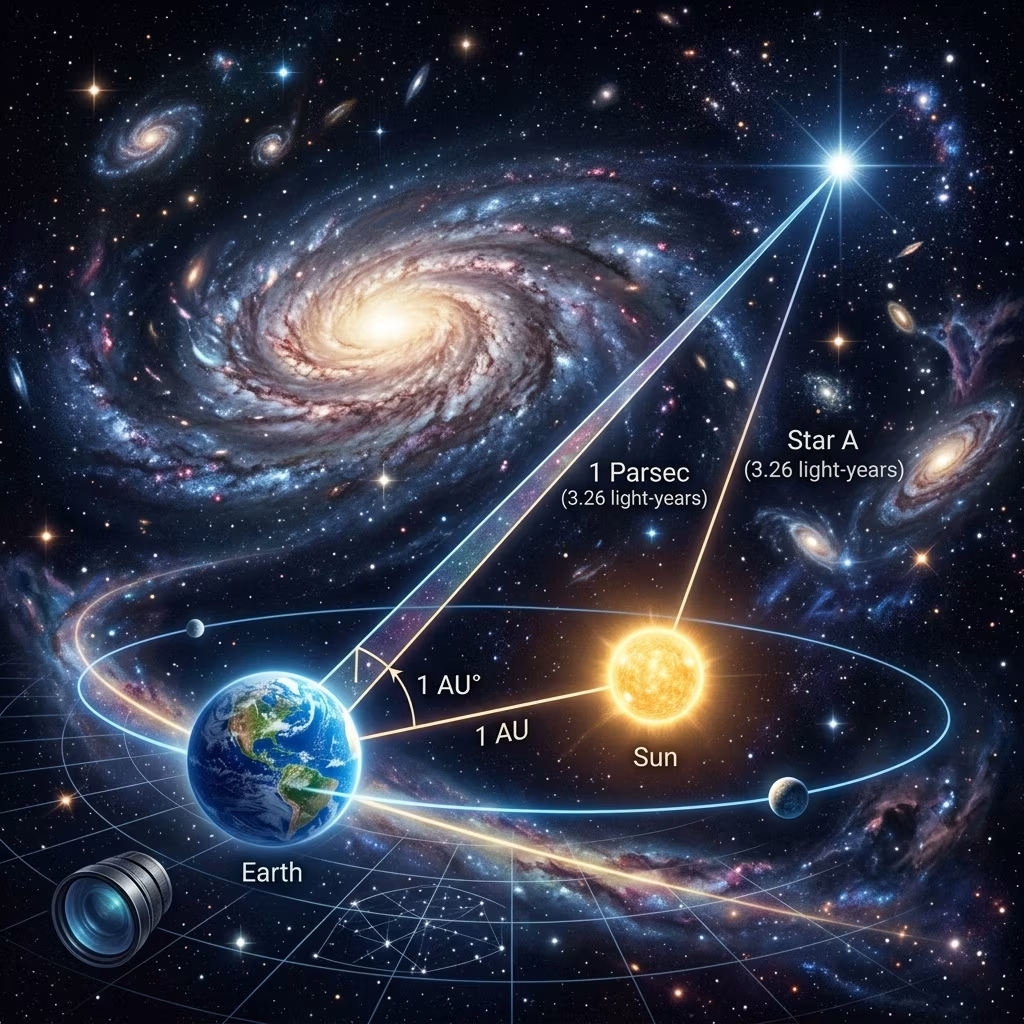
The concept behind a parsec relies on stellar parallax, the apparent shift of a star’s position against background stars when observed from opposite points in Earth’s orbit around the Sun:
- Parallax angle (p): The tiny angle, measured in arcseconds, that a star appears to shift when observed from two points separated by 1 astronomical unit.
- 1 parsec: The distance at which a star has a parallax shift of exactly one arcsecond when viewed from Earth at opposite points in its orbit.
This relationship is expressed mathematically as:
Distance (parsecs) = 1 / parallax angle (arcseconds)
Example: If a star’s parallax angle is 0.5 arcseconds, its distance is 2 parsecs.
Historical Context and Importance
Prior to the parsec, astronomers struggled with unwieldy numbers when describing distances. The parsec simplified calculations, allowed direct conversion from observations to distances, and became the preferred unit among professionals.
- First used: Early 20th century
- Motivation: Directly relate measured angles (parallax) to cosmic distances without requiring conversion
- Standardization: International Astronomical Union (IAU) formally defines the parsec
Multiples of the Parsec
- Kiloparsec (kpc): 1,000 parsecs. Used for large structures such as the diameter of the Milky Way.
- Megaparsec (Mpc): 1,000,000 parsecs. Used for intergalactic distances, such as to other galaxies.
- Gigaparsec (Gpc): 1,000,000,000 parsecs. Used in cosmology for measuring distances to quasars or the edge of the observable universe.
Examples from Astronomy
- Proxima Centauri: 1.3 parsecs (about 4.2 light-years) from the Sun.
- Andromeda Galaxy: Over 700,000 parsecs away.
- Diameter of Milky Way: Approximately 30,000 parsecs.
Why Use the Parsec?
Professional astronomers use parsecs because:
- It connects directly to parallax observations and trigonometry.
- Multiples of the parsec (kpc, Mpc, Gpc) allow concise expression of very large and small distances.
- It streamlines calculations in research, publications, and data analysis.
However, the light-year remains common in popular science due to public familiarity.
Common Misconceptions
Popular Culture and the “Parsec Problem”
Blockbuster franchises such as Star Wars have famously misused the term. In the original film, Han Solo boasts about the Millennium Falcon, claiming it made the “Kessel Run in less than 12 parsecs,” erroneously implying parsec is a unit of time rather than distance.
This notorious misstatement has led to decades of fan debate and humorous retcons. The 2018 film Solo: A Star Wars Story attempted to reframe the claim, suggesting the Kessel Run required navigation through a particularly short route—redeeming the use of “parsec” as a measure of distance.
Key Takeaway: The parsec only measures distance, not time or speed.
Real-World Applications
- Mapping the galaxy: Galactic structure and star positions are cataloged in parsecs, kiloparsecs, and megaparsecs.
- Understanding cosmic scales: Enables concise expression of extreme distances in galaxy clusters and cosmology.
- Exoplanet discovery: Parallax measurements help determine the distance to stars hosting exoplanets.
- Stellar catalogs: Distances to thousands of nearby stars are listed in parsecs.
Parsec Calculation Example
Imagine observing a nearby star. When viewing it from opposite points in Earth’s orbit, the star appears to move slightly against the background stars. If the shift—parallax—is measured as 0.2 arcseconds:
Distance = 1 / 0.2 = 5 parsecs
This method is fundamental to the astronomical distance ladder and builds our three-dimensional map of the solar neighborhood.
Fun Facts about Parsecs
- The word “parsec” helps astronomers avoid using impractically huge numbers, acting like a shorthand for cosmic distances.
- Most stars visible without telescopes are within a few hundred parsecs of Earth.
- The edge of the observable universe is estimated at over 10 gigaparsecs away.
Parsec in Science versus Public Use
While the parsec is integral in scientific literature, the light-year is favored in mainstream communication:
- Light-year: Easier for the public to grasp (distance light travels in one year).
- Parsec: Directly derived from measurement techniques like parallax and used in precise analyses.
Frequently Asked Questions (FAQs)
Q: What is the exact length of a parsec?
A parsec is approximately 3.26 light-years, 206,265 astronomical units, or nearly 19 trillion miles (31 trillion km).
Q: Why do astronomers prefer parsecs over light-years?
Parsecs connect directly with the method of parallax used to determine distance and make calculations more practical in astrophysics.
Q: What is the difference between a parsec and a light-year?
A light-year is the distance light travels in one year (about 5.88 trillion miles); a parsec is the distance at which 1 astronomical unit subtends an angle of 1 arcsecond, roughly equal to 3.26 light-years.
Q: Are parsecs ever used in popular science?
While parsec is the standard among professionals, public science outlets and education usually use the light-year because it’s easier to relate to.
Q: Did Star Wars really use parsec incorrectly?
Yes, the original Star Wars script mistakenly used ‘parsec’ as a unit of time, which led to much debate and subsequent creative reinterpretations within the franchise.
Summary Table: Key Parsec Facts
| Fact | Value |
|---|---|
| Parsec Symbol | pc |
| Equivalent Light-Years | 3.26 |
| Equivalent Miles | ~19 trillion |
| Origin | From “parallax” and “arcsecond”; coined by Herbert Hall Turner (1913) |
| Calculation Method | Distance where 1 AU subtends 1 arcsecond |
References in Science and Culture
- Astronomers: Parsecs used almost exclusively in catalogs, scientific papers, and research.
- Texts and Media: Light-years preferred for outreach and education.
- Science Fiction: Occasional misuse (notably in Star Wars), but sometimes inspires interest in space measurement and terminology.
Conclusion
The parsec is key to understanding and exploring astronomical distances, offering a uniquely practical measure for professionals while also sparking curiosity and debate in pop culture. With its origins in parallax science and its continued relevance in mapping galaxies and stars, mastering the parsec means grasping one of astronomy’s fundamental tools for navigating the vastness of the universe.
References
- https://www.space.com/parsec
- https://www.space.com/star-wars-the-mandalorian-parsec.html
- https://en.wikipedia.org/wiki/Parsec
- https://www.britannica.com/science/parsec
- https://www.popularmechanics.com/space/deep-space/a61683087/final-parsec-problem-dark-matter/
- https://space.fandom.com/wiki/Parsec
- https://www.skyatnightmagazine.com/space-science/parsec
- https://changeunit.com/article/unit/parsec/
- https://www.iflscience.com/brand-new-multi-planet-system-discovered-just-10-parsecs-from-earth-64092
- http://law885995.com/upload/fckimages/file/67641634338.pdf
- https://thecontentauthority.com/blog/megaparsec-vs-parsec
- https://www.sciencefocus.com/space/what-is-a-parsec
- https://www.skyatnightmagazine.com/space-science/final-parsec-problem
- https://www.astronomy.com/science/what-is-a-parsec-why-do-scientists-use-this-unit-instead-of-light-years/
- https://www.youtube.com/watch?v=Phdc68Aqi6o
- https://blog.wyzant.com/how_to_calculate_a_parsec/
- https://www.nature.com/articles/s41586-019-1532-5
- https://www.merriam-webster.com/dictionary/parsec
- https://www.bokmcdok.com/stories-and-tales-from-60-parsecs/